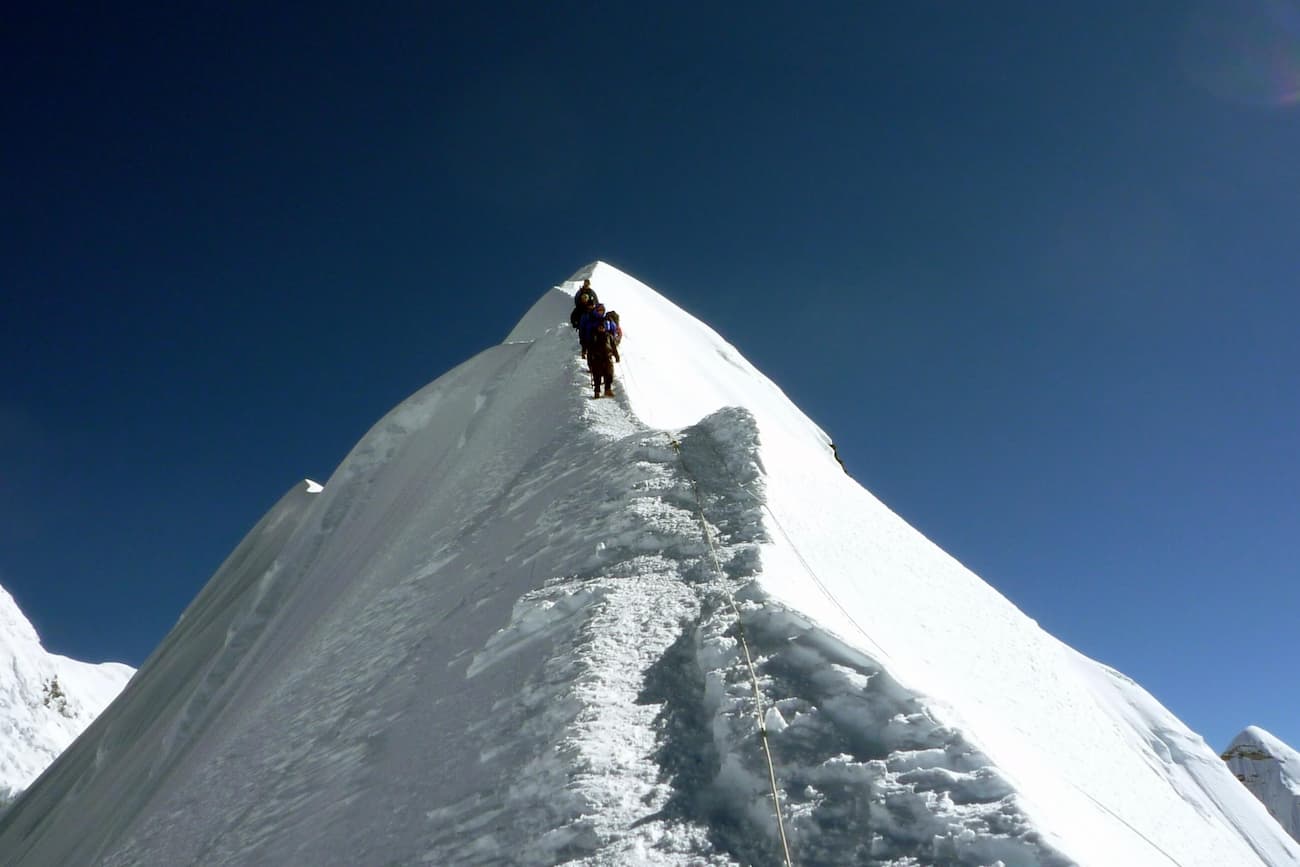
Island Peak Trek and Climb, leads to high Khumbu areas around picturesque Imjatse Valley, where Island Peak is located. The local name is Imjatse Himal, due to its location, looking from the distance stands like an Island in the middle of Imjatse valley, hence the name is tagged as Island Peak.
Island Peak at 6,160 m / 20,205 feet is one of the most climbed peaks around the Himalayas. Where the success rate is higher than any other trekking peak in Nepal, due to its location and accessibility.
The grade of Island Peak is used from the popular and famous French and Swiss Alpine Climbing Classification Systems. The grading as PD + means more Per Difficult, a straightforward climb to the summit, and encountering few technical sections to negotiate. The climb over rocks, snow, ice, and glaciers with ropes support in some areas to reach the Island Peak summit.
The altitude in various guidebooks and maps may differ, but the most accurate as listed by NMA; (Nepal Mountaineering Association).
As mentioned above, a good height for a stunning-looking Island Peak. The success rate is higher than any other trekking peak in Nepal, making Island Peak the most popular mountain to climb.
The climb to Island Peak, we have reserved at the end after getting fully acclimatized with some exercise. Before the ascent of Island Peak, the adventure takes you to higher areas to the famous Everest Base Camp. Including the climb of Kalapathar a popular high rocky ridge for the best closest views of Mt. Everest on the treks. On completing the popular treks to Everest base camp and climb of Kalapathar, then getting ready for the real adventure.
The walk leads to beautiful and scenic Imjatse valley, with a lovely settlement of Dingboche and Chukung. From here onwards reach our main highlight of the trip walking up towards Island Peak base camp. Treklanders Adventures has reserved a free spare day, for final preparation to make the climb a huge success.
As well as having one more high or advanced camp making the ascent possible with a shorter time to reach the summit. Before the final bid, with time to check the safe accessible route. As our guide gets busy fixing snow bars and necessary safe arrangements on technical sections. The climb starts early morning before the break of dawn which will be quite dark, where good head-torch is essential.
Following our lead expert guide who will support every member on technical or difficult areas. After an arduous steep climb and negotiating the technical section, then finally reach on top of the Island Peak summit.
After a hard effort with time to breathe and enjoy the spectacular views of giant snow mountains, that encircles the top. Facing a grand close look at Mt. Everest, Lhotse, and Nuptse with majestic Ama Dablam, Baruntse, and Mt. Makalu.
Includes countless series of peaks, after a jaw-dropping scenic panorama, a safe descent leads to base camp.
Leaving the base camp after a jubilant moment return journey on the scenic main trail to Namche Bazaar. Walking through Chukung, Dingboche, and Pangboche villages with a beautiful spot of Tengboche and the majestic colorful monastery.
Walk leads amidst a green forest of pines and rhododendron to Namche Bazaar and then back to Lukla. For the last overnight around high Khumbu and Everest, and then a sweeping flight brings you to Kathmandu.
After an overwhelming adventure and experience on Island Peak Trek and Climb with the grand services of Treklanders Adventures.
Trip Summary:
Mode of Trek: Best available lodge / guest house on treks.
Includes tented camp on climb for few nights.
Trekking Grade: Moderate to Adventurous.
Climbing Grade: PD + (Per Difficult with plus) from French / Swiss
Alpine Climbing System Classification.
Trekking Region: Around Khumbu district, North Mid-East Himalaya.
Start and End of trek: From Lukla to Lukla with flight both ways.
Trek / Climb: 16 Nights and 17 Days with flight both ways.
Total Trip: 20 Nights and 21 Days, from arrival to departures.
Best Seasons for Island Peak Trek & Climb:
The best season for Island Peak Trek & Climb is from spring, March to May.
Including autumn/fall begins from September to early November.
Springtime is bright and beautiful, most days are clear with sunny days, can be cloudy afternoons. Bringing cold chill in the late afternoon, and night till morning this is the time when wildflowers are in seasonal bloom.
The next best season is autumn/fall, where days are clear with sunny days for views and walks. But shorter days due to limited sunlight hours, cold morning and night time can expect snowfall sometimes. But an enjoyable day for pleasant walks with clear views of the beautiful snow mountain range.
Interested people can venture during winter times of December to February, freezing temperatures morning and nights. But clear sunny days from late morning till afternoon, can expect snowfall during trek and climb.
Culture & Religion:
The high Khumbu district of Everest region is populated by the Sherpa’s, the main mountain tribes of eastern Himalayas. The Sherpa culture and traditions interwoven to Tibetan heritage with Buddhism religion. Where trekkers will come across religious monuments of prayer walls, spinning wheels, Stupas, and monasteries. All houses are adorned with Buddhist prayer flags. Traditionally the Sherpa are farmers and cattle herders, raising and breeding livestock.
But with the influx of foreign visitors and mountaineers, majority of Sherpa of Khumbu are depended upon tourism. One can witness with best hotels and lodge accommodation from Lukla to Gorakshep and at Chukung.
Trekking Peak climbing equipment list:
Following items can be bought or hired in Kathmandu or Chukung and at Namche Bazaar.
Please Note:
The flight to Lukla and back to Kathmandu, can get delayed sometimes or might be postponed for next morning. If weather is bad and unfavorable for regular, this is normal, around the Himalayas. On this situations please bear with us, the company will try the best finding other solution to avoid inconvenience to all our clients.
The next important information for all trekkers to Everest and Khumbu region needs to be aware. The flight from Kathmandu to Lukla might get diverted to Manthali town airport of Ramechap district. The diversion is made by Nepal Civil Aviation due to heavy air-traffic at Kathmandu international or domestic airport.
This notice applies till further notice from respective Government departments.
Manthali airport of Ramechap located approx. 150 km / 93 miles from Kathmandu, driving distance of 4 to 5 hours. Might need to travel to Ramechap on the second day after international arrival in Kathmandu.

On reaching departure air terminal on landing at Kathmandu / international airport. Our staff and guide receives you for short transfer to respective hotels in the heart of Kathmandu city. After checking into your rooms, getting refreshed join with other members of the treks for group briefing. Provided by our guide or trek leader, briefing includes all important subjects related to trek and climb of Island peak, includes information of Kathmandu and hotels. Evening a group welcome dinner in an authentic Nepalese restaurants, an introduction to Nepali meals and cultures.


Morning options for half-day sightseeing tour around Kathmandu world heritage sites of great cultural and historical interest. After the tour free for trek preparation. (In case if the flight operates from Ramechap, Manthali town airport. Trek Landers Adventure, will inform for early departure from the hotel to Ramechap airport for Lukla flight next morning).


Flying either from Kathmandu or from Manthali airport at Ramechap, transfer to the domestic airport, having early breakfast. Board on a small aircraft of 25 to 30 minutes to land at Lukla’s Tenzing & Hillary Airport. Lukla town the door to various adventure destination around Khumbu and Everest region.
From Lukla a short day walk of 3 hours or more to reach Phakding village for overnight stop. The walk leads downhill and on gradual pleasant trail through several lovely Sherpa villages adorned with Buddhist monument. Following the Dudh Koshi River to a nice village at Phakding, and checking into a best available lodge.

Enjoy the day from Phakding onwards, morning walk heads higher past smaller villages to cross a long bridge. The climb leads to a nice Monjo village and then at the entrance of Sagarmatha National Park. (The name Sagarmatha for Everest in Nepal, the native Sherpa calls Chomolungma of Tibetan origin language).
From the park to the last village of Jorsalle before Namche Bazaar, possible lunch stop. Afternoon walk following the river bed and climb up to a high suspension bridge, and then on undulating uphill. Taking another few hours to famous
Namche Bazaar the capital of Khumbu Sherpa’s, and major hub for trekkers.
All house are in an amphitheater U shaped basin, the size of a town provides great facilities for visitors. As well as for the local also, where once a week a busy colorful Saturday market takes place. Hence the name as Namche Bazaar, arriving on this large settlement check into a nice lodge for two overnight stops.

An ideal place with perfect altitude for rest day to support acclimatization before heading higher destination. At Namche enjoy a leisure morning and take a hike around its scenic viewpoints.
Suggested short hike and excursion around Namche Bazaar and beyond:
The short and scenic is short steep climb to Park museum above Namche Bazaar offers grand vista of Mt. Everest. Includes views of Lhotse and majestic Ama Dablam with arrays of snow clad peaks. Visit the park museum provides good interesting information of the Khumbu and its people, cultures and custom.
As well of exotic flora and fauna with history of mountaineering expeditions around Khumbu high mountains.
The next great hike is to Everest View Hotel at 3,880 m, located on a high ridge amidst forest surrounding. One of the world’s highest deluxe hotels offers superb views of Mt. Everest, Lhotse, Nuptse and magnificent Ama Dablam. A walk of 2-3 hours with an hour or more climb and down, overlooking birds-eye views of whole Namche Bazaar.
Rest of the afternoon rest or explore the fancy streets of Namche Bazaar, lined with shops, stores and restaurants. Includes café, fresh bakeries, pubs and bars with backdrop of stunning views of Kwangde Peaks.

Morning enjoy the grand views of Kwangde peaks, having breakfast, walk starts to Tengboche and the monastery. A short steep up from Namche Bazaar outskirt, and then on scenic winding trail facing views of Mt. Everest. Then walk down to Imjatse River to cross a bridge reaching a small settlement of Phungi Tenga for possible lunch stop. After a refreshing stop, walk uphill into cool shade of lovely woods of tall rhododendron, pines, firs and junipers. As climb continues, then finally reaching atop a wide scenic plateau. Where Tengboche located with a colorful impressive monastery stands atop of the small settlement.
A picturesque spot for Everest Panorama with stunning views of Ama Dablam, Kantega, Tharmasarku and Kwangde range of peaks. This beautiful place surrounded by green lovely forest, enjoy the views and check into a nice lodge.
Late afternoon a refreshing tour of the monastery interior, witness the vibrant religious arts and paintings. Includes large statues of Lord Buddha with other famous saints and Gurus, and observe the monks and priest on prayer activities.

From Tengboche enjoying the morning panorama of Everest and magnificent peak of Ama Dablam. The trail heads down to a river where tree lines drops for short juniper bushes, a slow climb to Pangboche. The last permanent village en route Everest base camp and beyond. Walk follows on gentle up to Somare for lunch break beneath the shadow of towering Ama Dablam peak.
After lunch heeding with slow up towards Pheriche valley, as walk descend to cross a river and then climb towards Pheriche valley, where a nice settlement of Pheriche is situated. A scenic lovely place with many good lodges for overnight stand, beneath North Face of Ama Dablam and Taboche peaks. Facing views of Cholatse Peak and surrounding snow-capped peaks that encircles Pheriche Valley. Overnight in the comfort of a nice cozy lodge at Pheriche with beautiful scenery to enjoy.

At Pheriche another pleasant rest day for acclimatization and short hikes, before heading higher terrain to Everest Base Camp and Island Peak. Hike up to Nakarjung hill for best panoramic views of surrounding series of giant peaks. Rest of the afternoon at leisure to explore Dingboche and back to Pheriche for lunch and overnight stop.

After a pleasant rest at Pheriche adventure starts with gradual walk to the north-west of the Pheriche wide valley. Then a short climb up to a small place of Thugla, for possible lunch stop. Afternoon a steep climb up to Thugla pass, and then on gradual up to Lobuche for overnight in the best available lodge.
Enjoy the comfort of a nice lodge after a great day and getting closer towards Everest base camp.

An exciting trek in the morning towards Everest base camp one of the highlight of the adventure. Start the day walk early morning for a long day, following on a gentle path with few ups. Then reach over a rocky moraine areas above Khumbu glacier. After few hours of pleasant morning walk arriving at Gorakshep, situated at the bottom of famous Kalapathar rocky hill. Gorakshep the last settlement of Khumbu area on route Everest and Lhotse base camp. From here the trail heads east on a well-defined path for an hour. The last leg of the hike continues over moraine of ice and glaciers to reach Everest base camp. Enjoy the dramatic scenery of arctic like landscapes enclosed by towering peaks of Lhotse, Nuptse and Lingtrin. The views of Mt. Everest is obstructed by adjoining peaks, however an amazing place to experience.
Overlooking close views of massif Khumbu Ice Fall as it tumbles down near the foot of Everest at base camp. From the base camp return walk back to Gorakshep for overnight stop.

An opportunity for closest views of Mt. Everest from Kalapathar Hill top, morning a steep climb to reach top of Kalapathar. The highest point of the treks beside climb of Island Peak summit. The best view-points in all Himalayas for the closest views of Mt. Everest at a stone throw distance.
Enjoy the tremendous panorama of giant peaks with close views of Mt. Everest, Lhotse, Nuptse and Mt. Pumori. After a refreshing morning hike head downhill to Gorakshep for breakfast. Morning walk follows on the same trail to Lobuche, and then down, where our route diverts from the main trail at Thugla.
From here heading towards Imjatse Valley on a nice pleasant downhill to Dingboche, situated on Imjatse Valley. After a refreshing stop walk continues heading east at the end of a valley rim. Wall on gradual wide valley with few short ups and down. Then finally ending the day reaching a small settlement at Chukung for overnight halt. Rest of the afternoon relax and marvel the close views of Island Peak and Lhotse with Lhotse Shar. For energetic people can enjoy few hours hike up to Chukung-Ri for excellent views of surrounding near snow peaks.

From Chukung onwards staying in tented camp for few overnights till the climb is completed. Morning walk leads with close views of Island Peak, with down and ups over rocky ridges of moraine. Then reaching our destination at Island Peak Base Camp with time for rest, after having lunch on setting the camp.
The lunch is prepared by our expert camping cook, having separate kitchen unit and dining tent as size of a group. Afternoon relax and marvel the views of surrounding glorious magic scenery of giant white peaks.

Enjoy the rest day to support good acclimatization, after the trek to Everest base camp and climb of Kalapathar hill. Everyone should be quite familiar with the rough mountainous terrain and getting acclimatized. The rest day allows preparation for the climb and checking the gear. As well using it and having short practice and training. The guide will instruct with useful information of the climb and the route to the summit of Island Peak.

To make the climb more enjoyable and shorter we have added an extra day establishing High or Advance Camp. Allowing climbers to get better knowledge of the route and technical section en route to the summit of Island Peak.
The climb leads behind towards eastern side of the mountain to set the high camp at available space and level ground. The route to High Camp climbing over glacier and icy snout of the peak; avoiding rock falls and finding the right spot for High Camp. Afternoon after setting a small camp as per size of the group, checking the route of climb. While our guide will make necessary arrangements fixing snow bar, making ledges and fixing ropes on technical sections.

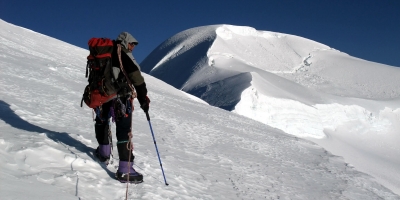
Start the big climb of the adventure, although the climb does not require much technical expertise. However requires strength, stamina and positive attitude and determination to pull up the spirits. The climb needs some basic skills and how and when to use the right tools for the climb. It is best to reach the summit before noon time due to strong wind, bringing extra cold from wind chill factor.
The path leads above sharp incline as it narrows before entering a steep rock vale (narrow channel of rock). Then finally, after continues effort crossing through the vale, the guide. For safety pre-caution the guide may fix a rope to each climber to assist in climbing. Reaching a snowy slope to the ridge at the summit, the rope often extends to some 350 m. As well depending upon the season and danger of crevices, the crevices may be 2 to 3 meters deep, might require use of ladders. After a hard struggle, reach on top of the summit and catching your breathe feeling relaxed. Enjoy the glorious panorama of surrounding giant peaks as far as your eyes can reach. Feeling on top of the world, descend safely on the same route back to High; and then at Base Camp for warm refreshments.
Enjoy the last overnight in tented camp before heading back to Lukla, after achieving the goal and highlights.

Morning clear the camp and leaving nothing only the footprints, walk on the same route on up and down to Chukung. Having lunch, walk to the end of scenic Imjatse Valley to Dingboche, and then head down to a river. Then short up, where route of Dingboche and Pheriche meets. Our route leads on easy downhill to Pangboche village for overnight stop.

Morning starts with easy descent to a bridge, and then climb towards Tengboche Monastery. One of the most picturesque spot surrounded by snow peaks amidst lovely forest with impressive monastery. Having time for short tour of the monastery interior, and then continue downhill to Imjatse River. A slow steady climb for an hour past Sanasa village, and then on easy winding trail reaching the junction. The point, where route of Gokyo, Khumjung and Everest base camp branches off. From here few hour walks to Namche Bazaar for overnight halt after a tiring long day treks.

Last day walk of the adventure, enjoy the pleasant walk downhill to Dudh Koshi River valley. A nice walk to Jorsalle crossing a bridge with short steep climb to the entrance and exit gate of Sagarmatha National Park. Walk continues past Monjo village heading towards Phakding for lunch stop. Afternoon few hours of good walks with last hour climb to reach Lukla. Arriving by late afternoon with ample time hang around and to enjoy the last dinner celebration with fellow members and trekking staff.

Early morning transfer to Lukla’s Tenzing and Hillary airport as the plane arrives either from Kathmandu or Ramechap. Board in a small aircraft of respective airlines for sweeping panoramic flight back to Kathmandu. Then get transferred to your hotel, with afternoon free at leisure.
If the flight lands at Manthali airport in Ramechap, our staff transfers you to a vehicles. A drive of 4-5 hours brings you back at the hotel in Kathmandu, after a great adventure on Island Peak Climb with Everest base camp Trekking.

Enjoy an extra day in Kathmandu, we have reserved as contingency day in case of flight delay and cancellation. Due to unfavorable bad weather condition, if all goes well according to our itinerary days, have a great enjoyable day.
For individual activities or get into shopping spree, interested people can join for another interesting tour of other cities of Kathmandu valley. Sightseeing around Patan / Lalitpur or the famous Bhaktapur city Durbar Square, worth a visit.

After an enjoyable and most mesmerizing adventure in Nepal and around the Himalayas with climb of Island Peak and trek to Everest base camp.
For final departure, our staff transfer you to international airport for flight homeward bound or to next port of call.
My Island Peak Trek and Climb with Treklanders Adventures was truly the adventure of a lifetime. From the moment I landed in Kathmandu, the team took care of every detail with professionalism, warmth, and genuine hospitality. The entire journey—from the classic Everest Base Camp trail to the summit push on Island Peak—was organized flawlessly. My guide was incredibly experienced and confident, which made a huge difference during the technical sections of the climb. He taught me proper rope techniques, checked my gear, and ensured safety at every step. The climb itself was challenging but absolutely worth it—standing on the summit with the sun rising over Lhotse, Ama Dablam, and Makalu is a moment I will never forget. What I appreciated most was the friendly nature of the Treklanders team. They were always checking if I was comfortable, eating well, and adjusting to the altitude. The porters and local staff were equally amazing—kind, strong, and always smiling. The logistics, accommodation, and communication were excellent throughout. I felt supported both physically and mentally, especially during the summit night, which is demanding but incredibly rewarding. If you’re dreaming of climbing Island Peak, Treklanders Adventures is the company you can trust. Their experience, safety standards, and genuine care make the entire expedition unforgettable. Highly recommended!

Purpose: Keep sweat off the skin and maintain warmth.
Purpose: Trap body heat in cold air at altitude.
Tip: Keep electronics in inner pockets at night to prevent freezing.
As this trek is more of an adventurous of two weeks duration, where all trekkers needs to be physically fit and in sound health to cope with ups and downhill walks. Rest of the walks is normal spending overnights in a nice lodge with comprehensive food menu to enjoy. Trekkers of minimum 18 years of age to maximum of 70 years old can join on this wonderful adventure. Requires Medical Insurance that covers emergency rescue if required by any means of transport including service of Helicopter.
Nearly all villages and lodges have electricity with Hydro or Solar power, where one can charge their electronic items. Where client needs to pay an extra fee for using the power as per gadgets charged. As for internet and cell phone communications, every lodges have the Wi-Fi and internet services, but can be quite disturbing sometimes due to weather and location wise.
From Lukla onwards to Gorakshep and at Chukung one can enjoy the comfort of nice lodges and guest house. As well with warm traditional hospitality in every overnight stops, people can choose from budget, standard to luxury lodges where available.
The foods are well served in a large cosy dining hall, can choose various items of foods from the menu with wide range of meals and snacks to choose from.
Serves Continental, Chinese, Indian, Tibetan and Nepali foods, as well Mexican, Italian, Korean or Japanese in some lodge restaurants. Includes fresh bakery products also.
It is the one of the most popular trek around high Khumbu and Everest region. The Everest base camp gets most visitors, being the world’s highest peaks as well for its picturesque scenery. The Island Peak, compared to other trekking peaks of Nepal Himalaya, it is one of the most popular peak for alpine style climb.
For Island Peak does not need much camping equipment just for few overnights, Island Peak with more than 90 % success rate. In best season of the year, that is why Island Peak is a favorite among trekkers and climbers.
The other reason due to its close location on the main route to Everest base camp with much facilities of good lodge and foods until Chukung.
As season wise with major flow of visitors to Lukla and vice versa from Kathmandu. During high season of trekking and mountaineering, the flight to Lukla and back can be quite busy. Where more than 20 flights operates in fine clear day, which causes much air traffic. As the airport in Kathmandu shares the same runways with the international and domestic airlines. To make the air traffic lighter, the flight to Lukla from Kathmandu might get diverted in Manthali airport at Ramechap district. Which is about 150 k.m driving distance of 4 to 5 hours, the flight from Ramechap to Lukla is just 20 to 25 minutes. Which makes it easier and quicker before the bad weather closes in. For further updates the company will inform to all our clients, joining with Trek Landers Adventures.
Imja Tse, also known as Island Peak, is one of the most recognizable trekking peaks in Nepal, located in the Everest region and rising to 6,189 meters. It is beautiful for the seekers of adventure because it provides the thrilling combination of high-altitude trekking, glacier travel, and an actual Himalayan summit, which can be done with minimal mountaineering skills. Besides, they also use it as a preparatory climb for bigger peaks such as Ama Dablam or Everest.
Although the conditions on Island Peak are generally suitable for both beginners and those with some experience, it is still necessary to have basic skills. Good physical condition and experience in trekking at altitudes above 4500 m are mandatory. Technical experience in using crampons, an ice axe, fixed ropes, and Jumar is only beneficial, as a guide will give training before departure to the summit. But you should be emotionally ready for steep glacier sections and long hours of climbing.
Island Peak is quite difficult as it is a technically moderately challenging climb with areas of steep snow, icy slopes, and ladder crossings, depending on the season. Generally, the route is non-technical trekking, but the final headwall near the summit requires the climber to have strength, be stable, and be able to handle rope handling. Due to altitude, cold, and a long summit day, the undertaking is quite challenging, meaning that the climber needs to be well-prepared and have undergone proper acclimatization to be successful.
The two good seasons are normally kept in spring (March–May) and autumn (September–November). These months mean less turbulent weather, fewer clouds, and safer glacier conditions. Spring means warmer temperatures and more climbing parties; however, autumn provides perfect mountain views and spectacular blue sky. Winter climbs are doable, but it is very cold, and during the monsoon season, the climb is not advised because of the loose weather and crevasses.
Most plans vary from 14 to 20 days, depending on which route and acclimatization schedule are chosen. Usually, climbers hike through the Everest Base Camp trail or Dingboche route and stay 2–3 nights in Chukhung before going to Island Peak Base Camp. The summit day usually involves starting around midnight and takes about 10–14 hours for the round trip back to base camp.
Indeed, altitude sickness is among the major risks as the ascent is over 6000 meters. Proper acclimatization, hydration, and slow ascent are the sure ways to prevent AMS. Taking more nights in Namche Bazaar, Dingboche, and Chukhung is very helpful. Your guide is always checking your symptoms along the trek, and if necessary, oxygen, Gamow bags, and evacuation support are there for you.
The best times to climb Island Peak are both the spring (March to May) and autumn (September to November) seasons. During these months, the weather is more stable, the views of the mountains are clear, and the snow conditions are ideal—thus, the chances for summiting are greatly increased.
During spring, you get warmer temperatures, longer daylight hours, and are provided with great climbing conditions. The snow is usually solid, and the weather changes are less frequent. Besides, the rhododendron-covered forests on the way to the peak also come into full bloom, making the trek more enjoyable.
After the monsoon, the autumn season is the most popular one among climbers due to its moderate temperatures, fresh air, and very clear visibility. Both paths and glaciers tend to be in good condition, and the sky stays clear; thus, the perfect summit day conditions are created.
Yes, technically, a December or January climb is feasible, but the cold is going to be really hard on you, and also, the days will be shorter, and the wind will be stronger. So, only a very skilled climber or a very well-prepared group should be the ones thinking about a winter trip. Still, Treklanders Adventures also extends full winter support if you require it.
Trying to climb Island Peak while the monsoon is going on (from June to August) would be a waste of time as far as the chances of success go. Rains make your path treacherous to walk on; it gets more difficult to see your surroundings, and the risks of getting caught in an avalanche or rock fall increase. Besides, the cloudy weather that usually accompanies this period makes helicopter rescues and flights difficult.
The trek is pretty much empty during the cold months and at the onset of the monsoon. However, the weather during these times is far from being trek able. Thus, if you want to have good conditions and fewer people around you, then the end of November and the beginning of March would be the ideal choices.
Generally, it is October during the autumn season and April during the spring season that have the highest success rates. This is because, at these times, the weather is stable; the climbers have ideal temperature ranges, and overall excellent conditions for their climbs.
Yes, weather profoundly impacts the difficulty of a mountaineering climber. The climb’s difficulty can increase due to the presence of strong winds, low temperatures, and fresh snow. Spring and autumn are the most favorable times for summiting when the weather is good, and there is less risk.
Island Peak is a moderate to challenging trekking peak of the Himalayan range. As it is a very steep snow route, a first-time climber may find it very difficult. The ascent includes fixed ropes, a traverse over a glacier, and a headwall climb. A fit climber who is properly acclimatized will make it to the summit without much difficulty.
It is advantageous but not necessary to have technical experience. The Treklanders Adventures organizes a pre-climb training session carrying instructions on the technique of using the ice axe and the use of a climbing harness, crampons, ascenders, and fixed lines. A beginner with a high level of fitness can accomplish this efficiently under the guidance of a professional mountaineer.
The most challenging section is the final 150–200 meters of the climb, which involves a steep ice and snow headwall. Climbers use fixed ropes, Jumar ascenders, and crampons to reach the summit ridge. The thin air at 6,000 meters makes this section physically demanding.
On the one hand, the trek is a classic of how to get to Everest Base Camp, and is moderately tough on the other hand. Hours 5–7 of walking daily, altitude, and steepness of the ground are all elements that challenge the body, but the trail is well-established. Proper pacing and acclimatization days are through which almost all trekkers can make it workable.
Yes, altitude sickness is one of the biggest problems on the mountain since the summit is situated above 6,000 meters. The climbers also get the chance for the practice of altitude acclimatization in towns like Namche, Dingboche, Chhukung, and EBC or Kala Patthar. Guides from Treklanders Adventures will not only watch your progress but also gauge the condition and modify the speed if necessary.
The climbers should be well-endowed with good heart-lung endurance, strong leg muscles, and an indomitable mind for success in the climb. Regular training for 6–8 weeks involving going uphill on hikes, running up stairs, jogging, and backpacking with weights will largely enhance your chances of reaching the peak.
Island Peak is safe for beginner mountaineers and is ranked among the least risky peaks in Nepal. However, all mountaineering carries risk with it. Apart from crevasses, risk at high altitude includes the cold and steep terrain, hence necessitating wearing the appropriate gear, the hiring of experienced guides, and good decision-making. Treklanders Adventures maintains the highest safety standards and also has the best-qualified climbing guides.
During the trek portion, you will stay in comfortable tea houses and lodges along the route to Everest Base Camp. These lodges offer simple yet comfortable rooms with two beds, blankets, and basic furnishings. At the base of the island, the accommodation changes to tented expedition-style camps with high-quality sleeping and dining tents set up by Treklanders Adventures.
MOST of the teahouses provide private twin-sharing rooms, thereby making them the Norm for trekking Groups. Moreover, during peak seasons such as October and April, it is highly probable that lodges will be fully occupied, but Treklanders Adventures will organize the accommodation beforehand in such a way that the best rooms will be ensured.
There are some lodges located at low altitudes, for example, in Namche or Tengboche, where attached bathrooms are available. Going higher, lodges mostly have shared bathrooms, which are quite basic but still functional. At Base Camp, toilet tents are provided for people’s hygiene and convenience.
Most teahouses in the lower parts of the region offer hot water showers, which are often solar or gas-heated. Nevertheless, at higher elevations like Dingboche, Lobuche, or Chhukung, the availability of hot showers may be limited; they may come at an extra charge, or it may be the case that no one can have a hot shower during the very cold days.
The camp at Base Camp is made to be quite comfortable and safe. Treklanders Adventures offers high-quality expedition tents, foam sleeping mats, warm sleeping bags (if you ask for one), and a separate dining tent with tables and chairs. The food is prepared fresh by the cook team of the expedition to keep climbers full of energy before the summit push.
The tea house dining rooms generally have a central stove that provides heat at night. On the other hand, individual rooms are not heated; therefore, warm clothes and a sleeping bag are a must. At Base Camp, even though the tents are not heated, climbers are kept warm by high-quality sleeping bags during the cold nights.
Various freshly made foods are available in teahouses along the Everest trekking route, such as dal bhat, fried rice, pasta, noodles, potatoes, momos, soup, pancakes, eggs, chapati, and porridge. The climbing team at Island Peak Base Camp serves hot meals specially crafted for the high-altitude climbers, e.g., soup, pasta, rice dishes, energy bars, and hot drinks for both warming and energizing.
Definitely, restaurants or teahouses in the Everest area not only maintain hygiene but also use fresh and local products. The meals at Base Camp are the result of the hard work of the well-trained, clean, and nutrition-conscious cooks from the expedition crew. One less stomach problem that can be nowadays is due to hot and fresh meal consumption at high altitudes.
Sure. Vegetarian dishes are readily available everywhere, while vegan food such as rice, potatoes, lentils, vegetable soups, chapati, and fried noodles is easily obtainable. If you are a person with strict dietary needs, it is better to bring some supplements or snacks with you.
They also provide boiled water to most teahouses for sale, and travelers may procure purification tablets, chlorine drops, or portable water filters on their own. Water in bottle form is available in lower villages, but it is not friendly to the environment, and therefore it is costly and discouraged.
You are allowed to refill your water container at every teahouse and in Base Camp as well. One can receive hot or boiled water every day. Most of the climbers take two reusable bottles or a hydration bladder with them so that they are sure of being able to drink enough during long walks and the summit push.
The most common drinks are hot ones and mainly include the following: black tea, lemon tea, ginger tea, hot chocolate, coffee, and soups. All of them are great for replenishing the fluid that one needs and also for keeping the body warm. Do not drink alcohol if you are at a high altitude, and, especially if you are going to summit, do not drink it before your attempt, as it slows acclimatization and causes loss of water from the body.
Indeed. It is wise to bring with you some energizing snacks such as energy bars, nuts, chocolate, dried fruits, hydration salts, and glucose gels. Snacks get very costly and are scarce at the higher parts, and thus having your own snacks enables you to meet your energy needs quickly during difficult sections or summit morning.
Before the summit, climbers are given high-energy foods such as pasta, rice, potatoes, soup, and tea to energize them for the climb. After coming down from the summit, warm soups, hot drinks, and carbohydrate-rich meals are used to help the recovery process and replenish energy.
Mobile network coverage is accessible at several villages on the way to Mount Everest Base Camp, basically in Lukla, Phakding, Namche, Tengboche, Dingboche, and Chhukung. Nevertheless, the mobile connection deteriorates when you go toward the Island Peak Base Camp, and sometimes it is even impossible.
Wi-Fi connections are available in teahouses through “Everest Link” or “AirLink” services up to Dingboche and Chhukung. The connection is sufficient for sending a few messages or browsing. Nevertheless, there is no Internet access at Island Peak Base Camp.
Using mobile internet is efficient only until the middle-altitude villages, after which its availability is sporadic and weakened. Hence, it is advisable that mobile data be used only as a backup, and one should depend on the teahouse Wi-Fi when accessible.
Indeed, you can. On the trekking trail, you can make family contacts at will via the use of either mobile data or by means of Wi-Fi. Nevertheless, from Chhukung onward to Base Camp, the network is very limited, so, in all probability, you will have to be off the grid for a day or two during the summit period.
Yes. Treklanders Adventures guides and climbing Sherpas use mobile networks when they can and depend on satellite phones, radio communications, or local contact points for their safety during the climb. These mobile devices are used for the smooth running of the logistics and in cases of emergencies.
It is better to get an NTC SIM card as it is generally more effective in the Everest region than an Ncell one. It only takes a few minutes to buy a SIM card in Kathmandu—just bring along a passport photo and some ID.
Indeed, nearly all teahouses offer electrification services for a small amount of money. The power supply is mostly of solar or hydropower origin. If at Island Peak Base Camp, no power is available, then you must have a power bank (10,000–20,000 mAh) with you.
To climb Island Peak, you must have a complete set of mountaineering gear. The mountaineering gear comprises a pair of crampons, one ice axe, a climbing harness, a Jumar (ascender), a figure-8 descenders, carabineers, safety lanyards, a helmet, fixed-line gear, glacier goggles, and mountaineering boots. The Treklanders Adventures has a great selection of climbing equipment, which they offer to the clients on demand.
If you have an insulated pair of mountaineering boots, it is better that you bring them with you; however, you can also rent double-layer mountaineering boots either in Kathmandu or Chhukung. The right boots are the main source of heat, stability, and safety during the summit.
Indeed, Treklanders take care of all the technical climbing gear requirements that include helmets, harnesses, ice axes, ropes, Jumar, carabineers, and crampons. In case you are inclined to use your own gear, there is no problem; you can bring it along.
You will require warm and layered clothes that also manage moisture efficiently, such as thermal tops, fleece jackets, down jackets, waterproof shell jackets, trekking pants, insulated gloves, warm hats, neck gaiters, and wind-resistant outer layers. Correct layering is very helpful in temperature regulation from Lukla to the summit.
Certainly, a four-season sleeping bag with a temperature rating of –20°C or lower is necessary for nights spent at Base Camp. The temperature there can fall quite a lot, and hence a warm sleeping bag is the only way to ensure rest prior to the summit attempt. Treklanders Adventures is more than happy to provide sleeping bags if asked.
A 30–40 liter daypack will be just right to carry your must-haves such as water, snacks, a camera, layers, and toiletries during trekking days and the summit push. The porter's job is to carry your main duffel bag (up to the standard weight limit).
Indeed, trekking poles are very helpful in balancing your body, particularly during the long uphill and downhill parts of the trail. What is more, they are instrumental in lessening the pressure on the knees and increasing the grip on rocky or snowy ground.
Absolutely, Crampon, glacier goggles, harness, ropes, Jumar, and helmet are the items you will need for the glacier crossing. These pieces of equipment are essential for safety when traveling in the crevasses and fixed-line sections.
Fixed ropes, a Jumar ascender, crampons, and ice axe techniques are the means by which the final steep section is negotiated. Your guides install firm fixed lines not only to facilitate the climb but also for your safety during the descent.
Gaiters are very useful in keeping the snow out of your boots throughout the glacier approach and summit climb. They give an extra layer of protection against deep snow or strong winds.
The Treklanders Adventures Island Peak mountaineering package normally consists of complete technical gear: ropes, helmets, crampons, harness, ice axe, ascenders, descenders, and safety equipment. If not requested, things such as clothing, sleeping bags, and boots are the personal items that are not included in the package.
Yes. Island Peak requires a certified climbing guide. The climb is a risky one as it is on the glacier and there are crevasses, fixed ropes, and steep snow slopes that need to be safely negotiated. Treklanders Adventures offers licensed and experienced climbing guides who are also trained in high-altitude rescue, rope techniques, and mountaineering safety.
Climbing Sherpas are the ones who, during the climb, lead you through the most difficult parts. They attach and set up fixed ropes, take care of monitors, lead you on the glacier, help you with the headwall ascent, and most importantly, ensure you have a safe and successful summit attempt. Without them, it would be nearly impossible to succeed on summit day.
Yes. The mountain guides and climbing Sherpas of Treklanders are government-licensed, NMA-certified, and equipped with skills related to high-altitude rescue, first aid, rope management, and mountaineering. A good number of them have made the summit of Island Peak, Mera Peak, Lobuche East, and even Everest numerous times.
Porters are those who carry your main duffel bag (generally weighing 12–15 kg), and you can trek comfortably with a smaller daypack that is only for carrying essentials. They help you so that you do not get too tired and therefore can save energy for acclimatization and summit day. Porters are definitely a very important factor in the success of the team and the smooth running of the expedition.
Yes. Treklanders Adventures takes good care of the safety and health of the whole team, including porters, guides, and climbing Sherpas, by insuring them with full coverage. They offer medical and high-altitude rescue and accident insurance to the local team members, thus ensuring their safety and well-being during the whole expedition.
Guides keep a close eye on your health situation throughout the climb at every altitude. In case symptoms such as headache, dizziness, and shortness of breath emerge, they lower the pace, give first aid, advise rest, or even suggest going down. If the case is really serious, they take the necessary steps to get the immediate evacuation done by their helicopter rescue partners.
Yes, most of the trekking and climbing guides are fluent in English. They can very well communicate to you the climbing methods, safety measures, briefings, and also local customs. They make it very easy and efficient to communicate during the trek.
Before climbing Island Peak, you must have the following three essential permits:
these permits are required for illegal climbers from foreign countries willing to enter the Everest region.
The Nepal Mountaineering Association (NMA) in Kathmandu issues climbing permits. Treklanders Adventures takes care of the permission formalities for all travelers, so there is no need for you to drop by any office personally.
Each permit has its implications. The climbing permit is the legal entry ticket to the summit, the park permit is used for the protection of the environment and upkeep of the trails, and the rural municipality permit is the source of income for villages in the Khumbu region.
Indeed, permits can be shown at various points while walking the trail, such as Monjo, Namche Bazaar, and Dingboche/Chhukung. Representatives of NMA or climbing sherpas at Island Peak Base Camp confirm your climbing permit before the summit.
Absolutely not! Unpermitted climbing is never allowed. Trekker and climbers who do not have permits and thus are small in number may get heavy fines, be taken to court, or be totally disallowed from the climbing zone.
You need to have a passport, a valid visa, passport-sized photos, and your itinerary for climbing. Besides that, Treklanders Adventures also assists in making sure your experience is smooth by completing documents, filling out forms, and obtaining permits for you.
Indeed! All fees associated with permits are accounted for by Treklanders Adventures in the mountaineering package of Island Peak. It guarantees no additional charges or extra office work for climbers.
Surely, the fee for the Island Peak climbing permit depends on the season. Spring (March–May) is the priciest period because of the strong demand; autumn (Sept–Nov) is a bit lower, while winter/summer rates are discounted. The fees for a national park and a rural municipality permit remain constant throughout the year.
Absolutely, Island Peak, going up to 6,189 meters, is definitely the case where altitude sickness is the most serious threat. Besides that, correct acclimatization procedure, slow walking, hydration, and rest days in Namche, Dingboche, and Chhukung are the factors that contribute greatly to AMS prevention.
If you suffer from these symptoms, you might have altitude sickness; they are headache, nausea, dizziness, shortness of breath, fatigue, loss of appetite, and difficulty sleeping. The symptoms may occur at an altitude of above 3,500 meters and should not be overlooked in order to avoid further complications.
I would say that none of these methods alone is enough: Acclimatizing well, walking slowly, consuming plenty of liquids, refraining from drinking alcohol, eating warm foods, and following the guide's instructions. Treklanders Adventures not only supplies you with a good plan, but through utilizing it, you and your body get more than enough time to settle into the high altitude.
When you exhibit signs of altitude sickness, your guide will check on you constantly. A coach may suggest that you take it easy, slow down your walk, or advise that you go down to a lower level. Driving down immediately is the only solution in the case of very low oxygen. Do not ever take it for granted that you can go up and push your AMS to the limit.
Besides giving a mild preventative effect and reducing the intensity of symptoms, Diamox should be given sparingly and one time only according to a doctor's guidance. The majority of mountaineers decide that they should have it readily available rather than not, especially when the summit effort is arduous.
Surely, travel insurance is a must that can't be overlooked. The ascent comprises a high-altitude, glacier journey, and an area quite far away from help by land, but helicopter rescue is assumed. Your coverage should include evacuation up to 6,500 m, medical treatment, and rescue operations.
Insurance policies should cover the risks of high-altitude trekking and climbing, helicopter evacuation, emergency medical treatment, accidents, and trip interruption, alongside baggage loss. Make sure your insurer gives the green light to activities above 6,000 meters.
Hospitals in high-altitude villages such as Chhukung or Base Camp do not exist. So, what if you get a severe case of altitude sickness, an injury, or an unexpected illness? Then, your only and safest option is evacuation by helicopter. It is very costly without coverage.
Along the route to Island Peak, you will find the basic medical posts in the villages such as Namche Bazaar, Tengboche, Dingboche, and Pheriche. The purpose of these clinics is to cure minor issues and the symptoms of altitude while treating the severe cases via a.k.a. evacuation to Kathmandu. There are no medical facilities near Island Peak Base Camp.
Keep your hands clean by washing or sanitizing them very often, eat only freshly prepared meals, stay away from raw food, drink only water that has been purified, and keep yourself warm with proper layering. Apply sun protection, stay hydrated, and rest well to help reduce the risk of getting sick and becoming tired.
Definitely, Island Peak is considered to be among the safest climbing peaks in Nepal, provided that you use the services of professional guiding and put on the proper gear. Moreover, Treklanders Adventures is always there to ensure your safety through their certified climbing Sherpas, technical equipment, secure fixed lines, and emergency communication systems.
Essentially, you are to wear warm layered clothing and have a -20°C sleeping bag. Also, bring trekking boots, mountaineering boots, gloves, sunglasses, waterproof jackets, and personal toiletries. Treklanders Adventures will provide a complete gear checklist before departure.
Certainly, the climb requires such things as crampons, a harness, a helmet, an ice axe, an ascender, and carabineers. In case you want, Treklanders Adventures can provide them, or you can rent them from a local shop.
It is recommended to keep your daypack as a light one, with a weight of 5–7 kg. The daypack should have only the necessary items such as water, snacks, a spare layer, sunscreen, a camera, and personal articles. Your porter will be the one to carry your main duffel bag.
Indeed. The ascent to the summit necessitates the use of insulated jackets, thermal layers, waterproof shells, warm gloves, a neck gaiter, and proper mountaineering boots to be able to withstand extreme cold and high winds.
Your journey begins with a scenic flight from Kathmandu to Lukla, followed by a trek through the Everest region. Treklanders Adventures arranges all flights and transfers for a smooth start.
After completing the climb, you trek back to Lukla and fly to Kathmandu. Weather can affect flight timings, so having one buffer day is recommended.
Yes. Helicopter flights are available during bad weather or emergencies. Treklanders can arrange them upon request, and they are typically covered by insurance if medically necessary.
| No of people | Price per person |
|---|---|
| 1 - 1 | $2,060 |
| 2 - 3 | $1,635 |
| 4 - 8 | $1,505 |
| 9 - 30 | $1,405 |
| No of people | Price per person |
|---|---|
| 1 - 1 | $2,105 |
| 2 - 3 | $1,405 |
| 4 - 8 | $1,315 |
| 9 - 30 | $1,220 |
| No of people | Price per person |
|---|---|
| 1 - 1 | $2,715 |
| 2 - 4 | $2,265 |
| 5 - 10 | $1,995 |