Mera Peak Trek & Climb with Treklanders Adventures takes you to sheer mountain wilderness, well hidden from the mainstream and villages.
Mera Peak towers high at above 6,654 m / 21,825 feet, listed as the highest trekking peak around Nepal Himalayas. The altitude mentioned, as on the list of NMA (Nepal Mountaineering Association), is the official height. Whereas in some maps and guide books the exact height might differ slightly, and not to be confused.
The climb to the Mera Peak summit is of less technical effort and skills.
Where all interested trekkers and adventures can join in, on this wonderful adventure for once in a lifetime experience.
For Mera Climb the grade is PD only, which means Per Difficult. As used by the most popular and famous French / Swiss Alpine Climbing Classification Systems.
Per Difficulty leads to less challenge, encountering few technical sections to overcome, then reaching the Mera Peak summit. Although a straight forward climb with some minor technical efforts, it leads to a strenuous steep climb.
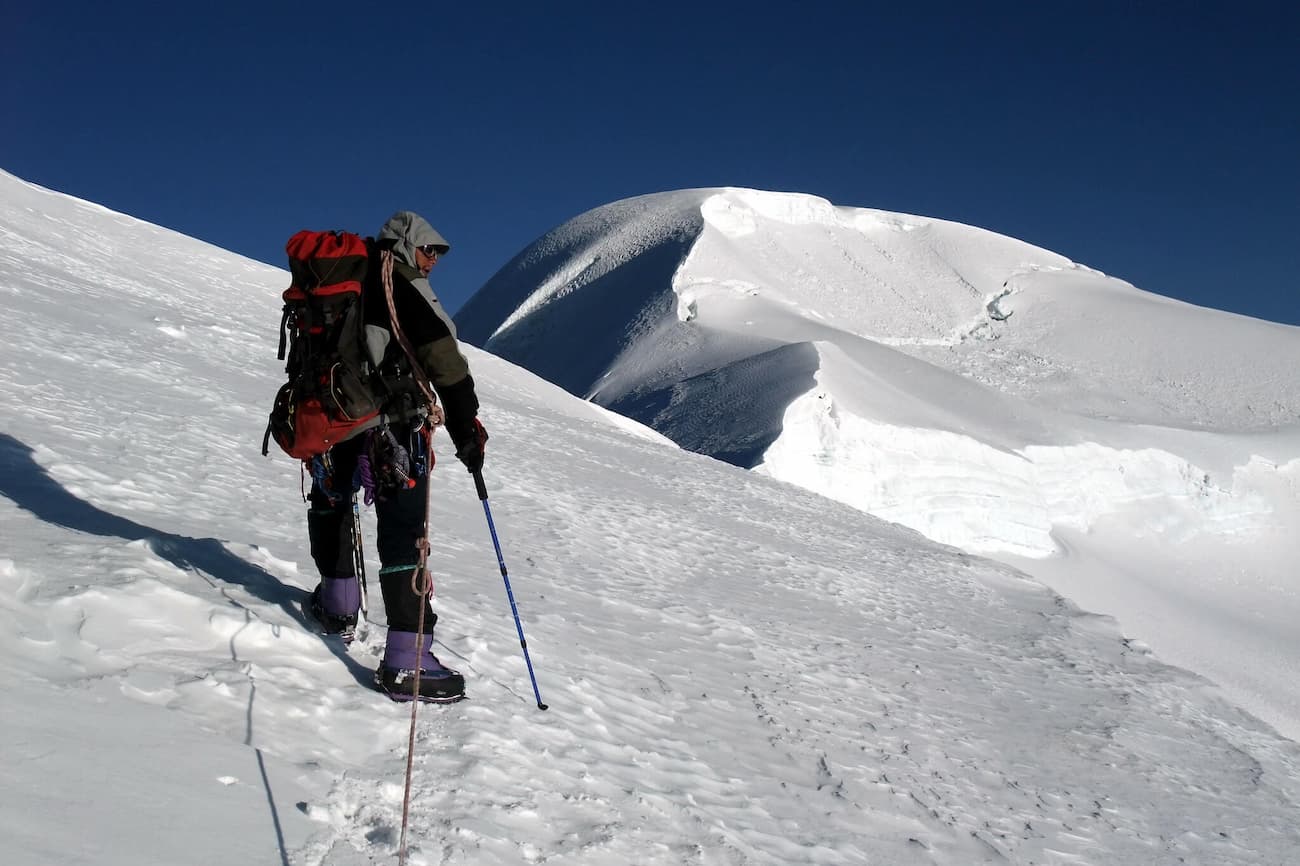
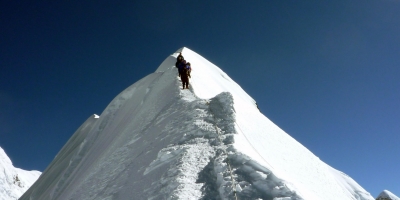
Climbing on a snowy slope ledge, with few icy areas as the climb progresses along with rapid altitude gain. Makes the climbers breathless, and tired, and finally with the last push reach on top of Mera Peak.
Every hard effort is rewarded with exceptional views, overlooking the grand vista of surrounding towering giant peaks.
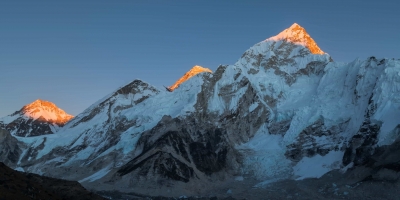
The panorama from the top of Mera Peak faces Mt. Everest, Lhotse, Ama Dablam, and Baruntse Himal with Mt. Makalu. Includes views as far as
Mt. Kanchenjunga towards the far eastern horizon with an array of peaks.
Mera Peak Trek & Climb starts and ends at Lukla town, after a short flight from Kathmandu. Landing at Lukla’s Tenzing & Hillary airport with unique runways, getting organized at Lukla. The adventure begins walking away from the main villages towards sheer mountain wilderness, reaching the hidden valley of Hinku.
The route to Mera Peak base camp and Hinku valley starts with a steep climb to Kalo Himal or Naulekh ridges. Which forms the boundary between Dudh Koshi River valley and the remote pockets of Hinku areas. The walk continues through beautiful woods of birch, juniper, rhododendron, and pine trees past summer grazing pastures. Staying overnights on temporary settlements simple lodges of Thuli-Kharka and Thagnak to reach the base of Mera Peak. On leaving the lush green vegetation and tree lines for an arctic zone of ice, rocky moraine, and glaciers.
At base camp with time for practice climbing and exercise as well as acclimatization and then getting ready with preparation. The Big Day! Starts following our expert guide on a faint vague path with a steep haul. Then finally reaching on top of Mera Peak summit, encircled by staggering snow-capped peaks, feeling on top of the world.
Feeling in high spirits after all the hard work and achieving the goal of a lifetime experience. Return journey on the same scenic route to Lukla, but enjoyable after completing the main highlight of the adventure.
On reaching Lukla back to civilization, after being in complete isolation for two weeks.
The next morning a swift scenic flight brings you back to Kathmandu, after a wonderful experience on Mera Peak Trek & Climb.
Trip Summary:
Mode of Trek: Best available lodge / guest house on treks.
As well in tented camp on Mera Peak climb.
Trekking Grade: Moderate to Adventurous.
Climbing Grade: PD (Per Difficult) From French / Swiss Alpine Climbing
Classification, Systems
Trekking Region: Around Khumbu district, North Mid-East Himalaya.
Start and End of trek: From Lukla to Lukla with flight both ways.
Trek / Climb: 13 Nights and 14 Days with flight from Lukla.
Total Trip: 17 Nights and 18 Days, from arrival to departures.
Best Seasons for Mera Peak Trek & Climb:
The best season for Mera Peak Trek & Climb is from spring, March to May.
Including autumn/fall begins from September to early November.
Springtime is bright and beautiful, most days are clear with sunny days, can be cloudy afternoons. Bringing cold chill in the late afternoon, and night till morning this is the time when wildflowers are in seasonal bloom.
The next best season is autumn/fall, where days are clear with sunny days for views and walks. But shorter days due to limited sunlight hours, cold morning and night time can expect snowfall sometimes. But an enjoyable day for pleasant walks with clear views of the beautiful snow mountain range.
Interested people can venture during winter times of December to February, freezing temperatures morning and nights. But clear sunny days from late morning till afternoon, can expect snowfall during trek and climb.
Culture & Religion:
The high Khumbu district of Everest region is populated by the Sherpa’s, the main mountain tribes of eastern Himalayas. The Sherpa culture and traditions interwoven to Tibetan heritage with Buddhism religion. Where trekkers will come across religious monuments of prayer walls, spinning wheels, Stupas, and monasteries. All houses are adorned with Buddhist prayer flags. Traditionally the Sherpa are farmers and cattle herders, raising and breeding livestock.
But on this trek and climb of Mera Peak, on leaving Lukla town, heading towards complete isolation away from villages. Trekkers will not have much opportunity to witness the local cultures, except in Lukla on the first and last day of the adventure.
Trekking Peak climbing equipment list
Following items can be bought or hired in Kathmandu.
Please Note:
The flight to Lukla and back to Kathmandu, can get delayed or might be postponed for next morning. Due to unfavorable, bad weather conditions which is normal, around the Himalayan mountainous region, sometimes even in the best time of the season. If the situation arise please bear with us, we will try our best to avoid such situation and inconvenience of all our clients.

On first arrival at Kathmandu-Nepal international airport, our staff and guide will receive with traditional welcome. A short drive to your hotel in the hub of Kathmandu city, on checking into your nice rooms. After getting refreshed from the jet-lag, join at the hotel lobby and at meeting room for trek briefing provided by our guide or leader. Information about the hotel, lodge on treks and camping with full details of trek and climbing routes, food and accommodation on treks. As well with do’s and don’ts with welcome group dinner in an authentic Nepali restaurants with local cultural program along with Nepali meals.


Start the morning after a good breakfast, the route from Chutanga leads through for a short while. Then starts steep climb on rocky ledge slopes of few hours reaching atop a ridge of Naulekh or Kalo Himal. The high ridges forms the boundary between Hinku and Dudh Koshi River valleys, the mainstream with many nice villages. Enjoy the grand views of Lukla town and the runways with towering peaks of Numbur and Kongde peaks. From here a short climb over Zatwar-La pass at 4,700 m high, a long descent leads back to greenery at
Thuli-Kharka for overnight stop. A small isolated place with few simple huts serves as Tea-House and lodge, enjoy the first day around Hinku valley.

From Thuli-Kharka, starts the walk following a pleasant trail towards inner Hinku valley, walk leads with short ups and down. Enjoying the trek on gradual path entering dense woods of juniper, rhododendron, birch and pine trees.
After a glorious morning walk of more than 4-5 hours reaching another small areas at Kothey for overnight halt. Enjoy the comfort of a nice lodge with simple small rooms, however serves good basic foods.

Morning after breakfast, enjoy the day to a lovely areas and nice settlement at Thagnak. Walk leads with gradual up and short down amidst beautiful woodland and past several pasture field. As walk proceeds to a clearing reaching a lovely areas called Gondaishung as well Lungsumgba Gompa an interesting place with a small Buddhist shrine. This holy monuments of more than two centuries old, where in early days monks and priest stayed here to meditate. As well for retreats for several months in the harmony of pristine surrounding around this remote isolated Hinku valley.
From this pleasant spot a short walk to Thagnak, a nice small settlement with few simple stone huts. Serves as Tea-House and lodges with basic accommodation and foods varieties to enjoy for two overnight stops.

A perfect location with an ideal altitude for rest day, after continues walks having time for a leisure break. Enjoy the day relaxing, take a short hike and climb to a high ridge, overlooking views of Peak 41 and 43 towers high at 6,769 meters with glimpse of Mera Peak towards east. Afternoon at leisure and marvel the beautiful surroundings before heading towards Mera Peak base camp.

From Thagnak, enjoying a pleasant rest then start the walk towards our ultimate goal and destination for Mera Peak climb. The trail follows towards north east, as tree lines and vegetation drops, as walk leads to rocky moraine. Walk continues on rough rugged path for few hours heading towards the end of Hinku valley.
Slowly the route leads close to Charpatte Tal, a square shaped glacial pond dammed by rocks and boulders. From here with steep climb on rocky moraine, with short descent to Dig Kharka. The path leads across a big boulder strewn with high ridges to reach Khare. At Khare our Base Camp is set for the climb, a small areas amidst towering mountains. Located close on route Mera Peak summit, the actual base camp is bit further. Enjoy the afternoon checking the climbing gear for next day climb, and have a leisure day.

Having another free day at Khare to support acclimatization and full preparation for Mera Peak climb. Enjoy the day with practice and training use of ice-axe, crampons, our expert guide provides full detailed and information.
Providing and advice regarding the climbing routes and obstacles to follow for the big climb.


Rising early having breakfast with refreshing warm drinks, then start early morning for a long day adventure. Follow our guide, taking easy pace as climb leads to steep snowy slope all the way. The good sides of Mera Peak the climb leads to less technical difficulty more or straightforward. The only technical sections is avoiding deep crevasses, as climb progresses reaching on top Mera Peak. Stand on the highest trekking peaks of Nepal Himalayas, facing awesome panorama of Mt. Everest, Lhotse and Nuptse. Includes views of majestic Ama Dablam, Baruntse and Chamlang Himal with Mt. Makalu, as far as Kanchenjunga towards east horizon.
After a rejoiceful triumph and exciting moments on top of Mera Peak, descent is made on the safe route. Reaching High Camp and then continue to Khare our base camp for overnight halt.

Enjoy the morning with leisure walks to Thagnak, after packing and collecting all the waste and garbage. Leaving nothing only your footprints, keeping the areas pristine as it was. Follow the same early route to Thagnak and back into green vegetation for overnight stop before Lukla.

From Thagnak onwards on the same pleasant trail amidst lovely dense tree line following nice path to Thuli Kharka. Enjoy the last overnight around hidden Hinku valley, before heading back to civilization.

The last climb of the adventure takes you to high ridges of Naulekh and over Zatwar-La pass. On leaving the tranquil surrounding of Hinku valley, start the morning walk with steep uphill. To reach Kalo Himal of Naulekh rocky ridges and traversing Zatwar-La Pass. Facing last views of Hinku valley towards north, a steep descent brings to Chutanga for last overnight around serene wilderness.

After a glorious morning with tough climb over Naulekh and Zatwar-La pass, morning walk on pleasant trail to Lukla. Walk across beautiful forest, and then reaching smaller hamlets and farm areas, then finally ending the wonderful trek reaching Lukla. Arriving in Lukla by lunch time and enjoy the lovely comfort in a nice lodge close to Tenzing and Hillary Airport. Afternoon with time to explore Lukla town and its market, catch glimpse of local Sherpa culture.
Enjoy the last overnight dinner, celebrating the successful trek and climb to the summit of Mera Peak.

Early morning transfer to Lukla’s Tenzing & Hillary airport as the plane arrives either from Kathmandu or Ramechap. Board in the small aircraft of respective airlines for sweeping panoramic flight back to Kathmandu. Then get transferred to your hotel, with afternoon free at leisure.
If the flight lands at Manthali airport in the district of Ramechap, our staff transfer you into a vehicles. A drive of 4-5 hours brings you at the hotel in Kathmandu after a great adventure on Mera Peak Trek & Climb.

Enjoy an extra day in Kathmandu, we have reserved as contingency day in case of flight delay and cancellation. Due to unfavorable bad weather condition, if all goes well according to our itinerary days, have a great enjoyable day.
For individual activities or get into shopping spree, interested people can join for another interesting tour of other cities of Kathmandu valley. Sightseeing around Patan / Lalitpur or the famous Bhaktapur city Durbar Square, worth a visit.

After an enjoyable and most mesmerizing time in Nepal and around the Himalayas with Mera Peak Trek & Climb. As time for departure, our staff transfer you to international airport for flight homeward bound or to next port of call.
My Mera Peak Trek and Climb was one of the most unforgettable adventures of my life. The journey took me through some of the most remote, peaceful, and breathtaking landscapes in the Himalayas. From dense forests and quiet alpine valleys to wide glaciers and sharp ridgelines, every day offered a new, incredible view. The trekking days were long but rewarding, with beautiful trails far away from crowds. I truly enjoyed the cultural side of the trek—passing through traditional villages, meeting friendly locals, and experiencing the authentic lifestyle of the Solu region. The acclimatization schedule was well planned, and I never felt rushed or uncomfortable. The summit climb was challenging, especially on the glacier section, but it was safe, well-guided, and extremely satisfying. Standing on top of Mera Peak with 360° views of Everest, Lhotse, Makalu, Kanchenjunga, and Cho Oyu felt surreal. It is a moment I will carry with me forever. Overall, Mera Peak is a perfect choice for anyone looking for a high-altitude Himalayan climb that combines adventure, beauty, and personal achievement. The trail is quieter, the scenery is incredible, and the summit feeling is truly unmatched. I highly recommend it to anyone seeking a meaningful peak climbing experience in Nepal.

Purpose: Keep sweat off the skin and maintain warmth.
Purpose: Trap body heat in cold air at altitude.
Tip: Keep electronics in inner pockets at night to prevent freezing.
Mera Peak is the highest and as well a peak for all types of trekkers and climbers, from beginners to expert veteran mountaineers. The climbing grade is just F to PD means Facial Easy to Per Difficult, a straightforward peak to climb. It is less technical, but leads to strenuous climb to the summit. The downhill is quite tough and slippery, but having good climbing gear will make the adventure most easy.
Overall even though it is the highest but compared to other trekking peaks of Nepal is much easier of less technical effort.
On booking for all trekking peaks, including Mera Peak. Himalayan Forever Treks will send the list of climbing gear required for the climb. The list is attached below for all interested climbers, if in doubt please contact us.
But for Mera Peak being a less technical peak to climb requires minimum climbing gear like good climbing boots, ice-axe, crampons, and carabineer including helmets. The ropes and snow-bar will be provided by the company.
On major route around Khumbu and Everest region nearly all villages and settlements have hydroelectricity or solar power. But on Mera Peak there are no facilities of electricity, few lodges on route have solar power, but it is best to carry a portable solar panel. Which easily fits on top of your backpack, as it collects much sunlight during day walk. So that you can charge your electronic items at the camp. The only last place is at the lodge in Lukla, having the facility of hydro power and Internet services including WI-FI.
Mera Peak Climb leads to remote mountain wilderness, the lodges are available in all overnight stops all the way to Thagnak and Khare. But very basic with limited food menu, for the trek and climb to Mera Peak, the company will provide full camping services with excellent camping equipment, spacious two-man tents.
On this trek and climb, only few overnights in tented camp, which includes large dining tent as size of a group. Having toilet tent / screen, includes separate kitchen unit with expert chef, kitchen crews, camping staff with guide and strong porters. In the lodge provides simple food menu, but our guide and camping cook will carry additional supplementary food also.
While camping, the food are hygienically prepared in our kitchen tent cooked in kerosene of LPG (cooking gas) stoves. No firewood used, as we are committed to Responsible and Eco Tourism. Foods are well prepared served in the dining tent from Continental, Indian, Chinese, Tibetan and Nepali famous Dal Bhat and mild vegetable / meat items with various spicy pickles. Includes good breakfast and lunch, served hot and warm depending on the location of day walks and in camps.
In early days few group of trekkers and climbers seldom ventured, where all camping and foods needs to be carried for the whole trip. But at present Mera Peak and Hinku valley gradually picking up more visitors, and number of lodges has increased over the years. Due to the demand of trekkers and climbers the standard of local lodges are slowly getting better, than it used to be before last few decades.
Mera Peak (6,476m) is the highest trek-cum-mountaineering-peaks peak allowed in Nepal. This is largely because of its broad and stunning summit view that shoots out for the five highest mountains of the world - Everest, Lhotse, Makalu, Cho Oyu, and Kanchenjunga. Mera Peak is the first choice of climbers for its accessible summit, pristine nature, and a once-in-a-lifetime Himalayan experience.
It is a plus if you already have some basic climbing experience, but it is not compulsory. Mera Peak is a non-technical trekking peak and can be done by physically fit beginners. Treklanders Adventures takes you through the full pre-climb training, including crampon use, rope techniques, and ice axe handling at Mera Peak High Camp or Base Camp.
The usual plan takes 17-22 days, and the variation depends on the acclimatization as well as the route chosen, i.e., Zatrwa La Pass or Paiya-Kothe trail, which is longer. There are also some days of rest incorporated in the plan to allow for acclimatization before the summit push.
The difficulty level of Mera Peak is between moderate and challenging. What awaits the climber is a long glacier walk, high altitude, and a steep final summit slope. In order to succeed, one has to be physically fit, have strong mental endurance, and get properly acclimatized.
The most appropriate season to make a summit attempt is spring (March to May) or autumn (September to November). The weather during these months is generally stable, visibility is good, and the snow is in a safer condition. A winter climb is not out of the question, but requires an experienced climber and very strong preparation.
Yes, altitude sickness can become a serious problem since the peak is over 6400 meters. Acclimatization stops at places like Chhukung, Thagnak, and Khare, and they have to be strictly adhered to. Your guide will keep an eye on your health every day and will also ensure that you maintain a safe pace.
The climbers can find accommodation in teahouses along the way, which provide simple and clean lodges. At Mera Peak Base Camp or High Camp, the stay is in a tented camp using the best quality expedition tents provided by Treklanders Adventures.
Indeed, Mera Peak is among the safest high-altitude trekking peaks in Nepal if the climbers are well-equipped, plan their climb according to the weather, and have experienced guides with them. Along with the safety measures. Treklanders Adventures delivers experienced climbing Sherpas with the necessary certification, dependable equipment, and complete safety support.
The best seasons for climbing Mera Peak are definitely spring (March–May) and fall (September–November). These months are more likely to offer good weather, bright days, and safer snow, which can double the chances of a successful summit.
It is spring when the temperature is rising, and the daylight is getting longer. Also, the weather is usually more stable during this time. The snow on the glacier becomes firm, and the views are magnificent. Climbers who look for warm ascents will find this season just perfect.
After the monsoon, the air is clean and fresh, and it is very clear. Hence, the best time to see the mountains is autumn. The temperature is nor too hot nor too cold, the paths are dry, and there is hardly any wind at the summit; therefore, it is the most chosen season for climbing.
Of course, but the winter (December–February) climb should only be done by the very skilled and experienced mountaineers. You will have to confront extremely low temperatures, heavy snowfall, and strong winds. Although the experience is gratifying, it demands a lot of preparation and high-quality equipment.
No, climbing in monsoon seasons is certainly not doable. The main problems will be very slippery trails due to heavy rainfall, while thick clouds will make the route very hard to follow, and landslides can happen in the lower parts. Moreover, glacier conditions are becoming unsafe, which is increasing the risk of accidents.
Generally, the best months for summit success rate are October in the fall and April in the spring. This is because these periods provide the most favorable weather windows, the snow is most stable, and the climbing temperatures are quite comfortable.
On the trekking part of the trip, local families run teahouses and lodges where you will stay. The rooms are basic, but comfortable; normally, they include twin beds with blankets and simple furniture. As you go higher, especially after Thagnak and Khare, the facilities get more basic.
Yes. Mera Peak Base Camp or High Camp are the places where you shift to tented camping. To make sure you have a safe and comfortable night before the summit push, Treklanders Adventures offers top-notch expedition tents, insulated sleeping mats, and warm sleeping bags (if requested).
Attached bathrooms are seldom. Most teahouses have shared toilets that are clean but very basic. At higher altitudes, such as Khare and Base Camp, you should expect simple squat toilets or tented toilet facilities.
In some villages like Paiya, Kothe, and Thagnak, you can have hot showers, usually for a certain amount of money. When it comes to Khare and Base Camp, there is no hot water, or it is very limited due to low temperatures and the area being far away from everything.
Most of the time, rooms are not heated, but teahouse dining halls normally have a stove that gives off heat during the night. There is no heating in the tents at Base Camp; therefore, warm clothes and a good-quality sleeping bag are necessary.
Definitely, the teahouses that are the choice of Treklanders are safe, clean, and friendly families that have been in this business for a long time and run them. The tents at Base Camp are looked after and set up by skilled and well-trained expedition staff, ensuring high levels of safety and comfort.
During cold nights at Khare and Base Camp, a -20°C sleeping bag is what you should have. If you are not willing to bring it along, please be informed that Treklanders Adventures may provide you with one upon your request.
High Camp lodging is made up of the bare essentials and serves mainly as a temporary place for climbers. To ensure safety but also to cut down on the weight, the tents used are of the lightweight type normally used in expeditions. The fact that it is cold and exposed doesn't change that for one night only; here climbers stay before the summit attempt.
On the trek route, guests in tea houses can avail of hot meals made to order, like dal bhat, fried rice, noodles, pasta, soups, momos, potatoes, eggs, chapati, porridge, and Tibetan bread. The menu gets restricted at higher altitudes like Thagnak and Khare, but the meals remain energizing and healthy to help the acclimatization process.
At Base Camp and High Camp, the climbing crew cooks and serves high-calorie meals made from ingredients that can be taken to extreme altitude. The menu staples are soups, rice-based dishes, pasta, potatoes, and oatmeal, along with tea and energy-packed snack foods. To keep the climbers warm and hydrated before the summit, hot drinks are served several times.
Definitely, the tea houses are in good hygienic condition, and the meals are always made fresh. The camp kitchens have trained chefs who ensure cleanliness during food preparation and cook food suitable for high-altitude conditions. The safest and healthiest option is to eat freshly cooked hot food.
There is no doubt about it. Vegetarians can eat any food from the menu during the trek, while vegans can also be served a dish made from rice, lentils, potatoes, chapati, and vegetable soup. If you have very strict dietary requirements, it is better that you bring some extra snacks with you.
Drinking water is perfectly safe, provided it is purified or boiled. Tea houses provide boiled water at a very small cost, and trekkers can also avail themselves of water purifying tablets, chlorinating drops, or use a filtration bottle. Do not drink water from streams that are not prepared.
No matter where you are on the trek, a water refill will be waiting for you at the next teahouse, including Base Camp, where it is also available. The majority of climbers take along two reusable water bottles or one hydration bladder to make sure enough water is with them on long trekking days and the summit ascent.
The teahouses sell black tea, ginger tea, lemon tea, hot chocolate, coffee, and soup, and also offer bread and juice. The warm liquids are very important for the body as they rehydrate it and keep its temperature steady during cold periods. Stay away from alcohol as it dehydrates the body and slows down the acclimatization process.
Definitely, the provision of energy bars, nuts, chocolate, hydration salts, dried fruits, and glucose gels is very good for bringing along on your trip. At higher elevations, snack choices are very limited and are more expensive, and if you have some with you, energizing will become easier during difficult sections.
A mobile network service is accessible to a certain extent in villages of lower regions like Paiya, Panggom, and Kothe. The signal strength further decreases towards Thagnak, Khare, and Base Camp, and eventually it disappear. Hence, it is advisable to keep in touch with the nearest villages.
The Wi-Fi signal strength remains in question even in some teahouses of the lower parts, where it might be available. In higher places such as Thagnak, Khare, and Mera Peak Base Camp, Wi-Fi services are absent. So, it is better to keep your devices offline.
In a few villages down the valley, mobile data can be activated. It turns out to be very intermittent near Khare, and it is not available at Base Camp. So, it is better not to think of mobile data as your main source of connection while climbing.
Treklanders Adventures guides and climbing Sherpas who may be in a difficult situation always carry satellite phones or radio communication equipment with them. This enables them to be in quick touch with the support team even if there is no mobile network.
Yes, an NTC SIM card is a good buy as it is more effective in the deep woods than an Ncell one. Nevertheless, the coverage is still spotty when you are at the upper stages of the trek and on the mountain.
Indeed, a teahouse can provide charging services to you either with solar or hydro energy for a small fee. Charge is not provided at Mera Peak Base Camp or High Camp, so you need to carry a power bank with great storage (10,000–20,000 mAh).
The answer is yes. Communication is possible via Wi-Fi or mobile data in the lower villages. But Kothe and Thagnak communications are quite different; the climb beyond these points means no contact with the outer world. So, most climbers take it for granted that they tell their families beforehand about their probable days of being offline.
One can upload content only in lower regions where there is Wi-Fi or mobile data. However, the speed is quite slow. It is better to upload in high resolution when you come back to Kathmandu.
Absolutely, Mera Peak requires a guide with a valid climbing certification. Just trekking it is not enough, because the summit is a technical one, a glacier has to be crossed, a crevasse is possible, there are some rope sections, and the slope is steep and covered with snow. Treklanders Adventures is offering you the best and safest climbing routes along with the most reliable and experienced government-licensed climbing guides.
Climbing Sherpas are the leaders of the technical team who undertake the most difficult part of the climb. They bring out the climbing gear and fix the ropes, connect you to the rope, and show you the way across the crevassed glacier, help you where it is steep, assess the weather, and also guide you to the summit by the safest route. Their experience and knowledge are indispensable for the accomplishment of the ascent.
Sure. The Mera Peak guides and Sherpas with Treklanders Adventures have National Mountaineering Association certificates. They have been highly trained and very experienced in all aspects of the mountain, such as rope usage, navigation on glaciers, safety at heights, and rescue at altitudes.
The porter is the one who carries your main bag (which usually weighs between 12 and 15 kg) with the necessary personal gear (and any other items you may need for the trek) so that you can hike easily with just a light daypack. Thanks to his help, you will not get tired as quickly and will be able to save energy for acclimatization and the final ascent.
Yes. The management at Treklanders Adventures has made provision for its guides, Sherpas, and porters to be fully covered by insurance. This includes medical coverage for high altitudes as well as emergency evacuation. It is designed for their safety as well as for your peace of mind.
Guides keep an eye on how healthy you are every day and ask if you have any of the following symptoms: headache, nausea, or dizziness. Once you have altitude sickness, it slows down your pace, gives the advice of taking rest or heading down, and in extreme conditions, you cannot use an evacuation device to send a call for help. Safety tops the list; down options are never options for them.
Trekking and climbing guides normally have good English skills and can communicate in English well. They can inform you about the route, the use of equipment, safety measures, weather, and even cultural aspects of the area throughout the trek.
Essentially, a climbing guide becomes 'attached' to two climbers on their final ascent and thus single-handedly shoulders the safety of these two. An extra Sherpa can be arranged for more climbers and a more personal contact for one climber.
Although not obligatory, tips are a nice gesture and thus still very much part of Nepali culture. It is most often the case that it is done at the end of the trek, as thus it sums up all of their great efforts, support, and commitment throughout the whole climb.
To climb Mera Peak, you need three essential permits:
The climbing permit is issued by the Nepal Mountaineering Association (NMA) in Kathmandu. Treklanders Adventures handles the entire permit application process for climbers, so you don’t need to visit any offices yourself.
Each permit supports a specific region:
You must carry all required permits throughout the trek.
Yes. Permit checkpoints are located in Lukla, Paiya, Kothe, Thagnak, and Khare. Your guide will keep all permits ready for inspection to ensure smooth passage.
No. Climbing without valid permits is illegal and can result in fines or denial of access to the climbing route. Proper permits ensure safety, registration, and legal compliance.
You need a passport, valid visa, passport-sized photos, and your climbing itinerary. Treklanders Adventures collects all required documents and arranges the permits for you.
Yes, all necessary permit fees are included in most Treklanders Adventures Mera Peak climbing packages. This ensures no extra costs or delays for trekkers and climbers.
The Mera Peak climbing permit fee changes depending on the season:
National park and rural municipality permit fees remain fixed.
Definitely, the highest point on Mera Peak is 6,476 meters. This means that altitude sickness was the biggest challenge encountered. Signs of altitude sickness can show up at 3,500 meters, so the ascent should be slow, acclimatization must be correct, and one needs to stay hydrated.
Generally, symptoms that accompany altitude sickness are headache, nausea, vertigo, and weakness. Along with that, the person will lose appetite and will have difficulty sleeping. If symptoms are not treated, they can evolve to serious conditions such as HAPE or HACE.
One prevention method is to follow an acclimatization schedule. Drinking a lot of warm fluids, walking at the right pace, not consuming alcohol, and eating healthy foods are also very good methods. Treklanders Adventures’ program has rest days in Thagnak and Khare, which is good for your body to get used to the altitude.
Notify your guide immediately. Depending on the extent of your symptoms, the guide may advise you to rest, drink fluids, take a medicine such as Diamox, or go down to a lower altitude. It is dangerous to ignore the symptoms of altitude sickness.
A person with severe altitude sickness must be immediately taken down. In case the condition does not improve with the change of altitude, Treklanders Adventures' guides have communication equipment to request a helicopter evacuation. Getting help on time is very important for your safety.
Indeed. One has to have travel insurance if Mera Peak is the climbing goal. Among other things, the insurance should be valid for high-altitude trekking and climbing up to 6,500 meters and also for helicopter evacuation, medical treatment, and emergency rescue.
Your insurance needs to specifically include the following coverage:
without these, the evacuation costs can be very high.
Places like Khare or Mera Base Camp are very far away and do not have any medical facilities. In a case of severe altitude sickness or injury, the only safe method to get the patient to a place where they can get help is via helicopter. Insurance makes sure that you don’t have to pay a big amount.
There are some medical posts in the villages down the valley, but the doctors’ posts in the higher areas like Thagnak, Khare, and Base camp are not available. The guides have first aid kits with them. If there’s a serious case, the person would have to be taken to Kathmandu for treatment.
Good hygiene should be practiced; one must wash or sanitize their hands regularly, drink purified water, eat freshly cooked meals, and keep oneself warm by wearing proper clothes. Also, drinking enough water and getting enough sleep are two things that greatly lower the risk of getting sick.
Yes. Mera Peak is regarded as one of the safest trekking peaks in Nepal and can be done with a professional team, proper guidance, acclimatization, and good-quality climbing equipment. Treklanders Adventures offers certified climbing Sherpas, safety-checked gear, and continuous support during the journey.
The majority of climbers take a Kathmandu-Lukla flight. From Lukla, they hike to Paiya, Kothe, and Khare. To begin your adventure, Treklanders Adventures will take care of all your flights and transfers.
After the mission, you return to Lukla on foot and then fly back to Kathmandu. The weather may cause delays. Therefore, it is a good idea to keep a buffer day at the end of your trip.
Indeed. Helicopters are on hand for instances when flights have to be canceled due to bad weather or in the case of a medical emergency. If the situation is medical, the evacuation is most likely going to be paid for by the travel insurance.
Along with the mentioned items, you will need trekking boots, warm layered clothing, thermal wear, waterproof jackets, trekking poles, a headlamp, gloves, UV-protection sunglasses, and a -20°C sleeping bag. Such equipment will ensure comfort and safety during the approach trek.
Some of the key technical items are crampons, ice axe, climbing harness, helmet, ascender (Jumar), carabineers, figure-8 descenders, and mountaineering boots. Treklanders Adventures is able to provide you with all the technical gear required or help you in renting it.
Definitely, the insulated mountaineering boots (double boots recommended) are a must for the glacier and summit day. Normal trekking boots will not be warm enough for the snow and ice at high altitude.
Sure. Treklanders Adventures can provide you with a -20°C sleeping bag as well as a durable duffel bag upon your request, thus keeping you warm and making it easier for you to carry your gear.
Certainly, you should have with you personal climbing accessories such as warm gloves, buff/neck gaiter, gaiters, sunscreen, lip balm, hydration system, and energy snacks for your comfort and convenience during the climb.
Train for 6–10 weeks with uphill hiking, cardio, and strength workouts. Focus on building endurance and strong legs for long walking days and the summit push.
Not necessarily. Basic skills help, but Treklanders Adventures provides pre-climb training in Khare to teach crampon use, ice axe techniques, and fixed rope climbing.
Pack layered clothing, thermal wear, a down jacket, waterproof shells, insulated gloves, trekking boots, and mountaineering boots for summit day.
You carry a light daypack (5–7 kg) with water, snacks, and one extra layer. Porters carry your main duffel bag up to 12–15 kg.
| No of people | Price per person |
|---|---|
| 1 - 1 | $2,060 |
| 2 - 3 | $1,635 |
| 4 - 8 | $1,515 |
| 9 - 30 | $1,405 |
| No of people | Price per person |
|---|---|
| 1 - 1 | $2,135 |
| 2 - 3 | $1,645 |
| 4 - 8 | $1,540 |
| 9 - 30 | $1,405 |
| No of people | Price per person |
|---|---|
| 1 - 1 | $2,815 |
| 2 - 4 | $2,475 |
| 5 - 10 | $2,295 |