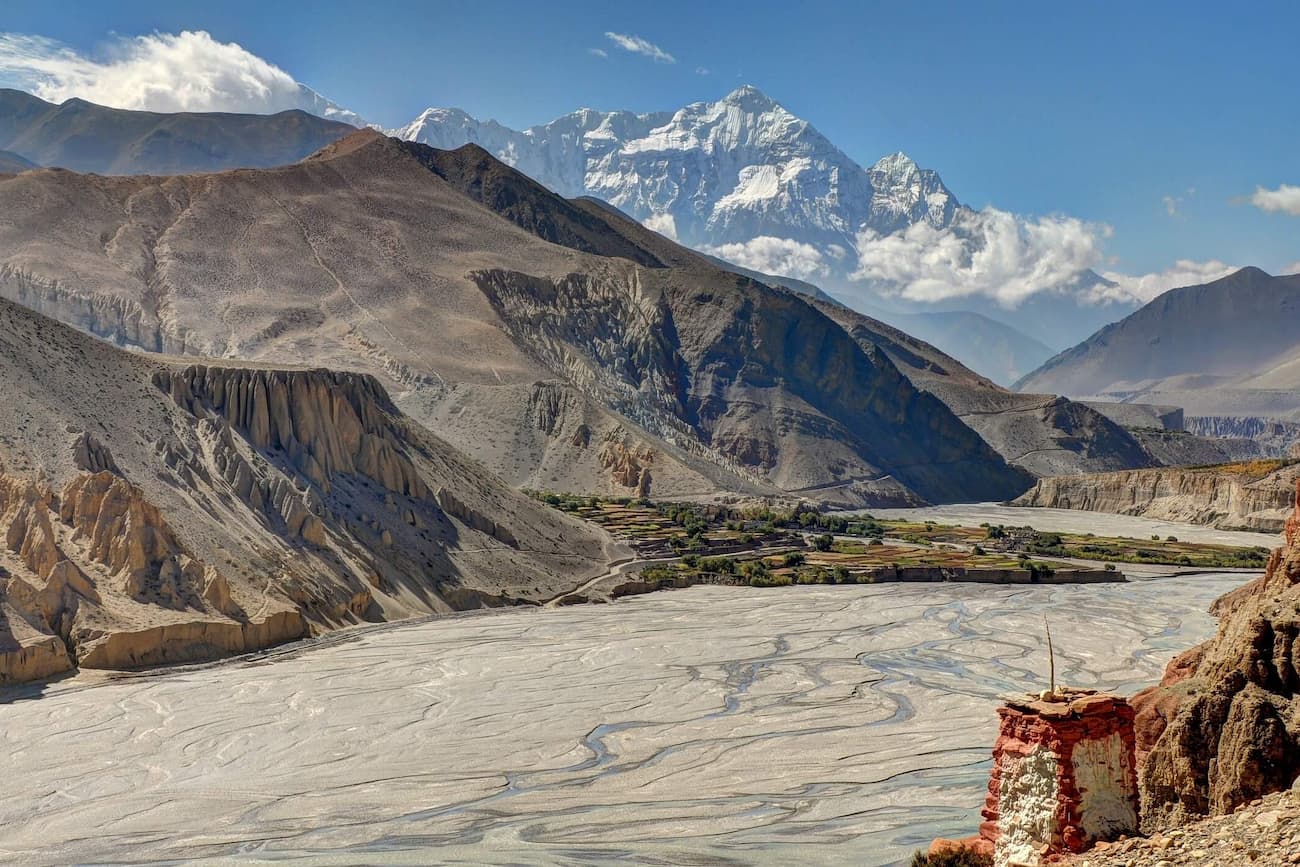
Upper Mustang Trekking, one of the most amazing and picturesque adventure to experience, although a windswept country. But unique place on earth full of charming scenery with natural background of high snow-capped mountains. Upper Mustang lovely villages enriched with ancient cultures and customs of age-old heritage of Buddhism and Bon religions.
Located Far North West Nepal, close to the border of Tibet / China, as well to eastern part of Dolpo. The former kingdom of Lo, Upper Mustang remained closed for outside visitors until it flung its door open in 1992. But remains as restricted areas of Nepal to enter the former forbidden kingdom of Upper Mustang. Where all trekkers requires a special permits, this is control the mass flow of visitors, to retain its pristine environment. As well as preserving its old cultural heritage as it were for past hundreds of centuries; since the kingdom was established.
Upper Mustang Trekking begins after reaching from Pokhara beautiful city in Jomsom, the headquarters town of Mustang district. Where our adventurous walks starts towards dry and arid country to enter Upper Mustang region, from the old Kagbeni village. The trek leads beneath the towering skyline of huge canyons and high windblown eroded hills and cliffs. As walk follows through villages lined with few surviving willows and populous trees, and green and yellow mustard field. As walk progresses climbing high passes over Yamada-La and Ni-La of above 3,900 meters high facing incredible snow-mountain panorama. Includes views of surrounding beautiful plateau landscapes, dotted with red and brown hills encountering prayer monuments. The route leads through lovely villages of Chusang, Samar and Ghiling reaching nice large settlement at Charang.
Most village’s houses a monastery the pride and respect of the Mustang people known as Lobas. The tribes of Upper Mustang and old former walled kingdom of Lo-Manthang, where all Mustang people follows Buddhism.
Similar to their Tibetan ancient predecessors, situated across the border of Nepal and Tibet. Bounded by high Kora-La pass 4,660 m / 15,290 feet high, the Upper Mustang and some parts of southern Tibet. Which was under the power of first king of Mustang Ame Pal around 1380 AD. A great warrior and followers of Buddhism and built the walled capital and kingdom of Lo-Manthang. Where our route follows from the lovely village of Charang / Tsarang, walking over high hills and valleys. Then entering the historical walled kingdom at Lo-Manthang, the first impression for visitors, takes you back to medieval periods.
At Lo-Manthang with ample time to explore around places of historical and religious interest. The visit leads to its famous monasteries the Namgyal, Champa Lakhang, Chyodi Gompa and Thubchen with Monastic museum. Thubchen and Chyodi Gompa, holds the famous colorful Tije festival, which falls during the auspicious time in midst of May.
The tour includes the fort palace of the last late king Jigme Parbal Bista who ruled the kingdom of Lo the Upper Mustang from 1933 until 2016.
After a wonderful time and experience at walled kingdom of Lo-Manthang, return journey leads on the same exciting routes. But with a difference visiting different lovely villages till the trail joins at Kagbeni, and then to Jomsom town.
An exciting short panoramic flight brings you to beautiful Pokhara city, after a grand glorious experience on Upper Mustang Trekking.
Trip Outlooks:
Mode of Treks: Hotels and Lodge on trekking.
Trekking Grade: Moderate to Adventurous walks
Highest Altitude: On top Nyi La pass 3,950 m / 13,035 feet high.
Duration of Treks: 11 Nights & 12 Days (With flight to and from Pokhara/
Jomsom / Pokhara)
Total Trip: 16 Nights & 17 Days (Kathmandu / Kathmandu).
Best Seasons:
The best season for Upper Mustang adventure is on spring time from April & May till pre-summer of June. Including autumn/fall from September and October only. By November, most villages and lodges will be closed for cold winter, where all Mustang people migrates to low warm region. Escaping the cold winter months from November till early spring of March.
Upper Mustang falls with rain shadow, where all black monsoon clouds are blocked by the great Himalayan range. This is why the country is dry and arid with near desert like landscapes and yet beautiful. Most days in late spring, summer and autumn / fall is clear with bright sunny days, cold in the shade. As well in late afternoon till next early morning. Afternoon can be very windy bringing extra cold chill factor, can expect snow during all seasons of the year sometimes.
Culture & Religion:
The Mustang region is populated by the Lobas, the native of Upper Mustang. The Lower Mustang of Kaligandaki River valley is inhabited by famous Thakali people closely related to Upper Mustang natives. Both Thakali and Lobas of Upper Mustang follows similar Buddhism religion, with slightly different cultures and customs. The Thakali and Mustang people beside farming and raising, breeding livestock, a good flourishing business and traders. Thakali and Lobas have been in trading goods across the border in Tibet. The areas falls on famous Trans Himalayan Salt Trade Route of Nepal, India and Tibet / China through Mustang.
Besides Buddhism religion, the Upper Mustang also practice Bon sect of pre-Buddhism, which exists in Dolpo and Langtang Himal regions.
The menfolk considered as finest horsemen and follows Buddhism with impressive heritage and culture similar to its Tibetan predecessors.
Most villages have monasteries known as Gompa, every house adorned with prayer flags, and prayer monuments. The famous and most important festivals of Upper Mustang is Tije, which falls during end of spring, around mid-May.
Please Note:
For interested people to attend and observe the colorful Tije Festival, which takes place on 16th to the 18th of May this year 2023. For more information and details, please contact us.

On first arrival at Kathmandu-Nepal international airport, our staff and guide will receive with traditional welcome. A short drive to your hotel in the hub of Kathmandu city, on checking into your nice rooms. After getting refreshed from the jet-lag, join at the hotel lobby and at meeting room for trek briefing provided by our guide or leader. Information about the hotel, lodge on treks with full details of trekking trails, food and accommodation on treks. As well with do’s and don’ts with welcome group dinner in an authentic Nepali restaurants with local cultural program along with Nepali meals.


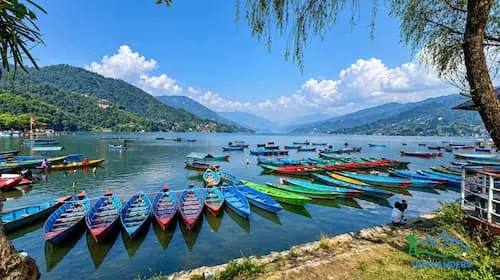

After breakfast, The journey from Pokhara to Kagbeni by bus typically begins early in the morning with a smooth ride along the blacktopped Pokhara–Beni highway, passing rivers, terraced fields, and small hillside villages. After reaching Beni in about three hours, the road gradually turns rough and off-road as the bus follows the deep Kali Gandaki Gorge toward Ghasa, passing through Tatopani and the famous Rupse Waterfall. The landscape shifts dramatically, offering views of waterfalls, cliffs, and snowcapped peaks. From Ghasa to Jomsom, the scenery becomes more open and semi-desert-like, with the route passing through Lete, Kalopani, and the apple-growing village of Marpha. The winds pick up in the afternoon, making the ride dusty but adventurous. After a short break in Jomsom, the final stretch to Kagbeni takes around 30–45 minutes, following the rugged Mustang terrain with impressive views of Nilgiri, Tukuche, and Dhaulagiri. By the time the bus arrives in Kagbeni, travelers are welcomed by its ancient alleys, monasteries, and the iconic windswept Mustang atmosphere, marking the end of an unforgettable Himalayan road journey.

Morning from Kagbeni, the gateway village to the border of Tibet and Upper Mustang. Kagbeni is the limit for trekkers with normal permits, from here on one needs a special entry permits. From Kagbeni onwards into a wild windswept country, walk on windswept trails in between large canyons. Amidst towering red mud cliffs dotted with smaller caves, as trail follows to a nice village of Chusang.
Actually spelled as Tsusang, the village surrounded by few willow and populus trees and pines. The only surviving trees around high altitude and dry terrain, on reaching Chusang in the comfort of a nice simple lodge. Having time to explore around the village and observe the local exciting cultures.

Morning from Chusang a short walk to cross a stream past broken, eroded canyons appears like a ruined old castles. Tucked on a series of high windblown cliffs, as walk heads above the mouths of an inaccessible caves.
As walk progresses reaching another interesting village of Chele / Tshele, and then climb leads to a high ridge and a pass above 3,130 m. Offers views of Gyagar village across a huge canyons, the walk then leads to another higher ridge.
Which is much higher at 3,540 m. Enjoy the surrounding magnificent scenery of surrounding beautiful formations of rocky and high cliffs. Then on gradual downhill to overnight stop in Samar a nice village, and check into a small lodge.

The morning walk leads to a short steep climb above Samar village to reach a scenic ridge top. Having time for views and refreshing stop, then descent to enter a gorge, walking past a large Chorten, a Buddhist prayer monuments painted red, black, yellow and white color. The official color of Sakya sect of Buddhism, where most Lobas the native of Upper Mustang follows.
Adventure continues reaching to next scenic valley, having sparse vegetation with few juniper trees. The route passes through a stream, with climb to a ridge at 3,800 m high, the climb continues to another pass. For the hard efforts rewards with an awesome views of surrounding scenic landscapes with snow-capped peaks. From the top down to Shyangmochen, a small isolated place with few little tea shops. Enjoying a pleasant rest, as trail follows up at 3,770 m high pass, then reaching a wide valley, after a long descent to Ghiling for overnight stop.
A lovely village surrounded by large crops fields of barley, buckwheat and mustard. Check into a nice simple lodge or a guest-house with a friendly hospitality to enjoy at Ghiling.

The morning starts from Ghiling with gradual slow climb past crops fields of barley and buck-wheat. Uphill continues reaching center of a beautiful valley and above Tama Gung, a small farm village. The walk from here with steep climb across the head of a valley then on top Nyi La pass 3,950 m. The highest spot of the adventure, enjoy the panoramic views of Mustang great landscapes with snow-capped peaks. From the top downhill to a junction, where route of Charang / Tsarang and Ghami villages diverts.
Our walk follows beneath a colored high cliff of blue, greyish and reds, and head across a valley. Reaching a strong steel bridge over Tangmarchu River, from here uphill reaching a long stretch of Mani (prayer) wall. One of the longest series of prayer walls in the whole Himalaya region.
From here with last and final climb of the day to a high ridge, as walk descent to Tsarang / Charang for overnight stop. Check into a nice guest-house, one of the beautiful village surrounded by crop fields and willow trees. Includes a huge five storied white colored high Dzong / fort and a Monastery. Located at the edge of the Kali Gandaki gorge.

From Charang towards our main highlight to Lo Manthang, morning begins with short down to Charang Chu River. Then heading for a steep climb to a high hill walk past Tholung valley.
On reaching the ridge top, our route diverts heading north with slow climb reaching a large Chorten. This monuments marks the boundary of Charang and Lo areas, the walk follows a stream, and then walk into a wide windswept valley.
The walk continues to the top of a high pass, overlooking walled former kingdom of Lo-Manthang. From the top a short down to a stream that outlines the walled kingdom of Lo-Manthang village. As walk leads to a short climb, then reaching inside the walled kingdom of Lo-Manthang.
At Manthang, transfer into a local lodge or guesthouses with time for short stroll the nice narrow paved streets, lined with shops, stores and restaurants.

Enjoy the free day at Lo-Manthang, the largest settlement around Upper Mustang, takes you back to medieval period time era. The old kingdom with more than 150 houses, includes residence of priest, monks and lamas. Most building are closely attached with the fort palace and monasteries. Located at the bottom sections within vertical part of L shaped houses.
Besides the apparent squalor of Lo-Manthang, the local are well-off and maintains strong sense of community. Here the native called as Lobas, the people of Lo.
Tour leads to famous monasteries of Namgyal Gompa, Champa Lakhang (God House), Red Thubchen Gompa. Includes Chyodi Gompa and the great Entrance Hall with special permission to visit interior of the former palace.
Lo-Manthang where a great Tije Festival takes place in the month of May, as per Buddhist Lunar Calendar. An interesting religious event to observe, during the time of Tije festival celebration for three days or more.

After a wonderful experience with enjoyable time in Lo-Manthang, return journey on the same trail for few hours. As our route diverts with short climb to Ghami village. Ghami is another major and important village of Upper Mustang.

The walk from Ghami leads to same route with climb on top Nyi La, contouring upwards, and then reaching that joins near to Charang.
From the ridge top, a steep descent to Geling Valley, as walk continues with gentle downhill to Tama Gung. A steep switchbacks path follows a stream; the trail climbs to a large painted Chorten. Slowly the walk leads on straightforward route to overnight stop at Samar, a nice small village with a simple homely type guest houses.

Morning walks from Samar leads downhill on the same direction for few hour past Chele village. As walk follows Mustang Khola, and then on gradual trail in between great canyons and eroded high cliffs. Slowly the walk leads to the end of Upper Mustang on reaching Kagbeni for overnight stop in the comfort of a nice lodge.

From Kagbeni onwards on the same route to Jomsom following the windswept Kaligandaki River Valley. A short walk of few hours reaching the large town of Jomsom, stands above Kaligandaki River. At Jomsom enjoy the afternoon with short walks around Jomsom town full of shops and stores and nice restaurants.
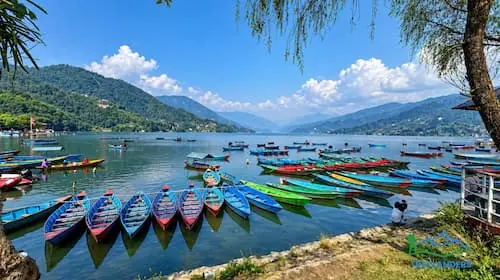
Today, we drive from Jomsom to Pokhara is a long but scenic journey that usually takes 8–10 hours, starting with a rough and dusty road along the Kali Gandaki River. The route passes through the beautiful apple village of Marpha, the forested areas of Kalopani and Ghasa, and the hot spring village of Tatopani before reaching Beni. From Beni onward, the road becomes smooth and blacktopped, offering a comfortable ride through green hills and river valleys until you arrive in Pokhara. Despite the bumpy start, the shifting landscapes and mountain views make the journey memorable.


Last day in Nepal and with Trail Himalaya, with your time for international flight back to your respective countries, our staff and guide transfers you to airport after a great experience on Upper Mustang Trekking.
Our Upper Mustang Trek with Treklanders Adventures was truly one of the most unforgettable experiences we’ve ever shared as a couple. From the moment we contacted the team, their professionalism, warmth, and attention to detail made us feel completely confident about taking on this remote Himalayan journey. Everything—from the itinerary to the accommodations and daily guidance—was perfectly organized. Walking through the ancient kingdom of Mustang felt like stepping into another world. Together, we explored dramatic cliffs, wind-carved caves, charming villages, and centuries-old monasteries filled with history and spirituality. Lo Manthang was especially magical, and we will always remember wandering through its narrow alleys and meeting the friendly local people. Our guide was exceptional—knowledgeable, patient, and always checking in on our comfort and safety. The porter was equally amazing, carrying our bags with a smile and making the trek feel lighter and more enjoyable. Throughout the journey, we felt well taken care of, supported, and encouraged, especially during the more challenging days. Treklanders Adventures made this trek not just an adventure, but a deeply meaningful experience for both of us. We returned home with stronger connection, incredible memories, and a profound appreciation for Mustang’s unique culture and landscapes. We wholeheartedly recommend Treklanders Adventures to anyone dreaming of exploring Upper Mustang. It was truly the trip of a lifetime.
Purpose: Keep sweat off the skin and maintain warmth.
Purpose: Trap body heat in cold air at altitude.
Tip: Keep electronics in inner pockets at night to prevent freezing.
Yes, interested travelers can take the overland journey to Upper Mustang on 155 k.m. / 96 miles driving distance. Taking few days with stops in chosen village’s en-route Upper Mustang, but the road from Beni town onwards. The drive is bumpy, and it is unsealed, in rough condition due to frequent landslides. But best to fly in to Jomsom and taking a drive of few days to Lo-Manthang distance of 59 km / 37 miles. The road is much better, although riding on dirt windswept valley with ups and downhill.
Upper Mustang is an extension of Tibetan South West plateau, where moistures in less and very minimum. The area hardly gets rains or touches the monsoon wet seasons of July and August. The rain black clouds are bounded by the high Himalayan range of peaks that is why Upper Mustang is dry and arid landscapes.
Lo-Manthang the old and former walled kingdom is the major town of Upper Mustang, it was tagged as city in early times. But it is more of a smaller town, but the main headquarters town of Mustang district is Jomsom.
The best is April and May to mid-June, where days are much clear with longer sunny days. Can get very windy afternoon till evening times, but enjoyable and one of the best time for visit. The other next best for visit is September to October, days are much clearer for views and walks. But can be much cold morning late afternoon and night times. Days are shorter due to sunlight hours for Upper Mustang visit, requires strong sun blocks creams. As the sun is bright due to high altitude with strong UV.
From Jomsom onwards and Kagbeni village, the lodge accommodation are simple and basic. But provides clean and nice cozy rooms around the route to Lo-Manthang. At Charang and Lo-Manthang one can have the options from budget, standard to luxury class hotel / lodge accommodation.
Most lodges en-route with common toilets and bath rooms due to the harsh terrain and cold climate. The foods at its best nearly guest-house and lodges provides comprehensive food menu with various items from Continental, Chinese and Indian to Nepali. Including Tibetan foods and snacks with wide refreshment to enjoy.
The Upper Mustang is a remote and deeply mysterious area in the Himalayas in northern Nepal. It is often called the Last Forbidden Kingdom. Among the many things that attract people to it, we can mention the pure and unpolluted Tibetan culture of ancient times, Lo Manthang (a city encircled with a wall), striking deserted-like scopes of nature, vibrant cliffs, caves that have been around for hundreds of years, and the Buddhist tradition, which has been well preserved.
The typical trek in Upper Mustang normally requires 10–14 days; this will depend on the itinerary and the walking pace. If a traveler chooses to go by jeep, the tour can be done in 5–7 days, and it is therefore suitable even for those who have only a limited amount of time.
Upper Mustang is accessible to foreign travelers, but as a restricted area, a Special Restricted Area Permit, a licensed guide, and a trekking company are mandatory for the trip.
The trek in Upper Mustang is rated as moderate. The daily distance covered is usually around 5–7 hours, and the terrain is dry, windy, and dusty. In addition, there are no very steep ascents or high-altitude passes, so this trek is considered safe for people with average physical condition.
Most itineraries have the highest point between 3,800 and 4,200 meters, depending on the side trips. The location of Lo Manthang is at about 3,840 meters, which is enough to warrant careful acclimatization.
There is no doubt that the Upper Mustang Tibetan Buddhist culture is a goldmine, and it will not be difficult for the visitor to come across any of the following: ancient monasteries, traditional stone-sealed houses, Chortens, Mani walls, and the like. For instance, Tiji is a festival that, among other things, helps in this regard and attracts global attention.
Although there are teahouses and lodges available all over the region, the latter are relatively simple but still comfortable and cozy. They provide basic rooms, wholesome meals, and warmth from the people who serve you. However, taking a deep dive into the Mustang, you will find that the amenities become more and more limited.
The answer to this question is yes. The trek is moderate, and a beginner who is in good shape can attempt it without any problem. The individuals who are not willing to walk too much can take advantage of the Jeep Tour, which is more convenient and less time-consuming.
Yes, it really is.
Upper Mustang is one of the most weird and wonderful places to go in Nepal because of:
The feeling of being totally cut off and yet very peaceful, which you won’t find on other trekking routes
It is frequently referred to as the "Last Forbidden Kingdom" and therefore, is still one of the most mystical and spiritually rich areas of Nepal. If that is what you are looking for: history, nature, spirituality, and something different from the usual Himalayan trails, then it is absolutely worth going there.
The Upper Mustang is a restricted area because of the following reasons:
Such measures, among other things, keep the area authentic, serene, and protected.
The best time to go to Upper Mustang is in spring (March–May) or autumn (September–November). During these periods, the weather is lively and the temperatures are comfortable. The sky is often free of clouds, which is perfect for trekking, sightseeing, and jeep rides.
Absolutely, Upper Mustang is in a rain-shadow region. Therefore, it gets very little rain even during the monsoon (June–August). Hence, it is one of the few areas in Nepal that can be trekked in the monsoon season without any risk. Besides, nature is greener, and the number of people taking the trail is lower.
In winter (December–February), it is generally cold and the wind can be quite strong. This is particularly true for the areas above 3,500 meters. The closure of the lodges is very likely, and at night the temperatures are very low. Travel is still feasible, but only trekkers with a lot of experience and who have the necessary gear for the extreme cold should attempt it.
During October and November, the visibility is the best, the weather is stable, and the air is very clear. It is the perfect time to admire the desert cliffs of Mustang, the whitewashed villages, as well as the surrounding Himalayan peaks.
Indeed, the Tiji Festival, which is normally held in May, is one of the highlights of visiting Upper Mustang. There is nothing quite likes it to witness the authentic Tibetan Buddhist ceremonies, experience the dancing with the colorful masks, and get a glimpse of the daily life of Lo Manthang.
Traveling by jeep is feasible for most of the months in a year, with the great ones being from March to November. Sometimes there could be snow in the winter, which might block some high passes. At the same time, the monsoon season might bring dust and wind. However, in general, the Upper Mustang roads are not closed.
Surprisingly, yes. Trekking in Upper Dolpo during the monsoon is possible because the region is in a trans-Himalayan rain-shadow, which means it gets much less rainfall. However, reaching the starting point (Juphal or Dunai) might be affected by weather-related flight delays, landslides, or slippery lower trails. Once inside Dolpo, conditions tend to stay dry, though humidity at lower elevations may still be noticeable.
The Upper Mustang trek comes under the moderate category. The paths are not very steep, and the height levels are not that hard to bear when compared to other treks that go to high altitudes in Nepal. A good number of trekkers with average fitness should be able to finish it without any major problems.
Upper Mustang has gentle slope ascents, extensively used trails, and quite stable weather. There are no technical sections or high mountain passes that could make the trek difficult for beginners or families.
The major challenges are strong winds, dry land, dust, and long walking hours. Sometimes you may have to walk for 6–7 hours in open desert-like areas, which can be quite exhausting if you are in the sun.
It is helpful if you have experience beforehand, but it is not a must. If you are reasonably fit and able to walk for several hours a day without any problem, then the trek will be a walk in the park for you.
The altitude is not as harsh as in other areas, but still, you will be at around 3,800–4,000 meters, which is near Lo Manthang. You may come across mild symptoms, but serious altitude sickness is very rare if one follows the right pace.
The remote valley of Mustang lies between 3,000 and 4,200 meters, and hence, altitude sickness can be a problem there. On the other hand, the risk is much lower than a very high-altitude trek, but the symptoms of that could still be headaches, tiredness, or the feeling of slight dizziness. Gradual ascent, good hydration, no alcohol, and following your guide’s advice are very basic but effective ways of precaution. Acclimatization days at Kagbeni or Lo Manthang are good for letting your lungs and blood get used to the amount of oxygen in the air.
First of all, if you have troublesome signs related to your head, stomach, or sleep, you should definitely talk to your guide without delay. The very initial action is to rest and warm up with some fluid, and letting it go, while at the same time forbidding further ascension. In case the side effects become worse, going down to a lower elevation is by far the best solution. The drivers who take you to Upper Mustang are not novices; they have etiquette for altitudes, and they know which villages you can descend to fast. Besides that, using altitude medication given to you by a doctor can be of great assistance.
If one does light training for 2–3 weeks, it can be of great help. Engaging in walking, stair climbing, stretching, and leg-strengthening exercises will make the trek more pleasurable. Drinking enough water and keeping a steady pace is also very important throughout the trek.
While Upper Mustang is not a hard trek, it nonetheless requires good stamina due to dry terrain and long hiking days. Regular walking, stair climbing, light jogging, and exercises to strengthen the legs for at least two to three weeks before the trip will definitely make the trip more comfortable. It is also worth noting that keeping a steady pace and drinking enough water are very important throughout the trek.
The Upper Mustang area is known for being dry, windy, and cold, especially during the morning and night. Packing layering clothes such as moisture-wicking T-shirts, warm fleece, a down jacket, windproof and waterproof outerwear, trekking pants, thermals, gloves, warm socks, and a hat will be quite beneficial. Layering gives you more freedom to easily adjust to the fluctuating temperatures.
Certainly, because the trails are dusty and uneven, it is strongly recommended that you trek with proper trekking boots that have ankle support and good grip. If you want to avoid getting blisters, and then ensure that your boots are well broken in before the trek. At the same time, a pair of lightweight shoes or sandals can come in handy while relaxing at the teahouses.
The list of your daily necessities should comprise a comfortable small bag, sunglasses, sunscreen, a headlamp, trekking poles, personal medication, toiletries, a reusable water bottle, and water purification tablets. If you have the intention of trekking, especially during the colder months, then a warm sleeping bag is very necessary as the temperature can drop drastically at night.
The weight of your main duffel bag should not exceed 10-12 kg, which is the weight a porter, whom you hire, will be carrying for you. As for your daypack, it should contain only the most necessary things, such as water, snacks, a camera, an extra layer, and any personal items that you may need during the day. The lighter your load, the easier the trek will be.
Definitely, among other things, during long walking days, energy bars, nuts, chocolates, and dried fruits are good sources of energy. Moreover, water purification tablets or a filter bottle can be of great help to you, as there are times when you may not find bottled water even in remote areas. The safest as well as the most environmentally friendly way is to purify your own water.
The available accommodation is mainly local teahouses and family-run lodges. These lodges offer clean and fresh rooms, warm dining areas, and home-cooked meals. Although the facilities are basic, they are sufficient for the comfort of the trekkers, and the hospitality is excellent throughout the region. The choices are a little bit more and better organized in Lo Manthang.
Twin-sharing is the most common type of accommodation in private rooms; hence, most lodges have two single beds in the room, mattresses, blankets, and pillows ready for use. It might be possible to get single rooms during the quiet months, but there are only a small number of single rooms during the peak season because of the high demand.
Attached bathrooms can be found in the lower Jomsom and Kagbeni areas, where tourism is more advanced. Whereas in the restricted Upper Mustang region, the number of attached rooms decreases and the majority use shared bathrooms.
Hot showers are available in most teahouses, and the heating is done through solar or gas systems. Hot water in showers may be limited in remote or higher villages, and you may also have to pay a small extra fee if you want hot water. The provision of hot water during cold seasons depends on the weather.
Indeed, most villages in Upper Mustang are either powered by electricity or solar energy. In general, charging is feasible; however, some lodges may require a small fee for it. In very remote locations, the electricity supply may be weak; thus, it is better to have a power bank with you.
You should carry a warm sleeping bag. Although the lodges provide blankets, the temperatures at night in Upper Mustang can be very low, especially in the early spring and late autumn. The quality of a good sleeping bag is that it not only retains heat but also provides comfort.
The food of Upper Mustang is plain, fresh, and made with local products. The range of foods served at teahouses includes Dal Bhat, vegetable curry, noodles, fried rice, chapati with curry, eggs, thukpa, pancakes, porridge, and Tibetan-style foods like momos and Tibetan bread. The meals are made warm and can be quite filling to help you sustain your energy during long trekking days.
Certainly, vegetarian meals are available almost anywhere, and they are usually the most hygienic and freshest options. Most of the consumption in Upper Mustang is inherently vegetarian as the region has a very limited supply of fresh meat. Veg meals such as Dal Bhat, vegetable soup, and noodle dishes are popular and nutritious choices.
Food is generally safe to eat because it is freshly cooked and served while still hot. Tea houses follow cleanliness standards well, particularly in those more crowded villages like Kagbeni and Lo Manthang. Consuming thoroughly cooked food and staying away from raw foods are the best ways to keep fit.
You can have a great selection of drinks such as milk tea, black tea, ginger tea, lemon tea, herbal teas, hot lemon, and instant coffee. These warm drinks are very nice to have in the cold and dry Upper Mustang climate.
Safe drinking water can be found at every lodge in the form of boiled water, which is available for a small fee. Most villages offer bottled water, but the use of boiled or purified water is a better option for the planet. Never drink untreated tap water.
It is a good idea to have purification tablets or a filter bottle with you. This way, you can safely refill water anywhere on the trail, and at the same time, you reduce plastic waste. It is, therefore, especially helpful in remote areas where bottled water may not be readily available.
The coverage of the mobile network is very restricted and also quite unstable, especially after going into the banned area. Although some lower villages, such as Jomsom, Kagbeni, and Chele, can have NTC or Ncell signals, it is almost impossible to get signals when you are close to Lo Manthang. Eventually, the signals are very weak or they even totally disappear.
Lo Manthang may have sporadic NTC coverage, but it is not dependable for calls or data. Signal can be affected by weather, wind, and the surrounding area, so do not expect mobile connectivity all the time.
Wi-Fi service is available at some teahouses, mainly in bigger villages like Kagbeni and Lo Manthang. Nevertheless, the speed of Wi-Fi is commonly very low, and it may also be influenced by power and weather conditions. It is good enough for simple texting but not for heavy use.
Certainly, it would be better if you bought an NTC SIM card since NTC offers more coverage in Mustang than Ncell. But still, in a large number of remote villages, the signal will be weak, or you may not be able to make calls even if you have a SIM card.
Definitely so, Upper Mustang is a distant area, and being offline is quite common for several hours and even days. Network availability is only around the lower Mustang and the main village hubs. Therefore, the trekkers should take it for granted that they will be mostly off the grid during their journey.
Guides have local phones with them, and they can also find out the limited signal areas in which they can make calls. Besides that, there are local communication systems in most teahouses for use in emergencies. So, even when mobile networks are absent, the safety of traveling with a licensed guide is still guaranteed.
The first thing you need to be allowed in Upper Mustang is to have two compulsory permits; one is the Upper Mustang Restricted Area Permit (RAP), and the other is the ACAP Permit (Annapurna Conservation Area Permit). These are your tickets to the restricted area and the conservation area; hence, they are issued only after a registered trekking agency gets them for you. Besides, you must keep them with you throughout the travel.
Bordering Tibet, Upper Mustang is famous for its heritage, culture, and rugged rock formations. To keep the area safe and clean, the government thus marks the region as a restricted zone, allowing only a limited number of people to visit the area. It also guarantees the preservation of their way of life and peace, along with that of the travelers.
The RAP is a permit that a trekker cannot sell; only a registered agency can. If you are going solo on a trek, you cannot get the Restricted Area Permit (RAP). It is your agency that deals with the requirements, such as copies of passports, photos, the guide's documents, and the application form, thereby making the whole procedure smooth and free of problems.
Indeed, a permitted and accredited mountain guide is obligatory in Upper Mustang. Without the data of a guide and an authorization from an agency, you cannot address the issue of permits. Thus, a guide is not only a companion but also your safety, orientation, and proper entry into the controlled areas.
They examine permits at checkpoints, for example, at Kagbeni, which is the main gate to Upper Mustang. The staff here can also come to people's houses in villages like Chhusang, Syangboche, Tsarang, and Lo Manthang to see that everything is going according to the rules and that everybody has the right papers.
There are absolutely no extra restricted permits required if you want to go to Jomsom and Kagbeni or any other areas of lower Mustang. The only thing is that the ACAP must be with you at all times, as the whole Mustang region is the Annapurna Conservation Area.
Through the first flight or the road, the majority of the travelers reach Pokhara. After that, they either take a mountain flight or go by jeep/bus from Pokhara to Jomsom, which is the starting point of the Mustang trek.
Indeed, only in favorable weather taking plane is quickest and most convenient solution. The trip is about 20 minutes from Pokhara. Unfortunately, the flights are very dependent on the weather, and if there are high winds, particularly in the afternoon, they can be delayed or canceled.
Traveling overland is a good choice for people who want to see the sights and want to have their own freedom. The fastest and most comfortable way is a private jeep, which will take you smoothly and quickly on the rugged mountain roads. Although there are buses too that operate on this route, they take more time and are less comfortable.
One can accomplish the journey by jeep and/or hiking from Jomsom or Kagbeni to Lo Manthang via the villages Chhusang, Syangboche, and Tsarang of the Upper Mustang region. Generally, trekkers combine hiking and jeep travel to make their trips less tiresome.
The roads are usually accessible during most parts of the year, but the situation depends on weather conditions and seasons. There are the safest travels for spring and autumn. Come monsoon, the road will be muddy and bumpy at times. During winter, snow may cover the road near Lo Manthang. For assuredness, a 4WD jeep is the best choice of vehicle.
If one is looking for comfort and flexibility in the Upper Mustang area, then a private 4WD jeep is the perfect solution. It not only saves time, but it is also good at handling rough terrain, and it gives you the freedom to stop for pictures, sightseeing, and cultural activities whenever you want.
Upper Mustang is a very safe and peaceful place to visit, so the answer is yes. It is a region with a vibrant culture, few people, and the locals are known for their friendliness. Crime is almost nonexistent, and the main safety issues are related to nature, such as altitude, weather, and rough terrain. So if you have a licensed guide and are well prepared, the trek or tour will be safe for you.
Absolutely, Trails or paths in Upper Mustang are safe but also quite difficult for reasons like deserts without water, time of day with wind; lose ground, and areas with no trees for shade. Winds usually begin after the middle of the day, and that is why early hours are always considered good for walking. Hiking boots in good condition and sunglasses together with trekking poles and face-coverings are very helpful to keep you away from blowing dirt and wind. Keep up your guide’s speed to make the trek safer and more fun.
Good health is maintained during the trek if proper habits are followed. Hot and freshly prepared meals should always be taken, safe water should be drunk, and it is better not to eat raw or unpackaged food. Besides that, you should take with you the medicines you need, and if you don’t have them, then get painkillers, stomach cures, and altitude tablets. The use of sunscreen, broad-brimmed hats, and lip balm can protect the skin from the sun’s rays and the dry air. Breaks are very important, so take them, do some stretching, and walk at a comfortable speed to avoid tiredness.
Water that comes from the tap is not good for the human body. Therefore, one should be drinking water that is boiled, purified, or filtered only. More than half of the teahouses give boiled water as a service, and that is the only place I could probably agree with you about the water safety. All tourists should carry water purification tablets or a filtering bottle to protect themselves from water-borne diseases, especially in the far-flung areas where there is very little bottled water. Water and water-related problems might come close to upping the risk of altitude sickness if not properly handled.
The Upper Mustang journey is less affordable than many other Nepal treks because you can only go there with a special permit, as it is a restricted area.
Typical cost range:
Transportation:
So, because of the permits, the remoteness, and the logistics, it is basically a premium trek.
Definitely, but only for certain types of travelers, those helicopter tours to Upper Mustang—especially to Lo Manthang—though costly, are worth the money.
Some of what they provide:
They charge more for the services, but for photographers, elderly travelers, luxury travelers, or those who are short of time, they are 100% worth it. On the other hand, regular trekkers who enjoy hiking and cultural immersion will find that the trek has much more value.
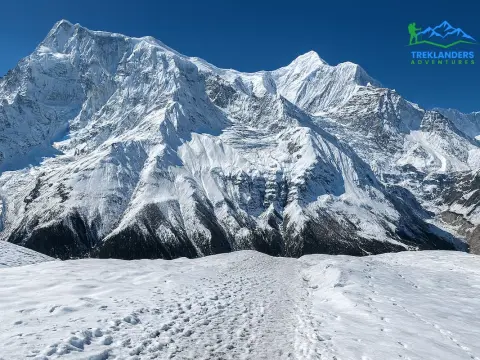
| No of people | Price per person |
|---|---|
| 1 - 1 | $2,505 |
| 2 - 3 | $1,905 |
| 4 - 8 | $1,615 |
| 9 - 30 | $1,495 |
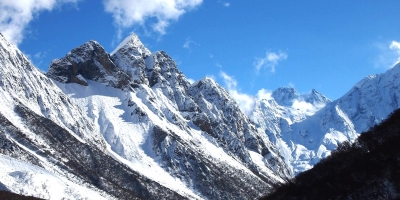
| No of people | Price per person |
|---|---|
| 2 - 3 | $1,750 |
| 4 - 8 | $1,350 |
| 9 - 30 | $1,225 |
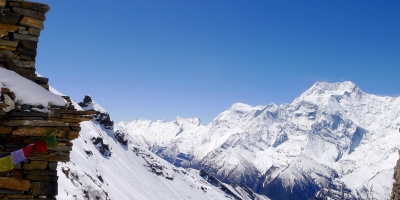
| No of people | Price per person |
|---|---|
| 1 - 1 | $1,825 |
| 2 - 3 | $1,545 |
| 4 - 8 | $1,425 |
| 9 - 30 | $1,315 |