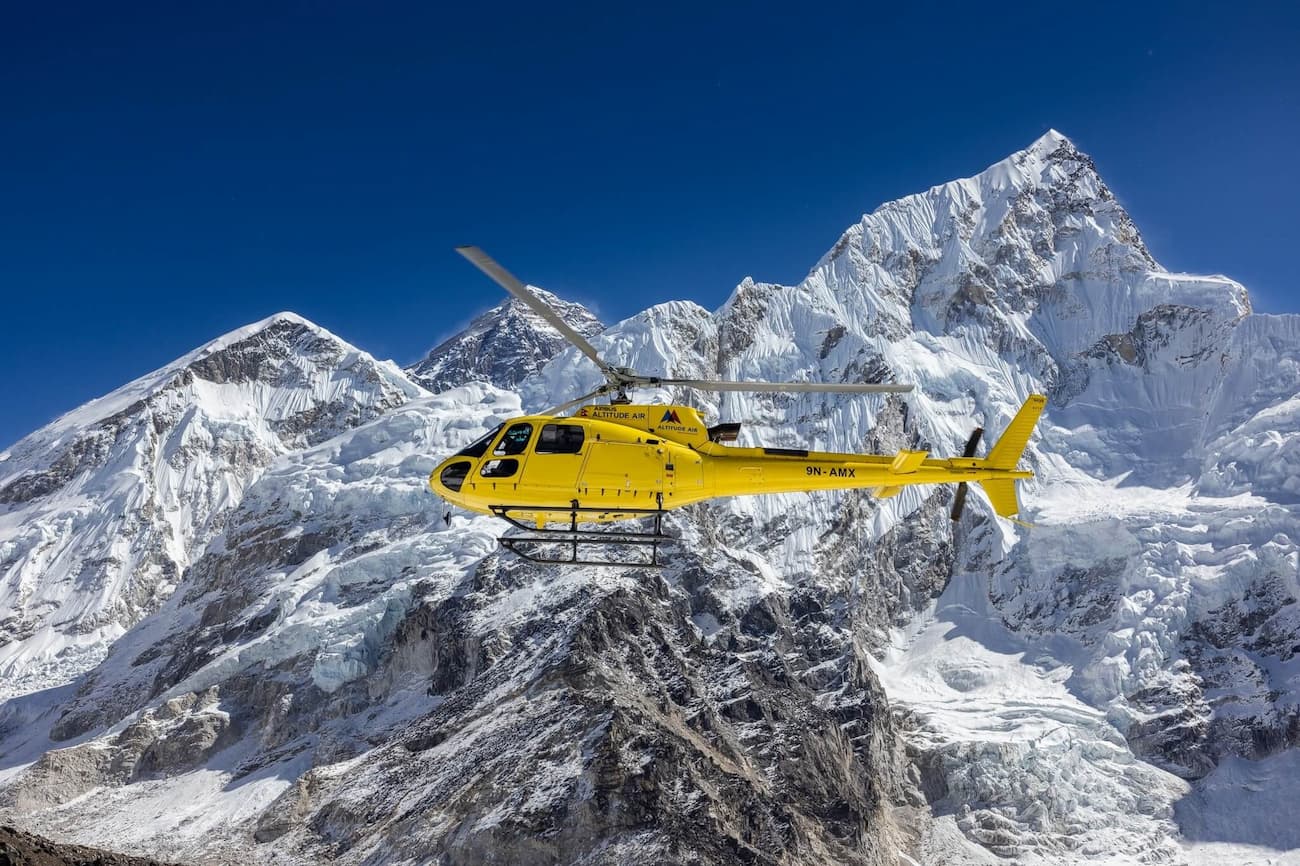
Everest Heli Tour is another way of enjoying as well as being close to the world's highest Mt. Everest. A marvelous experience flying high above the beautiful countryside of Nepal, facing tiers of green hills and verdant valleys.
Overlooking the grand vista of the Himalayan chain of peaks with the world’s famous and tallest mountain range. This could be the ever-exciting moment for some interested visitors to Nepal joining for Everest Heli Tour.
The Heli Tour 3 to 4 hours, is the fastest and quickest means to enjoy the stunning Himalayas. As well as the picturesque landscapes flying above the Himalayan blue sky, swirling high in the comfort of a Helicopter.
Everest Heli Tour is the best way to catch glimpse of the Himalayan range of peaks with Mt. Everest. Where most trekkers walk, for more than ten days for closet views of Mt. Everest. While Heli Tours cover a short distance of time, in comparison to adventurous long treks.
The mass flow of visitors in Nepal is for trekking and mountaineering, besides other various adventure sports activities. The country is famous for short and long adventures from the Far East to the Western end of the Nepal Himalayas.
Everest Heli Tour is a great opportunity for people having limited holidays in Nepal, and with dreams; to catch glimpse of Mt. Everest.
Treklanders Adventures will fulfill your wish, joining us for the flight to enchantment in Everest Heli Tour.
In the past few decades, the Helicopter Tour around the Nepalese Himalayan blue sky is gaining more popularity. Among all types of visitors from a family with young kids to elderly people, without the effort of walking ups and downs.
Everest Heli Tour, besides views of Mt. Everest, the flight provides a great experience of the Himalayan country's dramatic landscapes.
So just enjoy the magnificent mountain flight, facing unparalleled views of the Himalayas with fascinating moments on Everest Heli Tour.
Short Tour Profile:
Tour Grade: Leisure with short moderate walks.
Tour Areas: Far North Mid-East around Khumbu, Everest region.
Activities: Drives, scenic flight with short walks for exciting views.
Tour duration: Minimum of 03 to Maximum of 04 hours with stops.
Maximum Height: On landing below Kalapathar Hill 5,250 m /17,224 feet.
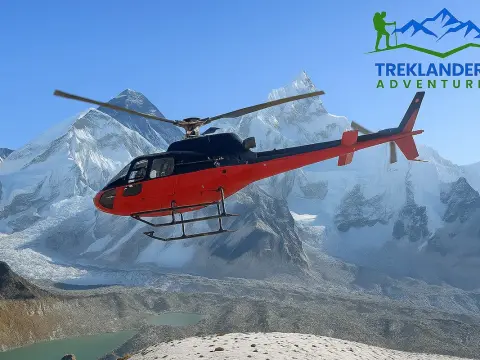
Type of Helicopter: AS 350 B series of helicopters of Euro-Copter, France
popular world-wide and Ecureuil model or similar types.
Stops and Landing: Lukla, Everest View Hotel for breakfast, refreshment,
the main stop at the upper base of Kalapathar Hill.
Maximum Seating: 4-5 passengers with spacious wide seating beside pilot.
Best Seasons for Everest Heli Tour:
The best season for all trip and tour in Nepal, is nearly all year round, except the monsoon wet rainy months of mid-June to August. Where spring season from March to May are the most preferable times for visiting Nepal and all around the Himalayas.
The next best time is autumn / fall from September to November, as well around winter season during Christmas and New Year Holiday also. Most days are clear but cold morning and nights, days are short due to sun-light hours.


My Everest Heli Tour with Treklanders Adventures was one of the most surreal and breathtaking experiences of my life. From the moment the helicopter lifted off, I knew this was going to be something unforgettable, but the views exceeded every expectation I had. Flying over the Himalayas felt like entering another world. The mountains were so close and so massive that it almost didn’t feel real. Seeing Everest, Lhotse, Ama Dablam, and the surrounding peaks from such a unique perspective left me completely speechless. The pilot made sure we had perfect angles for photos, and the commentary during the flight added so much meaning to what we were seeing. Landing near Kala Patthar was the highlight. Standing there, surrounded by towering peaks and complete silence except for the wind, was an emotional moment for me. It’s the closest I’ve ever been to Everest, and I will never forget it. A huge thank you to the Treklanders team for organizing everything seamlessly—from the early-morning pickup to making sure we felt safe and comfortable throughout the tour. They communicated clearly, handled all procedures smoothly, and made the entire experience feel personal and special. If you’re thinking about an Everest helicopter tour, don’t hesitate. It’s worth every second, and Treklanders Adventures is absolutely the team you want to go with. This was a dream come true, and I can’t recommend it enough.

Even though the tour is short, temperatures near Everest can be extremely cold — especially in the early morning. Bring:
The air distance from Kathmandu is approx. 160 k.m. / 100 miles to Mt. Everest and the base camp. Takes more than little one hour with stops to reach near Everest base camp.
Depending upon the seasons, but mostly for all seasons carry a light day pack with necessary items for the morning trip. Wearing warm clothes, down jacket, sun hat and woolen tops, scarf, sun-glass and sun-blocks. On higher altitude the sun is bright with strong UV, needs protection against the bright sunlight.
Wearing boots, or sport shoes, might need to walk for short distance like at Kalapathar hill bottom and at Everest View Hotel. As well some money for refreshment drinks and breakfast at Everest View Hotel.
Mt. Everest straddles the border with Nepal and Tibet / China, the southern Face known as South Col is in Khumbu-Nepal. The North Face located in Rongbuk, Tibet-China.
The present official and standard height as agreed by both Nepal and China is 8,848.86 m or 29, 031.7 feet. From the previous height of 8,848 m, increase of 0.86 m, but some guide books and maps mentions at 8,849 m.
Yes you can carry a packed breakfast, but it will be cold to consume but can carry with you. Enjoy the breakfast wherever the landing spot is on the tour. The price for set breakfast at Everest View Hotel is about US$ 40 per person.
Nearly all year round on a clear morning for views and safe flight. Except for the monsoon wet times of mid-June to August. The best is spring from March to May and autumn / fall starts from September to November. Interested people can enjoy the joy ride during winter times of December till February. But can be very cold in the morning, however most days are fine with sunshine.
The Everest Heli Tour is usually about 3 to 4 hours. The time accounts for the flight from Kathmandu to Lukla, a quick refueling stop, Everest Base Camp sightseeing, landing in the vicinity of Kala Patthar, having breakfast at the Everest View Hotel, and finally flying back to Kathmandu. Though brief, the tour showcases the entire Everest region's topmost highlights, thereby making it an ideal choice of travel for those who have only limited time.
The beginning of the tour is normally between 6:00 a.m. and 7:00 a.m. This is because the weather is usually clear and safe for flying at high altitude early in the morning. Once a staff member comes to get you from your hotel and helps you with the airport formalities, you can expect the flight to take off soon after.
One helicopter may carry 4 to 5 passengers. Nevertheless, the ultimate number depends on the overall weight of the passengers and the weather. To be on the safe side, the pilot may change the places or do shuttle flights if the group is heavy at high altitudes.
The majority of helicopters have large windows with a view in mind. In general, each passenger can have good viewing access through wide windows. The pilot is known to change seats during different parts of the flight so every passenger has clear aerial views.
There is no need for accommodation since it is a few-hour tour. Your hotel will be the pick-up point early in the morning, and after the trip, you will be dropped off. Therefore, the question about Kathmandu tourists and the schedule of the day does not even come up.
Indeed, this is the right choice for people with kids, couples, elderly people, as well as children, and those who may not manage the trekking stage but would like to have a view of Mount Everest. Not a single physical obstacle exists through the travel means; thus, it is the most accessible way to explore the Himalayas.
The Everest Mountain Flight is an early-morning scenic flight from Kathmandu that aims to impress the traveler with the fantastic view of the Himalayan range, including Mount Everest. The idea is to take the Mountain View to the travelers instead of the other way round, which obviously takes a lot of time and requires strenuous trekking. The flight thus helps folks with time constraints and those who might not be physically fit or simply wish to travel in a relaxed manner to see the world's tallest peaks.
The airplane gets very close to Mount Everest so that the views are not only clear but also awe-inspiring. The passengers on the flight are able to identify Mount Everest easily, along with the other peaks, and enjoy a once-in-a-lifetime aerial perspective that is incomparable to any other.
An Everest Heli Tour is maintained with first-rate safety measures, and the tour is also accompanied by skillful and experienced pilots. They only undertake their journey after considering the weather, wind speed, visibility, and the condition of the aircraft. Before takeoff, you will be given safety instructions, and the authorities’ operations are in accordance with international aviation standards.
The helicopter Ecureuil AS350 B-Series / Eurocopter is the one used in the tour. It is a high-performance aircraft produced in France and certified safe by different authorities all over the world for use in mountainous areas. This model is very suitable for extremely high altitudes and is also very stable and strong enough to lift heavy loads; thus, it is the most suitable one for the Everest region.
Yes, the helicopters operating in the Everest region must have oxygen cylinders in case of emergency. The time of highest altitude exposure is very short; therefore, the risk of altitude sickness is very low. Nevertheless, oxygen is available for a passenger who might feel uncomfortable at a higher altitude.
Every time before takeoff and landing, the pilot checks the conditions on the ground, wind direction, and the balance of the aircraft. At high-altitude landing zones such as Kala Patthar, the helicopter is off the ground for a short time only to allow the engine to cool and to ensure the safety of the passengers. Passengers have to obey the instructions of the pilot when getting into and out of the airplane as well as when moving around it.
Most of the travelers are eligible to take this tour safely. The absence of trekking makes it good for children, old people, and travelers with limited mobility. Nevertheless, individuals with serious heart or lung problems are advised to seek medical advice before taking a flight at high altitude.
Most of the travelers are eligible to take this tour safely. The absence of trekking makes it good for children, old people, and travelers with limited mobility. Nevertheless, individuals with serious heart or lung problems are advised to seek medical advice before taking a flight at high altitude.
Pilots operating in the Everest region are top-notch and among the best-trained aviators in Nepal. With long-term training in flying in the mountains, landing at high altitude, and emergency situations, they have gained the required experience through regularly flying this route and are very proficient in dealing with the weather and the terrain of the Himalayas.
Where the terrain is made of shifting glaciers, loose rocks, and unstable ground, no one is allowed to land a helicopter. The noise and vibration from helicopter engines can trigger avalanches or disturb the fragile environment. Apart from safety reasons, landing at Base Camp is also prohibited to protect the environment. A safe landing is made near Kala Patthar, which has the best view of Mt. Everest.
The helicopter lands on a flat, stable area below Kala Patthar (5,250 m) with a view of Everest and other Himalaya peaks like Lhotse, Pumori, and Nuptse. This place is also very famous for the highest Cabinet meeting in the world held by the Nepalese government in 2009.
Yes. The helicopter takes a scenic flight over EBC, giving the passengers a view from the air of the Khumbu Glacier, Icefall, climbing routes, and expedition camps. This is one of the most exciting parts of the whole journey.
Throughout the tour, you will see a series of iconic locations, including.
These stops and flyovers give you a complete view of the Everest region in a short time.
Yes. After the Everest viewing from Kala Patthar, the helicopter is parked at the Everest View Hotel, where you can have breakfast or a refreshing drink. This hotel offers one of the world's highest dining experiences with an unparalleled view of Mt. Everest.
Certainly, In case the total weight of the passengers is too much for a single direct landing at a high altitude, the pilot may decide on a shuttle system through Pheriche. This implies that some passengers are taken in two short flights while the rest of the journey is continued on the ground to ensure utmost safety and aircraft performance at high altitude.
Everest Heli Tour is very pleasant during spring (March–May), and autumn (September–November) as these months have the clearest sky, stable weather, and extremely good visibility of the Himalayan peaks. Kristallklar views can also happen during the winter (December–February), but it is cold.
Winter flights are allowed and generally offer a beautiful, clear view of the mountains because of the fresh, dry air. The landscapes are very attractive because they appear distinct and are snow-covered. The only problem is the temperature at high altitude, but the flight is safe and still comfortable.
Security is the main priority. If weather conditions such as low visibility, strong winds, or fog are met, then flying will be unsafe, hence the tour may be delayed, rescheduled, or changed. Passengers are kept informed, and the flight only takes off when the pilot confirms safe flying conditions.
The Everest Heli tour is, in fact, open throughout the year; however, there are heavy rains and cloud cover that last from mid-June to August, which have an impact on visibility and sometimes cause delays. Travelers should avoid the monsoon if they are looking for clear views.
Flights usually start between 6:00 a.m. and 8:00 a.m. Early morning is the safest and most stable time to fly due to calm winds and clear skies. The morning departures offer the best opportunity to see Everest before clouds form later in the day.
Yes, in most cases. Pilots avoid flying through the clouds and find clear viewpoints. Also, there are usually only small patches of clouds in the Everest region, not full coverage. However, it is not possible to guarantee visibility at all times, and decisions regarding visibility depend on weather conditions at that moment, and safety always comes first.
You are actually going to the highest point at the landing site near Kala Patthar at 5,250 meters (17,224 ft). From this point, Everest is the only mountain that can be seen so clearly and closely; the whole world is talking about it. There is no doubt that Mount Everest Base Camp is at a lower level; however, because from that angle one can practically see the whole of the Everest range, the panorama from Kala Patthar is far better.
A helicopter can only be grounded for a safe and short period of time, so the time during which the machine is stationary is usually between 5 and 10 minutes, weather and engine performance permitting, especially at high altitude. This brief visit is enough time to take pictures and view the surroundings, as well as, of course, get some fresh Himalayan air, all while not putting you at risk of encountering altitude-related difficulties.
The world-famous Everest View Hotel is where you will degust your breakfast or warm refreshments. The meal usually consists of tea, coffee, juice, eggs, toast, or light continental items—all of which can be enjoyed while taking in the breathtaking view of Mount Everest directly in front of you.
Definitely not problems, those helicopters that the tour utilizes have roomy, comfortable seats and are equipped with large windows, specifically for sightseeing purposes. During the course of the tour, the seating layout might be altered so that each individual will have equal access to the window and thus the view of the mountains.
At high altitudes, the temperature can drop drastically, and you may feel cold at the time of landing, even if the interior of the helicopter is kept warm. Hence, it is advisable that you dress warmly in layers, gloves, and a cap so that you can be comfortable even if you are only outside for a very short while.
Sure thing! Taking pictures is what this tour is all about. The big windows and the smoothness of the flight are factors that make photo- or video-taking really easy, and this is what you should expect. There is no escaping the fact that photos and videos can be easily captured while on a flight, for example, Everest Base Camp, the Khumbu Glacier, and the Himalayas.
Just have your gear ready and do what the pilot says if you want to snap the outside of the helicopter.
Though it might be warm in Kathmandu, the weather at the Everest Heli Tour is very cold. High altitude temperatures are very low. So you are advised to wear layered clothes. Thermal underwear, fleece or warm jacket, windproof outer shell, gloves, hat, and comfortable shoes are all good ideas. Dress in layers so that you can regulate your temperature more effectively during the flight.
Definitely not, special trekking gear is not a must. Nevertheless, it is necessary to have sunglasses, sunscreen, lip balm, gloves, a camera or phone fully charged, and a camera or phone. With these things, you stay comfortable, and you can take pictures of the stunning mountains during the tour.
Yes. Nevertheless, it is most advantageous to carry a small and light bag due to the very limited space in the helicopter. It is OK to have a water bottle, your medications, and a camera, but do not take any large backpacks on board if you want to be safe and help with space management.
Though you will be at a high altitude in Kala Patthar, the time you will spend there is so short that you will hardly get altitude sickness. If anyone who has already had altitude sickness wants to be certain, he/she should let the pilot and guide know. In any case, oxygen may be carried on the plane in case of emergencies, and one has to refrain from exercising and strenuous activity at the landing spot.
Passengers are obliged to carry a valid ID, for example, a passport or an identification document issued by the government, when they come to check in at the airport. In addition, if the tickets are secured through a travel agency, bring a copy of the confirmation of your booking as well.
Training or some form of physical preparation is not mandatory. The heli tour to Everest is open to all, regardless of age or physical condition, as it does not include carrying a load or walking up a hill forcibly. Just come when expected, wear warm clothes, and have a great time. This is probably the easiest way of getting close to Mount Everest without spending several days hiking.
Booking your Everest Heli Tour with Treklanders Adventures can be done in a few easy and flexible ways. By visiting our website, dropping a message on WhatsApp, sending an email, or walking into our Kathmandu office, you can book your spot and then leave everything to us. Once you fix your date with our team, they will await you at the airport for the transfers, flight bookings, and the whole tour management.
Absolutely, Treklanders Adventures always looks forward to having a solo traveler on board the Everest Heli Tour. Yes, the tour can be conducted for a single individual, and if the situation allows, we link solo travelers with each other to lower the cost of the journey. Thus, there is no difference in the level of service and support one receives, regardless of being a solo traveler or a group member.
If adverse weather conditions lead to flight cancellations, the helicopter journey will be moved to another day when it is safe to take off. In the event of a change, Treklanders Adventures is responsible for the rescheduling, and they communicate with you all the time. If it is impossible to reschedule because your dates are tight, we will talk about alternative solutions or refunding your money in accordance with the policy and on a case-by-case basis.
Of course, every package for the Everest Heli Tour with Treklanders Adventures entails a breakfast meal or complementary drinks at the world-famous Everest View Hotel. In addition, nothing could be better than the combination of a hot meal and the breathtaking view of Mount Everest.
Yes. Mostly for the helicopter's safety, the aircraft are required to be within a specific weight limit range when flying in high altitudes. In case the total weight of the passengers does not allow a direct landing near Kala Patthar, a shuttle helicopter will come from Pheriche to pick up the passengers at the site. Do not worry; Treklanders Adventures is with you every step of the way, even when the tour is conducted through a shuttle.
The departure time of flights is according to weather and airport clearance and is thus between 6:00 a.m. and 8:00 a.m. A representative from Treklanders Adventures will meet you at the hotel and serve you at check-in. We give handy hints, such as being prepared at least 15 minutes ahead of the time you will be taken from the hotel, to help make the trip a success.
Absolutely, this tour is a dream experience for photographers. The helicopter features large panoramic windows, allowing passengers to capture breathtaking aerial shots of Everest, Lhotse, Ama Dablam, Pumori, and the Khumbu Glacier. Whether you’re using a phone or a professional camera, the Everest Heli Tour offers some of the most stunning Himalayan visuals you can imagine.
Yes, you can take photos during all phases of the tour, including takeoff, landing, and scenic flyovers. However, passengers must follow the pilot’s safety instructions—especially when stepping out near Kala Patthar. The open Himalayan landscape and close-up views of Everest make every moment photograph-worthy.
The seating arrangement is designed to maximize visibility for all passengers. The helicopter’s wide windows provide excellent views from every seat. When possible, the pilot may rotate passengers during stops so everyone gets a fair chance for the best photo angles.
You will have approximately 5–10 minutes at the Kala Patthar landing point. While short, this is enough time to capture dramatic, up-close photos of Mount Everest and the surrounding peaks. The brief stop ensures passenger safety while still giving ample opportunity for unforgettable shots.
Some of the most iconic photography moments include:
These moments produce extraordinary images that stay with you forever.
Yes. Cold temperatures can drain batteries faster, especially at high altitudes. Bringing an extra battery and additional storage ensures you won’t miss any important shots. Also, keep your device warm in your pocket when not in use.
The ground of the Everest Base Camp is located on a fragile glacier that changes all the time due to the movement of the ice. The helicopter landings can harm the delicate environment to the point that it becomes dangerous for rocks to fall from the cliff or for avalanches to occur. Also, the downwash from the helicopters can disturb other climbing expeditions. For this reason, landings are not allowed there, and flights only hover or fly over the camp—protecting both nature and safety.
Treklanders Adventures practices environmentally friendly methods by not staying too long at sensitive high-altitude locations, not producing unnecessary noise pollution, and following all aviation regulations. By landing only at safe and proper places like Kala Patthar, the tour keeps the glaciers, wildlife, and the local people free from pollution. We aim to educate travelers about Himalayan conservation and promote responsible tourism to them.
Sure. The Everest region, or Khumbu, is the area where the Sherpa community lives, and it is also known as one of the most culturally significant areas with its heritage and Buddhism. On the way, you will see many monasteries, prayer flags, and rugged mountain villages that symbolize the spiritual heritage of the Himalayas.
The flight path is well thought out so that it causes as little disruption as possible. Helicopters keep a reasonable height over villages, forests, and wildlife areas so as not to disturb them. They land only where allowed, so local animals are safe from being disturbed, and cultural sites are quiet and undisturbed.
Visitors are encouraged to follow basic cultural etiquette:
These small gestures help preserve the cultural dignity of the Sherpa community.
Definitely, they should not litter and should not take part in activities such as touching the rocks, flowers, or going outside the protected area. High-altitude areas are very vulnerable, and so to protect them, one has to minimize their movements and follow the instructions given. Treklanders Adventures takes the necessary measures to reduce the environmental impact of each tour.
Indeed, the Everest Heli Tour is typically safe for those who have only mild health concerns since it is a no-trekking and no-exercise-required kind of activity. However, patients with severe heart, lung, or high-altitude-related problems ought to ask their doctors for advice before going on the tour. Treklanders Adventures, which is always concerned about the safety of the passengers, urges you to inform them of any health conditions while booking.
A quick ascent to a very high altitude is part of the tour, but the stay there especially at Kala Patthar is extremely brief (5–10 minutes). Such a short exposure to altitude reduces the likelihood of getting altitude sickness. Travelers have to keep a slow pace, refrain from doing any heavy work, and comply with the pilot’s directions when the plane lands, as they are instructed.
Certainly, the helicopters that operate in the Everest area are equipped with additional oxygen that is required in case of emergencies. Even though the bulk of travelers do not need it, oxygen can be delivered straight away if a passenger is in a situation of discomfort or suffers from altitude-related symptoms.
Besides the pilots flying to Everest being very skilled, they are also trained for mountain rescue, emergency landing, and high-altitude scenarios. If there is a sudden change of weather or some health problems, the pilot can lower the altitude to a safe one or go to the closest landing area. Besides that, Treklanders Adventures keeps in touch with the ground teams during the entire flight.
Feeling dizzy, out of breath, or generally uncomfortable, and if such a situation happens at any time, it is necessary to notify the pilot without a doubt. Normally, the symptoms vanish soon after the helicopter is taken to a lower altitude. The airplane has the option of coming back to Lukla or Kathmandu in a short time if the situation requires so, thus ensuring safety for every passenger.
Strictly speaking, there is no limit imposed on age. Kids, grown-ups, and aged people alike can join the tour, provided they can physically withstand a short period at altitude. It is common that families with little children and elderly people travel by air with Treklanders Adventures without any problems.
| No of people | Price per person |
|---|---|
| 2 - 3 | $2,105 |
| 4 - 8 | $1,805 |
| 9 - 30 | $1,715 |
| No of people | Price per person |
|---|---|
| 1 - 1 | $5,000 |
| 2 - 2 | $2,500 |
| 3 - 3 | $1,650 |
| 4 - 4 | $1,250 |
| No of people | Price per person |
|---|---|
| 1 - 1 | $3,000 |
| 2 - 3 | $2,400 |
| 4 - 8 | $2,200 |
| 9 - 30 | $2,100 |