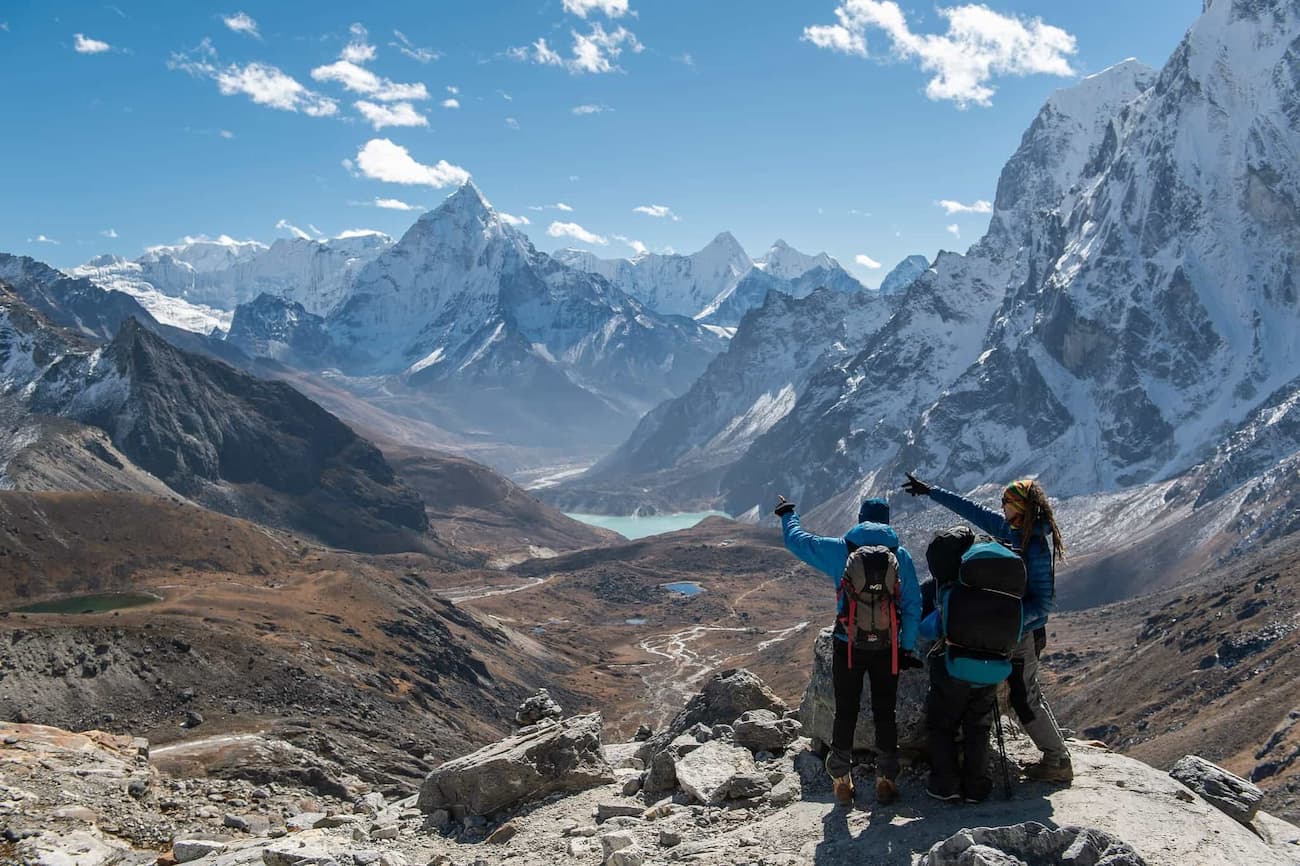
Everest Base Camp via Cho-La pass from Gokyo Valley Trekking an exciting and a great combination. Covering both picturesque areas of high scenic Khumbu valley with the guidance of ‘Treklanders Adventures’.
The first part of the journey leads to high Gokyo Valley, at one time a Yak grazing summer pasture. But due to its amazing and beautiful location, trekkers began to venture around Gokyo valley. A wonderful place and close on route to world’s 6th highest Mt. Cho Oyu and number one tallest Mt. Everest.
Gokyo valley and its serene turquoise colored lakes, located North Central Khumbu, in between high passes of Renjo-La and Cho-La. Where adventurers and trekkers can enjoy traversing over these passes to reach other scenic sides of Khumbu region.
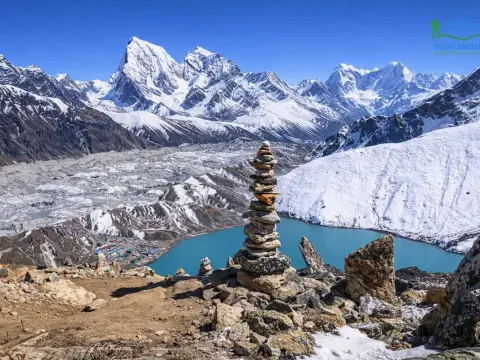
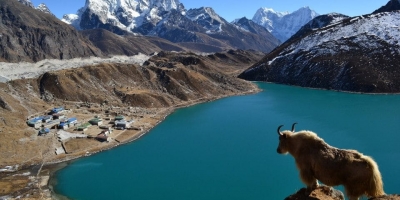
The Gokyo Lake consists of five lakes, the closest is 1st, 2nd and 3rd which is called Dudh Pokhari. Which is the main lake where all nice lodges are situated close to the 3rd lake of Gokyo. The charm and beauty of Gokyo is the lakes and high scenic Gokyo-Ri. From this high ridge offers breathtaking panorama of world’s four highest peaks, namely Mt. Everest, Lhotse, Cho-Oyu and Mt. Makalu.
The views from Gokyo-Ri incudes whole of Gokyo valley and its serene lakes with Ngozumpa glacier; the longest glaciers in Nepal and around the Himalayas.
Everest Base Camp via Cho-La pass from Gokyo Valley Trekking, begins on arrival at Lukla town with an airport. The airport is named in tribute to famous legendary mountaineers Tenzing & Hillary the first climbers to summit Mt. Everest. Walk leads from Lukla on the main trail through nice Sherpa villages festooned with religious monuments of prayer walls. As walk proceeds following the glacial Dudh Koshi River to enter Sagarmatha National Park, listed in World Heritage Sites. The trek follows through cool shade of lovely forest and then on the high trails to famous Namche Bazaar. The major hub of Khumbu and Everest region, an interesting place to experience local cultures and the busy colorful markets.
Enjoying a free day for acclimatization with side hikes to glorious view-points, and then on the road to Gokyo. The route to Gokyo diverts from the main and popular trail of Everest Base Camp, heading due north. An interesting walk with climb into a river gorge covered in dense tree lines, reaching an open exposed country.
The walk leads on high ridges after spending overnights in Dole and Machermo small settlements, then reaching Gokyo valley. Which is the second most popular destinations around Khumbu areas after Everest base camp.
At Gokyo marvel the beautiful surrounding of towering high snow-capped peaks with climb to Gokyo-Ri view-points. After an exciting and marvelous time at picturesque Gokyo Valley; our next adventure proceeds to other sides of Gokyo towards Everest base camp. The walk leads past the lakes reaching end of Gokyo valley at the base of Cho-La pass.
A big day and a long haul to cross over high Cho-La pass, climb leads on rocky boulders and moraines. Finally reaching atop Cho-La, often spelled as Tsho-La, the pass adorned with rock cairns and prayer flags. Enjoy the fabulous views of high peaks that encircles the top of Cho-La pass, facing close look of Cholatse peak.
From the pass a long descend to another summer pasture areas at Dzongla, a small settlement. The route leads to join the main trail towards Everest base camp, walking through Lobuche and Gorakshep settlements.
Then finally adventure takes you on the foot of world’s number one at Mt. Everest base camp. Enjoy the fascinating scenery of remorseless fields of ice and snow with Khumbu Ice-Fall at a mere distance.
On completing the main highlights of the journey, next adventure takes you to steep climb on top of Kalapathar hill. For the hard effort rewards spectacular panorama of giant towering peaks, facing grand closest views of Mt. Everest. Return walk leads on the main trail to Pheriche valley, past Pangboche village with uphill to beautiful Tengboche Monastery. A famous and popular spot for grand views of Mt. Everest and Ama Dablam with arrays of peaks.
The trek continues heading down, and ups to Namche Bazaar; finally walk takes you to Lukla for last overnight. Next morning a sweeping scenic flight brings you back at Kathmandu, after a wonderful adventure and great experience on Everest base camp via Gokyo valley and Cho-La Pass trekking.
Trip Summary:
Mode of Trek: Best available lodge / guest house on treks.
Trekking Grade: Moderate to Adventurous.
Trekking Region: Around high Khumbu and Everest Area.
Start and End of trek: Lukla to Lukla with flights both ways.
Highest elevation: Kalapathar 5,643 m / 18,514 feet and
Everest Base Camp 5,364 m / 17, 598 feet.
Gokyo-Ri 5,357 m / 17, 575 feet and Cho-La Pass
5, 420 m / 17, 782 ft.
Trek duration: 13 Nights and 14 Days from Lukla to Lukla.
Total Trip: 17 Nights and 18 Days, from arrival to departures.
Best Seasons:
The best season for this adventure is on spring time from March to May.
Including autumn/fall begins from September to November, interested people can visit all year round, except for the summer/monsoon time of mid-June to August. Springtime is bright and beautiful, most days are clear with sunny days, can be cloudy afternoons. Bringing cold chill in the late afternoon, and night till morning this is the time when wildflowers are in seasonal bloom.
Expect snow-fall sometimes during spring times, around the high areas on treks.
The next best season is autumn/fall, where days are clear with sunny days for views and walks. But shorter days due to limited sunlight hours, cold morning and night time can expect snowfall sometimes. Winter from December to February with clear sunny days, but cold mornings, late afternoons, and night time with freezing temperatures. But an enjoyable day for pleasant walks with clear views of beautiful scenery. Could get heavy snow-fall sometimes but an adventurous feat to enjoy.
Culture & Religion:
The Everest region of the high Khumbu district is populated by the famous highlanders the Sherpa. The menfolk considered as finest natural mountaineers and expert Mountain Guides. The Sherpa interwoven with the teaching of Buddhism follows an impressive heritage and culture similar to its predecessors the Tibetans. Most villages have monasteries known as Gompa, every house adorned with prayer flags, and prayer monuments.
Please Note:
The flight to Lukla and back to Kathmandu, can get delayed sometimes or might be postponed for next morning. If weather is bad and unfavorable for regular, this is normal, around the Himalayas. On this situations please bear with us, the company will try the best finding other solution to avoid inconvenience to all our clients.
The next important information for all trekkers to Everest and Khumbu region needs to be aware. The flight from Kathmandu to Lukla is diverted to Manthali town airport of Ramechap district. The diversion is made by Nepal Civil Aviation due to heavy air-traffic at Kathmandu international or domestic airport.
This notice applies till further notice from respective Government departments.
Manthali airport of Ramechap located approx. 150 km / 93 miles from Kathmandu, driving distance of 4 to 5 hours. Might need to travel to Ramechap on the second day after international arrival in Kathmandu.

On reaching departure air terminal on landing at Kathmandu / international airport. Our staff and guide receives you for short transfer to respective hotels in the heart of Kathmandu city. After checking into your rooms, getting refreshed join with other members of the treks for group briefing. Provided by our guide or trek leader, briefing includes all important subjects related to the treks, includes information of Kathmandu and hotels. Evening a group welcome dinner in an authentic Nepalese restaurants, an introduction to Nepali meals and cultures.


Morning options for half-day sightseeing tour around Kathmandu world heritage sites of great cultural and historical interest. After the tour free for trek preparation. In case if the flight operates from Ramechap, Manthali town airport. Trek Landers Adventure, will inform for early departure from the hotel to Ramechap airport for Lukla flight next morning.


Flying either from Kathmandu or from Manthali airport at Ramechap, transfer to the domestic airport, having early breakfast. Board on a small aircraft of 25 to 30 minutes to land at Lukla’s Tenzing & Hillary Airport. Lukla town the door to various adventure destination around Khumbu and Everest region.
From Lukla a short day walk of 3 hours or more to reach Phakding village for overnight stop. The walk leads downhill and on gradual pleasant trail through several lovely Sherpa villages adorned with Buddhist monument. Following the Dudh Koshi River to a nice village at Phakding, and checking into a best available lodge.

Enjoy the day from Phakding onwards, morning walk heads higher past smaller villages to cross a long bridge. The climb leads to a nice Monjo village and then at the entrance of Sagarmatha National Park. (The name Sagarmatha for Everest in Nepal, the native Sherpa calls Chomolungma of Tibetan origin language).
From the park to the last village of Jorsalle before Namche Bazaar, possible lunch stop. Afternoon walk following the river bed and climb up to a high suspension bridge, and then on undulating uphill. Taking another few hours to famous Namche Bazaar the capital of Khumbu Sherpa’s, and major hub for trekkers.
All house are in an amphitheater U shaped basin, the size of a town provides great facilities for visitors. As well as for the local also, where once a week a busy colorful Saturday market takes place. Hence the name as Namche Bazaar, arriving on this large settlement check into a nice lodge for two overnight stops

An ideal place with perfect altitude for rest day to support acclimatization before heading higher destination. At Namche enjoy a leisure morning and take a hike around its scenic viewpoints.
Suggested short hike and excursion around Namche Bazaar and beyond:
The short and scenic is short steep climb to Park museum above Namche Bazaar offers grand vista of Mt. Everest. Includes views of Lhotse and majestic Ama Dablam with arrays of snow clad peaks. Visit the park museum provides good interesting information of the Khumbu and its people, cultures and custom.
As well of exotic flora and fauna with history of mountaineering expeditions around Khumbu high mountains.
The next great hike is to Everest View Hotel at 3,880 m, located on a high ridge amidst forest surrounding. One of the world’s highest deluxe hotels offers superb views of Mt. Everest, Lhotse, Nuptse and magnificent Ama Dablam. A walk of 2-3 hours with an hour or more climb and down, overlooking birds-eye views of whole Namche Bazaar.
Rest of the afternoon rest or explore the fancy streets of Namche Bazaar, lined with shops, stores and restaurants. Includes café, fresh bakeries, pubs and bars with backdrop of stunning views of Kwangde Peaks.

After a pleasant and exciting time in Namche Bazaar, walk leads on the main trail for an hour or more. Then our route diverts heading for a steep climb away from main busy trail of Everest base camp. The climb continues till a high ridge at Mong Hill is reached, a small place with few tea-houses and shops. From Mong enjoy grand views of Tharmasarku and Kwangde peaks with Ama Dablam.
A short descent to Phortse Tenga, situated on Dudh Koshi River gorge covered in thick forest of rhododendron and pine trees. Possible lunch stop, in a small lodge restaurants, afternoon walk leads to gradual climb within a narrow gorge.
After few hours of steady climb reaching an open area at Dole, a small settlement with several lodges and guest houses. Overnight in the comfort of a nice lodge, with time to enjoy short stroll around Dole.

Today a short day trek to Machhermo, after breakfast a steep climb of less than hour. Then reaching an open high ridge, a lovely pleasant walk past the settlement of Luza and above Dudh Koshi River. After a good walk of few hours reaching near Machhermo, facing views of Mt. Cho-Oyu towards north.
Enjoying the scenic surrounding views, downhill to a stream with few trees of willow and populous trees. A short climb brings you to Machhermo for lunch and overnight stop, a lovely settlement with few nice lodges.
Afternoon, relax or take a short hike facing views of near Machhermo Peak with back side of Mt. Khumbila, the patron god of Khumbu Sherpa’s.

Morning walk leads to our first highlight destination at Gokyo with beautiful lakes.
A short uphill, and then walk on a high ridge reaching a small isolated place of Panga. Having a refreshing break, continue walk up on stone steps the areas with lush green vegetation and few trees. The climb leads to first and then second lakes, on reaching the last third lakes. Where Gokyo main settlement is situated above the third main lake, also called Dudh Pokhari (Milky Pond).
On reaching the higher side of Gokyo, check into a nice lodge for lunch and overnight halt. Rest of the day enjoy the views of Mt. Cho-Oyu, the 6th world highest peaks, straddles the border of Nepal and Tibet / China.

An early morning hike before breakfast, walk leads across the shore of 3rd lake, then steep climb starts. Continue uphill walk on grassy slope sided hill, after a tough climb reach on top at Gokyo-Ri. Take a rest and enjoy the breathtaking panorama of world’s four highest peaks, overlooking Mt. Everest, Lhotse and Makalu with Mt. Cho-Oyu. Includes series of snow-capped peaks that surrounds the Gokyo valley and Gokyo-Ri hill top. The view of Gokyo valley and the lakes with Nepal’s longest Ngozumpa glaciers is clearly seen from Gokyo-Ri.
After a refreshing morning hike, down to Gokyo for breakfast and lunch, afternoon a short walk to Thagnak for overnight stop. Located at the far eastern end of Gokyo valley at the base of Cho-La Pass.

A big day of the adventure and one of the main trip highlights, start the morning early carrying packed lunch. Follow our expert guide scrambling on rocky uphill path and over moraines of rocks, heeding slowly as altitude gains.
After few hours of steady climb reaching on top Cho-La Pass marked with rock cairns and Buddhist prayer flags. For all the tough effort rewards you with a grand vista of an array snow-capped peaks. Enjoy close views of Cholatse and Lobuche East, West peaks with Nirekha as far towards Mt. Cho-Oyu.
From the pass a slow and safe descend to the bottom of the pass, reaching a flat ground. A short hour of good walk reaching Dzongla for overnight stop, on completing the first phase of the adventure.

From Dzongla onwards on nice and easy walk reaching the main trails to Everest Base Camp. The walk leads to slow ups to Lobuche for overnight stop, located on the corner of a wide grassy field. Lobuche with number of nice guest houses and lodges, facing views of Lobuche and Nuptse peaks.

An exciting trek in the morning towards our last final highlight destinations of the adventure. Walk follows on gentle path with few ups reaching rocky moraine areas above Khumbu glacier. After few hours of good morning walk reached Gorakshep, situated at the bottom of famous Kalapathar rocky hill.
Gorakshep the last settlement of Khumbu area on route Everest and Lhotse base camp. Following the trail towards east on well-defined path for an hour and then the last leg of the hike. The walk continues over moraine of ice and glaciers to Everest base camp. Enjoy the dramatic scenery of arctic like landscapes enclosed by towering peaks of Lhotse, Nuptse and Lingtrin. The views of Mt. Everest is obstructed by adjoining peaks, however an amazing place to experience.
Overlooking close views of massif Khumbu Ice Fall as it tumbles down near the foot of Everest at base camp. From the base camp return walk back to Gorakshep for overnight stop.

Great options and opportunity for last steep climb and hike to the top of Kalapathar. The highest point of the adventure, start early morning heading towards at the base of Kalapathar. As climb begins heading higher and higher on steep slope then reach a rocky hill top of Kalapathar. One of the best view-points in all Himalayas for the closest looks of Mt. Everest at a stone throw distance.
Enjoy the tremendous panorama of giant peaks with close views of Mt. Everest, Lhotse, Nuptse and Mt. Pumori. After a refreshing morning hike head downhill to Gorakshep for breakfast, and getting ready for a long day walk to Pangboche village. The trail follows on the same route past Lobuche, reaching Thugla, where route of Dingboche and Pheriche meets. Our route leads down to Pheriche valley and reaching the nice settlement with many lovely lodges and resorts. Possible lunch stop at Pheriche, a place where HRA (Himalayan Rescue Association) Post is located. From Pheriche walk down to a river and then up to a small hill top, and then on easy downhill to Pangboche village for overnight stop.

Morning starts with easy descent to a bridge, and then climb towards Tengboche Monastery. One of the most picturesque spot surrounded by snow peaks amidst lovely forest with impressive monastery. Having time for short tour of the monastery interior, and then continue downhill to Imjatse River. A slow steady climb for an hour past Sanasa village, and then on easy winding trail reaching the junction. The point, where route of Gokyo, Khumjung and Everest base camp branches off. From here few hour walks to Namche Bazaar for overnight halt after a tiring long day treks.

Last day walk of the adventure, enjoy the pleasant walk downhill to Dudh Koshi River valley. A nice walk to Jorsalle crossing a bridge with short steep climb to the entrance and exit gate of Sagarmatha National Park. Walk continues past Monjo village heading towards Phakding for lunch stop. Afternoon few hours of good walks with last hour climb to reach Lukla. Arriving by late afternoon with ample time hang around and to enjoy the last dinner celebration with fellow members and trekking staff.

Early morning transfer to Lukla’s Tenzing and Hillary airport as the plane arrives either from Kathmandu or Ramechap. Board in a small aircraft of respective airlines for sweeping panoramic flight back to Kathmandu. Then get transferred to your hotel, with afternoon free at leisure.
If the flight lands at Manthali airport in Ramechap, our staff transfers you to a vehicles. A drive of 4-5 hours brings you back at the hotel in Kathmandu, after a great adventure on Everest base camp via Gokyo and Cho-La Pass Trekking.

Enjoy an extra day in Kathmandu, we have reserved as contingency day in case of flight delay and cancellation. Due to unfavorable bad weather condition, if all goes well according to our itinerary days, have a great enjoyable day.
For individual activities or get into shopping spree, interested people can join for another interesting tour of other cities of Kathmandu valley. Sightseeing around Patan / Lalitpur or the famous Bhaktapur city Durbar Square, worth a visit.

After an enjoyable and most mesmerizing adventure in Nepal and around the Himalayas on Everest base camp via Gokyo and Cho-La Pass Trek. As time for departure, our staff transfer you to international airport for flight homeward bound or to next port of call.
My Everest Base Camp via Cho La Pass trek with Treklanders Adventures was absolutely unforgettable. This route through the stunning Gokyo Valley offered everything I had imagined about the Himalayas—quiet trails, turquoise lakes, panoramic viewpoints, and the thrill of crossing a high mountain pass. From the very beginning, the team made everything smooth, safe, and enjoyable. Gokyo Lake and the climb to Gokyo Ri were among the most beautiful moments of the journey. Standing above the lakes with a full 360° Himalayan view—including Everest, Lhotse, Makalu, and Cho Oyu—felt surreal. Crossing the Cho La Pass was challenging but incredibly rewarding, and our guide ensured we moved safely and confidently throughout the icy sections. Reaching Everest Base Camp after days of adventure through valleys, ridges, glaciers, and remote Sherpa villages felt like a dream come true. The entire trek was well-organized—our guide was knowledgeable, friendly, and highly experienced, while the porter was hardworking and always supportive. The teahouse accommodations, meals, and daily planning were all handled perfectly by the Treklanders team. This trek is ideal for anyone looking for both beauty and adventure, and I’m grateful to Treklanders Adventures for making it one of the best experiences of my life. I highly recommend this company to anyone planning a trek in Nepal—they truly go above and beyond.
Purpose: Keep sweat off the skin and maintain warmth.
Purpose: Trap body heat in cold air at altitude.
Tip: Keep electronics in inner pockets at night to prevent freezing.
As this trek is more of an adventurous of two weeks duration, where all trekkers needs to be physically fit and in sound health to cope with ups and downhill walks. Rest of the walks is normal spending overnights in a nice lodge with comprehensive food menu to enjoy. Trekkers of minimum 18 years of age to maximum of 70 years old can join on this wonderful adventure.
Nearly all villages and lodges have electricity with Hydro or Solar power, where one can charge their electronic items. Where client needs to pay an extra fee for using the power as per gadgets charged. As for internet and cell phone communications, every lodges have the Wi-Fi and internet services, but can be quite disturbing sometimes due to weather and location wise.
From Lukla onwards to Gokyo one can enjoy the comfort of nice lodges and guest house. As well with warm traditional hospitality in every overnight stops, people can choose from budget, standard to luxury lodges where available.
The foods are well served in a large cosy dining hall, can choose various items of foods from the menu with wide range of meals and snacks to choose from.
Serves Continental, Chinese, Indian, Tibetan and Nepali foods, as well Mexican, Italian, Korean or Japanese in some lodge restaurants. Includes fresh bakery products also.
It is the second best and popular trek around high Khumbu and Everest region. Besides direct routes to Everest base camp, most trekkers visits just Gokyo valley and returns via different easy alternative trails. Instead of crossing Cho-La pass to reach Everest base camp. Few trekkers traverse over three passes covering whole of Khumbu including Gokyo and Cho-la pass.
As season wise with flow of visitors to Lukla and vice versa from Kathmandu.
During high times of trekking season, the flight to Lukla and back can be quite busy. Where more than 20 flights operates in a fine clear day, which cause air traffic with the international and other domestic airlines. To make the air traffic lighter, the flight to Lukla from Kathmandu is diverted in Manthali airport at Ramechap district. Which is about 150 k.m driving distance of 4 to 5 hours, the flight from Ramechap to Lukla is just 20 to 25 minutes. Which makes it easier and quicker before the bad weather closes in. For further updates the company will inform all the clients flying to Lukla joining with Trek Landers Adventures.
This trek is the riskiest and most exciting trail that links the scenic Gokyo Lakes with crossing the well-known Cho La Pass and following the classic route to Everest Base Camp. It basically has everything with magnificent panoramas of Everest, Lhotse, Makalu, and Cho Oyu while acquainting trekkers with Gokyo Valley and the Khumbu Valley in just a single trip.
The majorities of the plans are between 15 and 18 days and are dependent on the individual’s walking speed, acclimatization days, and weather conditions. The Treklanders Adventures can make a time duration change to suit you.
The answer is yes to some extent; it is quite a tough and potentially dangerous hard-to-very-hard type of challenge caused by the steep ascent of Cho La Pass (5,420m) and the icy, rocky terrain. Being in good shape, having strong willpower, and acclimatizing properly are your best allies.
Anyway, knowing beforehand how to trek at altitude is better, but a beginner, if he is very fit and takes good preparations, can still do the trek and be safe with the help of a guide.
The main highlight of this trek is the combination of Gokyo Lakes, Gokyo Ri viewpoint, the heart-breaking Cho La Pass crossing, Everest Base Camp, and Kala Patthar sunrise views. At the start, it gives you the advantage of fewer crowds compared to the standard EBC route.
The best times are spring (March–May) and Autumn (September–November) as the weather during these periods is very stable, and the pass can be crossed safely. In winter, there is a lot of snow, which makes the pass unsafe.
First of all, the highest point is Kala Patthar (5,545m), followed by Cho La Pass (5,420m) and Everest Base Camp (5,364m).
Of course, nice tea houses can be found anywhere along Gokyo Valley and the EBC trail. However, places to stay around Cho La Pass (like Dzongla) are not so good and are very basic.
Several permits are mandatory, including those for Sagarmatha National Park and Khumbu Pasang Lhamu Rural Municipality. Treklanders Adventures will take care of all your permits.
Charging your devices is possible, but comes with an additional fee in most locations. So it is also good to have a power bank along with you.
You should prepare for quite low temperatures at high altitudes, and that is especially true around Cho La Pass. Also, days are mostly clear during the two main trekking seasons, but mountain weather can deteriorate quickly.
Yes, to be more specific, Cho La Pass is an extremely difficult, very high, and very steep pass with climb sections, ice-covered stretches, and sometimes areas of snow that are hard to walk on. For sure, things like crampons, warm coats, and a walking stick must always be with you.
It is a challenging and strenuous trek, as it combines steep ascents, long trekking hours, high altitude, and a technically difficult crossing at Cho La Pass. This trail follows the glacier and rocky terrain, which are not part of the standard EBC route; hence, it requires more effort and stability. Strong physical fitness and mental toughness are a must for the trekkers.
Cho La Pass is at 5,420 meters and involves a steep, sometimes icy and slippery climb of the path. There is a glacier to cross in the upper section, which can be difficult if one doesn't have the right equipment, such as crampons. The weather can also change very quickly, and snow or strong winds can make the pass difficult to negotiate. If you have a guide and the right gear, you can do it, but it is still a hard one.
It is not a must, but it is greatly advantageous. High altitude experience will help your body to acclimatize better and give you the confidence to handle steep and technical sections. On the other hand, first-timers can also finish the route if they are well-trained, follow acclimatization instructions, and have a licensed guide with them.
On most days, 6 to 8 hours of walking is required, which is largely dependent on the altitude and the nature of the terrain. The day on Cho La Pass is the longest one, and it usually takes 8 to 10 hours, including the ascents, descents, and the glacier crossings. Good stamina is necessary in order to be able to complete each day in a comfortable manner.
On most days, 6 to 8 hours of walking is required, which is largely dependent on the altitude and the nature of the terrain. The day on Cho La Pass is the longest one, and it usually takes 8 to 10 hours, including the ascents, descents, and the glacier crossings. Good stamina is necessary in order to be able to complete each day in a comfortable manner.
Those who trek should be very fit from a cardio point of view, have good coordination, and strong legs. If one regularly goes for hikes, does cardio exercises, and muscle trains before starting the trek, one will be much more comfortable and successful on the trail.
Besides the strong recommendation for a licensed guide to be with you safety-wise, to lead you on the track, and for help during the Cho La Pass crossing, Treklanders Adventures can offer you skilled guides who know the local area.
Yes, a licensed trekking guide is highly recommended to be with you, especially when you are heading for the Cho La Pass. The route entails steep climbs, glacial areas, and very quickly changing weather. Therefore, a guide makes sure you are following the right path, going at a safe pace, and managing your altitude properly.
The guide leads the way, takes care of your daily routine, checks on your health and acclimatization, makes arrangements for the places to stay and food, and ensures your safety in difficult parts of the trek. In addition, they give you interesting cultural facts, handle communication with tea houses, and give support when you are going through hard moments on the trail.
Yes, porters can help you with your luggage, which is normally around 15-20 kg combined for two trekkers, depending on the regulations. With their help, you can save energy, have a comfortable walk at high altitude, and go through long trekking days without getting too tired.
The guides are normally good in English, and they are trained in giving clear communication regarding the condition of the trail, the plan for the day, and the safety instructions. Porters may know a little English, but they understand essential trekking terms and instructions.
Companies providing trekking services, such as Treklanders Adventures, make sure that their guides and porters are well-equipped, appropriately dressed for high altitude, and are insured. This puts them in a safe condition and takes care of their well-being during the whole journey.
There is a possibility, as the trek usually attains very high places. However, if you drink a lot of water, walk slowly, and follow a good acclimatization schedule, you should be safe from AMS.
Altitude sickness, as a matter of fact, is the main concern because the trek goes beyond 5,000 meters at least several times. Those who trek should follow this regimen: ascent slowly, take acclimatization days, drink a lot of water, and look out for symptoms like headache, vomiting, and dizziness. The correct pacing is of the utmost importance.
Guide your symptoms and report them to your guide as soon as possible. Hydration, rest, and fresh air are the very first things to do after recognizing these symptoms. If the condition deteriorates, it will have to be a descent to a lower altitude. Treklanders Adventures guides have skills and knowledge that allow them to track symptoms and decide the next step at any time of the trek.
Almost every tea house provides Wi-Fi that you can get if you pay for it, but the service can be very weak if you are close to the high pass or other cold places.
Some mobile network coverage can be found in the likes of Lukla, Phakding, Namche Bazaar, and Dole. As you move up to Gokyo, Dragnag, Dzongla, Lobuche, and Gorak Shep, the network becomes weak, unstable, or sometimes there is no coverage at all. Near Cho La Pass, in general, no connection is available.
Ncell and NTC (Nepal Telecom) are both possible choices in some areas of the Everest region. For the most part, Ncell provides better service in the villages down the valley, and NTC might work better in the upper settlements. But still, in Gokyo, Cho La Pass, or Gorak Shep, there is no need to expect good coverage from these two networks.
Indeed, almost every lodge has paid Wi-Fi services called Everest Link or Airlink. The link is often good in the valleys, but at a high place like Gokyo, Lobuche, or Gorak Shep, it can be quite slow and unstable due to bad weather and limited power.
The prices for Wi-Fi set vary with altitude. Thus, in the low areas, the cost is around USD 3–5, while in the upper places it can be as much as 5–10 USD per card or per session. The speed is sufficient for text-based communication, but it is not an option if you want to do heavy browsing or video calls.
Of course, charging is available in most tea houses for an extra fee. When you move to a higher place, the price will go up because there is less electricity, and they mainly use solar power. It would be very helpful if you have a power bank (10,000–20,000 mAh).
The months when one could most likely and safely accomplish crossing the Cho La Pass are April, May, October, and November. During these times, the weather is usually good, the sun is out, and the snow level in a pass is considerably lower compared to the cold season. Spring (April–May) to be exact, sees the temperature rising gradually, getting the trail handier, and snow gradually melting, reducing the risk of people slipping on ice. Whereas in fall (October–November), the monsoon has practically rinsed off dust and haze, resulting in the clearest of mountain views. Also, these months give weather conditions that are easier to predict, thus making the high pass safer and more manageable for trekkers.
It is, however, not advised to do so. The winter pack is characterized by heavy snowfall, extremely low temperatures, and the formation of ice on the slopes. All these factors make the pass crossing a hard and risky task. Oftentimes, trails get covered with snow, and consequently, route markers are buried, thus increasing the risk of losing one's way. The Cho La glacier part gets very unsafe, and there are some days when the pass is not accessible for a few days following heavy storms. Only extremely experienced mountaineers who have the right winter gear and are supported may give it a go.
Certainly, spring has everything which is necessary for a wonderful Gokyo Valley and the Cho La Pass trek, i.e., warm days, blooming rhododendron forests, steady weather, and clear mornings.
Yes, indeed. The best and most vivid Himalayan views, the driest trails, and the most comfortable temperatures of the year are the highlights of the great autumn season, which thus attracts the highest number of trekkers and sees them at their busiest and most scenic time.
Although trekking is possible, it is not advisable. During monsoon months, heavy rains occur, and generally, we may find cloudy skies, slippery trails with the consequent risk of falling, and poor visibility. Due to wet ice and frequent storms, the Cho La Pass could be risky.
The cleanest and sharpest of the Himalayan views are what make fall season photography optimal, while the lush green hills and the blooming, colorful rhododendron forests make the spring season perfect for vibrant landscape shots.
On this trek, the accommodation is offered in tea houses, which are modest family-run lodges that provide basic rooms usually with twin beds, blankets, and very basic furniture. Even though they are not luxurious, they are still warm, relatively clean, and comfortable enough to stay in while trekking in the Everest region. The facilities depend on the village and altitude.
Generally, most rooms are twin-sharing, that is to say, two trekkers share one room. Phakding, Namche, and Gokyo are the lower regions where you can get single rooms, but they might be limited or not available at all during peak seasons or in places with high altitudes, especially close to Cho La Pass and Everest Base Camp.
There are attached bathrooms in the lower-altitude areas like Lukla, Phakding, and Namche Bazaar. Meanwhile, going higher towards Gokyo, Dragnag, Dzongla, Gorak Shep, and Lobuche, one can find rooms with shared bathrooms, most of the time outside the room. If a hot shower is offered, it could be for an extra charge.
Hot water is available, but it comes at a cost. Tea houses provide bucket showers or gas/solar-heated showers at extra rates. In the case of very high-altitude places like Dzongla or Gorak Shep, hot showers are rarely available, and if they are, it is mostly during the warm season.
Yes, tea houses offer blankets, but at high altitudes, they might not be sufficient in terms of warmth. Thus, it is advisable that each person carry a sleeping bag rated between -10°C and -15°C for additional warmth. Treklanders Adventures is willing to provide you with a sleeping bag if you require one.
Apart from the dining hall, which has a central stove, the rooms are mostly without any heating facilities. The stove can be operated by yak dung or gas and is the main source of heating in the dining hall. Wearing layers of clothing during the day and using sleeping bags at night are some of the ways trekkers keep themselves warm.
Along the provision path, we meet tea houses prepared to serve us plenty of different foods of different natures, from immediate Eastern and Western foods to local, typical Nepali dishes like Dal Bhat. And Dal Bhat is understandable why, because it is the most nourishing of all and also the limitless one, so it's the best choice for long trekking days. The frequency of meals becomes minimal above, yet food is still fresh and clean.
Yes. Such food in the Everest region is generally prepared in good hygienic conditions, particularly in well-established tea houses located on the Gokyo and EBC routes. Treklanders Adventures makes a selection of lodges that are trustworthy and keep up with safety and cleanliness, yet also have cooking methods. However, to stay away from stomach troubles, travelers are advised not to eat raw salads and only consume hot and freshly cooked meals.
Definitely So! The Everest region is a very vegetarian-friendly place, as the locals barely eat meat in the high altitudes. Thus, the supply of vegetarian, vegan, egg-free, and dairy-free meals is never a problem. At higher altitudes, proteins may become a scarce commodity, so nuts, protein bars, and other snacks can be a good take-along option to solve the problem.
The recommendation is to only drink tap water that has been purified. At tea houses, water, which is distilled and ready for consumption, can be bought, or water can be purified by tablets, drops, or bottle filters. This is the most convenient way and also the most earth-friendly.
Yes, bottled water is available for most villages, but you will pay more as the altitude increases, and it will add to plastic pollution. Treklanders Adventures is promoting the use of refillable bottles together with purification.
Once a day, a trekker should consume about 3–4 liters of water to keep healthy and avoid altitude sickness. The correct and necessary hydration has to be taken care of when one is to cross any high-altitude area, such as Gokyo Ri, Cho La Pass, and Gorakshep.
For this trek, you should have only two major permits: the Sagarmatha National Park Entry Permit and the Khumbu Pasang Lhamu Rural Municipality Permit. These are the only permits that are compulsory for the region of Everest and the areas of Gokyo Valley and EBC that the two permit zones cover.
You can procure this permit either in Kathmandu from the Nepal Tourism Board office or at the entrance to the park in Monjo. Most trekkers obtain the permit at Monjo while going to Namche Bazaar. Treklanders Adventures, your trekking agency, could also do this for you.
The Khumbu Rural Municipality Permit is granted at Lukla and is a must for anybody going into the Khumbu area. The money collected through this permit is used for the promotion of local tourism and trail maintenance. It is the only identification that is compatible with Everest treks now, after the UI
There is no need for an additional permit just for Cho La Pass. The two main permits, i.e., Sagarmatha National Park and Khumbu Rural Municipality, are sufficient for your trek in sections that include Gokyo Valley, Cho La Pass, and the Everest Base Camp route.
Indeed, it is a must. Along your route, you will come across checkpoints in places such as Lukla, Monjo, Namche, Dole, Pangboche, Dingboche, Lobuche, and Gorak Shep. Officials may decide to check your permits at any time.
Certainly, Treklanders Adventures is all in for you when they take care of your permits, giving you the comfort of the completion of all paperwork, photocopies, and formalities before your departure.
It is very important to have layered clothing in your luggage, which must include your base layers, fleece jackets, a warm down jacket, waterproof jackets, trekking pants, thermals, gloves, hats, and good trekking socks. The layering system will enable you to adjust to different temperatures in the valleys as well as on the cold high passes like Cho La.
You need a pair of strong, well-worn waterproof trekking boots commonly used for rocky trails and with good ankle support, especially for icy sections near the Cho La Pass. You can also bring light shoes or sandals for tea house evenings.
Certainly, the pass is usually covered with snow or ice most of the time, hence microspikes or crampons, trekking poles, and warm gloves are very necessary. Also, depending on the season, sunglasses with UV protection, a buff, and gaiters can be useful.
A 30–40L daypack is just right for your daily necessities such as water, snacks, a camera, gloves, and jackets. Your porter will have the larger duffel bag with him. Ensure your daypack is equipped with a proper hip belt and a rain cover.
Don’t forget to bring along the following: sunscreen, lip balm, personal medications, a simple first-aid kit, hand sanitizer, wet wipes, toiletries, and a reusable water bottle with purification tablets or a filter. Headlamps with extra batteries are a must for the very early morning walks.
Training for your trek should commence not later than 6–8 weeks before the day. You should primarily be doing cardiovascular exercises such as hiking, running, or cycling, and strength exercises for your legs and core. Wearing a backpack while walking will help improve stamina. Proper preparation is a great factor in achieving both comfort and success in high-altitude treks like Cho La Pass and EBC.
Most backpackers typically start their journey with a plane ride from Kathmandu or Ramechhap to Lukla, which is considered the main hub of the Everest region. After Lukla, the trek continues passing through Phakding, Namche, and eventually the trail branches off toward the Gokyo Valley.
No, Lukla flights are in the hands of the most qualified and experienced Himalayan pilots. They undergo numerous training sessions for landings in the mountains. Weather is taken into consideration to the minute, and the planes are loaded only when visibility and wind conditions are good.
Yes, postponements and cancellations are often due to the weather conditions that are hard to predict in the mountains. In case of flight disruptions, trekkers might have to wait for more favorable weather or, if it is an option, take a helicopter. It is always good to have some extra days for unforeseen events in your itinerary.
One may take a helicopter from Kathmandu to Ramechhap or to Lukla and vice versa. Generally, it is done when flights are canceled or during heavy traffic periods. Helicopters are less affected by bad weather, but must also have clear visibility to be safe.
Almost all trekkers come back via the traditional trail from Gorak Shep to Lukla and then get a flight to Kathmandu. Some have the luxury of being picked up by a helicopter from Gorak Shep for a faster way back, especially after a tiring day of trekking.
Absolutely, Treklanders Adventures takes care of everything, starting from airport pickups, domestic flights, and helicopter (if required) to all the necessary ground transportation before and after the trek, thus giving you the comfort of a fully organized and stress-free journey from the beginning till the end.
It is one of the serious health problems that have to be focused on because the path leads to several places whose altitude changes drastically, such as Gokyo RI, Cho La Pass, Lobuche, Gorak Shep, and Everest Base Camp. Intense head pain, vomiting, dizziness, and weakness are some of the signs that can be detected. Acclimatize well, keep your paces slow, drink enough water, and follow your guide's instructions, and soon you will be out of danger.
It is necessary that the cardio endurance and leg muscles are in good condition and that the subject is physically strong and has good stamina. Trekking is of long duration, with steep and rocky or sometimes icy trails as the hardest part. Preparing for the trek with hikes, cardio workouts, and strength training will not only make it safe but also comfortable.
Cho La Pass can be considered safe if the weather is stable and you are properly equipped with items such as trekking poles, microspikes/crampons, and warm clothing. The route may become dangerous if snow or strong winds prevail. Your guide will check the weather and decide when it will be safest to make the crossing.
Definitely, Treklanders Adventures ensures safety through trained and experienced guides, first aid kits, well-planned acclimatization, continuous health monitoring, and communication devices such as satellite phones or walkie-talkies.
Some primary medical facilities are available in Namche Bazaar, Khumjung, and Pheriche. Limited high-altitude medical clinics are open only during the peak seasons. In case of emergencies, evacuation can be facilitated without delay.
Yes, travel insurance is a must for this trek. Since the path is in a high altitude area with glaciers and can be subject to inclement weather, your policy should cover trekking up to 6000 meters, a medical emergency, and also a helicopter evacuation. In case you suffer from altitude sickness or there is any other unforeseen incident, having the right insurance will guarantee your safety and support.
Your insurance must provide coverage for high-altitude trekking, a rescue helicopter in an emergency, medical treatment, and trip cancellation. Some policies may exclude trekking above certain altitudes, so make sure it explicitly covers the elevation of Gokyo RI, Cho La Pass, and Everest Base Camp. It is also a good idea to carry a copy of your insurance with you on the trek for quick access in case of an emergency.
| No of people | Price per person |
|---|---|
| 1 - 1 | $2,060 |
| 2 - 3 | $1,635 |
| 4 - 8 | $1,515 |
| 9 - 30 | $1,405 |
| No of people | Price per person |
|---|---|
| 1 - 1 | $2,060 |
| 2 - 3 | $1,635 |
| 4 - 8 | $1,505 |
| 9 - 30 | $1,405 |
| No of people | Price per person |
|---|---|
| 1 - 1 | $2,435 |
| 2 - 3 | $1,875 |
| 4 - 8 | $1,745 |
| 9 - 30 | $1,635 |