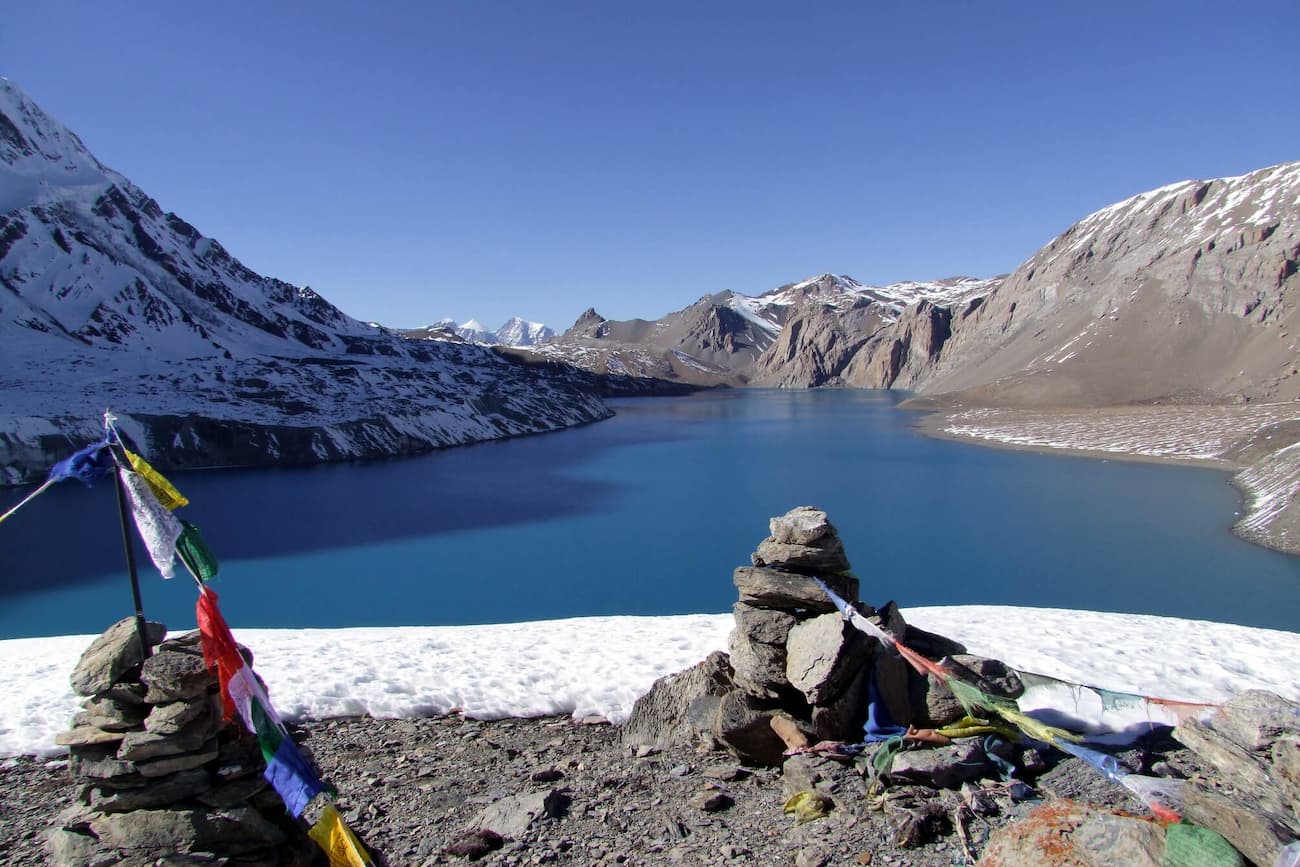
Tilicho Lake Base Camp Trek is an amazing adventure where the walk leads beyond the scenic Manang Valley. Heading off the beaten path around remote far flung corners of Manang's southern windswept country with sheer mountain wilderness.
Located at an altitude of 4,919 m / 16,138 feet high considered Nepal’s and the world's highest lakes. But recently a new and unexplored area within Manang close to Lamjung Himal, a lake has been discovered by explorers.
The newly found lake known as Kajin Sara at 5,200 n high and 83 m higher than Tilicho Lake. Nevertheless, Tilicho still retains the world's highest lakes, where hundreds of trekkers venture every season as a side trip. The Tilicho Lake is combined with the famous and popular Annapurna Circuit Trek, the trip to Tilicho Lake as an extension. Before heading towards Thorang-la pass or traversing Mesokanto-La Pass, southwest of Tilicho areas to reach Jomsom town in Mustang district.
Tilicho Lake Base Camp Trek leads to incredible scenery where one feels and experiences as out of this world. The Tilicho Lake is also regarded as a holy site for the Hindu religion, which is mentioned in the Ramayana Epic. Adventure to Tilicho Lake Base Camp and its beautiful surroundings is one of the best adventures.
Where one can enjoy the thrills of pure wilderness, around its pristine environment, although a desert-like appearance. But engulfs you with its magnificent picturesque surroundings of high snow-capped peaks with great contrast with brown rocky landscapes terrains.
Tilicho Lake Base Camp Trek begins with interesting long drives to reach the starting point of the trek at Dharapani village. A nice mountain village located at the junction of the Manaslu and Annapurna Circuit trekking routes within the Manang district. The trail leads on a gradual wide path through lovely woods of pine and rhododendron trees. Enjoy the views of Annapurna IV and III past villages of Bagarchap and Danaque with apple orchard farms. Then reaching the big town of Chame, the headquarters of the Manang area, as the walk progresses towards the high country of Manang.
The trail leads through Pisang village to enter a wide and scenic Manang Valley, surrounded by a high mountain range. Overlooking views of Annapurna Himalayas in the south with Chulu’s and Pisang peaks towards the north.
A beautiful walk as the snow peaks follows you to the main Manang village after visiting the old monastery of Braga. Manang is a perfect altitude for acclimatization and enjoying a rest day, before heading towards Tilicho Lake Base Camp. It is also a great place to explore scenic viewpoints and its traditional villages adorned with the ancient cultural heritage of Buddhism.
From Manang adventure leads towards our main highlight to Tilicho Lake Base Camp and its dramatic landscapes. Leaving the main popular trail of Annapurna Circuit walks leads to remote parts of southern Manang. Finally reaching our main highlight destination at Tilicho Lake Base Camp, where the hike leads to beautiful Tilicho Lake. A spectacular place in the Western Himalayas, enclosed by staggering snow-capped peaks of Gangapurna Himal, Tilicho, and Nilgiris peaks.
After a mesmerizing moment walk leads back on the same scenic route to join the Annapurna circuit trail. Following the high path to the base of Thorang-La pass and then having a rest at High Camp. The next early morning a big climb to the top of Thorang-La pass, standing on the highest point. Facing overwhelming views of mountains that encircle the top of Thorang-La, overlooking towards massif Annapurna and Dhaulagiri Himalayan range. Includes views of Chulu’s and Damodar Himal as far towards Manaslu Himal in the Far East direction.
Slowly the walk heads to a long descent reaching around the Mustang area at the holy site of Muktinath. Revered as a sacred pilgrimage for Hindu followers, from Muktinath, the walk leads towards Kaligandaki River valley to reach Jomsom town. From Jomsom enjoy a short, scenic flight to land at scenic Pokhara and close to its serene Phewa Lake. Pokhara is a most popular and renowned tourist destination for all types of adventure holidays around the Mid-West Himalayas.
A perfect place to conclude our marvelous experience on Tilicho Lake Trek.
After a great time around the high mountains, valleys, and hills of the Annapurna Himalayas.
Trip Summary:
Mode of Trek: Best available lodge / guest house on treks.
Trekking Grade: Moderate to Adventurous.
Trekking Region: Around Manang district Northern side of Annapurna’s.
Start and End of trek: From Dharapani to Jomsom and Pokhara with drive.
Highest elevation: On top Thorang-La Pass at 5,416 m /17,697 feet high.
Trek duration: 13 Nights and 14 Days with drives.
Total Trip: 18 Nights and 19 Days, from arrival to departures.
Best Seasons for Tilicho Lake Base Camp Trek:
The best season for Tilicho Lake Base Camp Trek is late spring April and May. Including autumn/fall begins from September to early November.
Springtime is bright and beautiful, most days are clear with sunny days, can be cloudy afternoons. Bringing cold chill in the late afternoon, and night till morning this is the time when wildflowers are in seasonal bloom.
The next best season is autumn/fall, where days are clear with sunny days for views and walks. But shorter days due to limited sunlight hours, cold morning and night time can expect snowfall sometimes. But an enjoyable day for pleasant walks with clear views of the beautiful snow mountain range.
Culture & Religion:
The Manang district is populated by Manang Gurung tribes, quite different to Gurung of Southern Annapurna and Lamjung Himal areas. The Manang people of Tibetan origin with similar Buddhism culture and religions. But beyond Manang crossing high Thorang-La pass around Mustang areas of Kaligandaki Valley dominated by Thakali people.
The tribes of Lower Mustang of Mongolian origin, interwoven to Buddhism. Follows similar culture to its neighbors of Upper Mustang and Manang people and Tibetan predecessors. Where trekkers will come across religious monuments of prayer walls, spinning wheels, Stupas, and monasteries. All houses are adorned with Buddhist prayer flags, as well on top of the Thorang-La pass. Which is a symbol of respect, the abode of gods and goddesses and holy mountain spirits. Traditionally the native of Manang are farmers and cattle herders, raising and breeding livestock.

On first arrival at Kathmandu-Nepal international airport, our staff and guide will receive with traditional welcome. A short drive to your hotel in the hub of Kathmandu city, on checking into your nice rooms. After getting refreshed from the jet-lag, join at the hotel lobby and at meeting room for trek briefing provided by our guide or leader. Information about the hotel, lodge on treks with full details of trekking trails, food and accommodation on treks. As well with do’s and don’ts with welcome group dinner in an authentic Nepali restaurants with local cultural program along with Nepali meals.


A long and exciting drive to the starting point of trek to Tilicho Lake Base Camp, start the day. As early as possible for an interesting long overland journey heading Mid-West from Kathmandu. The road follows on main busy highway to Bhesisar the headquarter town of Lamjung district. From here the drive leads along the
Marsyangdi River to Syange village, then climbs on winding rough hilly tracks.
Reaching Jagat a nice mountain village, where air gets much cooler as the dirt tracks follows through Chamje. Then entering district of Manang from Tal Besi towards Dharapani for overnight halt, in the comfort of a nice lodge.
Dharapani located on a river gorge, which is also the route of Manaslu Circuit, a pleasant and lovely village.

Enjoy the walk today, after a long hour drive of previous day feeling fresh, start the first day walk. A pleasant with gradual up on winding trail through lovely cool forest of pines and rhododendron. Walk through Bagarchap and Danaque villages,
from here onwards within strong Buddhist religion and cultures. As you come across Buddhist monuments of Stupa and Mani Walls. The trail leads to a steep climb reaching Timang a large village of mixed tribes of hill people Gurung, Magar and Manange. A possible lunch stop facing grand views of Lamjung peaks in the south with Manaslu Himal towards North East. From here a slow and easy walk to Kodo village, where route to Nar-Phu and main Manang village branch-off.
After Kodo village a short walk up to reach Chame for overnight stop, in a large town of Chame, the headquarters of Manang district. Facing views of Lamjung Himal over a green rolling hills and rocky ridges.


Enjoying a pleasant overnight in the comfort of nice lodge at Pisang village, today’s walks is quite short. From here entering into scenic Manang Valley towards the main Manang village, a slow morning walk with climb to a high ridge.
From the hill top facing grand views of Manang valley outlined by series of snow-capped peaks. Facing Chulu’s in the north with Annapurna, Gangapurna Himal and Tilicho Peak towards South-West direction. Includes views of Hongde village with a small airstrip which on the route to Manang village. Walk downhill within a valley and tree lines reaching Hongde village close to Manang airport.
After a refreshing stop, continue walk on winding gradual path to Braga village with an oldest monastery of Manang. Having time for short visit of the monastery stand above the Braga village on a sandy hillock. A short climb to enter the monastery interior enriched with ancient idols of Lord Buddha and famous saints and gurus. From the monastery stunning panorama of snow-mountain range of Annapurna’s and Chulu’s with towering Pisang peaks. From Braga a short walk with few minutes climb to Manang village, enclosed by staggering mountain range. Located on a plateau above Marsyangdi River valley, an exciting place to enjoy additional day in Manang.

A great place for an extra day at main Manang village with the right altitude for acclimatization. Before heading towards picturesque Tilicho Lake Base Camp, enjoy the day exploring the scenic areas. The best walks is to Gangapurna Himal ice fall and glaciers, a few hours walks both ways. Stands on the southern ridge from Manang village and above Marsyangdi River, the view includes Manang small glacial lake. Enjoy the dramatic panorama of Chulus towards north with Annapurna II, IV and III close to where you stand. Rest of the afternoon explore the Manang village of typical Tibetan traditions and cultures.

A moderate day walks on scenic trails to Khangsar, on leaving Manang village, our route diverts; from the main popular trail of Annapurna Circuit for some days.
Walking on nice gradual path down on winding path with few short steep climb to reach a small settlement. Reaching Khangsar for overnight stay in the comfort of nice homely environment guest-house.

The walk from Khangsar, although a gradual trail but needs to be cautious from the rock falls on a narrow path. Walk continues crossing smaller fast streams and over a small bridge, where some section can be damaged from previous landslides. However the walk is enjoyable and taking care as you step on rocky path to Tilicho Base Camp. Reaching by late afternoon and for lunch either in Sri-Kharka or at Base Camp with overnight stop.


Morning enjoying the magnificent views of surrounding landscapes with giant peaks, retrace the journey back to Khangsar for overnight.


Morning leaving the hotel in Pokhara, drive on regular Tourist Bus, as per size of a group. The scenic and interesting overland journey to Kathmandu on the same exciting highway. After hours of driving reaching back to your hotel in Kathmandu, rest of the day at leisure.
Note:- You can also fly to Kathmandu from Pokhara (25-minute flight), but you will need to pay extra.

Enjoy an extra day in Kathmandu with individual activities or get into shopping spree. Interested people can join for another interesting tour of other cities of Kathmandu valley. Sightseeing around Patan / Lalitpur or the famous Bhaktapur city Durbar Square, worth a visit.

After an enjoyable and most mesmerizing time in Nepal, around the Annapurna Himalayas on Tilicho Lake Base Camp Trek. As time for departure, our staff transfer you to international airport for flight homeward bound or to next port of call.
My Tilicho Base Camp Trek followed by the crossing of Thorong La Pass with Treklanders Adventures was one of the most rewarding and unforgettable journeys of my life. From start to finish, the Treklanders team made sure I felt safe, supported, and inspired every single day. The trek to Tilicho Lake was absolutely breathtaking—the landscapes changed constantly, from pine forests and suspension bridges to rugged cliffs and icy high-altitude valleys. Reaching Tilicho Base Camp and then witnessing the turquoise beauty of Tilicho Lake was magical, something I will carry in my heart forever. The highlight, of course, was crossing Thorong La Pass (5,416m). It was challenging, emotional, and incredibly empowering. My guide stayed right beside me the entire way, adjusting the pace perfectly, encouraging me when the altitude felt tough, and making sure I was hydrated and safe. I could feel how experienced and professional he was, which gave me so much confidence. The porters were equally amazing—kind, strong, and always smiling despite the difficult terrain. What I really appreciated was how well-organized everything was: clean and comfortable teahouses, great meals, flexible plans when needed, and constant communication from the Treklanders office team. They took care of all logistics so I could focus on enjoying the journey. This trek was a perfect mix of adventure, culture, and natural beauty, and I’m so grateful I chose Treklanders Adventures. They truly go above and beyond to make sure every traveler has a safe, memorable, and meaningful experience. I highly recommend Treklanders to anyone dreaming of the Tilicho Lake and Thorong La Pass adventure. I would 100% trek with them again!

Purpose: Keep sweat off the skin and maintain warmth.
Purpose: Trap body heat in cold air at altitude.
Tip: Keep electronics in inner pockets at night to prevent freezing.
As this is a high altitude trek of moderate and adventurous walks of two weeks. The best for people from above 16 years to maximum of 70 years of age, all trekkers must obtained medical insurance.
Nearly all villages and lodges have electricity from Hydro or Solar power, where one can charge their electronic items. Where client needs to pay an extra fee for using the power as per gadgets charged. As for internet and cell phone communications, every lodges have the Wi-Fi and internet services, but can be quite disturbing sometimes due to weather and location wise.
In major villages from budget to tourist standard as well offers luxury hotels or resorts like in Manang. Including Muktinath and Jomsom with high-class accommodation. of international standard. On treks most lodges and guest-house are simple with spacious rooms with attached or non-attached bathrooms and toilets. Where meals are served in a large dining room with a warm environment provides comprehensive food menu. Includes from Continental, Chinese, Indian, Tibetan and popular Nepali meals. As well varieties of snacks and appetizers with home-baked bakeries items in large villages. The only simple comfort of accommodation is on the route to Tilicho Lake Base Camp and at Thorang High Camp.
Depends upon the trek and grade chosen, for below 3,000 m high no risk of altitude sickness, but for trekking above 3,000 m and crossing high passes of over 5, 000 m. All trekkers should be well aware of altitude sickness or AMS (Acute Mountain Sickness). Our guides, leaders offer safety advice about the route and rise of altitude on daily walks to designated overnight stops.
Enjoying the walks taking slow pace when required, having short stops to catch with your breath against getting exhaustion. Taking advice from your guide and walking slow, drinking enough water or any fluids (except alcoholic drinks) as well having rest. All our itineraries for high altitude treks, have rest days for acclimatization before heading higher ground.
Yes, certainly of course a short panoramic flight of 30 minutes to Kathmandu from Pokhara. But the flight airfare depends upon the cost as set on the itinerary days. If the flight is not included on trip cost, it will be at extra cost, where trekkers needs to inform the Trek Landers Adventure on early booking.
Tilicho Lake sits in the Annapurna region of Nepal at 4919 m altitude. That makes it one of the highest water bodies in the world. The lake is located west of Manang and is encircled by towering Himalayan peaks and valleys full of glaciers.
The majority of the walkers cover the path within a 7–12 day time frame that depends on their walking pace, itinerary, and the number of days they take to acclimatize in Manang. A few connect it with the Annapurna Circuit, and thus, the total trekking time can be longer.
Tilicho Lake is the highest point (4,919 m) of your trek. Most trekkers usually make their ascent from Tilicho Base Camp early in the morning and after enjoying the stunning view of the mountain and lake, they come back.
The journey is labeled as between moderate and hard. It is true that the trails are marked, but the steep parts, rocky slopes, and the high altitude can make the trek very tough. To be able to complete the trek safely and have fun during the trek, you must be physically fit and properly acclimated.
The trek provides:
The trek is usually started in Manang, the route to which from Kathmandu or Pokhara is accessible by jeep or bus. Although the journey is pretty long, it sure is lovely with rivers, hills, and rural villages on the way before you reach the Annapurna region.
A beginner who is well-fit may be able to do the trek, but as a rule, it is not a form of activity that a person completely new to trekking should engage in. Appropriate acclimatization, slow walking, and frequent drinking are very important. Also, a guide with a license will be of great assistance in terms of walking speed, security, and handling the route.
Fortunately, a person can trek there in the four seasons, but the ideal ones are spring (March–May) and autumn (September–November). In both periods, tourist will be delighted to find the sky clear, the weather stable, and the visibility excellent. While the winter is doable albeit chilly, the monsoon months are not advisable due to landslides and poor visibility.
Tilicho Lake Trek is highly recommended during the months of spring (March–May) and autumn (September–November). First of all, the weather is more reliable, temperatures are stable, and the mountains are visible, which makes the trekking experience safe and pleasant.
Spring becomes a good time due to the nature being full of bright colors with blooming rhododendrons and green valleys. The days are warmer - at lower altitudes, the temperature is usually between 10°C and 20°C - so walking is quite comfortable. Besides, the sky is generally clear, thus there are no interruptions in the view of Tilicho Peak, Annapurna II, Gangapurna, and other ridges.
The advantages of autumn include fresh air, blue sky, and far-reaching views of the mountains. Once the monsoon has washed the dust and haze away, the visibility becomes really clear. The temperatures are neither very hot nor too cold, the weather is dry, and the trail conditions are quite good. That is the reason why the number of trekkers in autumn is at its highest.
Winter trekking (December–February) may be carried out, however, the coldest extreme is responsible for most of the difficulties. It is quite likely that the road up to the Tilicho Base Camp is covered by snow or ice and is therefore slippery. Some teahouses situated in the upper parts may be closed for the winter season. It is only proper for seasoned trekkers having the necessary equipment and are well prepared for the cold weather.
The monsoon (June–August) is definitely not the right time to go for a trek. Besides, there is a continuous rain that causes landslide, makes the trail slippery, and reduces the visibility. The road to Manang can also have problems like blockages. In spite of the fact that nature becomes very green and fresh, the mountain views are mostly covered by clouds that come and go frequently.
Springs as well as autumn are the two seasons that can provide not only the most spectacular but also the most reliable mountain views. From early mornings at Manang to the peaceful lake viewpoint, the clearness and the beauty of Himalayan peaks can hardly be compared to other seasons.
Yes, as per the prevailing trekking rules, hikers must have a licensed guide accompanying them for safety and navigation purposes. Besides, a guide can be a great help with accommodation, permits, and provide more acclimatization and communication with the locals.
Indeed, according to the present trekking regulations in Nepal, trekking with a certified guide is a must in most areas, the Annapurna region being one of them. Having a guide provides security, facilitates the finding of the way, and the guide is at your disposal in case of any need or trouble.
By offering more security and comfort, a guide licensed and regulated by the proper authorities is certainly also a source of enjoyment during your trek. They keep an eye on your pace, assist with acclimatization, make lodging arrangements, acquire permits, and keep you informed about the weather. Furthermore, guides have contact with the outside world as well as first-hand information on the local culture and milieu which informs and enriches your overall impression.
Certainly, Treklanders Adventures is committed to providing highly skilled, government-certified support personnel who are up to the task of demanding mountain excursions and have knowledge and experience in dealing with emergencies. They can help because they have had many experiences on the same route.
No, solo trekking is prohibited in most protected areas, such as the Annapurna Conservation Region. For safety reasons and to take care of proper trekking management on the trail, the presence of a guide is required.
Guide will:
The majorities of mountain guides are good English speakers and also speak Nepali and the local dialects. The communication is almost always very good, and guides are committed to explaining to you the aspects concerning not only local culture but also the pilgrimage and life in the Himalayas.
Absolutely, it’s quite convenient and trouble-free when you, the guide, or the agency handling your trekking take care of obtaining the necessary permits (ACAP and TIMS). Only passport information and photos are required of you.
Indeed. The guide will be there for you all the way along the trek, from where you set off until the moment you return from Tilicho Lake. They accompany and support you in dividing your walk in sections, they help you stay away from places that are dangerous, and guarantee that you are always in good shape and safe.
Along the trail, there are teahouses and lodges where you can stay in guestrooms that are simple in style and comfortable enough. The offered facilities are shared bathrooms, hot meals, charging services, and sometimes Wi-Fi. While the rooms might be basic, the hosts' hospitality is high-quality and comforting.
There are teahouses and lodges along the Tilicho Lake Trek to provide accommodation to the travelers. Such accommodations are usually small-scale, local, and run by families, letting the visitors have basic rooms, nutritious meals, and a friendly atmosphere. A typical room is equipped with two beds and some blankets, with toilets and bathrooms shared among different rooms.
Rooms are done with the bare necessities but still comfortable to the trekkers. You will find rustic wooden beds, foam mattresses, and clean blankets. While they lack in luxury, they have all the necessary things that will ensure a restful night's sleep after the day of trekking.
There are scarcely any attached bathrooms in high-altitude places like Manang and Tilicho Base Camp. Bathrooms are usually communal in most places, and toilet facilities may be of varying types such as Western-style or squat toilets depending on the location.
Certainly, hot water for a shower can be availed at lower and mid-altitude lodges for some additional money (NPR 300–500). However, at the higher altitude zones, especially close to Tilicho Base Camp, it is almost certain that there will be no hot water due to cold weather and the use of solar energy.
Charging services are provided to a great number of teahouses and therefore one can charge their phones or cameras here. Such services are not for free but quite cheap (NPR 100–300) per device. High up on the mountain, electrification is only done by solar power, thus charging may not always be possible.
Some teahouses provide Wi-Fi services, but at a cost. However, both the speed and the signal strength can vary greatly and thus at a high altitude, they are often very weak or even nonexistent. Therefore, it is better to be captivated with the beauty of nature and only utilize the internet when it is accessible.
There can be no available accommodation in teahouses during the busiest trekking season, especially in the area of Manang. In case you want to book a room beforehand, your guide or your trekking company can do it for you. Most of the time, you will be able to find a place upon your arrival.
Certainly, Besides the thing that blankets are already available, you still should have a sleeping bag especially if it is rated for -10°C or lower. The reason is not only for warmth but also for hygiene as the bag will be your personal bedding especially above 3,500 meters.
Yes, food is available in the same places where you stay. They prepare various Nepali foodstuffs (such as dal bhat) and handicapped easy international meals. Commonly done in the local community is that you eat where you stay and that, thus, helps the locals.
Yes, most teahouses offer paid Wi-Fi, but the signal strength may not be consistent at higher altitudes. Users can also charge their electronic devices for a small fee, particularly in places where the electricity is generated through solar power.
Both Ncell and NTC, as far as the Chame and Manang regions are concerned, have working networks. On the other hand, when going to the Tilicho Base Camp where the mountains are high, you hardly find a connection that can get you on the internet, a call or a message. Generally, the network connection can be very limited, and in certain spots close to the lake, you may not have access to any network at all.
Hikers have the option to pay for some internet services, mainly Wi-Fi, provided at various teahouses throughout the trekking route. The quality and availability of the signal vary and are more prevalent in the valleys and hills than in the relay stations situated at the higher altitudes. In fact, in some higher areas, due to harsh weather and lack of infrastructure, travelers may not access the internet at all.
Yes. Most of the tea houses and lodges along with the trail provide paid Wi-Fi services (NPR 200–500). It is good enough for sending quick messages, getting weather updates, and uploading photos of what you see. However, do not anticipate usual internet speeds to be offered so that you can watch videos or download large files.
It is advisable to take a local SIM card such as Ncell or NTC, in hand and buy it without any hassle in either Kathmandu or Pokhara. Ncell generally works better in tourist regions, while NTC offers broader nationwide coverage. At high altitudes, the data connection might be unstable and sometimes even unavailable.
You can get your device charged in teahouses but be prepared to pay for this service (about NPR 100–300 per device). A good portion of the energy for the teahouses that you will be charged in will be from the solar panels they have on their roofs, so the charging speed will depend on the intensity of sunlight at that time. To keep your trek hassle-free, a power bank or solar charger is almost a must-have.
Yes. Treklanders Adventures’ guides are equipped with mobile phones and in some cases, radio communication devices, for communication. In case of a tricky situation, they will be able to place calls to the rescue team and have the closest support get to the scene. Besides, flight assistance can also be arranged if the condition is such that requires immediate evacuation.
In fact, yes, you can, mostly in the areas below 3000 meters or so. However, it is advisable to let your family know in advance that the days when you are heading to the lake, you might not be able to get any signal. It is always better to communicate with others and provide them with updates when you have access to a network.
It's definitely not wise to think of the internet as your navigation assistant when going to those high regions. And that is because the network here is weak and unstable most of the time and hence one should use the help of a certified guide who can ensure their safety and give them the correct way and directions.
Signal strength is also indirectly dependent on weather as it obviously gets better in sunny days or when it isn’t raining or snowing. Nevertheless, at those high altitudes, communication means cannot always be relied upon regardless of season as they are still quite far from perfect.
If beginners are in good shape and have the willpower, then the trek is doable for them. The main barrier is the altitude, thus, the importance of taking acclimatization days, moving slowly, and drinking plenty of water cannot be overstated for a safe experience.
The Tilicho Lake Trek is rated as being somewhere between a tough and challenging level type of trek. While the path itself is clear and marked, the mixture of high altitude, steep stretches, and rough ground makes this a trek that requires a lot of physical stamina. A person who is in good shape, has the necessary patience, and has acclimatized properly will find the trek easy to go through.
The difficulty of the challenge mainly lies in the steep gradients where the slopes are more than 30 degrees, the limited width of the trail, and the areas with loose rocks, most of all, between Manang and Tilicho Base Camp. In addition to this, the difference in height that the trekker has to endure is extremely large, and the oxygen content of air above 4,000 meters is so low that going uphill has to be done slowly, and one gets tired easily.
Walking for 5–7 hours is necessary on most days, and this depends on the walking speed and condition of the trail. The trek to Tilicho Base Camp as well as the walk to Tilicho Lake can seem longer due to the cold temperature, high altitude, and elevation gain.
Prior trekking experience definitely makes the job easier but is not necessarily a requirement. This trek is doable for very determined hikers but it is highly advisable to prepare by doing regular exercises, short hikes, using the stairs and doing cardio training for a minimum of 2–3 weeks before the trip.
The risks that come with the option of altitude sickness are what one has to watch out for the most throughout the trek. The mistakes that subsequently lead to injury include using feet on slippery locations with ice or snow, and becoming tired due to insufficient walking hours. In addition, wearing the right gear, having good trekking boots, dressing warmly, and carrying trekking poles will help in decreasing the problems.
In order for one to be ready for this difficult and demanding trek, one should keep in mind that regular walking, doing exercises that will strengthen the body, and being mentally prepared for simple mountain accommodation, as well as unpredictable weather, are key parts of the preparation. Persons on the trek should keep themselves in good physical shape by drinking enough water, eating good meals, and getting their proper rest because doing these things will help them complete their journey in comfort.
Local teahouses along the trek serve a combination of Nepali, Tibetan, and basic global dishes. The most Diesel meal is Dal Bhat, a very healthy mix of rice, lentils, and vegetables that provides energy for a whole day. You will also meet in different foods like noodles, soups, pasta, fried rice, pancakes, and omelets.
Teahouse food is prepared fresh and is usually safe. It is strongly recommended to consume hot meals and stay away from raw vegetables and uncooked salads when you are at high altitudes. Eating only cooked foods will reduce the risk of digestive problems.
Hot drinks such as tea, coffee, ginger lemon honey, hot chocolate, and soups are generally available most of the time. Water is also available in different forms such as bottled, boiled, and filtered. Drinking enough water is very important, especially when you are at a high altitude.
Yes, indeed. Vegetarian dishes are very easily and widely accessible as they are a part of Nepali typical food. Dal Bhat, vegetable soups, noodles, and fried rice are also very good vegetarian dishes. The plant-based trekkers will not encounter any problems in meal finding.
In most teahouses, meals are separately ordered unless there is a prearranged package. By Treklanders Adventures, meals can be a part of the full package if that is your wish.
Breakfast is also served by teahouses. The most common breakfast foods are porridge, toast, eggs, pancakes, muesli, Tibetan bread, and teas. Breakfast is served quite early as most of the trekkers like to start their day's work early.
Drinking tap water without prior purification is harmful to health. Go for boiled, bottled, or purified water. It is always good to have with you some purification tablets or a filter bottle in case of emergencies.
Better be safe than sorry. There is no guarantee that meat has been transported with good refrigeration from low areas, therefore, do not eat meat when you are at a high altitude to avoid food-related diseases. Vegetarian food is the safest and the most trustworthy.
Most teahouses are willing to accommodate the dietary requirements of their guests such as vegetarian, vegan, lactose-free, or gluten-free. Nevertheless, your choices might be few, so it is better that you notify your guide in advance.
Yes. For example, In Manang, you can get such things as chocolate bars, biscuits, noodles, and energy snacks. On the other hand, costs increase as you go higher, so from that, it follows that you should have a few extra snacks in your bag when you leave the city.
Generally, yes. However, it must be noted that a licensed guide and proper acclimatization are necessary. The paths are safe and there are teahouses where you can rest and eat throughout the route. The altitude and the physical challenge of the steep parts need to be handled with care and slow, steady walking.
The leading health problems are:
The main methods to prevent this disease are:
when symptoms such as headache, nausea, dizziness, and loss of appetite worsen, you should go down immediately and inform your guide.
Manang has some medical facilities, including a small health center where altitude-related advice can be gotten. There are very few facilities after Manang. In cases of emergency, helicopter evacuation can be availed if your guide recommends it and your insurance covers it.
Definitely, Travel insurance is a necessity, and it should be comprehensive enough to cover:
Indeed, hikers are required to procure two essential permits for this journey:
These are compulsory for the access and hike in the Annapurna area.
The ACAP permit is a pass for tourists going in the environmentally safe Annapurna Conservation Area. The money from the permit supports the conservation efforts, area maintenances, and aids in protecting the various living species in the region. By doing so it guarantees the area is managed both for the visitors and the local people responsibly.
The main purpose of the TIMS card is to register the trekkers and have a digital journal for the safety of the tourists. The information on the card aids the local authorities in monitoring the trekking routes and help in cases of emergencies. The green TIMS card is given to trekkers who are with a licensed guide.
Both ACAP and TIMS can be obtained:
Most of the trekkers decide to leave this paperwork to their trekking agency, which is more convenient for them.
One must provide:
Moreover, your guide or agency may request your emergency contact information.
Indeed, you can procure at least some of the permits at checkpoints like Besisahar or Manang but pre-purchasing them is a better option since it allows you to save time and steer clear of waiting in long queues.
Are you traveling with Treklanders Adventures? Then you don't have to worry about the permit arrangements as they will take care of it on your behalf. For this, all you need to do is furnish them with the copies of your passport, photographs, and a few basic details. This allows you to save your valuable time and be assured of the correctness of the work done.
During Tilicho Lake Trek, it is best to pack layered clothes suitable for cold weather that can change any time. Items of the utmost importance are thermals, fleece, a warm down jacket, trekking trousers, gloves, a hat, and a jacket that is windproof. Layering will help as you can easily change temperature at the high camps or in the valleys.
The most important equipment are tough trekking boots, trekking poles, a sleeping bag (preferably with a temperature rating of -10°C or lower), a headlamp, a 35–45L backpack, water bottles or a hydration bladder, and a rain cover. To make the trek more comfortable, you can also bring a power bank and basic toiletries.
Start training at least 2-3 weeks before the trek. Primarily, you should be doing walking or jogging, stair climbing, and exercises that strengthen your legs. Practicing physical exertion will increase your stamina and it will also condition your body for long walking hours and altitude changes.
Definitely, you need to have copies of your passport, ACAP and TIMS permits, travel insurance information, and contact details of the people that can help you in an emergency. Make sure you have both digital and hard copies, and that they are stored securely in your backpack.
Yes. You can find most of the indispensables either rented or bought in Kathmandu or Pokhara. These are items for instance, jackets, sleeping bags, and poles. This solves the problem for those who want to start their trek with light stuff but have heavy gear waiting for them at home.
Normally porters carry 20-25 kg between two trekkers. A light daypack filled with necessities like water, snacks, camera, and rain gear should be with you. The less weight there is in your backpack, the more comfortable your hike will be.
The trek generally lies in a route starting from Manang, a charming mountain village in the Annapurna region. In most cases, trekkers take a jeep or a bus from Kathmandu or Pokhara to Manang and then proceed with the hike.
Whether you choose to ride in a private jeep or hop on a bus, both options are available. With a private jeep, you can expect a more comfortable and quicker trip that lasts about 8-10 hours. Buses are affordable but may take more time due to the stops and road conditions.
Manang road is both paved and unpaved, with the latter part being more prominent in the higher areas. It follows the winding mountain roads with the views of rivers, hills, and local villages. Some parts may be muddy or slippery during the monsoon season.
Yes, there are several checkpoints along with ACAP entry points where your permits (ACAP and TIMS) are checked. Guides take care of all the permit verifications so the process is quite fast and easy for trekkers.
Certainly, Private jeeps cater to the needs of solo trekkers, small groups, or families. Treklanders Adventures can provide the service of either a shared or a private vehicle depending on your budget and level of comfort.
A helicopter flight can be available only for the cases of a rescue mission or luxury sight-seeing, it can't be considered as a regular means of transport. They take off from Lahore or Kandy and land directly at Manang or some other nearby place where you can enjoy the great Himalayan views from above.
| No of people | Price per person |
|---|---|
| 1 - 1 | $1,475 |
| 2 - 3 | $1,050 |
| 4 - 8 | $955 |
| 9 - 30 | $845 |
| No of people | Price per person |
|---|---|
| 1 - 1 | $1,475 |
| 2 - 3 | $1,050 |
| 4 - 8 | $955 |
| 9 - 30 | $845 |
| No of people | Price per person |
|---|---|
| 2 - 3 | $1,750 |
| 4 - 8 | $1,350 |
| 9 - 30 | $1,225 |