[{"name":"Everest Base Camp Trek","duration":"16","image_url":"https:\/\/www.treklanders.com\/storage\/trip-galleries\/1\/thumb_419a755c003cc609f3030ee332965ebe.jpg","offer_price":1405,"url":"https:\/\/www.treklanders.com\/trips\/everest-base-camp-trek"},{"name":"Gokyo Valley Trekking","duration":"16","image_url":"https:\/\/www.treklanders.com\/storage\/trip-galleries\/2\/thumb_23ed0891a1c25539fd69a1bdd50f9a85.webp","offer_price":1205,"url":"https:\/\/www.treklanders.com\/trips\/gokyo-valley-trekking"},{"name":"Annapurna Circuit Trek","duration":"23","image_url":"https:\/\/www.treklanders.com\/storage\/trip-galleries\/3\/thumb_2a9a92ea23c62f41de27b37f5e3e8c17.webp","offer_price":1495,"url":"https:\/\/www.treklanders.com\/trips\/annapurna-circuit-trek"},{"name":"Everest Panorama Trek","duration":"12","image_url":"https:\/\/www.treklanders.com\/storage\/trip-galleries\/4\/thumb_35c9f677ea2e88b1ff11a9f43daa3ddb.jpg","offer_price":1100,"url":"https:\/\/www.treklanders.com\/trips\/everest-panorama-trek"},{"name":"Everest Base Camp Trekking from Jiri","duration":"22","image_url":"https:\/\/www.treklanders.com\/storage\/trip-galleries\/6\/thumb_14763592492417b294aa66bf0ebf4e64.webp","offer_price":1400,"url":"https:\/\/www.treklanders.com\/trips\/everest-base-camp-trekking-from-jiri"},{"name":"Everest Base Camp via Cho la Pass from Gokyo Valley Trekking","duration":"18","image_url":"https:\/\/www.treklanders.com\/storage\/trip-galleries\/7\/thumb_d4e470e98d4e9e2ab8e93e39b8b7d252.jpg","offer_price":1405,"url":"https:\/\/www.treklanders.com\/trips\/everest-base-camp-via-cho-la-pass-from-gokyo-valley-trekking"},{"name":"Everest Three Passes Trekking","duration":"22","image_url":"https:\/\/www.treklanders.com\/storage\/trip-galleries\/8\/thumb_b413b221e913171500bb3dfd5c08ceea.jpg","offer_price":1635,"url":"https:\/\/www.treklanders.com\/trips\/everest-three-passes-trekking"},{"name":"Annapurna Base Camp Trekking","duration":"14","image_url":"https:\/\/www.treklanders.com\/storage\/trip-galleries\/9\/thumb_2e71f2ffe116c659fa66b01c2d571b4e.webp","offer_price":845,"url":"https:\/\/www.treklanders.com\/trips\/annapurna-base-camp-trekking"},{"name":"Mardi Base Camp Trekking","duration":"14","image_url":"https:\/\/www.treklanders.com\/storage\/trip-galleries\/10\/thumb_d7b2d2dc638f6bbf2c31c167ac68029d.webp","offer_price":845,"url":"https:\/\/www.treklanders.com\/trips\/mardi-base-camp-trekking"},{"name":"Mohare Danda Trekking","duration":"12","image_url":"https:\/\/www.treklanders.com\/storage\/trip-galleries\/11\/thumb_a384c8d35d789d29b19991c1d675c910.webp","offer_price":755,"url":"https:\/\/www.treklanders.com\/trips\/mohare-danda-trekking"},{"name":"Khopra Ridge & Khair Lake Trekking","duration":"15","image_url":"https:\/\/www.treklanders.com\/storage\/trip-galleries\/12\/thumb_c0f50461ddc74acfb553ba85be00fab0.webp","offer_price":855,"url":"https:\/\/www.treklanders.com\/trips\/khopra-ridge-khair-lake-trekking"},{"name":"Upper Mustang Trekking","duration":"17","image_url":"https:\/\/www.treklanders.com\/storage\/trip-galleries\/13\/thumb_7aa4dfdb69186b0f224a303d80a25c95.jpg","offer_price":1715,"url":"https:\/\/www.treklanders.com\/trips\/upper-mustang-trekking"},{"name":"Langtang Valley Trek","duration":"12","image_url":"https:\/\/www.treklanders.com\/storage\/trip-galleries\/14\/thumb_8650b4b1a3c160cff75da65369398353.webp","offer_price":735,"url":"https:\/\/www.treklanders.com\/trips\/langtang-valley-trek"},{"name":"Gosainkunda Lake Trek","duration":"11","image_url":"https:\/\/www.treklanders.com\/storage\/trip-galleries\/15\/thumb_bfe94c14e760c48234e117021105be84.webp","offer_price":735,"url":"https:\/\/www.treklanders.com\/trips\/gosainkunda-lake-trek"},{"name":"Chisapani-Nagarkot to Dhulikhel Hiking","duration":"7","image_url":"https:\/\/www.treklanders.com\/storage\/trip-galleries\/16\/thumb_468defe9a4000ee3129cd7e6421ee105.webp","offer_price":565,"url":"https:\/\/www.treklanders.com\/trips\/chisapani-nagarkot-to-dhulikhel-hiking"},{"name":"Kanchenjunga Trek","duration":"23","image_url":"https:\/\/www.treklanders.com\/storage\/trip-galleries\/17\/thumb_51f43fa4203106cc49aaedc89d76e01d.jpg","offer_price":1725,"url":"https:\/\/www.treklanders.com\/trips\/kanchenjunga-trek"},{"name":"Helambu Trek","duration":"12","image_url":"https:\/\/www.treklanders.com\/storage\/trip-galleries\/18\/thumb_0fe8e3fa1299d2e43bf1fb5977875ce2.jpg","offer_price":685,"url":"https:\/\/www.treklanders.com\/trips\/helambu-trek"},{"name":"Upper Dolpo Trek","duration":"26","image_url":"https:\/\/www.treklanders.com\/storage\/trip-galleries\/19\/thumb_d6080d490e1db83b0a711e7304000864.jpg","offer_price":3005,"url":"https:\/\/www.treklanders.com\/trips\/upper-dolpo-trek"},{"name":"Manaslu Circuit Trek","duration":"18","image_url":"https:\/\/www.treklanders.com\/storage\/trip-galleries\/20\/thumb_1fdd224e849f4f328e73d2d12b3d282d.jpg","offer_price":1225,"url":"https:\/\/www.treklanders.com\/trips\/manaslu-circuit-trek"},{"name":"Tilicho Lake Base Camp Trek","duration":"19","image_url":"https:\/\/www.treklanders.com\/storage\/trip-galleries\/21\/thumb_eba8ac5e029e6543e0c17630ebd9e2fb.jpg","offer_price":1220,"url":"https:\/\/www.treklanders.com\/trips\/tilicho-lake-base-camp-trek"},{"name":"Nar-Phu Valley With Thorang-La Pass Trek","duration":"21","image_url":"https:\/\/www.treklanders.com\/storage\/trip-galleries\/22\/thumb_43597423a5a366fe9c8937fb30d2fe2a.jpg","offer_price":1315,"url":"https:\/\/www.treklanders.com\/trips\/nar-phu-valley-with-thorang-la-pass-trek"},{"name":"Nepal Round Trip of Kathmandu-Pokhara-Lumbini and Chitwan Tour","duration":"10","image_url":"https:\/\/www.treklanders.com\/storage\/trip-galleries\/23\/thumb_32497d170b2ab340b0a1b3310e91e784.webp","offer_price":845,"url":"https:\/\/www.treklanders.com\/trips\/nepal-round-trip-of-kathmandu-pokhara-lumbini-and-chitwan-tour"},{"name":"Nagarkot Day Hike","duration":"2","image_url":"https:\/\/www.treklanders.com\/storage\/trip-galleries\/24\/thumb_a5a654930fd8ba7852e41738105bacfc.webp","offer_price":105,"url":"https:\/\/www.treklanders.com\/trips\/nagarkot-day-hike"},{"name":"Nagarkot Sunrise Tour","duration":"1","image_url":"https:\/\/www.treklanders.com\/storage\/trip-galleries\/25\/thumb_17dc28a29cfa44381ad503f0a75ee84f.webp","offer_price":22,"url":"https:\/\/www.treklanders.com\/trips\/nagarkot-sunrise-tour"},{"name":"Namobuddha Day Tour with Shiva Statue","duration":"1","image_url":"https:\/\/www.treklanders.com\/storage\/trip-galleries\/26\/thumb_beeb34202f9077764aa08c67ef2867f9.webp","offer_price":45,"url":"https:\/\/www.treklanders.com\/trips\/namobuddha-day-tour-with-shiva-statue"},{"name":"Kathmandu Full Day Sightseeing Tour","duration":"1","image_url":"https:\/\/www.treklanders.com\/storage\/trip-galleries\/27\/thumb_d045fc0f1acee2cfa6b3c95f3c656d18.jpg","offer_price":30,"url":"https:\/\/www.treklanders.com\/trips\/kathmandu-full-day-sightseeing-tour"},{"name":"Patan and Bhaktapur Sightseeing Tour","duration":"1","image_url":"https:\/\/www.treklanders.com\/storage\/trip-galleries\/28\/thumb_750eacac3424b5dba686dd93656ab87c.jpg","offer_price":30,"url":"https:\/\/www.treklanders.com\/trips\/patan-and-bhaktapur-sightseeing-tour"},{"name":"Upper Mustang Heli Tour","duration":"1","image_url":"https:\/\/www.treklanders.com\/storage\/trip-galleries\/29\/thumb_0b785f69a15557f8660c805c76fda14e.webp","offer_price":1250,"url":"https:\/\/www.treklanders.com\/trips\/upper-mustang-heli-tour"},{"name":"Everest Heli Tour","duration":"1","image_url":"https:\/\/www.treklanders.com\/storage\/trip-galleries\/30\/thumb_dc45f2beb36a3699e0decf0de41a6f17.jpg","offer_price":1495,"url":"https:\/\/www.treklanders.com\/trips\/everest-heli-tour"},{"name":"Island Peak Trek & Climb","duration":"21","image_url":"https:\/\/www.treklanders.com\/storage\/trip-galleries\/31\/thumb_a0f3e3468c92a8e436045cf8b2fbf361.jpg","offer_price":2295,"url":"https:\/\/www.treklanders.com\/trips\/island-peak-trek-climb"},{"name":"Mera Peak Trek & Climb","duration":"18","image_url":"https:\/\/www.treklanders.com\/storage\/trip-galleries\/32\/thumb_3e8128a23c36f02fa38135475e811b9e.jpg","offer_price":2815,"url":"https:\/\/www.treklanders.com\/trips\/mera-peak-trek-climb"},{"name":"Chandragiri Cable Car Tour","duration":"1","image_url":"https:\/\/www.treklanders.com\/storage\/trip-galleries\/33\/thumb_faa70b716449eada6d7f1450335edbb3.jpg","offer_price":30,"url":"https:\/\/www.treklanders.com\/trips\/chandragiri-cable-car-tour"},{"name":"Everest Base Camp Trek and Returning via Heli","duration":"13","image_url":"https:\/\/www.treklanders.com\/storage\/trip-galleries\/34\/thumb_11190941866206e1d578db11986ebc73.webp","offer_price":2100,"url":"https:\/\/www.treklanders.com\/trips\/everest-base-camp-trek-and-returning-via-heli"},{"name":"Annapurna Semi Circuit Trek","duration":"15","image_url":"https:\/\/www.treklanders.com\/storage\/trip-galleries\/35\/thumb_30ddd8ba818cdcb52efd5eb0a017bcdb.jpg","offer_price":965,"url":"https:\/\/www.treklanders.com\/trips\/annapurna-semi-circuit-trek"},{"name":"Everest Base Camp Luxury Trek","duration":"14","image_url":"https:\/\/www.treklanders.com\/storage\/trip-galleries\/39\/thumb_6079aea3c5dd83e745a16fd6162270dc.jpg","offer_price":2685,"url":"https:\/\/www.treklanders.com\/trips\/everest-base-camp-luxury-trek"},{"name":"Mt. Kailash & Lake Manasarover Tour","duration":"15","image_url":"https:\/\/www.treklanders.com\/storage\/trip-galleries\/41\/thumb_cf3fededfd7dd2b40399af399e04f95a.jpg","offer_price":2205,"url":"https:\/\/www.treklanders.com\/trips\/mt-kailash-lake-manasarover-tour"},{"name":"Ghorepani Poonhill Trek","duration":"11","image_url":"https:\/\/www.treklanders.com\/storage\/trip-galleries\/43\/thumb_602d9a56976e1b836ba8adc69b8d09c5.webp","offer_price":720,"url":"https:\/\/www.treklanders.com\/trips\/ghorepani-poonhill-trek"},{"name":"11 Days Gokyo Valley Trekkking","duration":"11","image_url":"https:\/\/www.treklanders.com\/storage\/trip-galleries\/45\/thumb_ab552c3c91de392f94230a937b1c4801.jpg","offer_price":900,"url":"https:\/\/www.treklanders.com\/trips\/11-days-gokyo-valley-trekkking"},{"name":"9-Day Everest Base Camp Trekking with Helicopter Return","duration":"9","image_url":"https:\/\/www.treklanders.com\/storage\/trip-galleries\/46\/thumb_9a8ba2b582500cd86786be056902c31a.webp","offer_price":1990,"url":"https:\/\/www.treklanders.com\/trips\/9-day-everest-base-camp-trekking-with-helicopter-return"},{"name":"12-Day Everest Base Camp Trek","duration":"12","image_url":"https:\/\/www.treklanders.com\/storage\/trip-galleries\/47\/thumb_d12c9ef776c0b395ceea817fe05c5892.jpg","offer_price":1000,"url":"https:\/\/www.treklanders.com\/trips\/12-day-everest-base-camp-trek"},{"name":"8-Day Everest Panorama Trek","duration":"8","image_url":"https:\/\/www.treklanders.com\/storage\/trip-galleries\/49\/thumb_c81ae3a8ac757a317a9362e6872e2dcb.jpg","offer_price":850,"url":"https:\/\/www.treklanders.com\/trips\/8-day-everest-panorama-trek"},{"name":"7-Day Langtang Valley Trek","duration":"7","image_url":"https:\/\/www.treklanders.com\/storage\/trip-galleries\/50\/thumb_99c2904df5475ab028c9e3633ea95ef3.jpg","offer_price":420,"url":"https:\/\/www.treklanders.com\/trips\/7-day-langtang-valley-trek"},{"name":"4-Day Trekking Adventure near Kathmandu","duration":"4","image_url":"https:\/\/www.treklanders.com\/storage\/trip-galleries\/51\/thumb_594681060514dc57be1959236a6996d0.jpg","offer_price":275,"url":"https:\/\/www.treklanders.com\/trips\/4-day-trekking-adventure-near-kathmandu"},{"name":"4-Day Ghorepani Ponnhill Trek from Pokhara","duration":"4","image_url":"https:\/\/www.treklanders.com\/storage\/trip-galleries\/53\/thumb_eede04edac01f983d9af2c16f55d03e8.webp","offer_price":500,"url":"https:\/\/www.treklanders.com\/trips\/4-day-ghorepani-ponnhill-trek-from-pokhara"},{"name":"7-Day Annapurna Base Camp Trek from Pokhara","duration":"7","image_url":"https:\/\/www.treklanders.com\/storage\/trip-galleries\/55\/thumb_547e91c74088c491111ebe31a759cfbb.jpg","offer_price":420,"url":"https:\/\/www.treklanders.com\/trips\/7-day-annapurna-base-camp-trek-from-pokhara"},{"name":"13-Day Manaslu Circuit Trekking","duration":"13","image_url":"https:\/\/www.treklanders.com\/storage\/trip-galleries\/56\/thumb_aef1af4f0c4a2a9622d518ad5959542b.jpg","offer_price":1050,"url":"https:\/\/www.treklanders.com\/trips\/13-day-manaslu-circuit-trekking"},{"name":"5-Day Mardi Himal Trek from Pokhara","duration":"5","image_url":"https:\/\/www.treklanders.com\/storage\/trip-galleries\/57\/thumb_dcd598d556c14835f0a18169afafcbc6.webp","offer_price":420,"url":"https:\/\/www.treklanders.com\/trips\/5-day-mardi-himal-trek-from-pokhara"},{"name":"Nagarkot Sunrise Tour with Day Hike","duration":"1","image_url":"https:\/\/www.treklanders.com\/storage\/trip-galleries\/58\/thumb_7cdfa1f16719486da2a0718da45b1f2f.webp","offer_price":30,"url":"https:\/\/www.treklanders.com\/trips\/nagarkot-sunrise-tour-with-day-hike"},{"name":"Seven Unesco Heritage Sites Day Tour in Kathmandu","duration":"1","image_url":"https:\/\/www.treklanders.com\/storage\/trip-galleries\/59\/thumb_92aed7b9c67e76740000aab9313dced7.jpg","offer_price":40,"url":"https:\/\/www.treklanders.com\/trips\/seven-unesco-heritage-sites-day-tour-in-kathmandu"},{"name":"10-Day Ghorepani Poonhill with Annapurna Base Camp Trek","duration":"10","image_url":"https:\/\/www.treklanders.com\/storage\/trip-galleries\/60\/thumb_d4c2c089497950ccb5f8541d76e1269b.webp","offer_price":835,"url":"https:\/\/www.treklanders.com\/trips\/10-day-ghorepani-poonhill-with-annapurna-base-camp-trek"},{"name":"3-Day Chitwan Wildlife Tour","duration":"3","image_url":"https:\/\/www.treklanders.com\/storage\/trip-galleries\/61\/thumb_fc4de9cbf5bc83d67491b41df5725552.jpg","offer_price":150,"url":"https:\/\/www.treklanders.com\/trips\/3-day-chitwan-wildlife-tour"},{"name":"3-Day Pokhara Sightseeing Tour","duration":"3","image_url":"https:\/\/www.treklanders.com\/storage\/trip-galleries\/62\/thumb_a79a253f1a8bcbbf288eefc1d2f4038f.jpg","offer_price":230,"url":"https:\/\/www.treklanders.com\/trips\/3-day-pokhara-sightseeing-tour"},{"name":"7-Day Kathmandu Pokhara and Chitwan wildlifeTour","duration":"7","image_url":"https:\/\/www.treklanders.com\/storage\/trip-galleries\/63\/thumb_4f963fc141d7ef39e8a6a3c60317ae9b.jpg","offer_price":545,"url":"https:\/\/www.treklanders.com\/trips\/7-day-kathmandu-pokhara-and-chitwan-wildlifetour"},{"name":"Nagarjun Jamacho Day Hiking","duration":"1","image_url":"https:\/\/www.treklanders.com\/storage\/trip-galleries\/64\/thumb_85867eb85c60c8228e44f927341f67d1.jpg","offer_price":30,"url":"https:\/\/www.treklanders.com\/trips\/nagarjun-jamacho-day-hiking"},{"name":"Everest Mountain Flight from Kathmandu","duration":"1","image_url":"https:\/\/www.treklanders.com\/storage\/trip-galleries\/65\/thumb_1a66526d340ec175023842c38efd8a95.webp","offer_price":120,"url":"https:\/\/www.treklanders.com\/trips\/everest-mountain-flight-from-kathmandu"},{"name":"One Day Trishuli River Rafting Adventures","duration":"1","image_url":"https:\/\/www.treklanders.com\/storage\/trip-galleries\/66\/thumb_55ba0ea676c9c625f99f3d41bda224fb.jpg","offer_price":35,"url":"https:\/\/www.treklanders.com\/trips\/one-day-trishuli-river-rafting-adventures"},{"name":"13-Day Annapurna Circuit Trek","duration":"13","image_url":"https:\/\/www.treklanders.com\/storage\/trip-galleries\/67\/thumb_859e7a1fbb468a9252d365cab8379f10.jpg","offer_price":815,"url":"https:\/\/www.treklanders.com\/trips\/13-day-annapurna-circuit-trek"},{"name":"15-Day Tilicho Base Camp with Thorong-La Pass Trekking","duration":"15","image_url":"https:\/\/www.treklanders.com\/storage\/trip-galleries\/68\/thumb_56a5fd1506c9b9f1f83844353dc55edf.jpg","offer_price":920,"url":"https:\/\/www.treklanders.com\/trips\/15-day-tilicho-base-camp-with-thorong-la-pass-trekking"},{"name":"Cooking Class in Thamel-Full Course Meal","duration":"1","image_url":"https:\/\/www.treklanders.com\/storage\/trip-galleries\/69\/thumb_ed5cfbc0d94b624642d347c0776d36bb.webp","offer_price":30,"url":"https:\/\/www.treklanders.com\/trips\/cooking-class-in-thamel-full-course-meal"},{"name":"Cooking Class in Thamel-Full Course","duration":"3 Hours 30 Minutes","image_url":"https:\/\/www.treklanders.com\/img\/default.gif","offer_price":30,"url":"https:\/\/www.treklanders.com\/trips\/cooking-class-in-thamel-full-course"},{"name":"Cooking Class in Thamel-Full Course Meal","duration":"3 Hours 30 Minutes","image_url":"https:\/\/www.treklanders.com\/img\/default.gif","offer_price":30,"url":"https:\/\/www.treklanders.com\/trips\/cooking-class-in-thamel-full-course-meal"},{"name":"Momo Making Class in Thamel","duration":"1","image_url":"https:\/\/www.treklanders.com\/storage\/trip-galleries\/72\/thumb_a36e5ceca4d5c4cb0ecda367505b31d3.webp","offer_price":20,"url":"https:\/\/www.treklanders.com\/trips\/momo-making-class-in-thamel"},{"name":"8 Days Bhutan Tour from Kathmandu","duration":"8","image_url":"https:\/\/www.treklanders.com\/storage\/trip-galleries\/73\/thumb_df319d7d3ac21bcd9cf728cb1a70ea09.webp","offer_price":2275,"url":"https:\/\/www.treklanders.com\/trips\/8-days-bhutan-tour-from-kathmandu"},{"name":"10 Days Bhutan Tour with Druk path Trek","duration":"10","image_url":"https:\/\/www.treklanders.com\/storage\/trip-galleries\/74\/thumb_c7d4a4b89aceaf5d3aac313265729bb3.webp","offer_price":5715,"url":"https:\/\/www.treklanders.com\/trips\/10-days-bhutan-tour-with-druk-path-trek"},{"name":"9 -Day Langtang Valley Trek","duration":"9","image_url":"https:\/\/www.treklanders.com\/storage\/trip-galleries\/75\/thumb_65e69cec8917e39091c9e40ae06df3da.webp","offer_price":620,"url":"https:\/\/www.treklanders.com\/trips\/9--day-langtang-valley-trek"},{"name":"14 Day Everest Base Camp Trek","duration":"14","image_url":"https:\/\/www.treklanders.com\/storage\/trip-galleries\/76\/thumb_446e7f33a5f43896c9cdf470cd7be947.webp","offer_price":1175,"url":"https:\/\/www.treklanders.com\/trips\/14-day-everest-base-camp-trek"},{"name":"Lhasa Tour from Kathmandu: 10-Day Tibet Overland Journey via Gyirong","duration":"10","image_url":"https:\/\/www.treklanders.com\/img\/default.gif","offer_price":null,"url":"https:\/\/www.treklanders.com\/trips\/lhasa-tour-from-kathmandu-10-day-tibet-overland-journey-via-gyirong"},{"name":"13 Day Lhasa Tour from Kathmandu via Everest Base Camp","duration":"13","image_url":"https:\/\/www.treklanders.com\/storage\/trip-galleries\/78\/thumb_8a2bfb2abd99ba9ddc902b768e7b0759.webp","offer_price":2565,"url":"https:\/\/www.treklanders.com\/trips\/13-day-lhasa-tour-from-kathmandu-via-everest-base-camp"},{"name":"11 Day Annapurna Base Camp Trek","duration":"11","image_url":"https:\/\/www.treklanders.com\/storage\/trip-galleries\/79\/thumb_4e48a19c538c00cc8c36160ca97c5f21.webp","offer_price":720,"url":"https:\/\/www.treklanders.com\/trips\/11-day-annapurna-base-camp-trek"},{"name":"9 Day Mardi Himal Trek","duration":"9","image_url":"https:\/\/www.treklanders.com\/storage\/trip-galleries\/80\/thumb_8214945c5614ac9a84e5ca0b58b1f5a3.webp","offer_price":735,"url":"https:\/\/www.treklanders.com\/trips\/9-day-mardi-himal-trek"},{"name":"14 Day Manaslu Circuit Trek","duration":"14","image_url":"https:\/\/www.treklanders.com\/storage\/trip-galleries\/81\/thumb_b3ec98cd4036da5cb6e92250afa0d59e.webp","offer_price":1085,"url":"https:\/\/www.treklanders.com\/trips\/14-day-manaslu-circuit-trek"},{"name":"20 Day Manaslu Circuit with Tsum Valley Trek","duration":"20","image_url":"https:\/\/www.treklanders.com\/storage\/trip-galleries\/82\/thumb_b8c202cf8e16197517811d535f2a6795.webp","offer_price":1765,"url":"https:\/\/www.treklanders.com\/trips\/20-day-manaslu-circuit-with-tsum-valley-trek"},{"name":"15 Day Langtang Gosaikunda Lake Helambu Trek","duration":"15","image_url":"https:\/\/www.treklanders.com\/storage\/trip-galleries\/83\/thumb_a9c7bbb74f733cdc9a3469a448df7109.webp","offer_price":985,"url":"https:\/\/www.treklanders.com\/trips\/15-day-langtang-gosaikunda-lake-helambu-trek"},{"name":"14 Day Tamang Heritage with Langtang Valley Trek","duration":"14","image_url":"https:\/\/www.treklanders.com\/storage\/trip-galleries\/84\/thumb_57fe1b0ad2b7d0489273633b906d2f43.webp","offer_price":895,"url":"https:\/\/www.treklanders.com\/trips\/14-day-tamang-heritage-with-langtang-valley-trek"}]
Manaslu Region Cultural Heritage: Sacred Valleys, Tibetan Buddhism, Ancient Trade Routes, and Himalayan Village Life
Manaslu Region Cultural Heritage: Sacred Valleys, Tibetan Buddhism, Ancient Trade Routes, and Himalayan Village Life
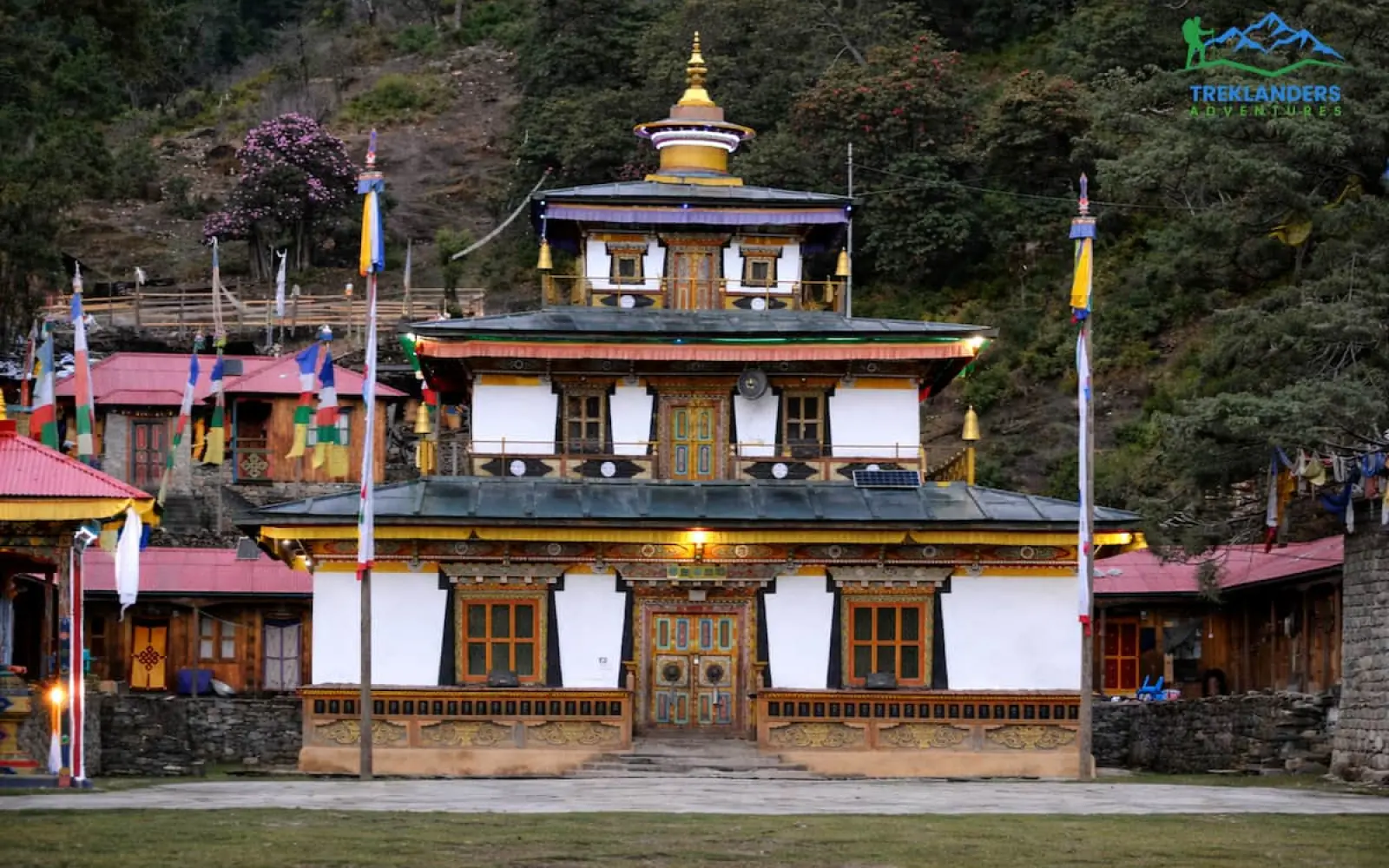
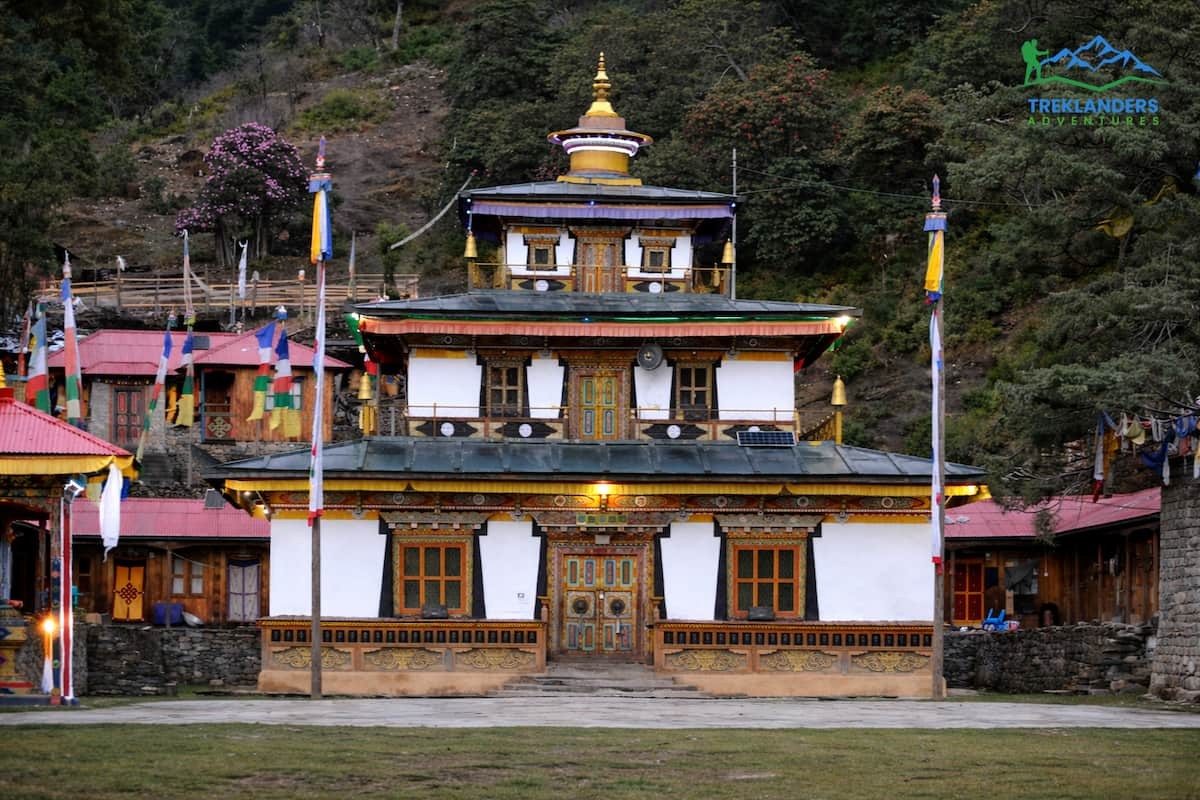
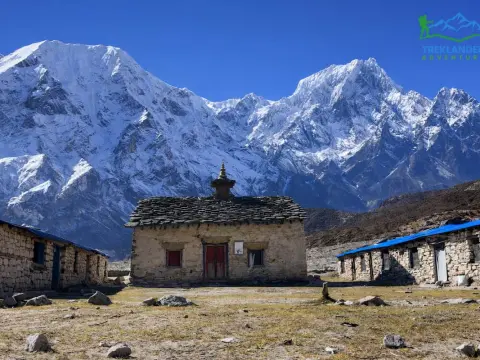
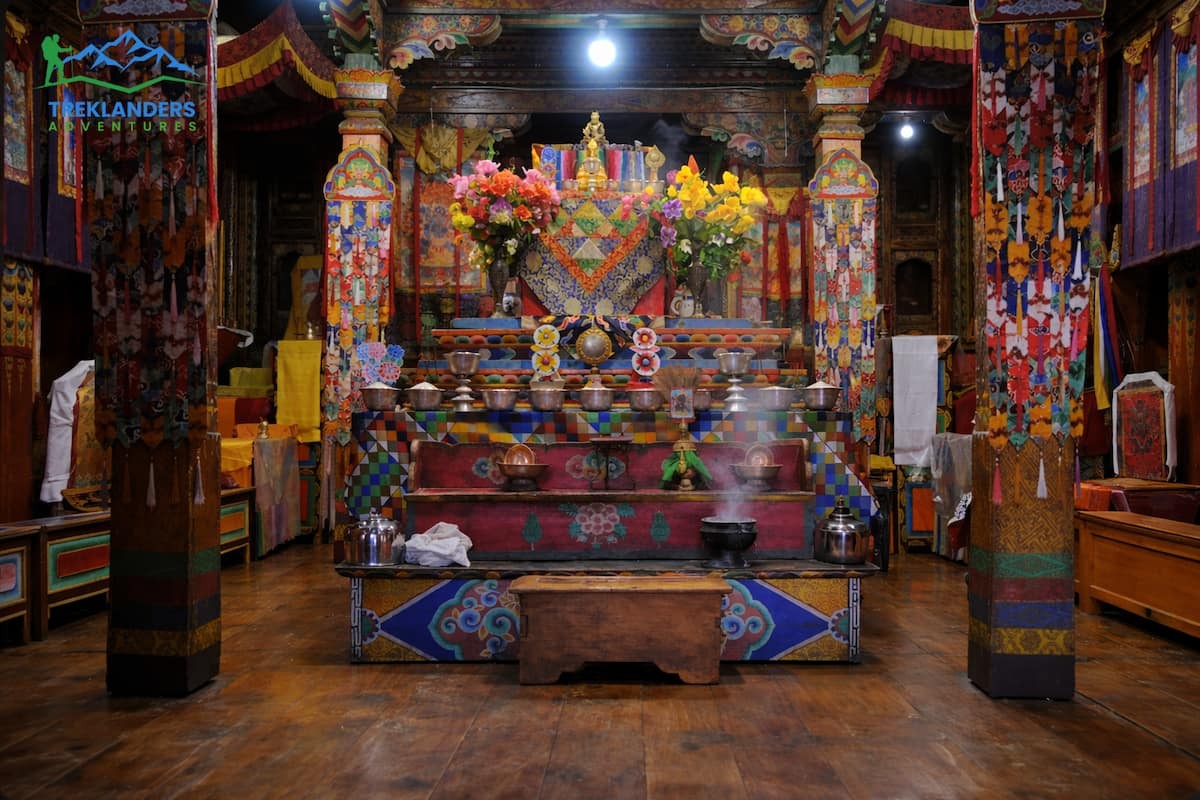
Serang Monastery, a Sacred Site on the Manaslu Circuit Trek
The Manaslu Region is one of the areas in Nepal where cultural and historical heritage is exceptionally well-preserved, and indigenous traditions, sacred nature, and mountain life coexist in a beautiful balance. The region is located in the northwest part of Nepal near the border with Tibet. Tibetan Buddhism, trans-Himalayan trade routes, and high-altitude pastoral culture have been the main influences in this region.
The Nubri Valley is the cultural core of the Manaslu Region. Nubri people who have kept their original lifestyle, dress, and language that are quite different from those of Tibetans are the inhabitants of the valley. The world-famous villages, including Samagaun, Lho, and Samdo, are where the majority of the locals live and are considered the center of their cultural heritage. Samagaun has become the hallmark of the region's culture owing to the long-established tradition of living in stone houses, the culture of yak herding, and closeness to the natural environment considered sacred in the region.
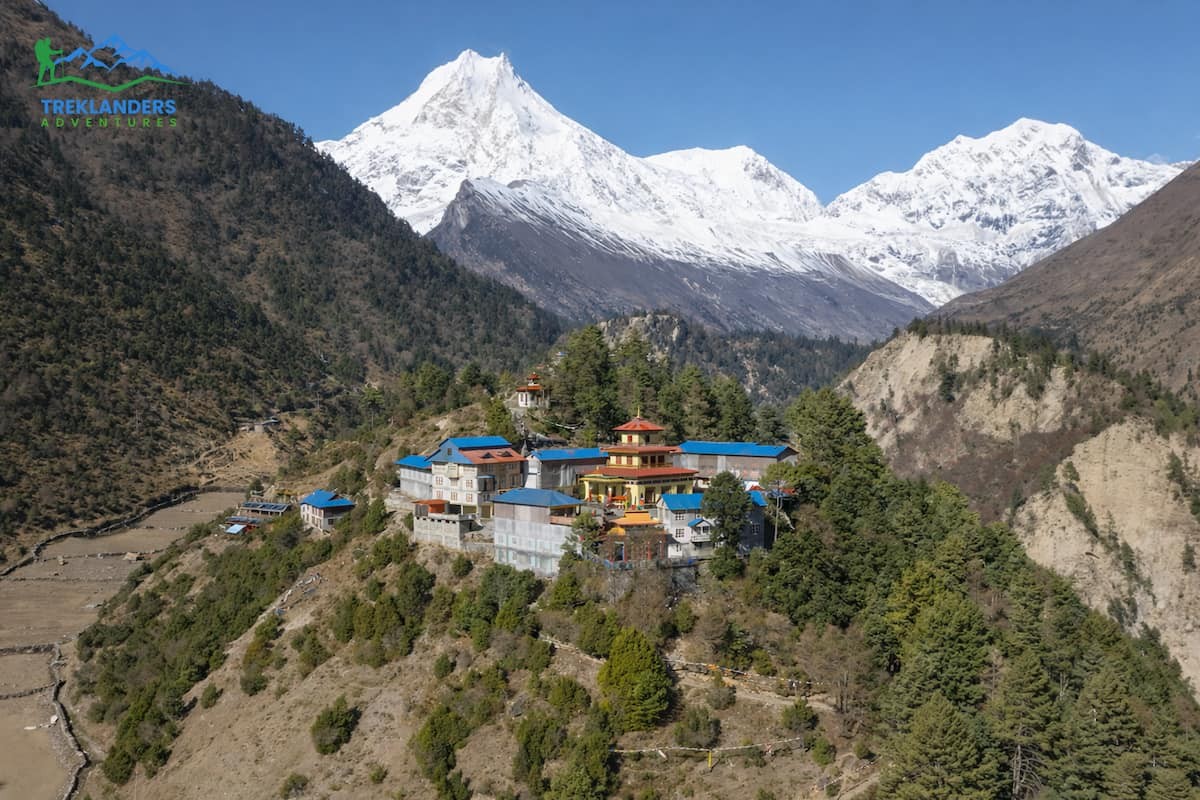
Ribung Monastery at Lho Gaun- Manaslu Circuit Trek
The spiritual aspects of society, the role of community rituals, the support of festivals, and the daily part of religious life are the characteristics of Lho Village that houses the Ribung Monastery, which is a revered place. Samdo lies close to the Tibetan border, and instead of being viewed as a normal village, it is still a place that represents the trading history very well. Currently, it still retains some cross-border cultural exchanges.
Tsum Valley cannot be left behind as it is also a yearned-for place. It is often described as a Valley of Happiness because it is a very peaceful and spiritually rich area of Buddhist sanctuary with a number of old monasteries, mani walls, and prayer flags. Hunting and violence are prohibited in most parts of the Tsum Valley and the larger Manaslu region, as these territories are regarded as deeply spiritual places where the life of all beings is highly respected.
Natural features like Birendra Lake, Kal Tal, and the astonishing Lower Budhi Gandaki Valley are not only home to diverse species but also are places of worship. The high mountain passes like Larkya La Pass and resting places such as Dharamsala (Larkya Phedi), as well as the beautiful settlements like Shyala Village, are not only the way through that connects the local people but also have the function of the pilgrimage as well as the trade routes. The huge peaks surrounding Mt. Manaslu, which is the Mountain of the Spirit, are even now remembered as the places where the protective deities reside.
All these valleys, villages, monasteries, and sacred places together form a culturally vibrant Himalayan world where traditions, heritage, and spiritual life continue to shape everyday existence in the Manaslu region.
Ancient Trade Routes and Settlement History of the Manaslu Region
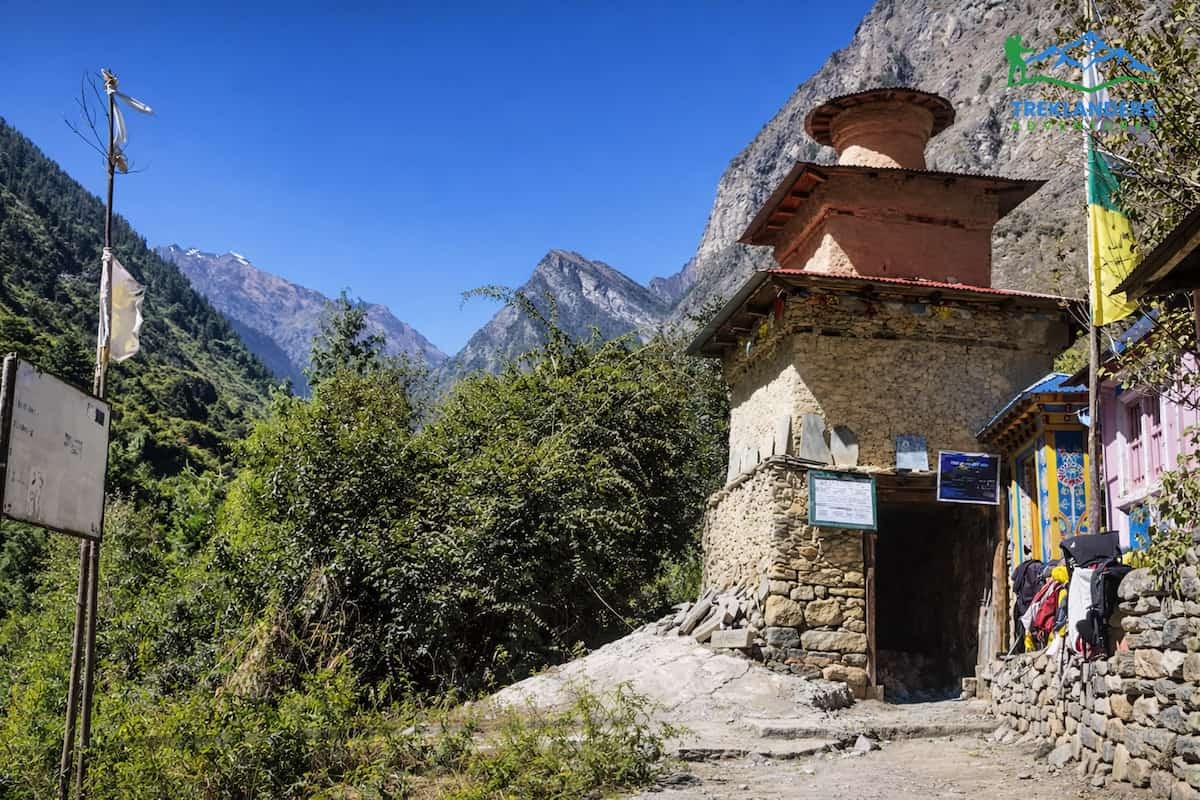
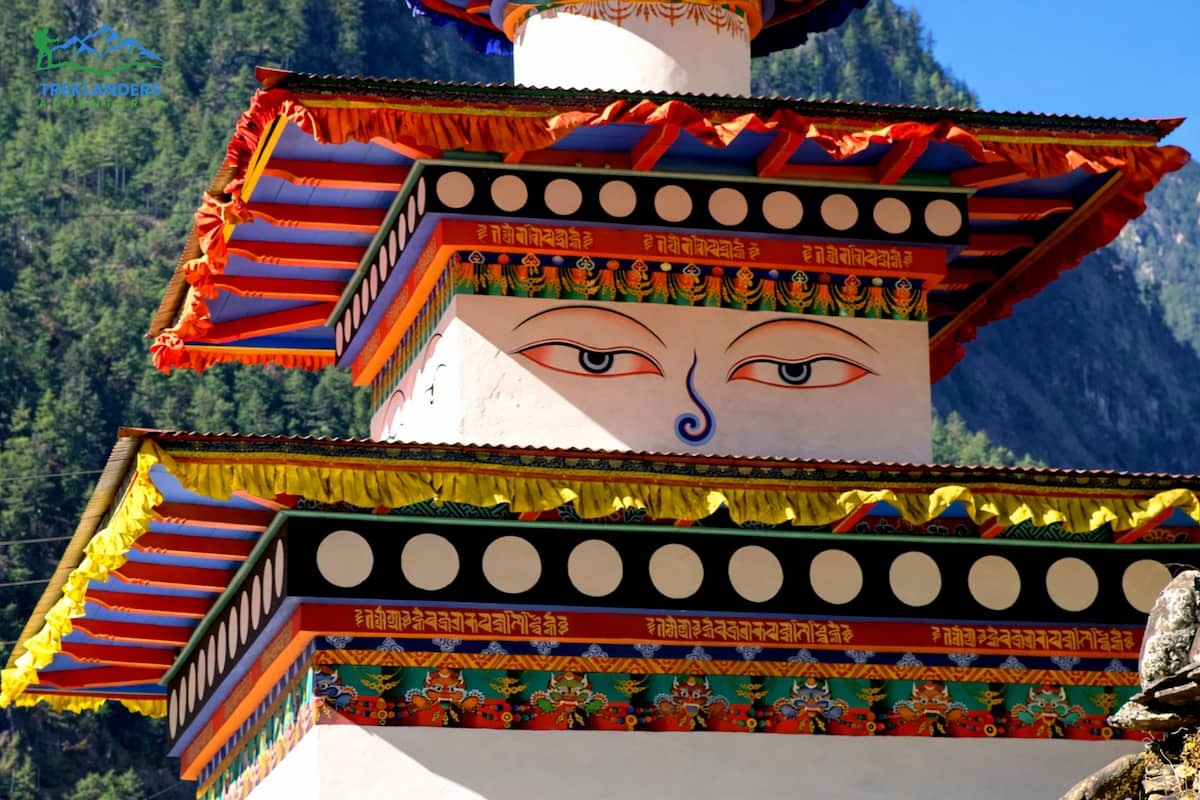
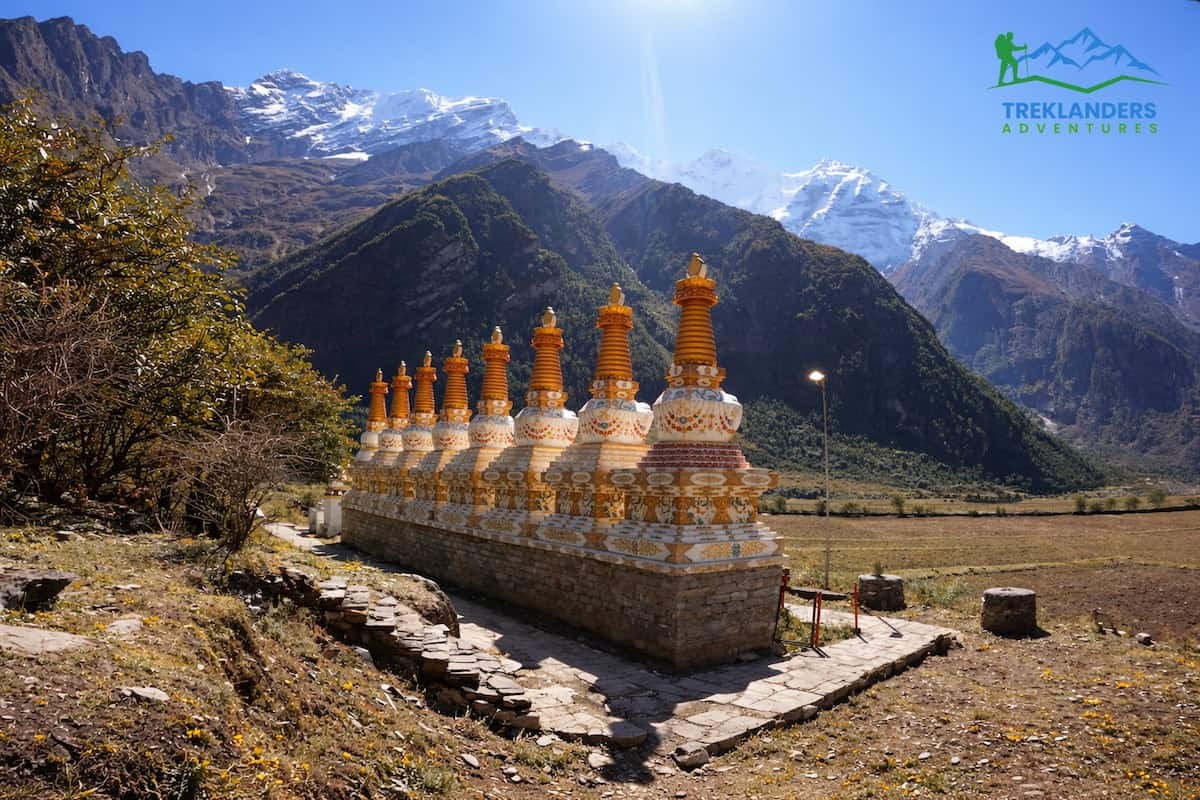
Ancient Stupa in Manaslu Region
The history of the Manaslu region is full of the influences of its ancient trade routes and human settlements. Even before trekking trails were carved out, the valleys and mountain pass of Manaslu functioned as major trans-Himalayan trade routes connecting Nepal with Tibet. The exchanges of goods, culture, language, and religious ideas through these routes contributed to the formation of the region's unique identity.
The Lower Budhi Gandaki Valley was for a long time an initial habitation area in Manaslu. Its lower altitude, fertile soil, and availability of water made it suitable for agriculture and establishing permanent villages. The first inhabitants cultivated vegetables, kept animals, and gradually formed communities that accommodated traders and pilgrims as they ventured further into the Himalayas. In time, this valley turned into the principal entrance to the Manaslu area, thus it became the link between the plains and the mountains.
Going further up, traders would have encountered the culturally rich Nubri Valley, which came to be recognized as a significant settlement area because of its convenient position near the Tibetan border. The Nubri community maintained extensive relations with Tibet, becoming familiar with the Tibetan language, attire, and Buddhist traditions. The villagers in this valley thrived through the trade of salt, wool, herbs, and livestock, exchanging these for grains and daily necessities from the lower regions. The valley's remoteness was one of the reasons that helped it retain its traditional way of life and cultural heritage.
The remote village of Samdo on the heights was very important to the trade with Tibet. In the past, Samdo, a place near Tibet, was a seasonal trading post where caravans would stop before heading into Tibet. The villagers, who were traders and herders, were very skillful and they depended on trade and yaks for their livelihood because the environment was very harsh.
Lastly, the lofty Larkya La Pass linked all these different places. It is definitely one of the major passes in the Himalayas. This pass was the route not only for traders but also for pilgrims and local populations who were changing valleys. Even though the conditions were quite difficult, Larkya La was the way through which the economy and the culture were exchanged across the Himalayas.
Therefore, the Lower Budhi Gandaki Valley, the Nubri Valley, Samdo, and the Larkya La Pass are the aspects of the trade routes which influenced settlement patterns, culture exchange and people's survival in the Manaslu region, and thus, these routes have been the backbone of the vibrant Himalayan life that we see today.
Tibetan Buddhist Influence Across Valleys and Villages
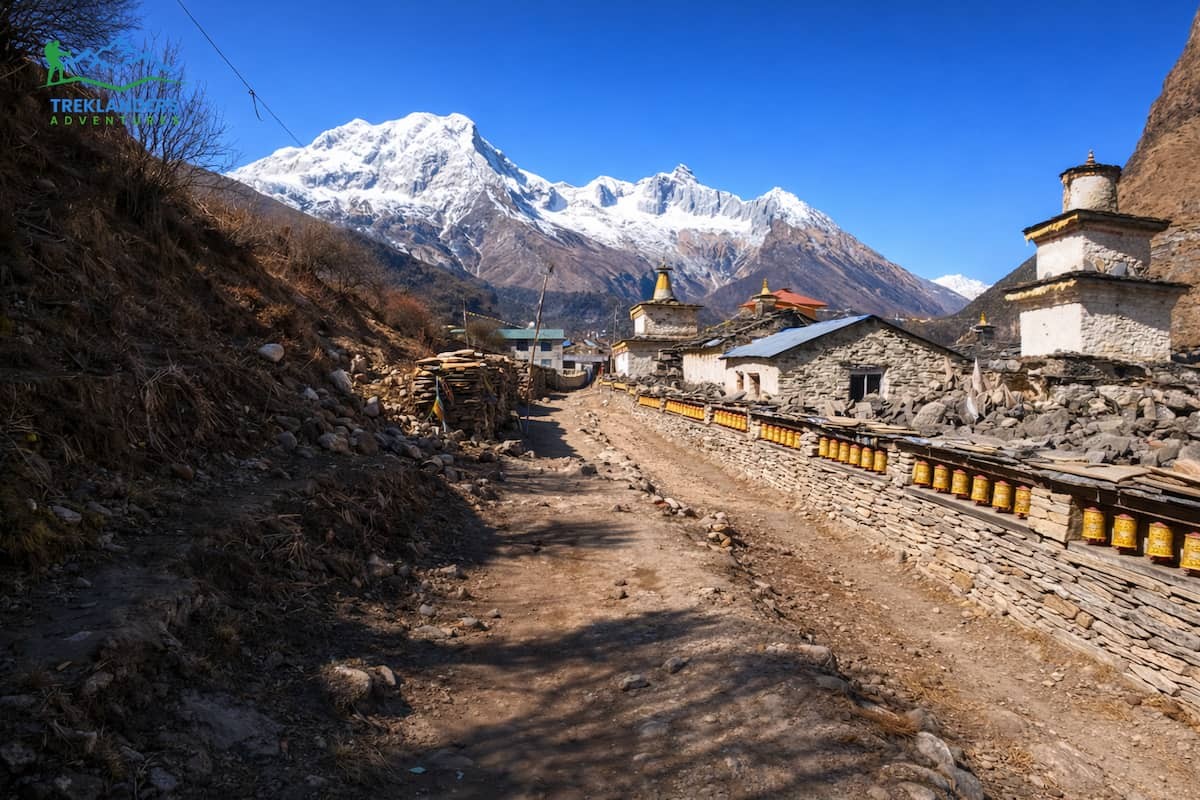
Ancient Buddhist stupa and prayer wheels at Samagaun.
For centuries, Tibetan Buddhism has been a great influence on the culture, customs, and lifestyle of the Manaslu region. The area was close to the Tibetan border and was historically connected through trade routes, so it was quite natural that the valleys and villages of the region got permeated with Tibetan religious beliefs. It is through the Nubri Valley, Samagaun, Lho, Tsum Valley, and spiritual centers like Ribung Monastery that this influence can be best witnessed today.
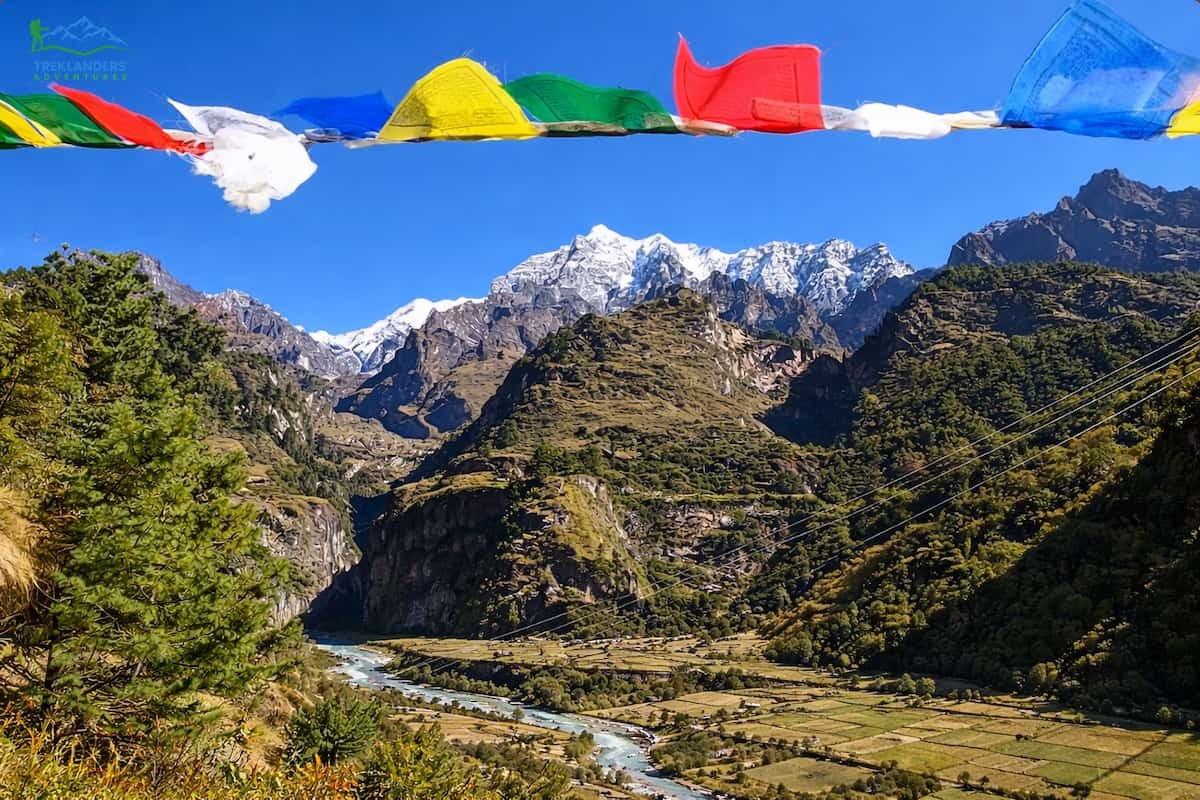
In Manaslu, the Nubri Valley shows the Tibetan Buddhist tradition of that region most vividly. The inhabitants here remain devoted to Tibetan Buddhism, marking their days with prayers and rituals. Mani walls that are inscribed with sacred chants, prayer flags hoisted in the wind, and chortens that form entrances to villages are only a few common sights of the religious life here. It is thought that these religious symbols protect the community from harm, bring them peace and attract good fortune.
Buddhism goes hand in hand with the lifestyle of the communities in a village such as Samagaun and Lho. Monasteries and gompas are not only spiritual centers but also educational and social ones. One of the most significant sites of spirituality in Lho is the Ribung Monastery. The monastery looks down on the village and is central to religious festivals, meditation sessions, and spiritual teachings by the monks. In fact, locals frequently visit the monastery to ask for blessings before embarking on the lifecycle or a seasonal journey.
20 Day Manaslu Circuit with Tsum Valley Trek | 20 days
The Tsum Valley is regarded as one of the most pious Buddhist areas in Nepal. It has frequently been called a "hidden valley." The Tsum Valley has been, at times, a place of spiritual retreat and to this day, it is one of the last places in Nepal that still follows the principle of non-violence (ahimsa), which means hunting and animal killings are traditionally prohibited. There are still several ancient monasteries and caves where Buddhist monks used to meditate, and the valley is still dominated by rituals which are done on a daily basis.
In these valleys and villages, Tibetan Buddhism contributes not only to religious practices but also to values like compassion, respect for nature, and community harmony. Tibetan Buddhism is a unifying factor that connects people, land, and spiritual life throughout the Manaslu region, from the quiet morning prayers in Nubri Valley to the holy ceremonies in Ribung Monastery and the tranquil traditions of Tsum Valley.
Sacred Landscapes, Holy Peaks, and Spiritual Geography
Bhimthang Valley- Manaslu circuit Trek
The Manaslu region is famous not only for its towering peaks and secluded valleys but also for its profound spiritual harmony with nature. It is the land itself that is holy to the local people. The mountains, lakes, and valleys are considered to be the abode of the protective deities and spiritual forces, thus influencing people's lifestyle, religious practice, and relationship with nature. The core of their religious beliefs thus constitutes the spiritual map of the region.
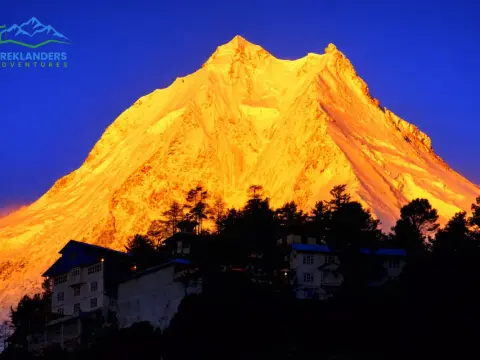
Mount Manaslu, the eighth-highest mountain in the world, is the focal point of this sacred terrain. Locally called the Mountain of the Spirit, Manaslu is a source of deep admiration and veneration. The people living around the mountain are convinced that it is guarded by mighty gods, and therefore, they perform rituals to ask for permission and blessings prior to any travel or climbing in the vicinity. The community demonstrates their respect for the mountain through prayers, offerings, and adhering to the traditional customs that forbid the unnecessary exploitation of nature.
Several other sacred peaks nearby overlook the entire region. Especially, villages like Shyala are encircled by such peaks forming a natural amphitheater that is believed to protect the inhabitants of the village. The open plateau of Shyala, where one can enjoy the majestic snow-capped mountains, is regarded as a spiritually nice place where nature and faith melt into one. Prayer flags and cairns scattered around the village symbolize the mutual spiritual attunement of the people and the land.
Sacred water bodies are also given special importance. A glacial lake near Samagaun, Birendra Lake, is said to be blessed by the mountains that surround it. The locals come to the lake for meditation and prayer and behave very respectfully towards it. Likewise, Kal Tal is considered a sacred lake which has been used for religious purposes. It is believed that the still water of the lake carries spiritual energy, and the old stories relate the lake to the local gods and protective spirits.
Mount Manaslu, the sacred peaks, glacial lakes, and the peaceful environment of Shyala together create a spiritual landscape in which nature is revered rather than dominated. These holy places influence the daily life, ceremonies of the seasons, and the values of the local people; they serve as a constant reminder to both the natives and the tourists that the Himalayas are as spiritually uplifting as they are visually stunning in the Manaslu region.
Traditional Village Life and High-Altitude Communities
Tsum Valley
The Manaslu area contains a number of old villages where the rhythm of life is set by the mountains as if time had stood still. Among them, Samagaun, Lho, Samdo, and Shyala demonstrate how their inhabitants not only got used to living at great heights but also managed to keep intact their traditions and culture.
Living in such remote and harsh conditions, the dwellings themselves have become an art form that tells stories of human endurance and faith in the power of nature. As a matter of fact, these places are not mere shelters anymore, but rather open-air museums full of Himalayan wisdom, piety and practice.
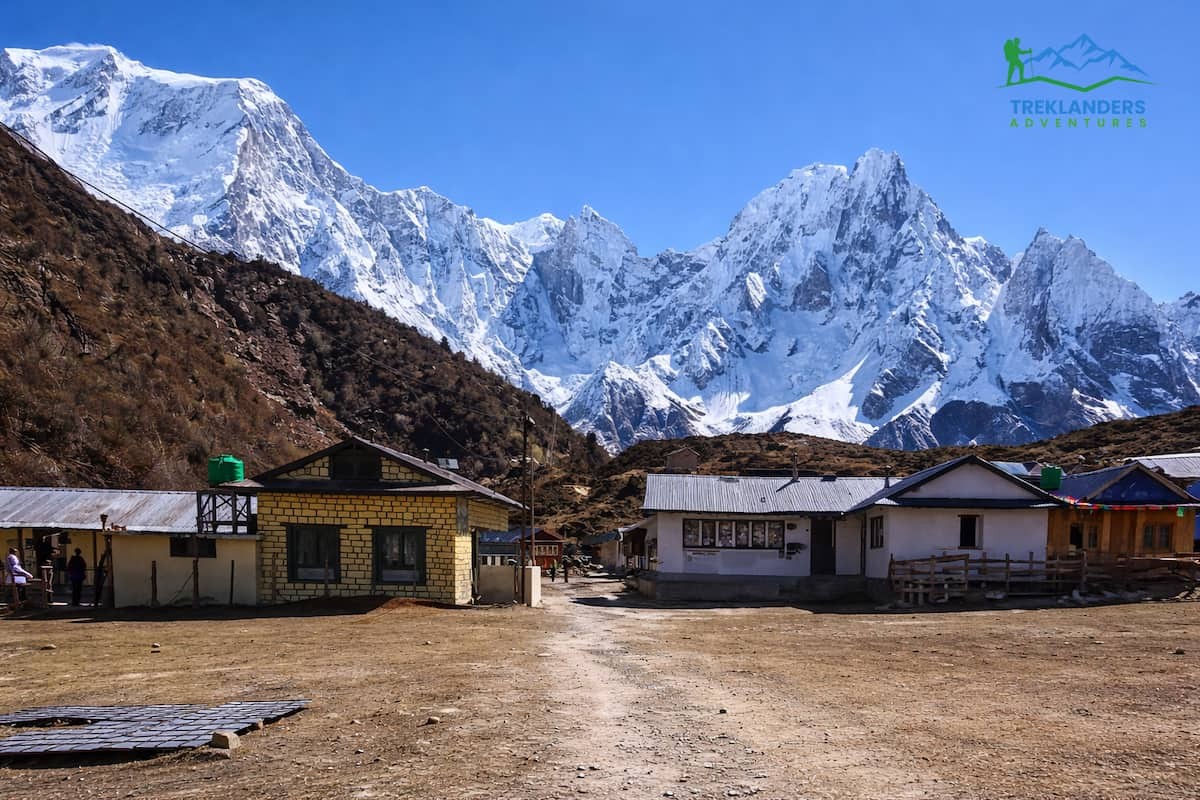
Samagaun, being the largest village in this upper Manaslu valley, is dotted with stone and wooden houses built so that they can resist severe cold and fierce winds. Generally, the farming is self-sufficient, and the staple crops are barley, potatoes, and buckwheat. Domestic animals like yaks, goats and sheep are the source of milk, meat and wool, which are indispensable for human survival. The concept of mutual help is deeply rooted in the villagers' tradition, and working together means not only sharing the labor but also the joy of the various activities.
Lho is the village adjacent to the well-known Ribung Monastery that is spiritually not far from physical closeness. The monastery is more than just a building, it is the living heart of the society whose rituals, feasts and the transmission of teachings dictate everyone’s behavior. The inhabitants are faithful to the Buddhist rites, and the presence of prayer flags, mani walls and chortens in the village can be seen as an outward sign of their piety.
Samdo, located at the northern tip just before the Tibetan border, has always been a trading and resting place for travellers and caravans. The villagers excel in yak herding, trading, and handicrafts. The village plays a crucial role in connecting the valleys and the Tibetan plateau. Migration with the seasons is natural as the families move the livestock to higher pasture in summer and come down to lower areas in winter.
Shyala Village, among other high-altitude settlements, is a testimony to the difficulties and charm of living in the mountains. The village, which is nestled in the vicinity of the snow-capped peaks, relies on traditional architecture, local materials, and thorough planning for the preservation of its long winters. Even though the conditions are severe, the villagers continue to hold festivals, perform rituals, and have community gatherings that keep the cultural identity alive.
On the one hand, these villages demonstrate how the inhabitants of the Manaslu region are in tune with nature, keep up their traditions, and are capable of adjusting to the challenges of a high-altitude location. Their everyday existence is a reflection of the coexistence of work, community, and spirituality; they serve as a window into the timeless Himalayan culture that has been passed down from one generation to another.
Monasteries, Gompas, and Living Spiritual Institutions
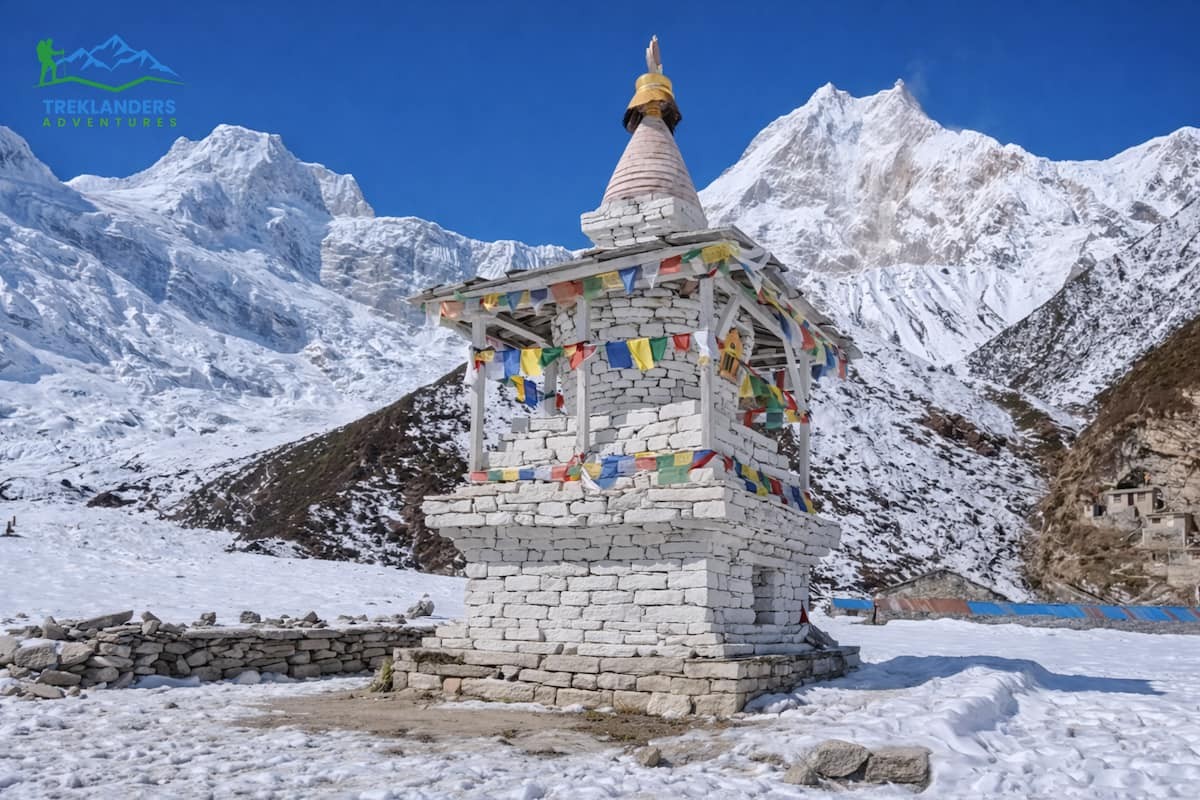
Ancient Stupa
The Manaslu area has a deep spiritual tradition. Monasteries, gompas, and different religious establishments have always been an essential part of community life here. These holy places are more than just venues for worship; they are centers of education, culture, and social relations, linking people with their heritage and faith.
A monastery that can be counted among the great landmarks is the Ribung Monastery from Lho Village. This monastery acts as a Buddhist teaching center, a place for meditation, and a ground for community rituals. Monks here study the Buddhist scriptures, sing prayers daily, and organize festivals that attract the villagers. Besides that, Ribung Monastery offers the spiritual support needed for the different stages of life, such as births, marriages, and harvest. Thus, it is at the heart of the spiritual and social life of the community.
In the Tsum Valley, monasteries are dispersed in tiny villages and on the mountain slopes. The valley attracts those who seek peace and spiritual growth, as the locals have preserved these rituals for centuries. Monks and nuns perform the old rites, and the villagers go to the ceremonies, prayers, and festivals. Monasteries here are typically small but packed with significance, serving not only as religious spaces but also as learning hubs where kids and grown-ups are taught Buddhist philosophy, morality, and the cultural past.
Village gompas-smaller than monasteries but equally important exist throughout Manaslu’s settlements such as Samagaun and Shyala Village. These gompas provide accessible spaces for villagers to perform daily prayers, hang prayer flags, and observe religious festivals. They also preserve sacred artifacts, statues, and manuscripts that reflect centuries of spiritual tradition.
Monasteries and gompas are more than just religious venues. They are the cornerstone of the local social life. Seasonal festivities, pilgrim accommodation, and the strengthening of community bonds through shared ceremonies and duties form some part of their spiritual and social roles. Quite a few are constructed in a way that is ecologically sensitive, and they tend to be oriented towards mountains or river which are considered divine elements. These practices underline the integral relation of spirituality and nature in the area.
In summation, the monasteries, gompas, and spiritual establishments of the Manaslu territory still actively represent faith and culture. On one hand, they safeguard ancient Buddhist heritage, and on the other, they orient the community life. As a result, they foster a powerful sense of belonging and heritage among the people of these lofty Himalayan valleys.
Hidden Valleys and Isolated Cultural Sanctuaries
Ancient Himalayan Monastery
The Manaslu area is famous for its secluded, secret valleys. These valleys have kept the cultures, traditions, and lifestyles of the local people unchanged for hundreds of years. The Tsum Valley, the Nubri Valley, and villages along the upper Budhi Gandaki are examples of such valleys that are very far from the main roads and towns, so they are cultural sanctuaries where ancient practices are still very much alive.
The Tsum Valley is frequently referred to as the Valley of Happiness. It is the most secluded place in Nepal. Because of its remoteness, Tibetan Buddhist traditions here have not been significantly altered. People of the valley are known for their practice of non-violence, great respect for the sacred sites, and continuation of the ancient rituals that are performed to worship local gods and nature spirits. Around the valley, you can spot monasteries, meditation caves, mani walls, and prayer flags - all these are the signs of the spiritual community. The valley has become a haven for those who are seeking peace, meditation, and spiritual learning because it is so far away from the hustle and bustle of the city.
The Nubri Valley is a cultural treasure that is hidden just like the Tsum Valley. It is slightly easier to get to, but because of the direct connection through trade and migration with Tibet in the past, it still has strong Tibetan influences. Locals still live in the traditional stone houses, they still herd yaks, and they make new handicrafts and sell them. The valley is unique; it has an important part of the world-left culture that is only influenced a little by the outside world. The people of the Nubri valley are very proud of their language, traditional clothing, and culture, which are examples of the rich Himalayan heritage.
Settlements in the upper Budhi Gandaki Valley are also considered to be part of these isolated sanctuaries. The small villages that are dotted along the valley have gradually shaped their way of life to be self-sufficient, depending on agriculture, livestock, and trade with the nearby highland communities. Besides, the rugged nature of the valley has acted as a natural barrier for the people of these villages; hence, they were able to retain the traditional knowledge, folklore, and spiritual practices that were handed down to them from their ancestors.
Actually, the Tsum Valley, Nubri Valley, and upper Budhi Gandaki settlements collectively depict the last living cultural sanctuaries of the Himalayas. Rather than being a drawback, their remoteness has served as a shield that enabled the communities to hold on to their habits, faith, and lifestyles. These secret valleys are a rare find and give the visitors a sneak peek of the Himalayan world, where nature, culture, and spirituality live together in perfect harmony. These places provide not only a historical perspective but also an extremely enriching cultural experience.
High Mountain Passes and Pilgrimage Connections
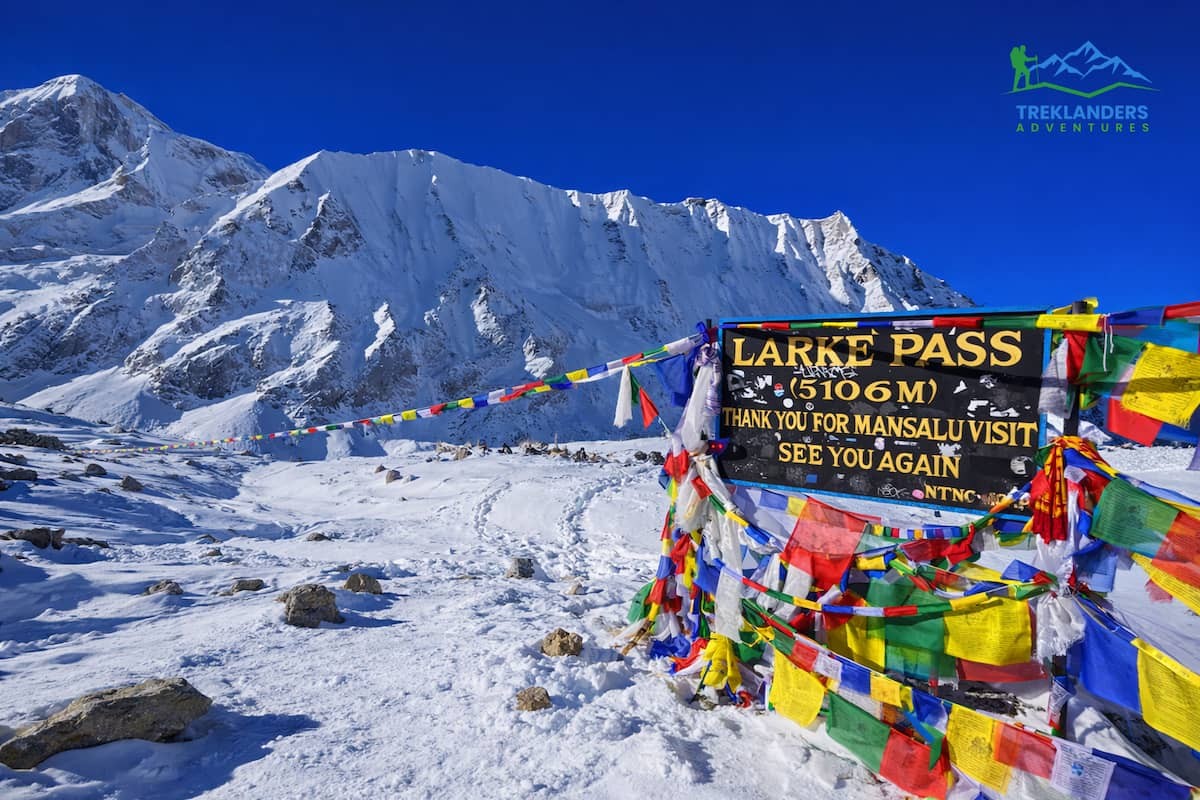
Larke Pass- Manaslu Circuit Trek
The Manaslu area is recognized not only for its towering mountains but also for its high passes, which have been an integral part of trade, travel, and spiritual pilgrimages for hundreds of years. Passes like the Larkya La Pass and resting points such as Dharamsala (Larkya Phedi) connect valleys, villages, and remote communities, forming routes that are both practical and sacred.
The Larkya La Pass, situated at an elevation of 5,106 meters, is the most important crossing in the Manaslu region. In the past, it was a crucial link between the Lower Budhi Gandaki Valley, the Nubri Valley, and the regions towards Tibet. Traders, pilgrims, and villagers used this pass to transport goods such as salt, wool, and grains across the Himalayas. Nowadays, it is a popular trekking route, although the locals and pilgrims who visit the area still wish to perform rituals before crossing the pass, aiming to receive the divine protection and safe passage.
Dharamsala (Larkya Phedi), situated in the vicinity of the pass, is a customary stopping place for people on the move. It offers shelter and an opportunity to get used to the altitude before embarking on the arduous climb over the pass. For a long time, Dharamsala has been a tiny spiritual center as well, where pilgrims and travellers make offerings asking for a safe journey. Prayer flags, chortens, and small shrines are reminders of the sacredness of these mountain passages.
Traditional routes linking villages such as Samagaun, Samdo, and the upper Budhi Gandaki settlements are mostly dependent on these passes. These routes, which were the main means of communication, culture, and religion exchange before the emergence of modern roads. The communities along the routes had the custom of providing shelter and food to travelers which helped to strengthen social cohesion and cultural continuity.
Mountain passes like Larkya La are not just about connection in terms of geography, but also linking communities and spiritual practices. They represent resilience, human adaptation, and the integration of travel and faith in the Himalayas. Allowing the Manaslu region to preserve its cultural heritage, these passes have served as links between the valleys, monasteries, and villages and thus have become a part of the lifestyle and pilgrimage traditions in the high Himalayas.
Sacred Water Bodies and Natural Worship Sites
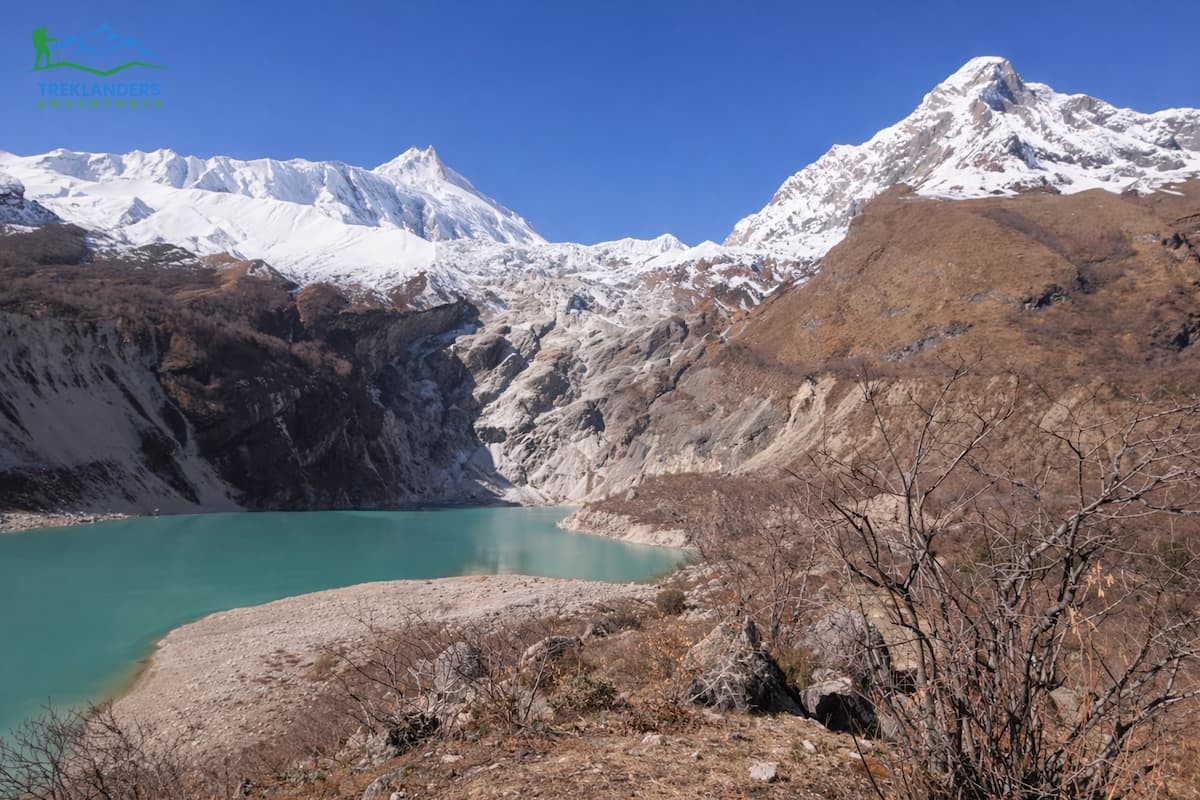
Birendra Lake- Manaslu Circuit Trek
In the area around Manaslu, water is venerated, and lakes, streams, and ponds are intimately involved in people's spiritual practices and their everyday lives. Birendra Lake, Kal Tal, and the glacial streams all over the area are not only natural features-they are considered sacred places, being so tightly linked with local beliefs, rituals, and Himalayan culture that one can hardly separate them.
Birendra Lake is a nearby glacial lake that has become a spiritual landmark for the local people of Samagaun. It is the traditional belief of the people that the lake is guarded by mountain deities and that its tranquil waters bestow blessings on those who visit it. The locals sometimes come here to do religious rites, giving prayers for health, protection, and abundance. The lake's peaceful atmosphere is conducive to reflection and meditation; it is a place where both locals and tourists can get in touch with nature and the holiness of the mountains.
Kal Tal, yet another sacred lake in the area, has the same spiritual importance to the locals. Prayer flags and small shrines encircle the lake, where villagers perform seasonal rites to the local gods and spirits. It is the faith of the people that the lake possesses spiritual power and that treating it with respect guarantees one's being in harmony with nature. Kal Tal is also the venue for community celebrations during festivals and religious ceremonies, which not only deepen the social relationships but also pay homage to the natural environment.
Besides the lakes, the glacial streams of Manaslu that are coming down from the high peaks are also considered sacred. These streams provide water for drinking, irrigation, and livestock, yet they are worshipped. Most of the village communities are careful not to pollute these waters as they know deep down, even nature is divine. Local lore supports the use of nature in a manner that is not only sustainable but also protective; thus, these streams will live on to serve both the life and spiritual practices.
In a way, the sacred water bodies together constitute a network of natural worship sites scattered all over the Manaslu region. They serve as a testament to how the local people incorporate faith, culture, and environmental respect in their lives.
By venerating lakes, streams, and ponds, the Manaslu inhabitants are able to stay in a peaceful coexistence with the mountains; thus, their spiritual and ecological heritage will be kept intact for future generations.
Pastoralism, Yak Herding, and Mountain Livelihoods
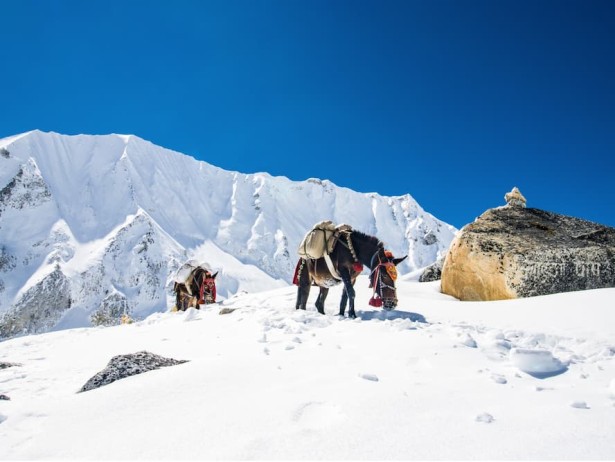
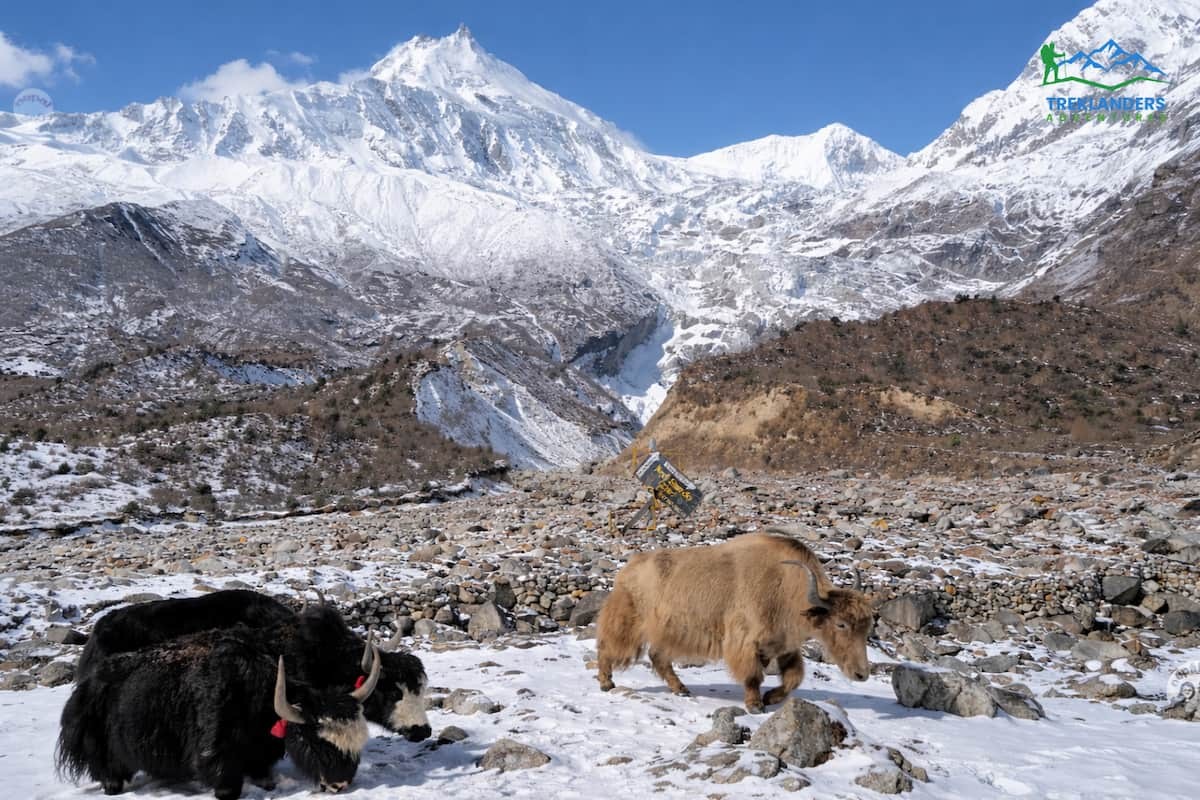
Yaks graze on a snow-covered Himalayan landscape beneath towering peaks along the Manaslu region.
Those villagers of high-altitude communities in the Manaslu area got used to the extreme Himalayan situation through the development of pastoralism, yak herding, and mountain traditional livelihoods. Localities such as Samagaun, Shyala, Nubri Valley, and Samdo count on these methods to provide food, generate income, and secure the means of living; thus, these methods are the main element of their culture and daily life.
Yak herding is one of the main means of existence in the considered areas. Yaks, apart from providing milk, meat, and wool, also serve as the means of transport for goods across the mountains. In Samagaun and Shyala, the families typically have a few animals that they keep on the summer mountain pastures and carry their stock down to the valley in winter. Taking the herds up to the mountains in summer and bringing them back to the valley in winter helps the grazing land to rest, and the family keeps a balance of farming and animal husbandry in a sustainable way.
The Nubri Valley pastoralism is entirely interwoven with agriculture. The villagers cultivate resilient crops such as barley, potatoes, and buckwheat, and on the other hand, they raise yaks, goats, and sheep. This mixture of farming and livestock rearing helps them to get their food requirements and produce a stable living, even though the mountain conditions are very harsh. They also engage in seasonal trading with the nearby valleys and Tibet for resources such as salt, wool, and grains.
Samdo, a town near the Tibetan border, has for many years been a center of pastoral and trade activities. The local herders are very capable of guiding livestock in difficult areas, and they frequently use yaks for transporting goods through the old trade routes. Besides raising livestock, the villagers also make woolen products, as one of the ways to survive and make a profit, turning the wool from the yaks into warm clothes, blankets, and carpets, which are necessary for life and also can be sold in the markets.
Besides the material advantages, pastoralism and yak herding also form the cultural and social life of these localities. Festivals, rituals, and seasonal celebrations are mostly connected to the herding calendar, and thus, they are planting, grazing, or livestock moving days. From the very beginning, kids are taught how to herd animals, and so this is another way of preserving these wild traditions.
To sum up, pastoralism, yak herding, and mountain living are much more than just the main source of income in the Manaslu region; they represent the whole identity of the people. They provide the communities of Samagaun, Shyala, Nubri Valley, and Samdo with the means to stay happy and healthy in one of the most extreme natural environments on the planet while at the same time holding onto their rich cultural and social heritage.
Cultural Exchange Between Nepal and Tibet
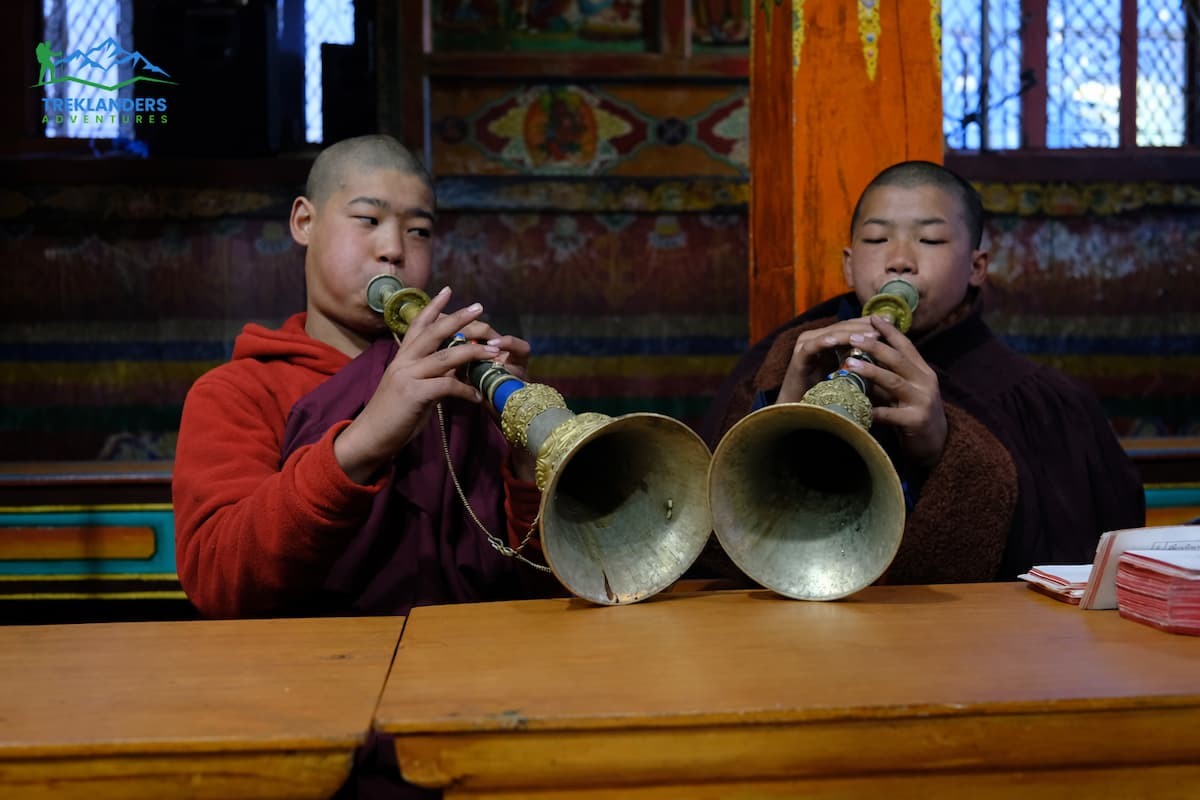
Young Buddhist monks play traditional Tibetan horns during a monastery ritual in the Manaslu region.
In fact, the Manaslu area has always been a place where the cultures of Nepal and Tibet meet and exchange. Besides Samdo, the valleys of Nubri and Tsum and the routes across the Larkya pass were the main points where trade, religion, and ideas flowed through the Himalayas. Due to this continuous interaction, the local culture, architecture, and divine practices have their distinct flavor.
Samdo, which is near the border with Tibet, has over time been a very significant trading center. Traders and cattle farmers from Nepal and Tibet would come to this place to barter goods such as salt, wool, barley, and livestock. The ongoing contact not only resulted in the exchange of material things but also in the sharing of cultural knowledge such as language, clothing, and religious rites. Some of the houses in Samdo are still in the Tibetan style, and quite a few people observe customs which they got from their 'neighbors over the mountains.
The Nubri Valley is yet another place where the Tibetan influence can be discerned very strongly. The locals speak a dialect which is very close to Tibetan, and they are followers of Tibetan Buddhism. Mani walls, chortens, and prayer flags everywhere in the valley attest to the presence of Tibet-originated spiritual and cultural elements after being fused with the Nepalese ones. The regular celebrations in Nubri incorporate rituals and dances that derive from Tibetan styles, thus keeping alive the age-old heritage.
Even the Tsum Valley, which is quite isolated, reflects this pattern of cross-cultural influence. Monasteries in Tsum usually follow Tibetan Buddhist traditions and often have monks who underwent their studies in Tibet. The valley's scriptures, ceremonies, and meditations are, in fact, Tibetan teachings showing how spiritual ideas crossed the mountains and became part of the local culture.
The Larkya corridor, with the Larkya La Pass as its highest point, was also an enabler of cultural exchange. Traders, pilgrims, and herders were people who used these mountain passes to link valleys and carry not only goods but also ideas. Gradually, these paths became a bond that backed the Nepalese and Tibetan communities, turning their clothing, food, crafts, and festivals into shared traditions.
In brief, the Manaslu area, through its very geography, the movement of goods, and religious faith, illustrated the opening of the line of communication between Nepal and Tibet. In attempts to preserve the heritage of the Himalayas, the villages of Samdo, Nubri, and Tsum Valley can be seen as the living proof of this long connection between the two sides of the mountain, thus providing a unique mixture of Himalayan traditions, beliefs, and lifestyles.
Festivals, Rituals, and Community Spiritual Practices
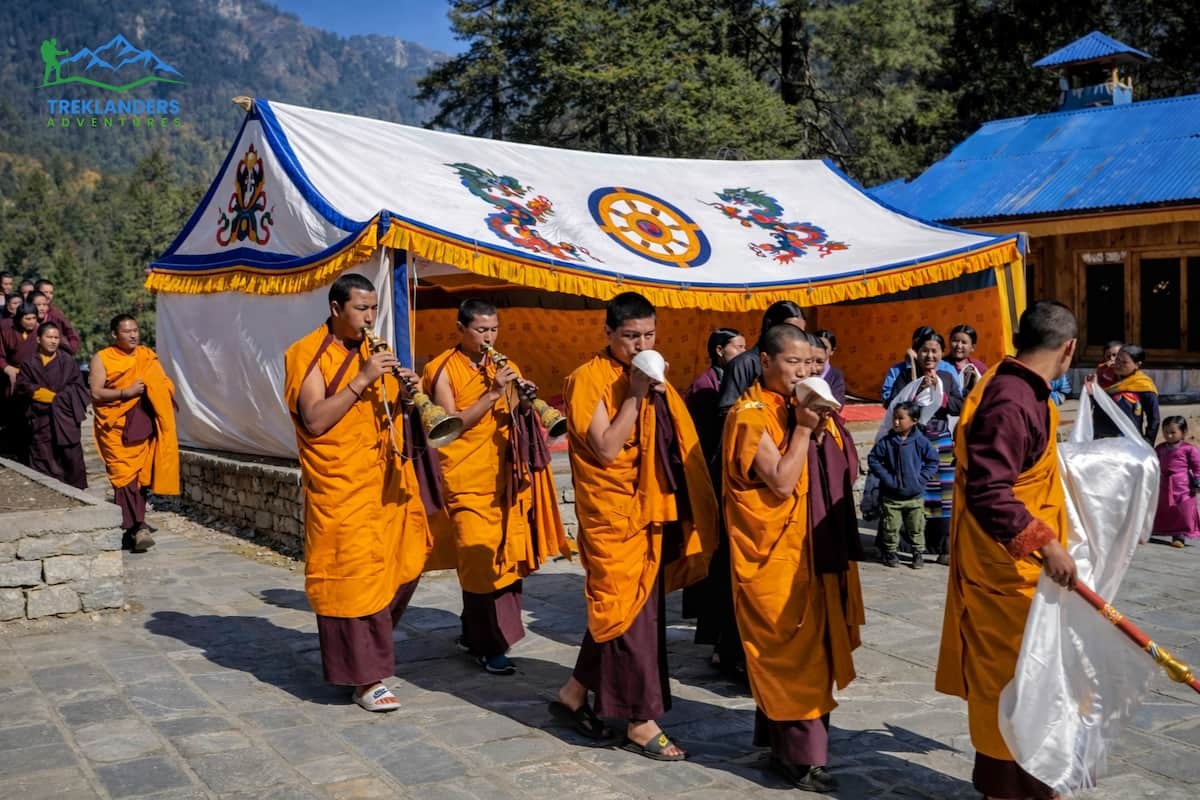
Buddhist monks take part in a traditional ritual procession at a monastery in Manaslu Region.
Manaslu is a land where the spirit of a community is alive and well through the festivals, rituals, and religious practices that are held there. These festivals, which are celebrated in the villages, monasteries, and holy places of the region, are manifestations of how the people of the area are inspired by their Tibetan Buddhist beliefs, their love for nature, and their respect for their ancestors. To the locals, feasts and ceremonies are more than just occasions for worship; they are moments when the ties between people are made stronger, the land is honored, and the culture is preserved.
In the villages of Samagaun, Lho, Shyala, and Samdo, the inhabitants celebrate festivals with great zeal and absolute happiness. Some of the most important Buddhist festivals, like Losar (Tibetan New Year) and Saga Dawa (commemorating the birth, enlightenment, and death of Buddha), are marked with prayer services, performance of mask dances, and social events. The monks officiate the rituals in the monasteries, reciting the prayers and doing the sacred rites, while the villagers are involved by giving food, decorating the houses with butter lamps, and putting up prayer flags so that blessings and protection may be extended to their homes and animals.
Besides the big festivals, rituals are also done as a part of everyday life. People pray in their family shrines, give water and incense to the chortens and mani walls, and do agricultural and other seasonal rites to invoke the blessings for crops, animals, and trips. Their whole way of life is permeated by a sincere and profound reverence for both the natural world and the divine as the community recognizes and acknowledges the existence of the manifold manifestations of the Holy One in the landscape of Manaslu mountains, rivers, and lakes which thus become not only places of faith but also their natural heritage and source of livelihood.
Sacred places such as Ribung Monastery, small village gompas, and holy lakes like Birendra Lake or Kal Tal are also the focus of communal spiritual life. People pray at these places for help, protection, and blessings. They do the rounds, meditate, and make offerings. Besides, many festivals and rituals are associated with the agricultural and pastoral cycle, e.g., the sowing and harvesting, or the yaks being moved to the high pastures.
In short, the villages, monasteries, and sacred places of the Manaslu area testify to a deeply spiritual life where religion, community, and the natural environment are in harmony. Through festivals and rituals, societies maintain their cultural identity while transmitting traditions and Himalayan heritage. As such, both faith and community remain the two pillars of life in this extraordinary mountain region.
Preservation of Heritage in a Remote Himalayan Landscape
Mu Gompa- Tsum Valley
The Manaslu region stands as a vibrant testimony of the survival of cultural heritage and traditional lifestyles in a remote Himalayan landscape. Deep valleys, aged settlements, ancient monasteries, and rugged passes of the region have been preserved by the geographical features as well as the community, which has taken care of the area, thus allowing traditions, spiritual practices, and architectural styles from centuries ago to be mostly unchanged.
Communities in the villages like Samagaun, Lho, Shyala, and Samdo have kept their distinctive culture alive through the lineage. Living in traditional houses constructed of stone and wood, yak herding, and farming for one's own needs still characterize their routines. The remoteness of these villages has made it impossible for them to get rapidly modernized, thus locals still have the ability to keep the traditions, clothing, language, and social customs reflective of their Tibetan Buddhist lineage. Festivals, rituals, and ceremonies related to seasons are, to a large extent, still being performed and are a means to strengthen social ties and cultural identity.
Religious centers and gompas like Ribung Monastery and the smaller ones in Tsum Valley, amongst other spiritual centers, are invaluable heritage resources. They not only preserve the Buddhist scriptures, manuscripts and sacred objects but also help the villagers to religiously practice their faith. Monasteries, thus, function not only as churches but also as cultural hubs where the arts, music, and traditional education are handed down to the younger generations, thereby guaranteeing the transmission of spiritual and cultural knowledge.
Tsum Valley
Also, the area's towering mountain passes, such as Larkya La Pass and the sacred natural sites like Birendra Lake and Kal Tal, greatly assist in heritage preservation. These are not only significant places for travel and pilgrimage, but they are also accorded the highest respect, as is evident from a deep-rooted ecological consciousness. The local people, through ceremonies, prayers and protective customs around those sites, not only preserve their spiritual heritage but also protect the environment.
Besides that, there are several local projects, community-based tourism, and guided trekking that have effectively assisted in increasing the understanding of the heritage value of the Manaslu region. It is being encouraged that tourists should respect the customs, support the local economies, and engage in cultural exchanges, which ultimately become the preservation agents.
In summary, the Manaslu region is an excellent example of how nature, communal values, and spiritual practices can be the pillars of heritage conservation in the Himalayas. Its valleys, villages, monasteries, and mountain landscapes are still vibrant witnesses to a culture that not only survives but flourishes in close contact with nature, thus paving the way for history and tradition to continue living in this far-flung corner of Nepal.
Conclusion
Pungen Gompa- Manaslu Circuit Trek
The Manaslu region is more than a trekking destination; it is a vibrant store of Himalayan culture, history, and spirituality. The entire area, from secluded Tsum and Nubri valleys to imposing Larkya La pass, illustrates a perfect coexistence of human beings with nature. In such villages as Samagaun, Lho, Shyala, and Samdo, you can see how the age-old ways of living through farming and animal husbandry, community lifestyles, and traditional housing have been kept for ages.
Spiritual and cultural centers, Ribung Monastery and small valley gompas, are gathering places of ancient Buddhist wisdom, as well as places for worship, and the practice and preservation of ceremonies. Manaslu Lake, Kal Tal, Mount Manaslu, and other such hills, rivers, and mountains that locals consider sacred, reflect the religious way of life in tune with nature.
On the one hand, the remoteness has kept the area's tradition intact and protected it from the influx of modernity; on the other hand, it has allowed the exchange of culture through trade and pilgrimage routes, especially the Larkya corridor with Tibet. The continuance of festivals, rituals, and spiritual practices in everyday life contributes to the strengthening of the community and the perpetuation of the identity of these mountain-dwelling people.
Thus, the Manaslu area is a very remarkable mix of historical, cultural, and natural elements, where each valley, village, monastery, and holy place is a piece of a living and flourishing heritage. Security of this fine harmony will grant future generations, visitors, as well as locals, the privilege of enjoying and gaining from one of the spiritually most rewarding and culturally most preserved Himalayan regions.
The Manaslu region stands as a testament to human resilience, devotion, and harmony with nature, reminding us that cultural preservation and respect for the environment are inseparable in the Himalayan world.