[{"name":"Everest Base Camp Trek","duration":"16","image_url":"https:\/\/www.treklanders.com\/storage\/trip-galleries\/1\/thumb_419a755c003cc609f3030ee332965ebe.jpg","offer_price":1405,"url":"https:\/\/www.treklanders.com\/trips\/everest-base-camp-trek"},{"name":"Gokyo Valley Trekking","duration":"16","image_url":"https:\/\/www.treklanders.com\/storage\/trip-galleries\/2\/thumb_676d1021b574aeba4d19d3f2a0b04ed2.webp","offer_price":1205,"url":"https:\/\/www.treklanders.com\/trips\/gokyo-valley-trekking"},{"name":"Annapurna Circuit Trek","duration":"23","image_url":"https:\/\/www.treklanders.com\/storage\/trip-galleries\/3\/thumb_2a9a92ea23c62f41de27b37f5e3e8c17.webp","offer_price":1495,"url":"https:\/\/www.treklanders.com\/trips\/annapurna-circuit-trek"},{"name":"Everest Panorama Trek","duration":"12","image_url":"https:\/\/www.treklanders.com\/storage\/trip-galleries\/4\/thumb_35c9f677ea2e88b1ff11a9f43daa3ddb.jpg","offer_price":1100,"url":"https:\/\/www.treklanders.com\/trips\/everest-panorama-trek"},{"name":"Everest Base Camp Trekking from Jiri","duration":"22","image_url":"https:\/\/www.treklanders.com\/storage\/trip-galleries\/6\/thumb_14763592492417b294aa66bf0ebf4e64.webp","offer_price":1400,"url":"https:\/\/www.treklanders.com\/trips\/everest-base-camp-trekking-from-jiri"},{"name":"Everest Base Camp via Cho la Pass from Gokyo Valley Trekking","duration":"18","image_url":"https:\/\/www.treklanders.com\/storage\/trip-galleries\/7\/thumb_d4e470e98d4e9e2ab8e93e39b8b7d252.jpg","offer_price":1405,"url":"https:\/\/www.treklanders.com\/trips\/everest-base-camp-via-cho-la-pass-from-gokyo-valley-trekking"},{"name":"Everest Three Passes Trekking","duration":"22","image_url":"https:\/\/www.treklanders.com\/storage\/trip-galleries\/8\/thumb_b413b221e913171500bb3dfd5c08ceea.jpg","offer_price":1635,"url":"https:\/\/www.treklanders.com\/trips\/everest-three-passes-trekking"},{"name":"Annapurna Base Camp Trekking","duration":"14","image_url":"https:\/\/www.treklanders.com\/storage\/trip-galleries\/9\/thumb_2e71f2ffe116c659fa66b01c2d571b4e.webp","offer_price":845,"url":"https:\/\/www.treklanders.com\/trips\/annapurna-base-camp-trekking"},{"name":"Mardi Base Camp Trekking","duration":"14","image_url":"https:\/\/www.treklanders.com\/storage\/trip-galleries\/10\/thumb_d7b2d2dc638f6bbf2c31c167ac68029d.webp","offer_price":845,"url":"https:\/\/www.treklanders.com\/trips\/mardi-base-camp-trekking"},{"name":"Mohare Danda Trekking","duration":"12","image_url":"https:\/\/www.treklanders.com\/storage\/trip-galleries\/11\/thumb_a384c8d35d789d29b19991c1d675c910.webp","offer_price":755,"url":"https:\/\/www.treklanders.com\/trips\/mohare-danda-trekking"},{"name":"Khopra Ridge & Khair Lake Trekking","duration":"15","image_url":"https:\/\/www.treklanders.com\/storage\/trip-galleries\/12\/thumb_c0f50461ddc74acfb553ba85be00fab0.webp","offer_price":855,"url":"https:\/\/www.treklanders.com\/trips\/khopra-ridge-khair-lake-trekking"},{"name":"Upper Mustang Trekking","duration":"17","image_url":"https:\/\/www.treklanders.com\/storage\/trip-galleries\/13\/thumb_7aa4dfdb69186b0f224a303d80a25c95.jpg","offer_price":1715,"url":"https:\/\/www.treklanders.com\/trips\/upper-mustang-trekking"},{"name":"Langtang Valley Trek","duration":"12","image_url":"https:\/\/www.treklanders.com\/storage\/trip-galleries\/14\/thumb_8650b4b1a3c160cff75da65369398353.webp","offer_price":735,"url":"https:\/\/www.treklanders.com\/trips\/langtang-valley-trek"},{"name":"Gosainkunda Lake Trek","duration":"11","image_url":"https:\/\/www.treklanders.com\/storage\/trip-galleries\/15\/thumb_bfe94c14e760c48234e117021105be84.webp","offer_price":735,"url":"https:\/\/www.treklanders.com\/trips\/gosainkunda-lake-trek"},{"name":"Chisapani-Nagarkot to Dhulikhel Hiking","duration":"7","image_url":"https:\/\/www.treklanders.com\/storage\/trip-galleries\/16\/thumb_468defe9a4000ee3129cd7e6421ee105.webp","offer_price":565,"url":"https:\/\/www.treklanders.com\/trips\/chisapani-nagarkot-to-dhulikhel-hiking"},{"name":"Kanchenjunga Trek","duration":"23","image_url":"https:\/\/www.treklanders.com\/storage\/trip-galleries\/17\/thumb_51f43fa4203106cc49aaedc89d76e01d.jpg","offer_price":1725,"url":"https:\/\/www.treklanders.com\/trips\/kanchenjunga-trek"},{"name":"Helambu Trek","duration":"12","image_url":"https:\/\/www.treklanders.com\/storage\/trip-galleries\/18\/thumb_0fe8e3fa1299d2e43bf1fb5977875ce2.jpg","offer_price":685,"url":"https:\/\/www.treklanders.com\/trips\/helambu-trek"},{"name":"Upper Dolpo Trek","duration":"26","image_url":"https:\/\/www.treklanders.com\/storage\/trip-galleries\/19\/thumb_d6080d490e1db83b0a711e7304000864.jpg","offer_price":3005,"url":"https:\/\/www.treklanders.com\/trips\/upper-dolpo-trek"},{"name":"Manaslu Circuit Trek","duration":"18","image_url":"https:\/\/www.treklanders.com\/storage\/trip-galleries\/20\/thumb_1fdd224e849f4f328e73d2d12b3d282d.jpg","offer_price":1225,"url":"https:\/\/www.treklanders.com\/trips\/manaslu-circuit-trek"},{"name":"Tilicho Lake Base Camp Trek","duration":"19","image_url":"https:\/\/www.treklanders.com\/storage\/trip-galleries\/21\/thumb_eba8ac5e029e6543e0c17630ebd9e2fb.jpg","offer_price":1220,"url":"https:\/\/www.treklanders.com\/trips\/tilicho-lake-base-camp-trek"},{"name":"Nar-Phu Valley With Thorang-La Pass Trek","duration":"21","image_url":"https:\/\/www.treklanders.com\/storage\/trip-galleries\/22\/thumb_43597423a5a366fe9c8937fb30d2fe2a.jpg","offer_price":1315,"url":"https:\/\/www.treklanders.com\/trips\/nar-phu-valley-with-thorang-la-pass-trek"},{"name":"Nepal Round Trip of Kathmandu-Pokhara-Lumbini and Chitwan Tour","duration":"10","image_url":"https:\/\/www.treklanders.com\/storage\/trip-galleries\/23\/thumb_32497d170b2ab340b0a1b3310e91e784.webp","offer_price":845,"url":"https:\/\/www.treklanders.com\/trips\/nepal-round-trip-of-kathmandu-pokhara-lumbini-and-chitwan-tour"},{"name":"Nagarkot Day Hike","duration":"2","image_url":"https:\/\/www.treklanders.com\/storage\/trip-galleries\/24\/thumb_a5a654930fd8ba7852e41738105bacfc.webp","offer_price":105,"url":"https:\/\/www.treklanders.com\/trips\/nagarkot-day-hike"},{"name":"Nagarkot Sunrise Tour","duration":"1","image_url":"https:\/\/www.treklanders.com\/storage\/trip-galleries\/25\/thumb_17dc28a29cfa44381ad503f0a75ee84f.webp","offer_price":22,"url":"https:\/\/www.treklanders.com\/trips\/nagarkot-sunrise-tour"},{"name":"Namobuddha Day Tour with Shiva Statue","duration":"1","image_url":"https:\/\/www.treklanders.com\/storage\/trip-galleries\/26\/thumb_beeb34202f9077764aa08c67ef2867f9.webp","offer_price":45,"url":"https:\/\/www.treklanders.com\/trips\/namobuddha-day-tour-with-shiva-statue"},{"name":"Kathmandu Full Day Sightseeing Tour","duration":"1","image_url":"https:\/\/www.treklanders.com\/storage\/trip-galleries\/27\/thumb_d045fc0f1acee2cfa6b3c95f3c656d18.jpg","offer_price":30,"url":"https:\/\/www.treklanders.com\/trips\/kathmandu-full-day-sightseeing-tour"},{"name":"Patan and Bhaktapur Sightseeing Tour","duration":"1","image_url":"https:\/\/www.treklanders.com\/storage\/trip-galleries\/28\/thumb_750eacac3424b5dba686dd93656ab87c.jpg","offer_price":30,"url":"https:\/\/www.treklanders.com\/trips\/patan-and-bhaktapur-sightseeing-tour"},{"name":"Upper Mustang Heli Tour","duration":"1","image_url":"https:\/\/www.treklanders.com\/storage\/trip-galleries\/29\/thumb_0b785f69a15557f8660c805c76fda14e.webp","offer_price":1250,"url":"https:\/\/www.treklanders.com\/trips\/upper-mustang-heli-tour"},{"name":"Everest Heli Tour","duration":"1","image_url":"https:\/\/www.treklanders.com\/storage\/trip-galleries\/30\/thumb_dc45f2beb36a3699e0decf0de41a6f17.jpg","offer_price":1495,"url":"https:\/\/www.treklanders.com\/trips\/everest-heli-tour"},{"name":"Island Peak Trek & Climb","duration":"21","image_url":"https:\/\/www.treklanders.com\/storage\/trip-galleries\/31\/thumb_a0f3e3468c92a8e436045cf8b2fbf361.jpg","offer_price":2295,"url":"https:\/\/www.treklanders.com\/trips\/island-peak-trek-climb"},{"name":"Mera Peak Trek & Climb","duration":"18","image_url":"https:\/\/www.treklanders.com\/storage\/trip-galleries\/32\/thumb_3e8128a23c36f02fa38135475e811b9e.jpg","offer_price":2815,"url":"https:\/\/www.treklanders.com\/trips\/mera-peak-trek-climb"},{"name":"Chandragiri Cable Car Tour","duration":"1","image_url":"https:\/\/www.treklanders.com\/storage\/trip-galleries\/33\/thumb_faa70b716449eada6d7f1450335edbb3.jpg","offer_price":30,"url":"https:\/\/www.treklanders.com\/trips\/chandragiri-cable-car-tour"},{"name":"Everest Base Camp Trek and Returning via Heli","duration":"13","image_url":"https:\/\/www.treklanders.com\/storage\/trip-galleries\/34\/thumb_11190941866206e1d578db11986ebc73.webp","offer_price":2100,"url":"https:\/\/www.treklanders.com\/trips\/everest-base-camp-trek-and-returning-via-heli"},{"name":"Annapurna Semi Circuit Trek","duration":"15","image_url":"https:\/\/www.treklanders.com\/storage\/trip-galleries\/35\/thumb_30ddd8ba818cdcb52efd5eb0a017bcdb.jpg","offer_price":965,"url":"https:\/\/www.treklanders.com\/trips\/annapurna-semi-circuit-trek"},{"name":"Everest Base Camp Luxury Trek","duration":"14","image_url":"https:\/\/www.treklanders.com\/storage\/trip-galleries\/39\/thumb_6079aea3c5dd83e745a16fd6162270dc.jpg","offer_price":2685,"url":"https:\/\/www.treklanders.com\/trips\/everest-base-camp-luxury-trek"},{"name":"Mt. Kailash & Lake Manasarover Tour","duration":"15","image_url":"https:\/\/www.treklanders.com\/storage\/trip-galleries\/41\/thumb_cf3fededfd7dd2b40399af399e04f95a.jpg","offer_price":2205,"url":"https:\/\/www.treklanders.com\/trips\/mt-kailash-lake-manasarover-tour"},{"name":"Ghorepani Poonhill Trek","duration":"11","image_url":"https:\/\/www.treklanders.com\/storage\/trip-galleries\/43\/thumb_602d9a56976e1b836ba8adc69b8d09c5.webp","offer_price":720,"url":"https:\/\/www.treklanders.com\/trips\/ghorepani-poonhill-trek"},{"name":"11 Days Gokyo Valley Trekkking","duration":"11","image_url":"https:\/\/www.treklanders.com\/storage\/trip-galleries\/45\/thumb_ab552c3c91de392f94230a937b1c4801.jpg","offer_price":900,"url":"https:\/\/www.treklanders.com\/trips\/11-days-gokyo-valley-trekkking"},{"name":"9-Day Everest Base Camp Trekking with Helicopter Return","duration":"9","image_url":"https:\/\/www.treklanders.com\/storage\/trip-galleries\/46\/thumb_9a8ba2b582500cd86786be056902c31a.webp","offer_price":1990,"url":"https:\/\/www.treklanders.com\/trips\/9-day-everest-base-camp-trekking-with-helicopter-return"},{"name":"12-Day Everest Base Camp Trek","duration":"12","image_url":"https:\/\/www.treklanders.com\/storage\/trip-galleries\/47\/thumb_d12c9ef776c0b395ceea817fe05c5892.jpg","offer_price":1000,"url":"https:\/\/www.treklanders.com\/trips\/12-day-everest-base-camp-trek"},{"name":"8-Day Everest Panorama Trek","duration":"8","image_url":"https:\/\/www.treklanders.com\/storage\/trip-galleries\/49\/thumb_c81ae3a8ac757a317a9362e6872e2dcb.jpg","offer_price":850,"url":"https:\/\/www.treklanders.com\/trips\/8-day-everest-panorama-trek"},{"name":"7-Day Langtang Valley Trek","duration":"7","image_url":"https:\/\/www.treklanders.com\/storage\/trip-galleries\/50\/thumb_99c2904df5475ab028c9e3633ea95ef3.jpg","offer_price":420,"url":"https:\/\/www.treklanders.com\/trips\/7-day-langtang-valley-trek"},{"name":"4-Day Trekking Adventure near Kathmandu","duration":"4","image_url":"https:\/\/www.treklanders.com\/storage\/trip-galleries\/51\/thumb_594681060514dc57be1959236a6996d0.jpg","offer_price":275,"url":"https:\/\/www.treklanders.com\/trips\/4-day-trekking-adventure-near-kathmandu"},{"name":"4-Day Ghorepani Ponnhill Trek from Pokhara","duration":"4","image_url":"https:\/\/www.treklanders.com\/storage\/trip-galleries\/53\/thumb_eede04edac01f983d9af2c16f55d03e8.webp","offer_price":500,"url":"https:\/\/www.treklanders.com\/trips\/4-day-ghorepani-ponnhill-trek-from-pokhara"},{"name":"7-Day Annapurna Base Camp Trek from Pokhara","duration":"7","image_url":"https:\/\/www.treklanders.com\/storage\/trip-galleries\/55\/thumb_547e91c74088c491111ebe31a759cfbb.jpg","offer_price":420,"url":"https:\/\/www.treklanders.com\/trips\/7-day-annapurna-base-camp-trek-from-pokhara"},{"name":"13-Day Manaslu Circuit Trekking","duration":"13","image_url":"https:\/\/www.treklanders.com\/storage\/trip-galleries\/56\/thumb_aef1af4f0c4a2a9622d518ad5959542b.jpg","offer_price":1050,"url":"https:\/\/www.treklanders.com\/trips\/13-day-manaslu-circuit-trekking"},{"name":"5-Day Mardi Himal Trek from Pokhara","duration":"5","image_url":"https:\/\/www.treklanders.com\/storage\/trip-galleries\/57\/thumb_dcd598d556c14835f0a18169afafcbc6.webp","offer_price":420,"url":"https:\/\/www.treklanders.com\/trips\/5-day-mardi-himal-trek-from-pokhara"},{"name":"Nagarkot Sunrise Tour with Day Hike","duration":"1","image_url":"https:\/\/www.treklanders.com\/storage\/trip-galleries\/58\/thumb_7cdfa1f16719486da2a0718da45b1f2f.webp","offer_price":30,"url":"https:\/\/www.treklanders.com\/trips\/nagarkot-sunrise-tour-with-day-hike"},{"name":"Seven Unesco Heritage Sites Day Tour in Kathmandu","duration":"1","image_url":"https:\/\/www.treklanders.com\/storage\/trip-galleries\/59\/thumb_92aed7b9c67e76740000aab9313dced7.jpg","offer_price":40,"url":"https:\/\/www.treklanders.com\/trips\/seven-unesco-heritage-sites-day-tour-in-kathmandu"},{"name":"10-Day Ghorepani Poonhill with Annapurna Base Camp Trek","duration":"10","image_url":"https:\/\/www.treklanders.com\/storage\/trip-galleries\/60\/thumb_d4c2c089497950ccb5f8541d76e1269b.webp","offer_price":835,"url":"https:\/\/www.treklanders.com\/trips\/10-day-ghorepani-poonhill-with-annapurna-base-camp-trek"},{"name":"3-Day Chitwan Wildlife Tour","duration":"3","image_url":"https:\/\/www.treklanders.com\/storage\/trip-galleries\/61\/thumb_7963c9033b4ecfb5d29583fb0965d521.webp","offer_price":150,"url":"https:\/\/www.treklanders.com\/trips\/3-day-chitwan-wildlife-tour"},{"name":"3-Day Pokhara Sightseeing Tour","duration":"3","image_url":"https:\/\/www.treklanders.com\/storage\/trip-galleries\/62\/thumb_61542f3c38329bcce9d2771c96f265a4.jpg","offer_price":230,"url":"https:\/\/www.treklanders.com\/trips\/3-day-pokhara-sightseeing-tour"},{"name":"7-Day Kathmandu Pokhara and Chitwan wildlifeTour","duration":"7","image_url":"https:\/\/www.treklanders.com\/storage\/trip-galleries\/63\/thumb_803b98ae15f14366124ebb109a32f49d.webp","offer_price":545,"url":"https:\/\/www.treklanders.com\/trips\/7-day-kathmandu-pokhara-and-chitwan-wildlifetour"},{"name":"Nagarjun Jamacho Day Hiking","duration":"1","image_url":"https:\/\/www.treklanders.com\/storage\/trip-galleries\/64\/thumb_85867eb85c60c8228e44f927341f67d1.jpg","offer_price":30,"url":"https:\/\/www.treklanders.com\/trips\/nagarjun-jamacho-day-hiking"},{"name":"Everest Mountain Flight from Kathmandu","duration":"1","image_url":"https:\/\/www.treklanders.com\/storage\/trip-galleries\/65\/thumb_1a66526d340ec175023842c38efd8a95.webp","offer_price":120,"url":"https:\/\/www.treklanders.com\/trips\/everest-mountain-flight-from-kathmandu"},{"name":"One Day Trishuli River Rafting Adventures","duration":"1","image_url":"https:\/\/www.treklanders.com\/storage\/trip-galleries\/66\/thumb_55ba0ea676c9c625f99f3d41bda224fb.jpg","offer_price":35,"url":"https:\/\/www.treklanders.com\/trips\/one-day-trishuli-river-rafting-adventures"},{"name":"13-Day Annapurna Circuit Trek","duration":"13","image_url":"https:\/\/www.treklanders.com\/storage\/trip-galleries\/67\/thumb_859e7a1fbb468a9252d365cab8379f10.jpg","offer_price":815,"url":"https:\/\/www.treklanders.com\/trips\/13-day-annapurna-circuit-trek"},{"name":"15-Day Tilicho Base Camp with Thorong-La Pass Trekking","duration":"15","image_url":"https:\/\/www.treklanders.com\/storage\/trip-galleries\/68\/thumb_56a5fd1506c9b9f1f83844353dc55edf.jpg","offer_price":920,"url":"https:\/\/www.treklanders.com\/trips\/15-day-tilicho-base-camp-with-thorong-la-pass-trekking"},{"name":"Cooking Class in Thamel-Full Course Meal","duration":"1","image_url":"https:\/\/www.treklanders.com\/storage\/trip-galleries\/69\/thumb_ed5cfbc0d94b624642d347c0776d36bb.webp","offer_price":30,"url":"https:\/\/www.treklanders.com\/trips\/cooking-class-in-thamel-full-course-meal"},{"name":"Cooking Class in Thamel-Full Course","duration":"3 Hours 30 Minutes","image_url":"https:\/\/www.treklanders.com\/img\/default.gif","offer_price":30,"url":"https:\/\/www.treklanders.com\/trips\/cooking-class-in-thamel-full-course"},{"name":"Cooking Class in Thamel-Full Course Meal","duration":"3 Hours 30 Minutes","image_url":"https:\/\/www.treklanders.com\/img\/default.gif","offer_price":30,"url":"https:\/\/www.treklanders.com\/trips\/cooking-class-in-thamel-full-course-meal"},{"name":"Momo Making Class in Thamel","duration":"1","image_url":"https:\/\/www.treklanders.com\/storage\/trip-galleries\/72\/thumb_a36e5ceca4d5c4cb0ecda367505b31d3.webp","offer_price":20,"url":"https:\/\/www.treklanders.com\/trips\/momo-making-class-in-thamel"},{"name":"8 Days Bhutan Tour from Kathmandu","duration":"8","image_url":"https:\/\/www.treklanders.com\/storage\/trip-galleries\/73\/thumb_df319d7d3ac21bcd9cf728cb1a70ea09.webp","offer_price":2275,"url":"https:\/\/www.treklanders.com\/trips\/8-days-bhutan-tour-from-kathmandu"},{"name":"10 Days Bhutan Tour with Druk path Trek","duration":"10","image_url":"https:\/\/www.treklanders.com\/storage\/trip-galleries\/74\/thumb_c7d4a4b89aceaf5d3aac313265729bb3.webp","offer_price":5715,"url":"https:\/\/www.treklanders.com\/trips\/10-days-bhutan-tour-with-druk-path-trek"},{"name":"9 -Day Langtang Valley Trek","duration":"9","image_url":"https:\/\/www.treklanders.com\/storage\/trip-galleries\/75\/thumb_65e69cec8917e39091c9e40ae06df3da.webp","offer_price":620,"url":"https:\/\/www.treklanders.com\/trips\/9--day-langtang-valley-trek"},{"name":"14 Day Everest Base Camp Trek","duration":"14","image_url":"https:\/\/www.treklanders.com\/storage\/trip-galleries\/76\/thumb_446e7f33a5f43896c9cdf470cd7be947.webp","offer_price":1175,"url":"https:\/\/www.treklanders.com\/trips\/14-day-everest-base-camp-trek"},{"name":"Lhasa Tour from Kathmandu: 10-Day Tibet Overland Journey via Gyirong","duration":"10","image_url":"https:\/\/www.treklanders.com\/img\/default.gif","offer_price":null,"url":"https:\/\/www.treklanders.com\/trips\/lhasa-tour-from-kathmandu-10-day-tibet-overland-journey-via-gyirong"},{"name":"13 Day Lhasa Tour from Kathmandu via Everest Base Camp","duration":"13","image_url":"https:\/\/www.treklanders.com\/storage\/trip-galleries\/78\/thumb_8a2bfb2abd99ba9ddc902b768e7b0759.webp","offer_price":2565,"url":"https:\/\/www.treklanders.com\/trips\/13-day-lhasa-tour-from-kathmandu-via-everest-base-camp"},{"name":"11 Day Annapurna Base Camp Trek","duration":"11","image_url":"https:\/\/www.treklanders.com\/storage\/trip-galleries\/79\/thumb_4e48a19c538c00cc8c36160ca97c5f21.webp","offer_price":720,"url":"https:\/\/www.treklanders.com\/trips\/11-day-annapurna-base-camp-trek"},{"name":"9 Day Mardi Himal Trek","duration":"9","image_url":"https:\/\/www.treklanders.com\/storage\/trip-galleries\/80\/thumb_8214945c5614ac9a84e5ca0b58b1f5a3.webp","offer_price":735,"url":"https:\/\/www.treklanders.com\/trips\/9-day-mardi-himal-trek"},{"name":"14 Day Manaslu Circuit Trek","duration":"14","image_url":"https:\/\/www.treklanders.com\/storage\/trip-galleries\/81\/thumb_b3ec98cd4036da5cb6e92250afa0d59e.webp","offer_price":1085,"url":"https:\/\/www.treklanders.com\/trips\/14-day-manaslu-circuit-trek"},{"name":"20 Day Manaslu Circuit with Tsum Valley Trek","duration":"20","image_url":"https:\/\/www.treklanders.com\/storage\/trip-galleries\/82\/thumb_b8c202cf8e16197517811d535f2a6795.webp","offer_price":1765,"url":"https:\/\/www.treklanders.com\/trips\/20-day-manaslu-circuit-with-tsum-valley-trek"},{"name":"15 Day Langtang Gosaikunda Lake Helambu Trek","duration":"15","image_url":"https:\/\/www.treklanders.com\/storage\/trip-galleries\/83\/thumb_a9c7bbb74f733cdc9a3469a448df7109.webp","offer_price":985,"url":"https:\/\/www.treklanders.com\/trips\/15-day-langtang-gosaikunda-lake-helambu-trek"},{"name":"14 Day Tamang Heritage with Langtang Valley Trek","duration":"14","image_url":"https:\/\/www.treklanders.com\/storage\/trip-galleries\/84\/thumb_57fe1b0ad2b7d0489273633b906d2f43.webp","offer_price":895,"url":"https:\/\/www.treklanders.com\/trips\/14-day-tamang-heritage-with-langtang-valley-trek"},{"name":"6 Day Pikey Peak Trek","duration":"6","image_url":"https:\/\/www.treklanders.com\/storage\/trip-galleries\/85\/thumb_f69c5c05ac7a2100c9010f66292efc86.webp","offer_price":550,"url":"https:\/\/www.treklanders.com\/trips\/6-day-pikey-peak-trek"},{"name":"Everest Base Camp Trek with Lobuche East Peak Climbing Expedition","duration":"17","image_url":"https:\/\/www.treklanders.com\/storage\/trip-galleries\/86\/thumb_9e7f330ecdbd7f74fe6f16202d3fed28.webp","offer_price":2295,"url":"https:\/\/www.treklanders.com\/trips\/everest-base-camp-trek-with-lobuche-east-peak-climbing-expedition"}]
Ghorepani Poon Hill Trek in Autumn (September–November): Best Time, Weather, Sunrise Views & 4-Day Itinerary
Ghorepani Poon Hill Trek in Autumn (September–November): Best Time, Weather, Sunrise Views & 4-Day Itinerary
The Ghorepani Poon Hill Trek features one of the best short trekking routes in Nepal. Besides, the trail is located within the Annapurna Conservation Area in western Nepal. Many trekkers choose this route because it offers stunning Himalayan views, visits to traditional villages, and passages through forested areas, all within a short time.
Most of the time, the trek starts from the lake city of Pokhara. Next, the trekkers reach Nayapul or nearby villages and start their walks in the terraced agricultural lands and thick forests. On the way, the trek passes Tess and Tikhedhunga, Ulleri and Ghorepani, the last being the location of the famous viewpoint of Poon Hill at 3,210 meters.
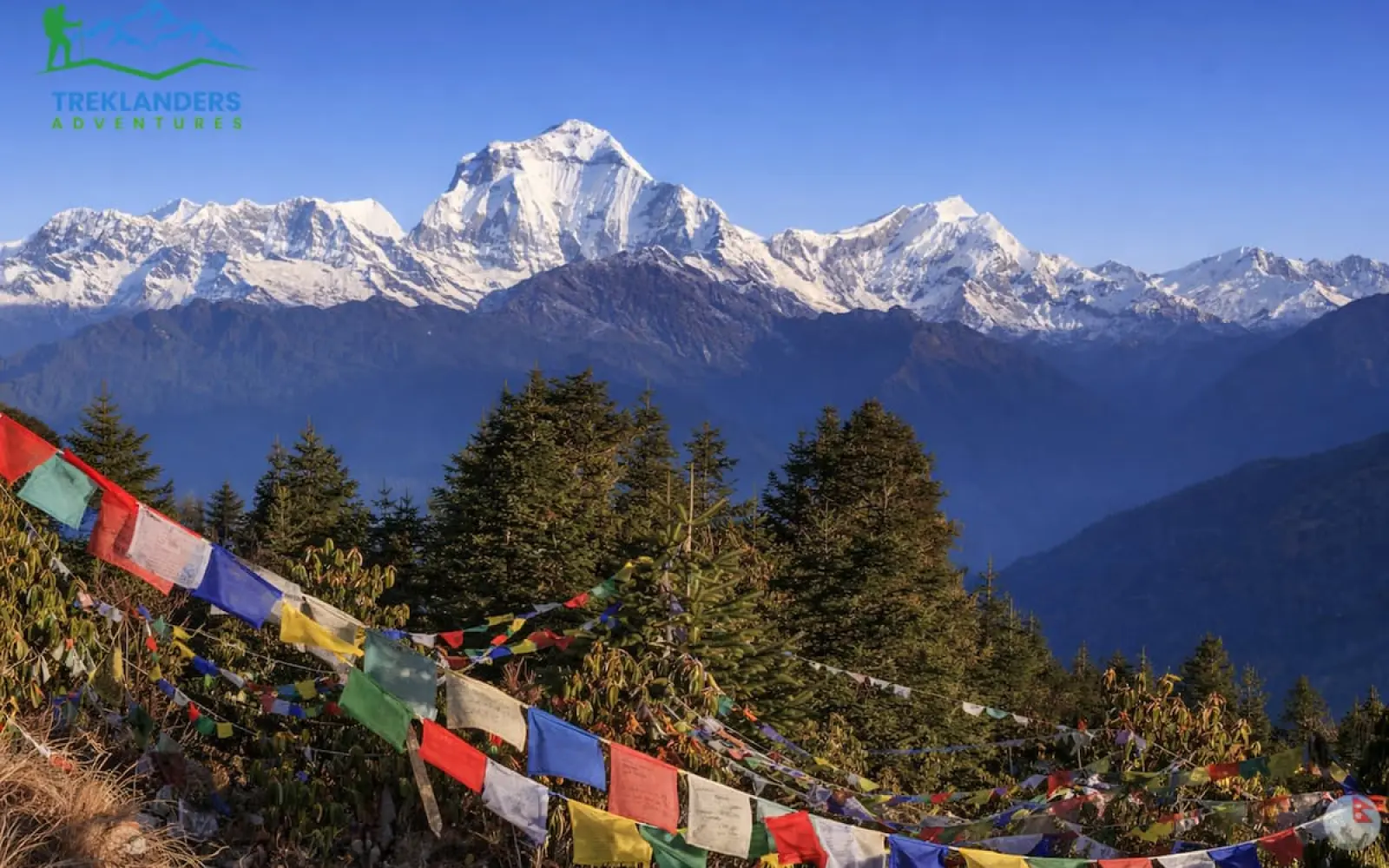
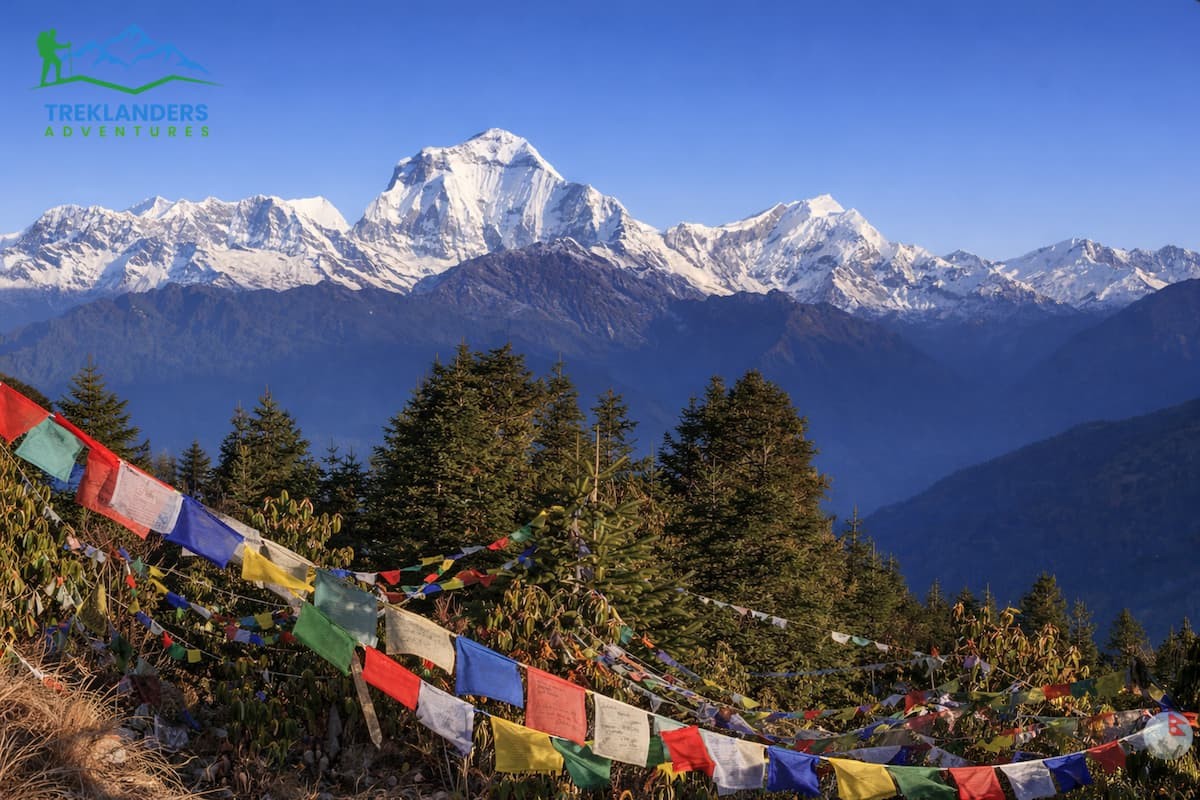
Poon Hill is famous for its extensive mountain panorama. Most trekkers arrive at the viewpoint before sunrise to have a splendid view of the sun touching the mighty Himalayas. Annapurna South, Dhaulagiri, Machhapuchhre, and Hiunchuli are some of the main peaks that become visible with the first light on the snow.
Generally, it is recognized that the best season for this trek is in the fall. The season normally lasts from late September to November. It is after the monsoon months that the air is fresh and free from dust and pollution. The sky is clear, and the views of the mountains in the whole Annapurna region are spectacular.
4-Day Ghorepani Ponnhill Trek from Pokhara | 4 days
Temperatures in autumn are still pleasant enough for trekking. Daytime temperature remains mild, generally ranging from 10 °C to 20 °C at mid-levels. Nightfall brings cooler air, particularly around Ghorepani, but overall, conditions are much more comfortable than in winter. With the help of clear skies, one is able to see sunrise views from Poon Hill without the interference of clouds.
Moreover, the paths in autumn turn into a hub of activity. A lot of trekkers head to the Annapurna region during this period because the weather is stable and the landscape looks amazing. Forests along the path are green after the monsoon.
Besides, waterfalls still have a good flow, and terraced farms near villages show the harvest season. On top of that, local culture is another aspect that autumn trekking brings us to. Nepal commemorates its major festivals, namely Dashain and Tihar, during this time of the year. That's why villages held to show decorations, family gatherings, and other festive activities for the tourists. The Ghorepani Poon Hill Trek in autumn is a good mix of nature, culture, and exercise.
Besides the amazingly clear Himalayan views, you will also have a very pleasant climate and be able to interact with the vibrant village life. The trek is quite short and simple, even first-timers will have no problems, and those who have experience in hiking and want a quick Himalayan adventure can do so.
Why Autumn is the Best Season for Ghorepani Poonhill Trek?
Magnificent Himalayan panorama from Poon Hill
Autumn is widely considered the best season for the Ghorepani Poon Hill Trek. The season usually runs from late September to November. During this period, weather conditions become stable, the sky turns clear, and trekking trails remain comfortable for walking. Many trekkers visit Nepal during these months because the mountains are easier to see and the trekking experience becomes more enjoyable.
Stable Weather Conditions
Autumn arrives in Nepal after the monsoon season. The heavy summer rains cleanse the atmosphere by washing away dust and pollution. Due to this, the weather stabilizes and turns dry. During this time, very little rain falls. The sky remains clear most of the time, and weather changes happen with less frequency than in spring or summer. Hikers will be able to stick to their plans without bearing the brunt of sudden rain or impassable trails. Stable weather means that not only mountain flights but also other forms of transport are more reliable as well. Flights from other popular trekking hubs like Kathmandu to Pokhara are rare, disrupting the smooth operation of flights during this season.
Clear Himalayan Views
One gets to see some of the clearest views of the Himalayas in Nepal during autumn. Since the monsoon rains have cleansed the environment, the entire Himalayan area is readily visible. From the acclaimed vantage point of Poon Hill, a wide scope of the mountain can be seen by trekkers. Some of the principal peaks one can expect to see from here are Annapurna South, Dhaulagiri, Machhapuchhre, and Hiunchuli. Watching the sun rise at Poon Hill is probably the pinnacle of the trek. With the arrival of the sun, the snow-capped peaks are gradually bathed in the warm golden light. This spectacle is a magnet not only for photographers but also for trekkers from across the globe.
It is comfortable to trek during the autumn season as temperatures do not fluctuate drastically. The climate is warm enough that it is not necessary to wear many layers, but it is also not so warm that you will be sweating a lot. Daytime temperatures at lower level such as at Tikhedhunga or Ulleri, usually hover between 15C and 20C. Ghorepani, a village situated at a high level, is generally chillier, particularly during the early hours of the morning and at night. Nighttime temperatures could get as low as 5 °C, but one hardly feels the cold. The temperature range is pretty moderate and comfortable, so don't worry about melting under the sun or getting frostbite on your fingers; you should be able to do longer hikes.
Colorful Forests and Landscapes
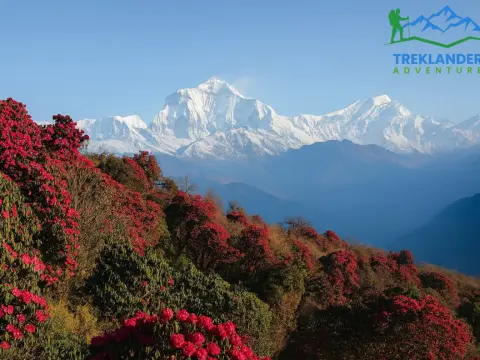
The Annapurna's autumn landscape is a vivid and colorful one. The greenery of the forests after the monsoon rains adds to their beauty. The paths mainly go through the thick rhododendron and oak woodlands of the Annapurna Conservation Area. Not only fields, but farms too get into full swing this season. Simple people are busy processing rice and millet. Trekkers can look at golden fields and active villages along the way. This scene adds a cultural dimension to the trekking experience.
Peak Trekking Season in Nepal
Autumn is by far the most popular trekking season in Nepal. Every year, thousands of trekkers find their way to the Annapurna region at this time of the year. What makes it so attractive are the pleasant weather conditions, which are pretty stable, the clear and spectacular views, and the overall comfortable conditions for trekking. Moreover, big festivals like Dashain and Tihar are usually celebrated around this time of the year. When trekkers pass through villages along the trail, they might come across decorated houses, hear traditional music and see that the whole community is out celebrating. It's really the combination of good weather, clear views of the Himalayas, moderate temperature, and the vibrant local culture that makes autumn the perfect season to go for the Ghorepani Poon Hill Trek.
Weather and Temperature during Autumn
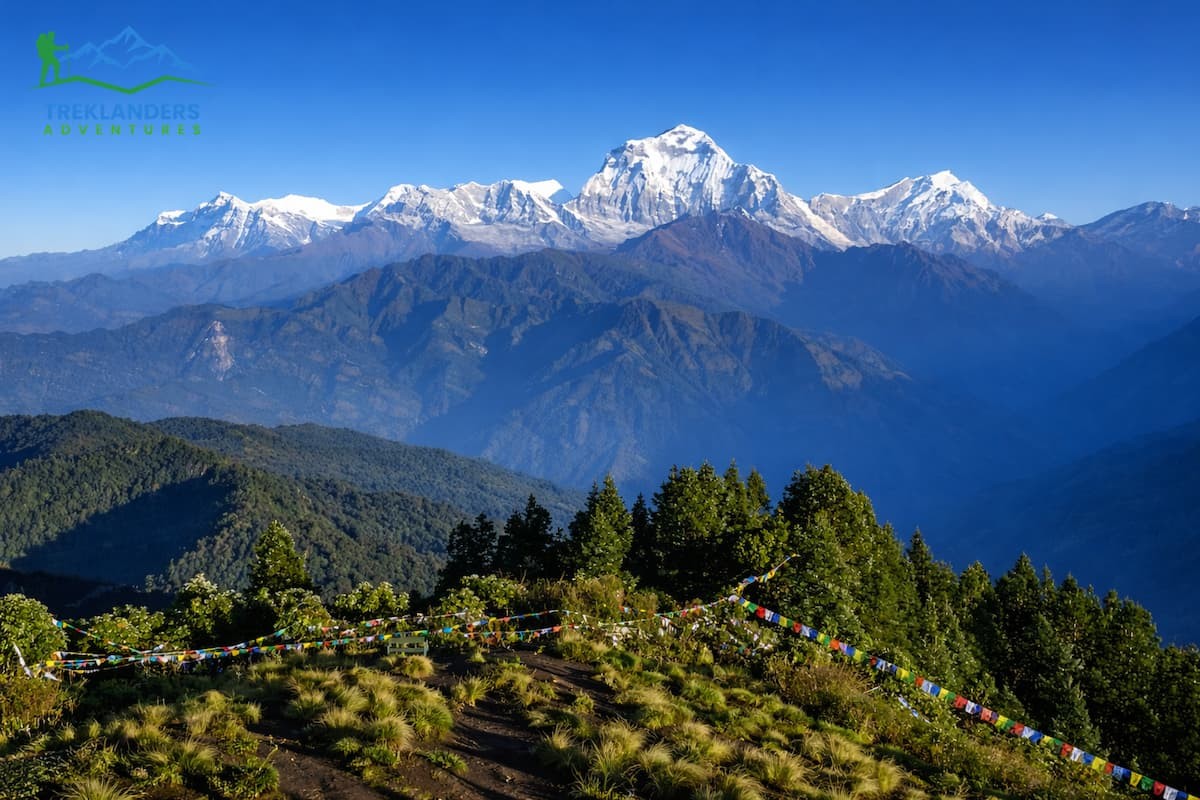
Breathtaking mountain views of Annapurna South from Ghorepani
Autumn brings stable weather and Clear Mountain views to the Annapurna region. The season lasts from September to November. Many trekkers choose this period for the Ghorepani Poon Hill Trek because the air becomes clean after the monsoon and the skies stay mostly clear. Temperatures remain comfortable for walking, and the chance of heavy rain is very low.
September marks the transition from the monsoon season to autumn. Early in the month, light rainfall can still occur in some areas, but conditions improve quickly as the monsoon ends. The landscape looks fresh and vibrant because of the recent rain. Forests appear dense and green, and streams and waterfalls remain active along the trails.
The route passes through forests inside the Annapurna Conservation Area, where vegetation looks especially lush during this time. Daytime temperatures usually range between 18°C and 22°C in lower villages along the trail. Higher locations such as Ghorepani remain cooler, with daytime temperatures around 15°C to 18°C. Nights become cooler but still comfortable, often dropping to around 8°C to 12°C. Mountain visibility begins to improve toward the end of the month as clouds gradually clear.
October is generally regarded as the prime month for trekking in Nepal. The monsoon season is completely over, the weather conditions become highly stable, and it is not uncommon for the skies to be clear for several consecutive days, allowing trekkers to have uninterrupted views of the Himalayas. Most parts of the trail experience daytime temperatures between 15 °C and 20 °C, which makes hiking quite comfortable. As for the nights, they get cooler than in September. This is significantly true for the higher villages like Ghorepani, where the temperature can often be around 5 °C to 8 °C.
Visibility in October is exceptional. People who go trekking to the Poon Hill viewpoint get a magnificent sight of the Himalayan peaks around them, the most prominent ones being Annapurna South and Dhaulagiri. The sunrise views in that month are very much in demand since the sky is generally cloudless. November in the Annapurna region is the late autumn season. The weather is dry and quite stable; however, temperatures slowly drop as the arrival of winter gets nearer. Usually, daytime temperatures fluctuate between 12 °C and 18 °C, which is still quite conducive for trekking. Night temperatures take a downward turn, and this is especially the case in the higher regions. In fact, Ghorepani may experience temperatures close to 0 °C to 5 °C.
Although it is a bit freezing, the mountain views start to become even more spectacular since the air remains dry and crystal clear. There is a large number of trekkers who think that November is the month with the highest chances for seeing the Himalayan scenes in their full glory. The Poon Hill sunrise often offers the most piercing and intricate mountain range sights during the season.
Scenic Beauty of Ghorepani Poonhill Trek in Autumn
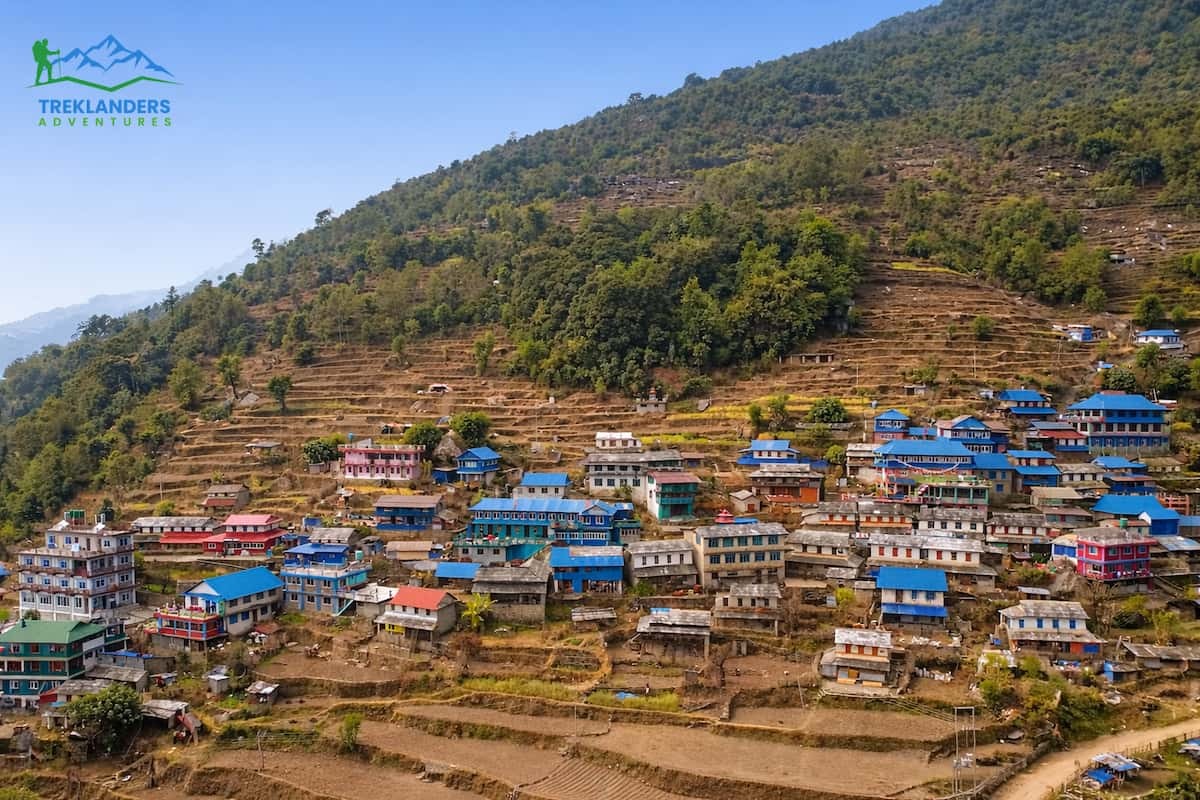
Stunning views of Ghorepani village and the surrounding mountains.
The Ghorepani Poonhill trek is famous for its stunning landscapes and mountain views. The trail becomes even more appealing in autumn since the air is clear and the forests stay green after the monsoon season. A trekker on the Ghorepani Poon Hill Trek will come across a combination of forested areas, farmland, traditional villages, and magnificent Himalayan scenery.
Most of the path goes through thick rhododendron and oak forests. You will find these forests located within the boundaries of the Annapurna Conservation Area. The trees create overhead canopies that make your walk enjoyable during the day. The forest in autumn is green and fresh thanks to the monsoon rains. Rocks, tree trunks and even the ground are covered in moss, and small streams are encountered in several places crossing the trail. The overall silence of the forest makes this part of the trek incredibly relaxing. The trek reveals more than just the forest.
It also meanders through splendid terraced agricultural landscapes. Settlements such as Ulleri and Ghorepani are set on the hillsides enclosed by farmers' fields. The locals on terraces cultivate rice, millet, and corn. In autumn, when most of the fields are ripe and ready for harvest, their colour turns golden, resulting in a very picturesque setting along the trekking route. As you pass through these villages, you may see farmers engaged in their daily work.
10-Day Ghorepani Poonhill with Annapurna Base Camp Trek | 10 days
Another feature of autumn is the gentle warm hues of the hills and woodlands. After the monsoon, the rays of the sun grow more distinct, and the sides of the hills look resplendent in the morning and evening. Thanks to the crystal-clear skies, hikers can relish the vast panoramas of the neighboring valleys and mountain ridges. It is the mixture of woodlands, settlements, and grasslands that makes the trek a visually satisfying experience from start to end.
In fact, the most amazing part of the trek is the grand mountain vista from Poon Hill. Normally, Poon Hill visitors start their day expedition to this spot very early to view the sunrise over the Himalayas, and it is really worth it. A vast number of snow-capped mountain peaks can be seen at the top.
A few of the prominent mountains that can be spotted from Poon Hill are Annapurna South, Annapurna I, Dhaulagiri, Machhapuchhre, and Hiunchuli. As soon as the sun appears above the horizon, the rays gradually dye the white peaks in golden and orange hues.
Nothing beats this sunrise viewing of mountain peaks as one of the most famous mountain panoramas in Nepal. The presence of forest paths, traditional settlements, vibrant farmlands, and clear Himalayan views together makes the Ghorepani Poon Hill Trek very attractive during the fall season.
Poon Hill Sunrise Experience in Autumn
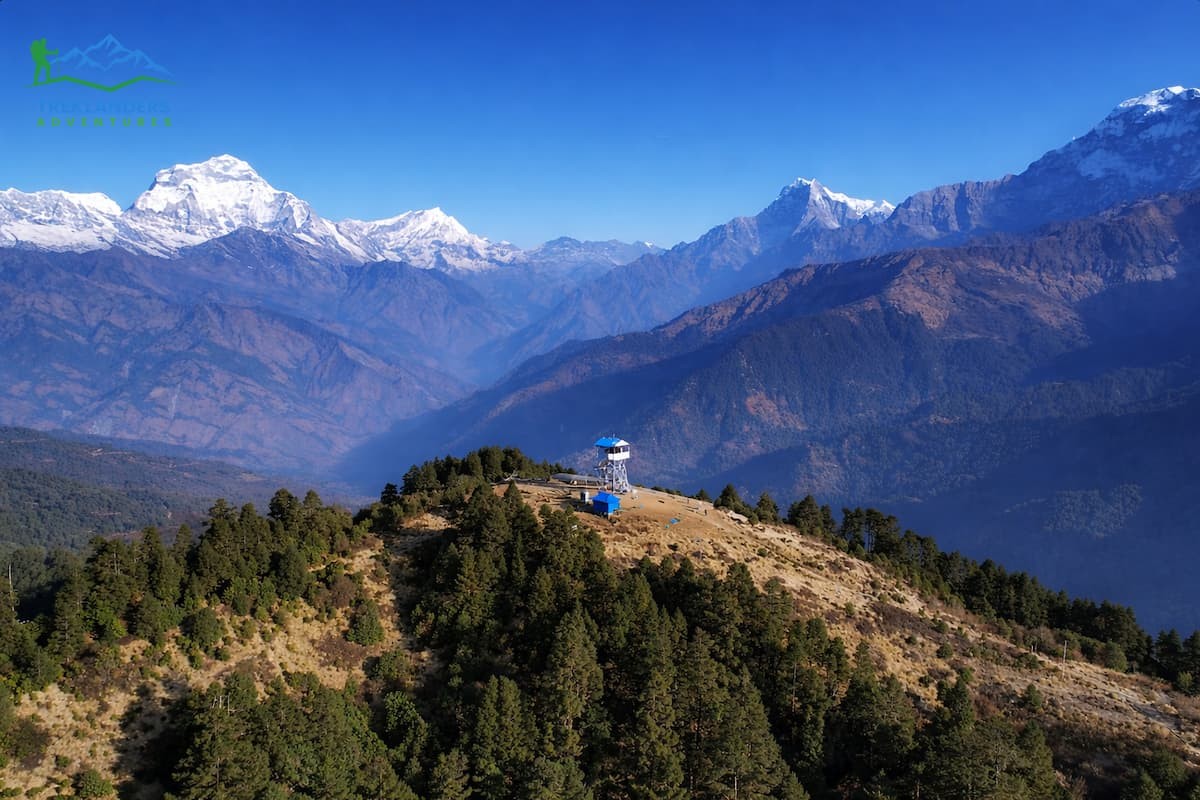
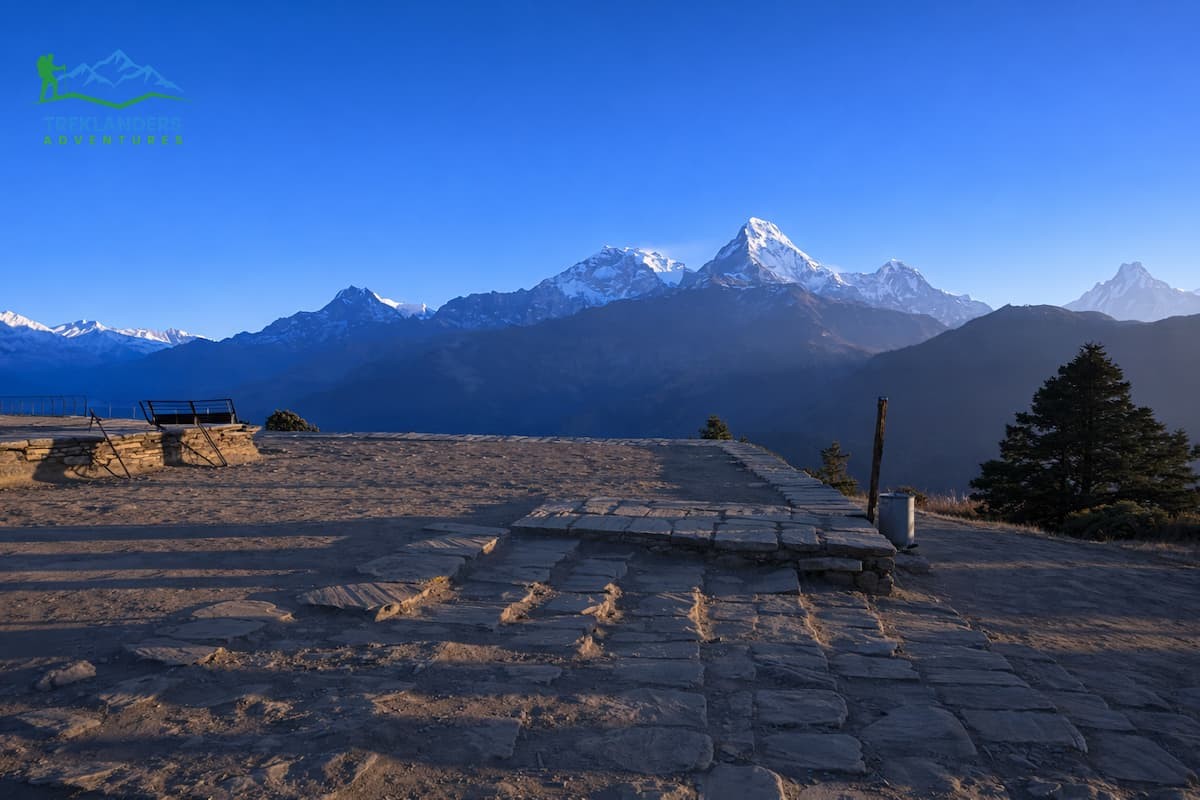
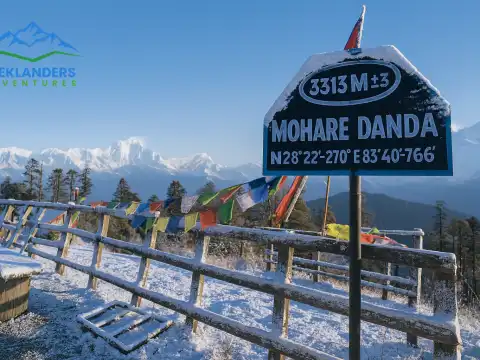
Poon Hill View Tower for Sunrise Views of the Himalayas
Usually, trekkers start hiking in the morning from the village of Ghorepani. They go before the sun comes up, usually at 4:30 or 5:00. The path goes up moderately through a forest trail and stone steps. Depending on one's pace, the journey should take 40 to 60 minutes. Most trekkers bring headlamps or flashlights as the path stays dark before sunrise.
Once they arrive at Poon Hill summit, it is a large open platform that provides a view of the Himalayan ranges. As the dawn light reaches the horizon, the sky gradually shifts colour from navy blue to orange and pink. The snow-clad peaks start to shine as sunlight touches them.
7-Day Annapurna Base Camp Trek from Pokhara | 7 days
Concerning the viewpoint, trekkers see a vast Himalayan panorama. The scene encompasses well-known mountains like Annapurna South, Annapurna I, Dhaulagiri, Machhapuchhre, and Hiunchuli. As the sun climbs higher, the golden light covers the whole mountain chain. The peaks rise above the deep valleys and the gentle rolling hills, forming a spectacular natural sight.
One of the very best seasons for photography at Poon Hill is autumn. The clear skies after the monsoon bring great visibility. The mountains look quite sharp and clear in photos. The colors changing during sunrise also cause very dramatic lights for photographs. Most of the photographers get there quite early so that they can get the very first sun on the mountain tops.
What also makes the whole thing so awesome is the sense of accomplishment after the climb to the lookout point. Hikers sit on the peak and watch the changing colors of the mountains during sunrise in silence. The serenity of the place, the fresh air of the morning, and the vastness of the Himalayas together create a special sensation, which many people have come to associate with the memory of this trek.
Due to clear weather conditions, dramatic sunlight at sunrise, and an extensive mountain panorama, the Poon Hill sunrise has continued to be the most iconic and inspiring moment throughout the whole Ghorepani Poon Hill Trek in autumn.
Popular Ghorepani Trek Itinerary (4 Days)
The Ghorepani trek is one of the most popular short trekking routes in the Annapurna region. The journey offers forest trails, traditional villages, and famous Himalayan views within a few days. Most trekkers complete the trek in four days, starting from Pokhara. The route passes through beautiful mountain villages before reaching the viewpoint at Poon Hill.
Day 1: Drive from Pokhara to Tikhedhunga and trek to Ulleri
Ulleri- Ghorepani Poonhill Trek
The journey begins with a scenic drive from Pokhara to Tikhedhunga. The road passes through small villages, terraced fields, and river valleys. The drive usually takes about three hours. From Tikhedhunga, the trekking trail begins with a gradual climb toward Ulleri village. The path includes famous stone steps that climb through the forest and farmland. Ulleri sits on a hillside at around 2,050 meters. The village offers beautiful views of the surrounding hills and traditional stone houses. The trek from Tikhedhunga to Ulleri usually takes about two hours.
Day 2: Trek from Ulleri to Ghorepani
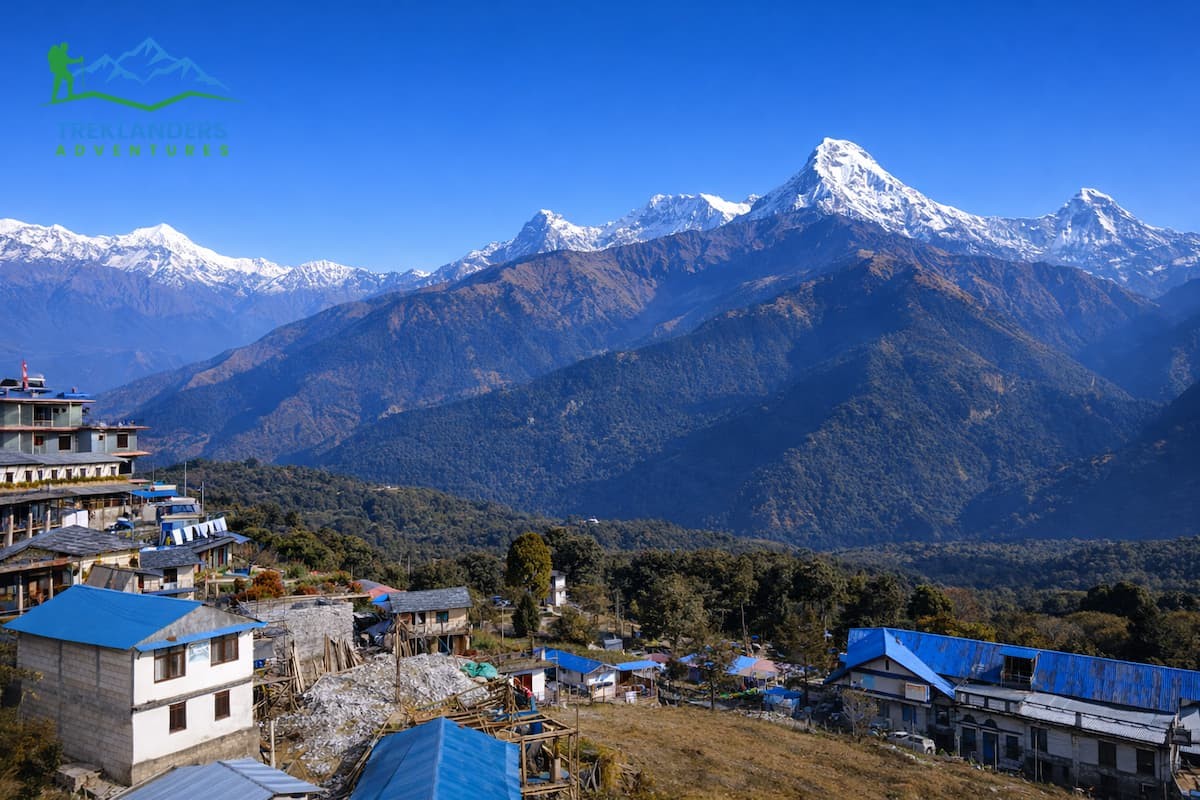
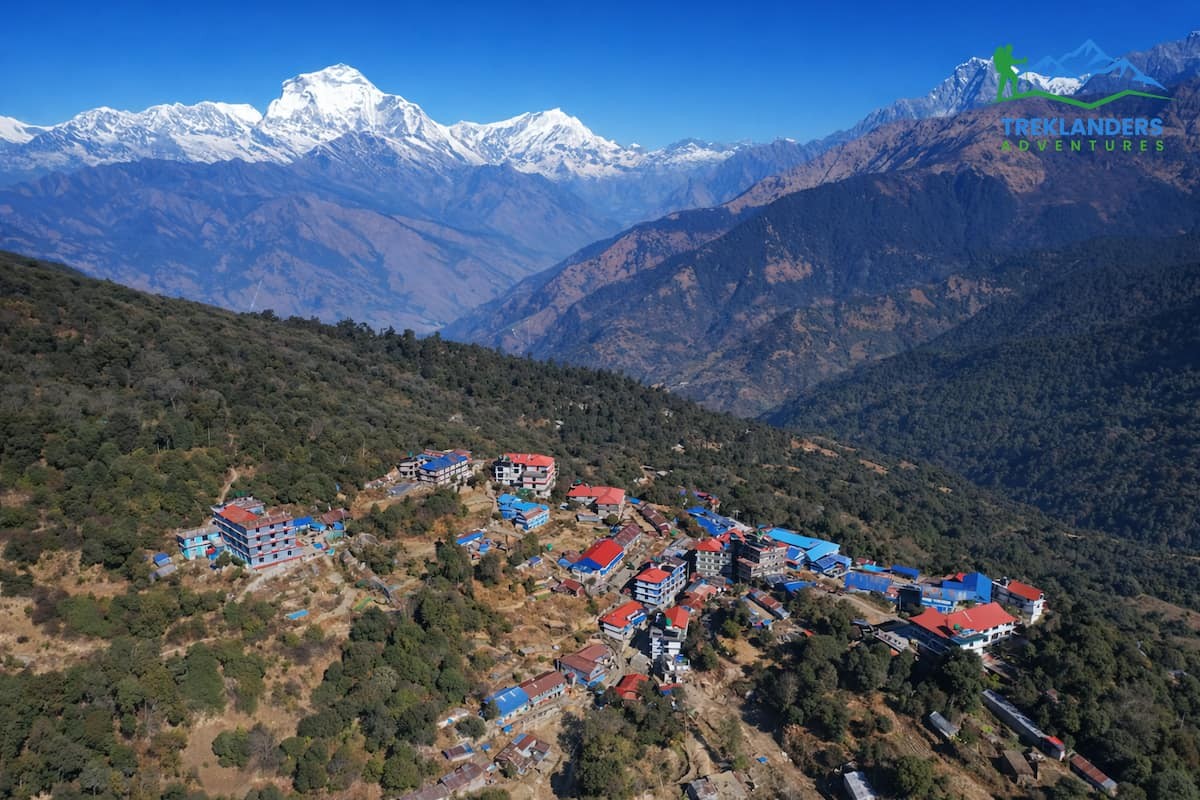
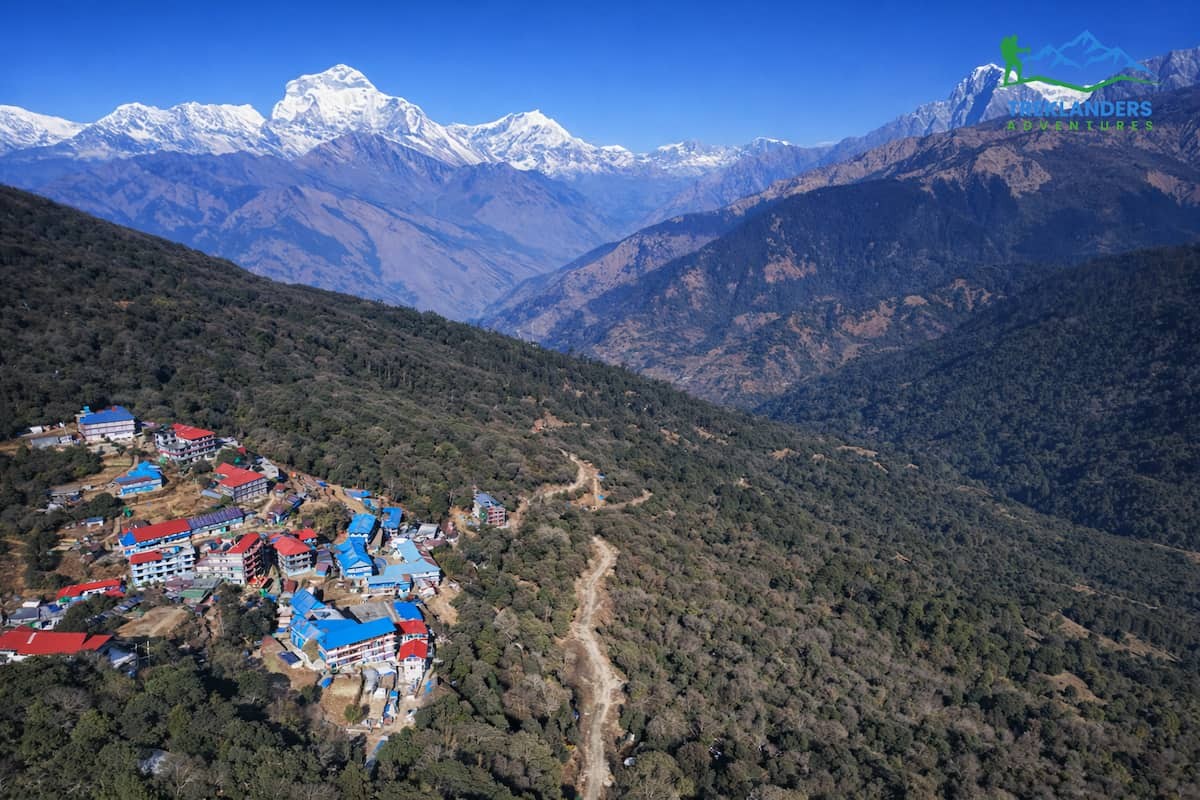
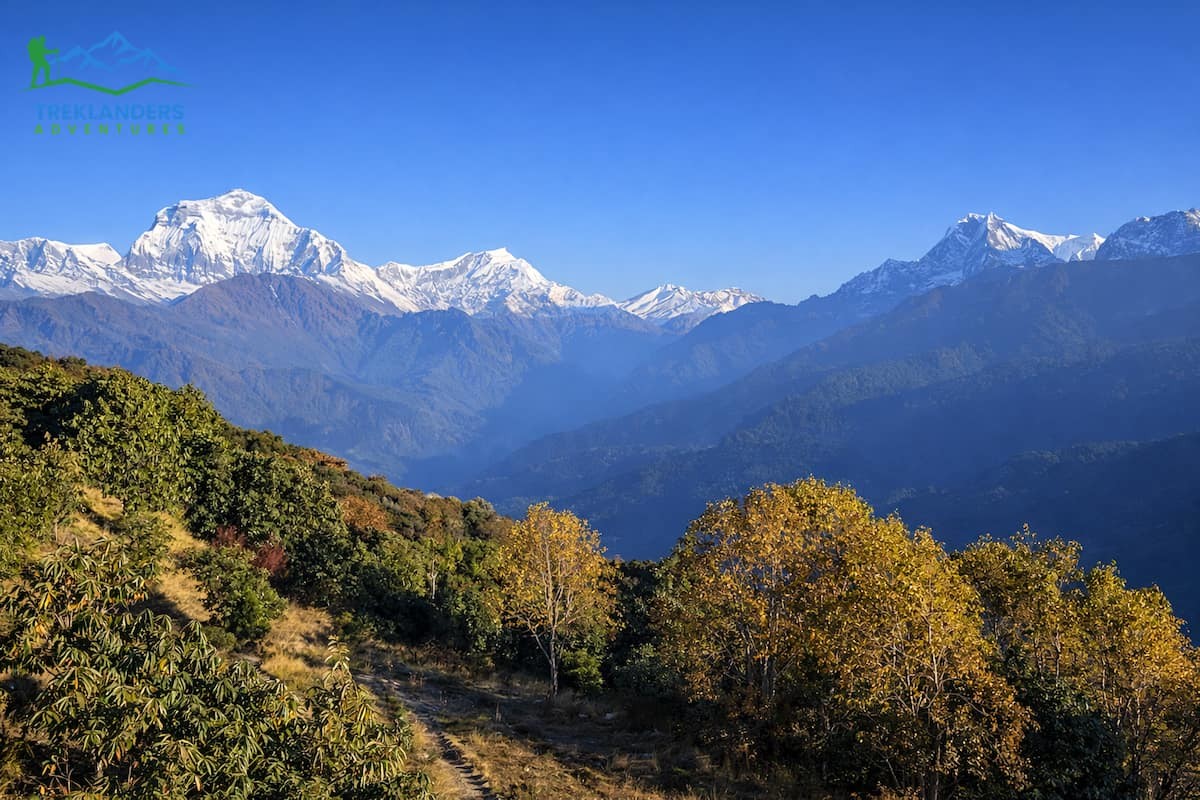
Scenic View of Ghorepani Village with Dhaulagiri Mountains
The second day leads deeper into the forests of the Annapurna Conservation Area. The trail passes through dense rhododendron and oak forests. During autumn, the forests remain green and peaceful. Trekkers gradually gain altitude as they walk toward the village of Ghorepani at 2,885 meters. The journey normally takes around four hours. Ghorepani is a popular trekking stop with many lodges and teahouses. From the village trekkers can already see views of mountains such as Annapurna South and Dhaulagiri.
Day 3: Sunrise hike to Poon Hill and trek to Tadapani
Poon Hill
The third day begins early in the morning with a hike to Poon Hill. The climb takes around 40 to 60 minutes from Ghorepani. From the top, trekkers enjoy sunrise views across the Annapurna and Dhaulagiri mountain ranges. After enjoying the view, trekkers return to Ghorepani for breakfast. The trail then continues through forests and mountain ridges toward Tadapani at 2,640 meters. The full walking time for the day is about six hours.
Day 4: Trek to Ghandruk and drive back to Pokhara
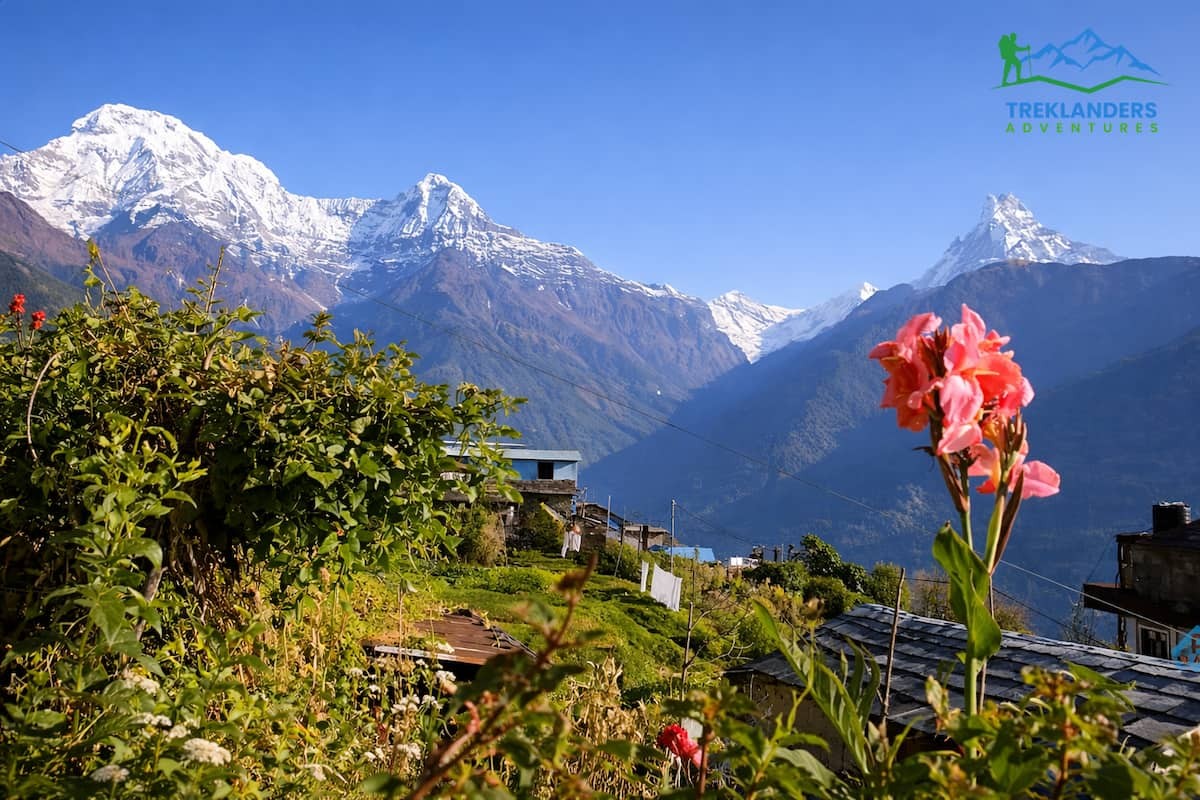
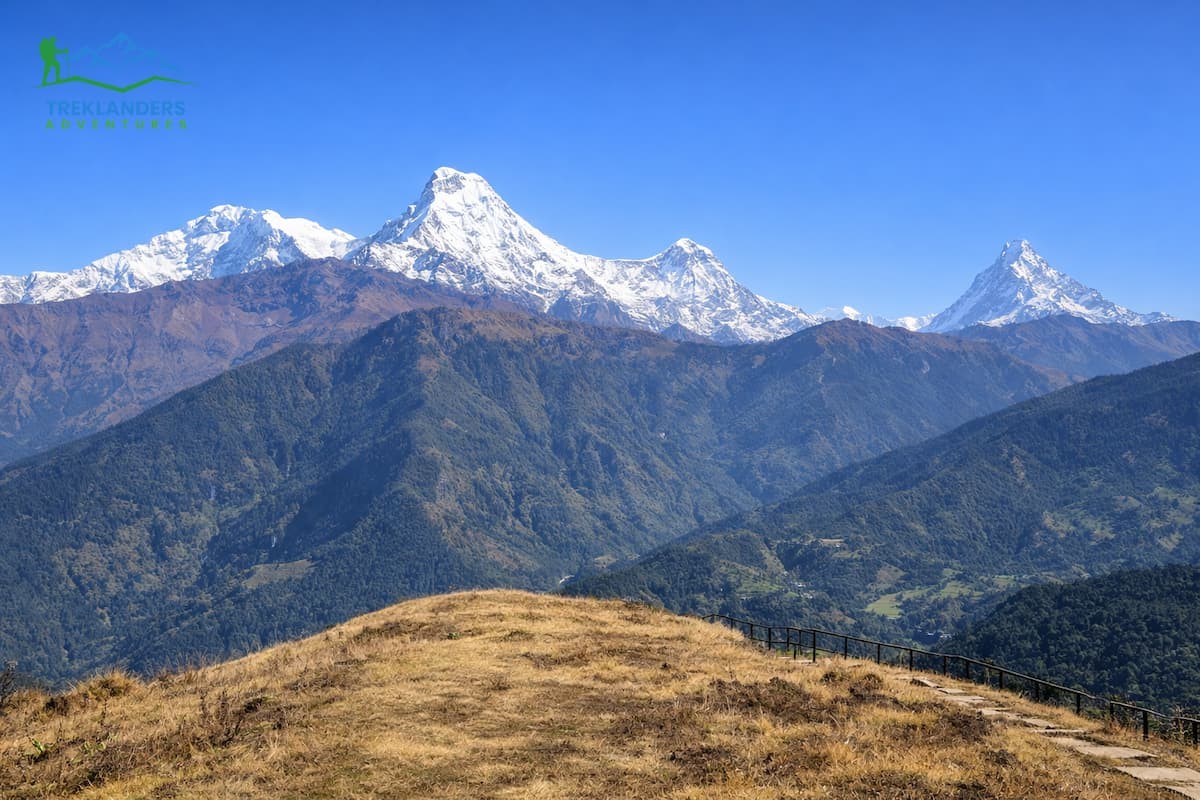
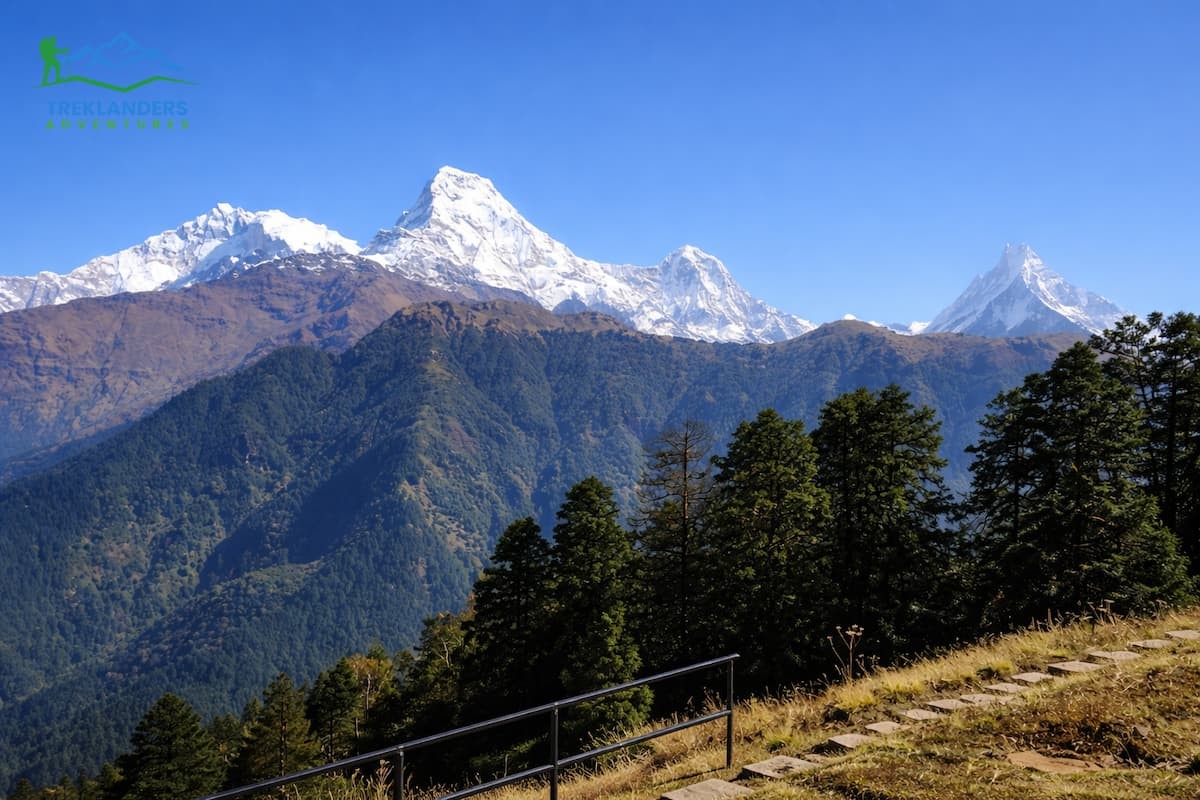
Beautiful views of Annapurna South and Fishtail from Ghandruk.
The final day follows a descending trail through forest paths toward the traditional Gurung village of Ghandruk. The village offers beautiful mountain scenery and traditional culture. After exploring Ghandruk, trekkers take a vehicle back to Pokhara. The total travel time for the day is usually around six hours, including the trek and drive. This short itinerary allows trekkers to experience forests, villages, and Himalayan views in a limited time.
Difficulty Level of the Ghorepani Trek
Beautiful views of Annapurna South and Fishtail from Gurung Hill.
The Ghorepani Poon Hill Trek is generally regarded as one of the easy-to-moderate trekking routes in Nepal, which is why many travellers opt for this one - not only does it give you stunning mountain views, but it also doesn't require a background in trekking or advanced experience. The trail leads to established paths and goes through a few villages where you can find well-equipped teahouses. These factors make the trek pretty nice for both beginners and experienced hikers.
The trekking is done within the Annapurna Conservation Area. Along the way, you will see forests, farmland, and villages that are up in the mountains. Most of the time, the paths are made up of stone steps or compact dirt trails. There is no need for technical climbing skills or special gear.
Apart from this, one of the ways the trek is friendly to beginners is the small amount of time spent walking each day. Normally, people on the trek walk four to six hours each day. As always, the pace of walking is constant but with breaks for rest, food, and even taking pictures. Moreover, since the trek is near villages, trekkers can easily stop for tea or each along the way.
The first day often involves a climb up the Ulleri village. This, which is a stretch of about a thousand stone steps. Although technically this climb may be one of the most difficult, the path is still very safe and goes up gradually. After this part, the trail becomes easy-going as it follows forested ridges and gentle slopes.
Altitude has a major influence on how difficult a trekking route is. Among the highest venues on this trek is the viewing area at Poon Hill, which is 3,210 meters above sea level. The majority of trekkers make it to this viewing area after beginning their hike very early in the morning from the village of Ghorepani. As the altitude is quite moderate compared with other Himalayan treks, the risk of serious altitude sickness is very low.
Even if the height that you gain on the trek isn't very large, you still should walk at a pace that is comfortable to you and make sure to supply your body with sufficient water. Adequate sleep and good eating will support the body in getting used to the altitude. Besides that, the good infrastructure all along the route is another major reason for the popularity of the Ghorepani trek.
Besides Ghorepani, there are other scattered small villages, such as Ghandruk, where you will have the availability of cozy lodges, restaurants, and other very basic services. Due to such facilities, the trek becomes relatively easy and hanging around for beginners also becomes quite safe. Due to the combination of reasonable walking hours, well-marked trails, and a moderate altitude, the Ghorepani Poon Hill Trek has become a very popular choice as one of the best introductory Himalayan treks. The itinerary provides the opportunity for trekkers to enjoy forests, mountain scenery, and traditional villages without having to work physically beyond their limits.
Accommodation and Food on the Trek
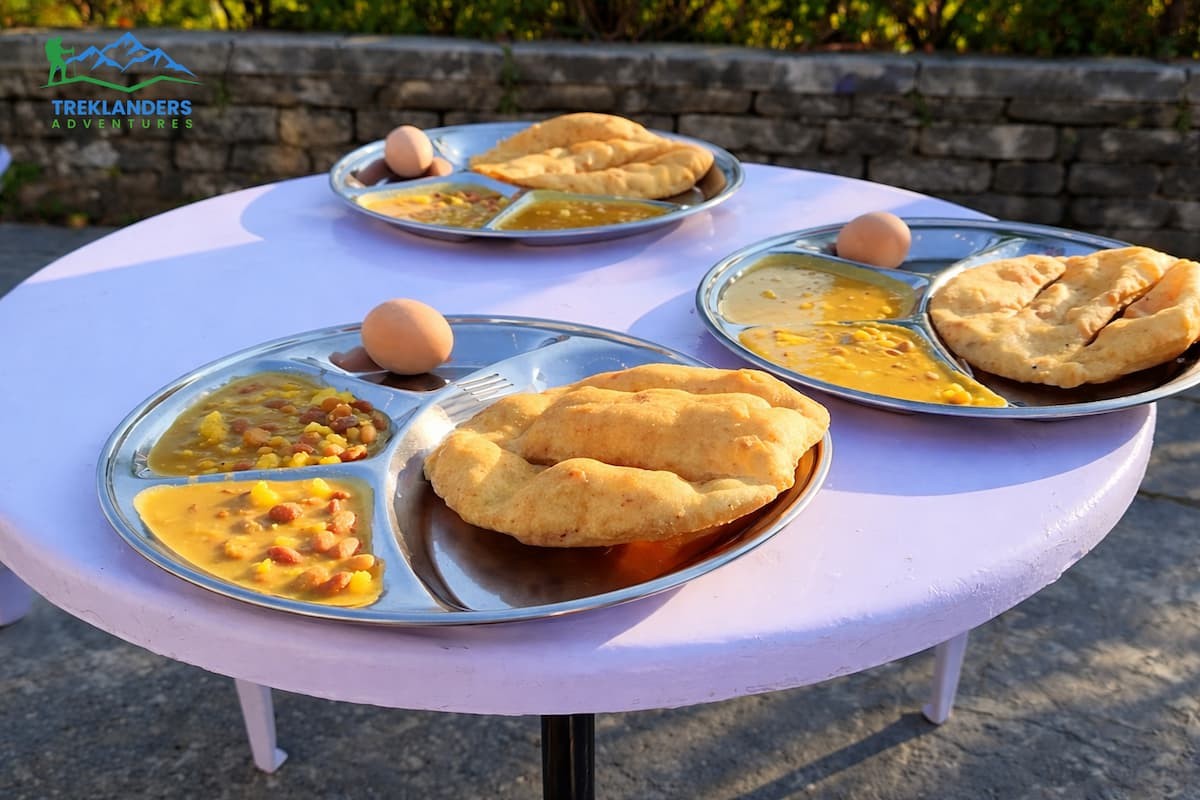
Food (Breakfast) served during Ghorepani Poonhill Trek
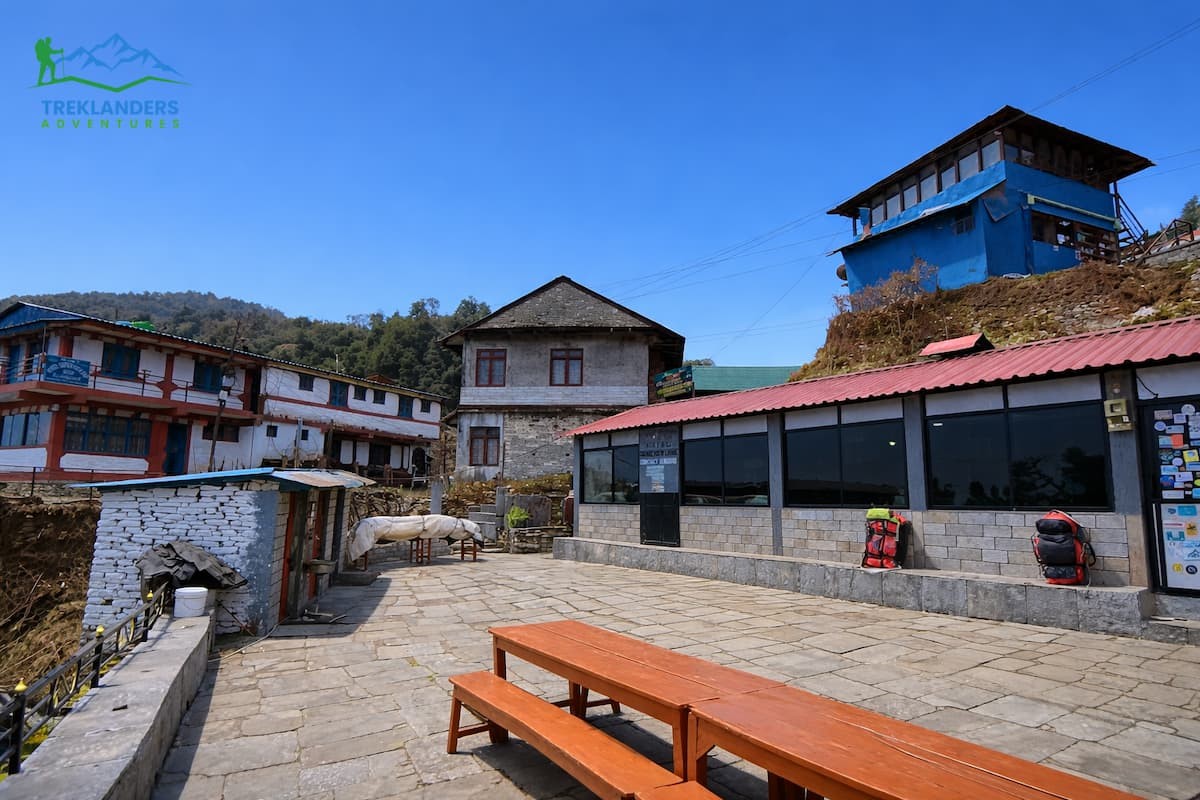
The accommodation on the Ghorepani Poon Hill Trek is very basic but decent and adequate for a trekking holiday. Most trekkers rely on the tea houses and Small Mountain lodges to take care of them overnight during the trek. Usually, these small family-run lodges give you simple rooms, wholesome meals, and a place to lie down and relax after the day's walking. As the trekking trail passes through the Annapurna Conservation Area, many local villages have set up visitor facilities.
Tea houses normally provide separate rooms with two beds, blankets, and pillows. The rooms, though quite basic, are clean. The bathrooms are usually shared with other trekkers, but some lodges, especially those located in bigger villages, can give you an attached bathroom. At places like Ghorepani and Ghandruk, the lodges are somewhat bigger and provide more comfortable facilities.
Most tea houses have a big common dining room where hikers come together for meals and to unwind. Often these dining rooms have a stove right in the center which makes the room quite cozy even after a very cold night. Trekkers usually spend their time here chatting, sipping tea, and exchanging their travel experiences. The trek food is delicious though unpretentious.
Teahouse Lodges at Ghorepani
Tea house menus have several dishes that release sufficient energy for extensive trekking days. Among the dishes, the most frequent and most liked is Dal Bhat. It is a traditional Nepali dish consisting of rice, lentil soup, vegetable curry, and pickles. The reason why Dal Bhat is so popular with the trekkers is that it is very satiating, and at quite a few lodges, it is customary to serve the meal with free refills.
Other popular meals are noodles, fried rice, pasta, and soups. Besides being quick and simple to make, these dishes also provide the necessary energy for trekking. Most breakfasts, for instance, consist of pancakes, porridge, eggs, and toast. Among the early morning trekkers, pancakes topped with honey or jam are a favorite. Alongside the trail, hot drinks are abundantly available. Tea houses offer various kinds of teas such as black tea, milk tea, ginger tea, and lemon tea.
Coffee is also served in the majority of the lodges, but it is mostly just plain instant coffee. A lot of trekkers appreciate having a hot beverage in the evening whilst they are taking a break after the day's trekking. Because supplies have to be hand-carried by porters or mules all the way up the mountain, food prices go up gradually with the altitude. However, it is still possible for trekkers to locate a decent assortment of meals all along the trek.
The tea house system on the Ghorepani Poon Hill route is so well developed that it allows trekkers to comfortably travel without camping gear or bulk food supplies.
Trekkers should get two permits for the Ghorepani Poon Hill Trek. These permits not only let visitors enter protected hiking areas but also enable authorities to keep track of trekkers for their safety and conservation purposes. Since the Ghorepani trek is inside the Annapurna Conservation Area, everyone going to this area must have permits.
One of the permits is called the Annapurna Conservation Area Permit (ACAP). This permit is necessary for anyone who wishes to enter and travel through the Annapurna Conservation Area. The Conservation Area is a protected area where local forests and wildlife are preserved, and traditional villages are supported. The monies from the permit fee go to fund conservation and protection efforts, keep trails in good condition, and support community programs aimed at the local people.
A second required permit is the TIMS Card, short for the Trekkers Information Management System. This card keeps a record of information relating to trekkers in Nepal. The authorities' main reason for having this information is to be able to locate and assist travelers in times of emergencies. Besides, it is also used for proper management of the trekking routes, only in busy areas like the Annapurna region.
Those intending to go trekking can also get the permit in any big city before leaving. Most trekkers get their permits either in Kathmandu or Pokhara. If you want to get the permit in Kathmandu, the most common approach is to visit the Nepal Tourism Board office. If you choose Pokhara, you will find the permit counter in the lakeside area. Additionally, trekking agencies can also arrange permits for travelers as part of the package.
To apply for these permits, trekkers normally need a passport copy and a passport-sized photo. The process is simple and usually takes only a short time if the offices are not busy. Many trekkers prefer obtaining permits in Pokhara because it is the main starting point for the Ghorepani Poon Hill Trek.
The cost of permits is reasonable compared to longer Himalayan treks. The Annapurna Conservation Area Permit typically costs about NPR 3,000 for foreign trekkers. The TIMS card usually costs about NPR 2,000 for individual trekkers. Prices may change slightly depending on government regulations.
During the trek, trekkers must show these permits at several checkpoints along the trail. Officials check permits when entering villages or conservation area gates. Trekkers should carry these documents at all times during the trek.
Autumn ranks as the favorite season for trekking in the Annapurna area. The chief perk is that the mountains can be seen clearly. Normally, after the summer rains, not only dust and clouds but also haze and smoke get washed from the air and the Himalayas stand out as crystal and extraordinary. So, from a scenic spot like Poon Hill, trekkers can clearly spot the main peaks of Annapurna South, Dhaulagiri, and Machhapuchhre. Also, the sunrises are superb with the snow-covered mountain tops being lit up with a soft golden light. Another reason why the weather is a plus for the tourist visitor to Nepal is that it does not go to extremes. Daytime temperatures are quite pleasant and quite dry, which makes for comfortable walking. At the lower levels, it is not hot, and at the higher villages like Ghorepani, it is not very cold. However, nights remain cool, but people can get used to it. Since the sky frequently remains blue and the condition of the atmosphere becomes nearly constant, the result is that the probability of rain or storm is minimized, hence giving the trekkers a chance to stick to the itinerary they had planned without any problem.
Moreover, autumn is the time when Nepal's most prominent festivals like Dashain and Tihar are held. A long bright dash of religious fervor and zest to life, the villages along the trek routes are decked with lights, festive ornaments, and cultural events. Passing through these villages, trekkers have the opportunity to see local customs, form close-knit family circles, and have a good time. Besides, all this will augment their cultural experience of trekking, which is quite unnoticeable at any other time of the year.
Along with that, hiking trails are the most vibrant in the fall. Since many people pick that time of year for hiking, the trails are bustling but not packed to the point that you feel uncomfortable. Encountering other hikers from all over the world is stimulating, and the villages that you hike through will be open tea houses and hotels that will gladly take in visitors. Putting together sharp mountain vistas, wonderful weather, an exuberant village setting, and animated trails, one may call autumn the most pleasant and satisfying time for the Ghorepani Poon Hill Trek.
Conclusion
Beautiful mountain views from Gurung Hill during the Ghorepani Poon Hill Trek.
The Ghorepani Poon Hill trek is a short and worthwhile Himalayan adventure. Autumn brings with it crystal clear mountain views, pleasant weather for walking, and extremely colorful forests. The villages along the way reveal local lifestyles and culture, especially during the festivals like Dashain and Tihar, which give the cultural aspect of the trip a more distinct flavor.
Generally, the daily walking hours are not too long, and the paths are well-kept. Tea houses offer good comfort and meals. The trek is thus really easy to do without carrying heavy camping gear. The biggest perks of the trek are a sunrise from Poon Hill and an uninterrupted view of the mountains such as Annapurna South, Dhaulagiri, and Machhapuchhre.
This time of the year (September to November) is favorable due to stable weather, outstanding visibility, and busy trails. People who go trekking will see the combination of the three-day natural beauty, urban life, and scenic Himalayan views. The GhorepaniPoon Hill Path/Trail is still one of the easiest and most popular ways to reach the beautiful Annapurna Himalayan mountain region.