[{"name":"Everest Base Camp Trek","duration":"16","image_url":"https:\/\/www.treklanders.com\/storage\/trip-galleries\/1\/thumb_419a755c003cc609f3030ee332965ebe.jpg","offer_price":1405,"url":"https:\/\/www.treklanders.com\/trips\/everest-base-camp-trek"},{"name":"Gokyo Valley Trekking","duration":"16","image_url":"https:\/\/www.treklanders.com\/storage\/trip-galleries\/2\/thumb_676d1021b574aeba4d19d3f2a0b04ed2.webp","offer_price":1205,"url":"https:\/\/www.treklanders.com\/trips\/gokyo-valley-trekking"},{"name":"Annapurna Circuit Trek","duration":"23","image_url":"https:\/\/www.treklanders.com\/storage\/trip-galleries\/3\/thumb_2a9a92ea23c62f41de27b37f5e3e8c17.webp","offer_price":1495,"url":"https:\/\/www.treklanders.com\/trips\/annapurna-circuit-trek"},{"name":"Everest Panorama Trek","duration":"12","image_url":"https:\/\/www.treklanders.com\/storage\/trip-galleries\/4\/thumb_35c9f677ea2e88b1ff11a9f43daa3ddb.jpg","offer_price":1100,"url":"https:\/\/www.treklanders.com\/trips\/everest-panorama-trek"},{"name":"Everest Base Camp Trekking from Jiri","duration":"22","image_url":"https:\/\/www.treklanders.com\/storage\/trip-galleries\/6\/thumb_14763592492417b294aa66bf0ebf4e64.webp","offer_price":1400,"url":"https:\/\/www.treklanders.com\/trips\/everest-base-camp-trekking-from-jiri"},{"name":"Everest Base Camp via Cho la Pass from Gokyo Valley Trekking","duration":"18","image_url":"https:\/\/www.treklanders.com\/storage\/trip-galleries\/7\/thumb_d4e470e98d4e9e2ab8e93e39b8b7d252.jpg","offer_price":1405,"url":"https:\/\/www.treklanders.com\/trips\/everest-base-camp-via-cho-la-pass-from-gokyo-valley-trekking"},{"name":"Everest Three Passes Trekking","duration":"22","image_url":"https:\/\/www.treklanders.com\/storage\/trip-galleries\/8\/thumb_b413b221e913171500bb3dfd5c08ceea.jpg","offer_price":1635,"url":"https:\/\/www.treklanders.com\/trips\/everest-three-passes-trekking"},{"name":"Annapurna Base Camp Trekking","duration":"14","image_url":"https:\/\/www.treklanders.com\/storage\/trip-galleries\/9\/thumb_2e71f2ffe116c659fa66b01c2d571b4e.webp","offer_price":845,"url":"https:\/\/www.treklanders.com\/trips\/annapurna-base-camp-trekking"},{"name":"Mardi Base Camp Trekking","duration":"14","image_url":"https:\/\/www.treklanders.com\/storage\/trip-galleries\/10\/thumb_d7b2d2dc638f6bbf2c31c167ac68029d.webp","offer_price":845,"url":"https:\/\/www.treklanders.com\/trips\/mardi-base-camp-trekking"},{"name":"Mohare Danda Trekking","duration":"12","image_url":"https:\/\/www.treklanders.com\/storage\/trip-galleries\/11\/thumb_a384c8d35d789d29b19991c1d675c910.webp","offer_price":755,"url":"https:\/\/www.treklanders.com\/trips\/mohare-danda-trekking"},{"name":"Khopra Ridge & Khair Lake Trekking","duration":"15","image_url":"https:\/\/www.treklanders.com\/storage\/trip-galleries\/12\/thumb_c0f50461ddc74acfb553ba85be00fab0.webp","offer_price":855,"url":"https:\/\/www.treklanders.com\/trips\/khopra-ridge-khair-lake-trekking"},{"name":"Upper Mustang Trekking","duration":"17","image_url":"https:\/\/www.treklanders.com\/storage\/trip-galleries\/13\/thumb_7aa4dfdb69186b0f224a303d80a25c95.jpg","offer_price":1715,"url":"https:\/\/www.treklanders.com\/trips\/upper-mustang-trekking"},{"name":"Langtang Valley Trek","duration":"12","image_url":"https:\/\/www.treklanders.com\/storage\/trip-galleries\/14\/thumb_8650b4b1a3c160cff75da65369398353.webp","offer_price":735,"url":"https:\/\/www.treklanders.com\/trips\/langtang-valley-trek"},{"name":"Gosainkunda Lake Trek","duration":"11","image_url":"https:\/\/www.treklanders.com\/storage\/trip-galleries\/15\/thumb_bfe94c14e760c48234e117021105be84.webp","offer_price":735,"url":"https:\/\/www.treklanders.com\/trips\/gosainkunda-lake-trek"},{"name":"Chisapani-Nagarkot to Dhulikhel Hiking","duration":"7","image_url":"https:\/\/www.treklanders.com\/storage\/trip-galleries\/16\/thumb_468defe9a4000ee3129cd7e6421ee105.webp","offer_price":565,"url":"https:\/\/www.treklanders.com\/trips\/chisapani-nagarkot-to-dhulikhel-hiking"},{"name":"Kanchenjunga Trek","duration":"23","image_url":"https:\/\/www.treklanders.com\/storage\/trip-galleries\/17\/thumb_51f43fa4203106cc49aaedc89d76e01d.jpg","offer_price":1725,"url":"https:\/\/www.treklanders.com\/trips\/kanchenjunga-trek"},{"name":"Helambu Trek","duration":"12","image_url":"https:\/\/www.treklanders.com\/storage\/trip-galleries\/18\/thumb_0fe8e3fa1299d2e43bf1fb5977875ce2.jpg","offer_price":685,"url":"https:\/\/www.treklanders.com\/trips\/helambu-trek"},{"name":"Upper Dolpo Trek","duration":"26","image_url":"https:\/\/www.treklanders.com\/storage\/trip-galleries\/19\/thumb_d6080d490e1db83b0a711e7304000864.jpg","offer_price":3005,"url":"https:\/\/www.treklanders.com\/trips\/upper-dolpo-trek"},{"name":"Manaslu Circuit Trek","duration":"18","image_url":"https:\/\/www.treklanders.com\/storage\/trip-galleries\/20\/thumb_1fdd224e849f4f328e73d2d12b3d282d.jpg","offer_price":1225,"url":"https:\/\/www.treklanders.com\/trips\/manaslu-circuit-trek"},{"name":"Tilicho Lake Base Camp Trek","duration":"19","image_url":"https:\/\/www.treklanders.com\/storage\/trip-galleries\/21\/thumb_eba8ac5e029e6543e0c17630ebd9e2fb.jpg","offer_price":1220,"url":"https:\/\/www.treklanders.com\/trips\/tilicho-lake-base-camp-trek"},{"name":"Nar-Phu Valley With Thorang-La Pass Trek","duration":"21","image_url":"https:\/\/www.treklanders.com\/storage\/trip-galleries\/22\/thumb_43597423a5a366fe9c8937fb30d2fe2a.jpg","offer_price":1315,"url":"https:\/\/www.treklanders.com\/trips\/nar-phu-valley-with-thorang-la-pass-trek"},{"name":"Nepal Round Trip of Kathmandu-Pokhara-Lumbini and Chitwan Tour","duration":"10","image_url":"https:\/\/www.treklanders.com\/storage\/trip-galleries\/23\/thumb_32497d170b2ab340b0a1b3310e91e784.webp","offer_price":845,"url":"https:\/\/www.treklanders.com\/trips\/nepal-round-trip-of-kathmandu-pokhara-lumbini-and-chitwan-tour"},{"name":"Nagarkot Day Hike","duration":"2","image_url":"https:\/\/www.treklanders.com\/storage\/trip-galleries\/24\/thumb_a5a654930fd8ba7852e41738105bacfc.webp","offer_price":105,"url":"https:\/\/www.treklanders.com\/trips\/nagarkot-day-hike"},{"name":"Nagarkot Sunrise Tour","duration":"1","image_url":"https:\/\/www.treklanders.com\/storage\/trip-galleries\/25\/thumb_17dc28a29cfa44381ad503f0a75ee84f.webp","offer_price":22,"url":"https:\/\/www.treklanders.com\/trips\/nagarkot-sunrise-tour"},{"name":"Namobuddha Day Tour with Shiva Statue","duration":"1","image_url":"https:\/\/www.treklanders.com\/storage\/trip-galleries\/26\/thumb_beeb34202f9077764aa08c67ef2867f9.webp","offer_price":45,"url":"https:\/\/www.treklanders.com\/trips\/namobuddha-day-tour-with-shiva-statue"},{"name":"Kathmandu Full Day Sightseeing Tour","duration":"1","image_url":"https:\/\/www.treklanders.com\/storage\/trip-galleries\/27\/thumb_d045fc0f1acee2cfa6b3c95f3c656d18.jpg","offer_price":30,"url":"https:\/\/www.treklanders.com\/trips\/kathmandu-full-day-sightseeing-tour"},{"name":"Patan and Bhaktapur Sightseeing Tour","duration":"1","image_url":"https:\/\/www.treklanders.com\/storage\/trip-galleries\/28\/thumb_750eacac3424b5dba686dd93656ab87c.jpg","offer_price":30,"url":"https:\/\/www.treklanders.com\/trips\/patan-and-bhaktapur-sightseeing-tour"},{"name":"Upper Mustang Heli Tour","duration":"1","image_url":"https:\/\/www.treklanders.com\/storage\/trip-galleries\/29\/thumb_0b785f69a15557f8660c805c76fda14e.webp","offer_price":1250,"url":"https:\/\/www.treklanders.com\/trips\/upper-mustang-heli-tour"},{"name":"Everest Heli Tour","duration":"1","image_url":"https:\/\/www.treklanders.com\/storage\/trip-galleries\/30\/thumb_dc45f2beb36a3699e0decf0de41a6f17.jpg","offer_price":1495,"url":"https:\/\/www.treklanders.com\/trips\/everest-heli-tour"},{"name":"Island Peak Trek & Climb","duration":"21","image_url":"https:\/\/www.treklanders.com\/storage\/trip-galleries\/31\/thumb_a0f3e3468c92a8e436045cf8b2fbf361.jpg","offer_price":2295,"url":"https:\/\/www.treklanders.com\/trips\/island-peak-trek-climb"},{"name":"Mera Peak Trek & Climb","duration":"18","image_url":"https:\/\/www.treklanders.com\/storage\/trip-galleries\/32\/thumb_3e8128a23c36f02fa38135475e811b9e.jpg","offer_price":2815,"url":"https:\/\/www.treklanders.com\/trips\/mera-peak-trek-climb"},{"name":"Chandragiri Cable Car Tour","duration":"1","image_url":"https:\/\/www.treklanders.com\/storage\/trip-galleries\/33\/thumb_faa70b716449eada6d7f1450335edbb3.jpg","offer_price":30,"url":"https:\/\/www.treklanders.com\/trips\/chandragiri-cable-car-tour"},{"name":"Everest Base Camp Trek and Returning via Heli","duration":"13","image_url":"https:\/\/www.treklanders.com\/storage\/trip-galleries\/34\/thumb_11190941866206e1d578db11986ebc73.webp","offer_price":2100,"url":"https:\/\/www.treklanders.com\/trips\/everest-base-camp-trek-and-returning-via-heli"},{"name":"Annapurna Semi Circuit Trek","duration":"15","image_url":"https:\/\/www.treklanders.com\/storage\/trip-galleries\/35\/thumb_30ddd8ba818cdcb52efd5eb0a017bcdb.jpg","offer_price":965,"url":"https:\/\/www.treklanders.com\/trips\/annapurna-semi-circuit-trek"},{"name":"Everest Base Camp Luxury Trek","duration":"14","image_url":"https:\/\/www.treklanders.com\/storage\/trip-galleries\/39\/thumb_6079aea3c5dd83e745a16fd6162270dc.jpg","offer_price":2685,"url":"https:\/\/www.treklanders.com\/trips\/everest-base-camp-luxury-trek"},{"name":"Mt. Kailash & Lake Manasarover Tour","duration":"15","image_url":"https:\/\/www.treklanders.com\/storage\/trip-galleries\/41\/thumb_cf3fededfd7dd2b40399af399e04f95a.jpg","offer_price":2205,"url":"https:\/\/www.treklanders.com\/trips\/mt-kailash-lake-manasarover-tour"},{"name":"Ghorepani Poonhill Trek","duration":"11","image_url":"https:\/\/www.treklanders.com\/storage\/trip-galleries\/43\/thumb_602d9a56976e1b836ba8adc69b8d09c5.webp","offer_price":720,"url":"https:\/\/www.treklanders.com\/trips\/ghorepani-poonhill-trek"},{"name":"11 Days Gokyo Valley Trekkking","duration":"11","image_url":"https:\/\/www.treklanders.com\/storage\/trip-galleries\/45\/thumb_ab552c3c91de392f94230a937b1c4801.jpg","offer_price":900,"url":"https:\/\/www.treklanders.com\/trips\/11-days-gokyo-valley-trekkking"},{"name":"9-Day Everest Base Camp Trekking with Helicopter Return","duration":"9","image_url":"https:\/\/www.treklanders.com\/storage\/trip-galleries\/46\/thumb_9a8ba2b582500cd86786be056902c31a.webp","offer_price":1990,"url":"https:\/\/www.treklanders.com\/trips\/9-day-everest-base-camp-trekking-with-helicopter-return"},{"name":"12-Day Everest Base Camp Trek","duration":"12","image_url":"https:\/\/www.treklanders.com\/storage\/trip-galleries\/47\/thumb_d12c9ef776c0b395ceea817fe05c5892.jpg","offer_price":1000,"url":"https:\/\/www.treklanders.com\/trips\/12-day-everest-base-camp-trek"},{"name":"8-Day Everest Panorama Trek","duration":"8","image_url":"https:\/\/www.treklanders.com\/storage\/trip-galleries\/49\/thumb_c81ae3a8ac757a317a9362e6872e2dcb.jpg","offer_price":850,"url":"https:\/\/www.treklanders.com\/trips\/8-day-everest-panorama-trek"},{"name":"7-Day Langtang Valley Trek","duration":"7","image_url":"https:\/\/www.treklanders.com\/storage\/trip-galleries\/50\/thumb_99c2904df5475ab028c9e3633ea95ef3.jpg","offer_price":420,"url":"https:\/\/www.treklanders.com\/trips\/7-day-langtang-valley-trek"},{"name":"4-Day Trekking Adventure near Kathmandu","duration":"4","image_url":"https:\/\/www.treklanders.com\/storage\/trip-galleries\/51\/thumb_594681060514dc57be1959236a6996d0.jpg","offer_price":275,"url":"https:\/\/www.treklanders.com\/trips\/4-day-trekking-adventure-near-kathmandu"},{"name":"4-Day Ghorepani Ponnhill Trek from Pokhara","duration":"4","image_url":"https:\/\/www.treklanders.com\/storage\/trip-galleries\/53\/thumb_eede04edac01f983d9af2c16f55d03e8.webp","offer_price":500,"url":"https:\/\/www.treklanders.com\/trips\/4-day-ghorepani-ponnhill-trek-from-pokhara"},{"name":"7-Day Annapurna Base Camp Trek from Pokhara","duration":"7","image_url":"https:\/\/www.treklanders.com\/storage\/trip-galleries\/55\/thumb_547e91c74088c491111ebe31a759cfbb.jpg","offer_price":420,"url":"https:\/\/www.treklanders.com\/trips\/7-day-annapurna-base-camp-trek-from-pokhara"},{"name":"13-Day Manaslu Circuit Trekking","duration":"13","image_url":"https:\/\/www.treklanders.com\/storage\/trip-galleries\/56\/thumb_aef1af4f0c4a2a9622d518ad5959542b.jpg","offer_price":1050,"url":"https:\/\/www.treklanders.com\/trips\/13-day-manaslu-circuit-trekking"},{"name":"5-Day Mardi Himal Trek from Pokhara","duration":"5","image_url":"https:\/\/www.treklanders.com\/storage\/trip-galleries\/57\/thumb_dcd598d556c14835f0a18169afafcbc6.webp","offer_price":420,"url":"https:\/\/www.treklanders.com\/trips\/5-day-mardi-himal-trek-from-pokhara"},{"name":"Nagarkot Sunrise Tour with Day Hike","duration":"1","image_url":"https:\/\/www.treklanders.com\/storage\/trip-galleries\/58\/thumb_7cdfa1f16719486da2a0718da45b1f2f.webp","offer_price":30,"url":"https:\/\/www.treklanders.com\/trips\/nagarkot-sunrise-tour-with-day-hike"},{"name":"Seven Unesco Heritage Sites Day Tour in Kathmandu","duration":"1","image_url":"https:\/\/www.treklanders.com\/storage\/trip-galleries\/59\/thumb_92aed7b9c67e76740000aab9313dced7.jpg","offer_price":40,"url":"https:\/\/www.treklanders.com\/trips\/seven-unesco-heritage-sites-day-tour-in-kathmandu"},{"name":"10-Day Ghorepani Poonhill with Annapurna Base Camp Trek","duration":"10","image_url":"https:\/\/www.treklanders.com\/storage\/trip-galleries\/60\/thumb_d4c2c089497950ccb5f8541d76e1269b.webp","offer_price":835,"url":"https:\/\/www.treklanders.com\/trips\/10-day-ghorepani-poonhill-with-annapurna-base-camp-trek"},{"name":"3-Day Chitwan Wildlife Tour","duration":"3","image_url":"https:\/\/www.treklanders.com\/storage\/trip-galleries\/61\/thumb_7963c9033b4ecfb5d29583fb0965d521.webp","offer_price":150,"url":"https:\/\/www.treklanders.com\/trips\/3-day-chitwan-wildlife-tour"},{"name":"3-Day Pokhara Sightseeing Tour","duration":"3","image_url":"https:\/\/www.treklanders.com\/storage\/trip-galleries\/62\/thumb_61542f3c38329bcce9d2771c96f265a4.jpg","offer_price":230,"url":"https:\/\/www.treklanders.com\/trips\/3-day-pokhara-sightseeing-tour"},{"name":"7-Day Kathmandu Pokhara and Chitwan wildlifeTour","duration":"7","image_url":"https:\/\/www.treklanders.com\/storage\/trip-galleries\/63\/thumb_803b98ae15f14366124ebb109a32f49d.webp","offer_price":545,"url":"https:\/\/www.treklanders.com\/trips\/7-day-kathmandu-pokhara-and-chitwan-wildlifetour"},{"name":"Nagarjun Jamacho Day Hiking","duration":"1","image_url":"https:\/\/www.treklanders.com\/storage\/trip-galleries\/64\/thumb_85867eb85c60c8228e44f927341f67d1.jpg","offer_price":30,"url":"https:\/\/www.treklanders.com\/trips\/nagarjun-jamacho-day-hiking"},{"name":"Everest Mountain Flight from Kathmandu","duration":"1","image_url":"https:\/\/www.treklanders.com\/storage\/trip-galleries\/65\/thumb_1a66526d340ec175023842c38efd8a95.webp","offer_price":120,"url":"https:\/\/www.treklanders.com\/trips\/everest-mountain-flight-from-kathmandu"},{"name":"One Day Trishuli River Rafting Adventures","duration":"1","image_url":"https:\/\/www.treklanders.com\/storage\/trip-galleries\/66\/thumb_55ba0ea676c9c625f99f3d41bda224fb.jpg","offer_price":35,"url":"https:\/\/www.treklanders.com\/trips\/one-day-trishuli-river-rafting-adventures"},{"name":"13-Day Annapurna Circuit Trek","duration":"13","image_url":"https:\/\/www.treklanders.com\/storage\/trip-galleries\/67\/thumb_859e7a1fbb468a9252d365cab8379f10.jpg","offer_price":815,"url":"https:\/\/www.treklanders.com\/trips\/13-day-annapurna-circuit-trek"},{"name":"15-Day Tilicho Base Camp with Thorong-La Pass Trekking","duration":"15","image_url":"https:\/\/www.treklanders.com\/storage\/trip-galleries\/68\/thumb_56a5fd1506c9b9f1f83844353dc55edf.jpg","offer_price":920,"url":"https:\/\/www.treklanders.com\/trips\/15-day-tilicho-base-camp-with-thorong-la-pass-trekking"},{"name":"Cooking Class in Thamel-Full Course Meal","duration":"1","image_url":"https:\/\/www.treklanders.com\/storage\/trip-galleries\/69\/thumb_ed5cfbc0d94b624642d347c0776d36bb.webp","offer_price":30,"url":"https:\/\/www.treklanders.com\/trips\/cooking-class-in-thamel-full-course-meal"},{"name":"Cooking Class in Thamel-Full Course","duration":"3 Hours 30 Minutes","image_url":"https:\/\/www.treklanders.com\/img\/default.gif","offer_price":30,"url":"https:\/\/www.treklanders.com\/trips\/cooking-class-in-thamel-full-course"},{"name":"Cooking Class in Thamel-Full Course Meal","duration":"3 Hours 30 Minutes","image_url":"https:\/\/www.treklanders.com\/img\/default.gif","offer_price":30,"url":"https:\/\/www.treklanders.com\/trips\/cooking-class-in-thamel-full-course-meal"},{"name":"Momo Making Class in Thamel","duration":"1","image_url":"https:\/\/www.treklanders.com\/storage\/trip-galleries\/72\/thumb_a36e5ceca4d5c4cb0ecda367505b31d3.webp","offer_price":20,"url":"https:\/\/www.treklanders.com\/trips\/momo-making-class-in-thamel"},{"name":"8 Days Bhutan Tour from Kathmandu","duration":"8","image_url":"https:\/\/www.treklanders.com\/storage\/trip-galleries\/73\/thumb_df319d7d3ac21bcd9cf728cb1a70ea09.webp","offer_price":2275,"url":"https:\/\/www.treklanders.com\/trips\/8-days-bhutan-tour-from-kathmandu"},{"name":"10 Days Bhutan Tour with Druk path Trek","duration":"10","image_url":"https:\/\/www.treklanders.com\/storage\/trip-galleries\/74\/thumb_c7d4a4b89aceaf5d3aac313265729bb3.webp","offer_price":5715,"url":"https:\/\/www.treklanders.com\/trips\/10-days-bhutan-tour-with-druk-path-trek"},{"name":"9 -Day Langtang Valley Trek","duration":"9","image_url":"https:\/\/www.treklanders.com\/storage\/trip-galleries\/75\/thumb_65e69cec8917e39091c9e40ae06df3da.webp","offer_price":620,"url":"https:\/\/www.treklanders.com\/trips\/9--day-langtang-valley-trek"},{"name":"14 Day Everest Base Camp Trek","duration":"14","image_url":"https:\/\/www.treklanders.com\/storage\/trip-galleries\/76\/thumb_446e7f33a5f43896c9cdf470cd7be947.webp","offer_price":1175,"url":"https:\/\/www.treklanders.com\/trips\/14-day-everest-base-camp-trek"},{"name":"Lhasa Tour from Kathmandu: 10-Day Tibet Overland Journey via Gyirong","duration":"10","image_url":"https:\/\/www.treklanders.com\/img\/default.gif","offer_price":null,"url":"https:\/\/www.treklanders.com\/trips\/lhasa-tour-from-kathmandu-10-day-tibet-overland-journey-via-gyirong"},{"name":"13 Day Lhasa Tour from Kathmandu via Everest Base Camp","duration":"13","image_url":"https:\/\/www.treklanders.com\/storage\/trip-galleries\/78\/thumb_8a2bfb2abd99ba9ddc902b768e7b0759.webp","offer_price":2565,"url":"https:\/\/www.treklanders.com\/trips\/13-day-lhasa-tour-from-kathmandu-via-everest-base-camp"},{"name":"11 Day Annapurna Base Camp Trek","duration":"11","image_url":"https:\/\/www.treklanders.com\/storage\/trip-galleries\/79\/thumb_4e48a19c538c00cc8c36160ca97c5f21.webp","offer_price":720,"url":"https:\/\/www.treklanders.com\/trips\/11-day-annapurna-base-camp-trek"},{"name":"9 Day Mardi Himal Trek","duration":"9","image_url":"https:\/\/www.treklanders.com\/storage\/trip-galleries\/80\/thumb_8214945c5614ac9a84e5ca0b58b1f5a3.webp","offer_price":735,"url":"https:\/\/www.treklanders.com\/trips\/9-day-mardi-himal-trek"},{"name":"14 Day Manaslu Circuit Trek","duration":"14","image_url":"https:\/\/www.treklanders.com\/storage\/trip-galleries\/81\/thumb_b3ec98cd4036da5cb6e92250afa0d59e.webp","offer_price":1085,"url":"https:\/\/www.treklanders.com\/trips\/14-day-manaslu-circuit-trek"},{"name":"20 Day Manaslu Circuit with Tsum Valley Trek","duration":"20","image_url":"https:\/\/www.treklanders.com\/storage\/trip-galleries\/82\/thumb_b8c202cf8e16197517811d535f2a6795.webp","offer_price":1765,"url":"https:\/\/www.treklanders.com\/trips\/20-day-manaslu-circuit-with-tsum-valley-trek"},{"name":"15 Day Langtang Gosaikunda Lake Helambu Trek","duration":"15","image_url":"https:\/\/www.treklanders.com\/storage\/trip-galleries\/83\/thumb_a9c7bbb74f733cdc9a3469a448df7109.webp","offer_price":985,"url":"https:\/\/www.treklanders.com\/trips\/15-day-langtang-gosaikunda-lake-helambu-trek"},{"name":"14 Day Tamang Heritage with Langtang Valley Trek","duration":"14","image_url":"https:\/\/www.treklanders.com\/storage\/trip-galleries\/84\/thumb_57fe1b0ad2b7d0489273633b906d2f43.webp","offer_price":895,"url":"https:\/\/www.treklanders.com\/trips\/14-day-tamang-heritage-with-langtang-valley-trek"},{"name":"6 Day Pikey Peak Trek","duration":"6","image_url":"https:\/\/www.treklanders.com\/storage\/trip-galleries\/85\/thumb_f69c5c05ac7a2100c9010f66292efc86.webp","offer_price":550,"url":"https:\/\/www.treklanders.com\/trips\/6-day-pikey-peak-trek"},{"name":"Everest Base Camp Trek with Lobuche East Peak Climbing Expedition","duration":"17","image_url":"https:\/\/www.treklanders.com\/storage\/trip-galleries\/86\/thumb_9e7f330ecdbd7f74fe6f16202d3fed28.webp","offer_price":2295,"url":"https:\/\/www.treklanders.com\/trips\/everest-base-camp-trek-with-lobuche-east-peak-climbing-expedition"}]
7-Day vs 10-Day vs 12-Day Annapurna Base Camp Trek: Best Itinerary Guide with Cost, Difficulty & Altitude Compared
7-Day vs 10-Day vs 12-Day Annapurna Base Camp Trek: Best Itinerary Guide with Cost, Difficulty & Altitude Compared
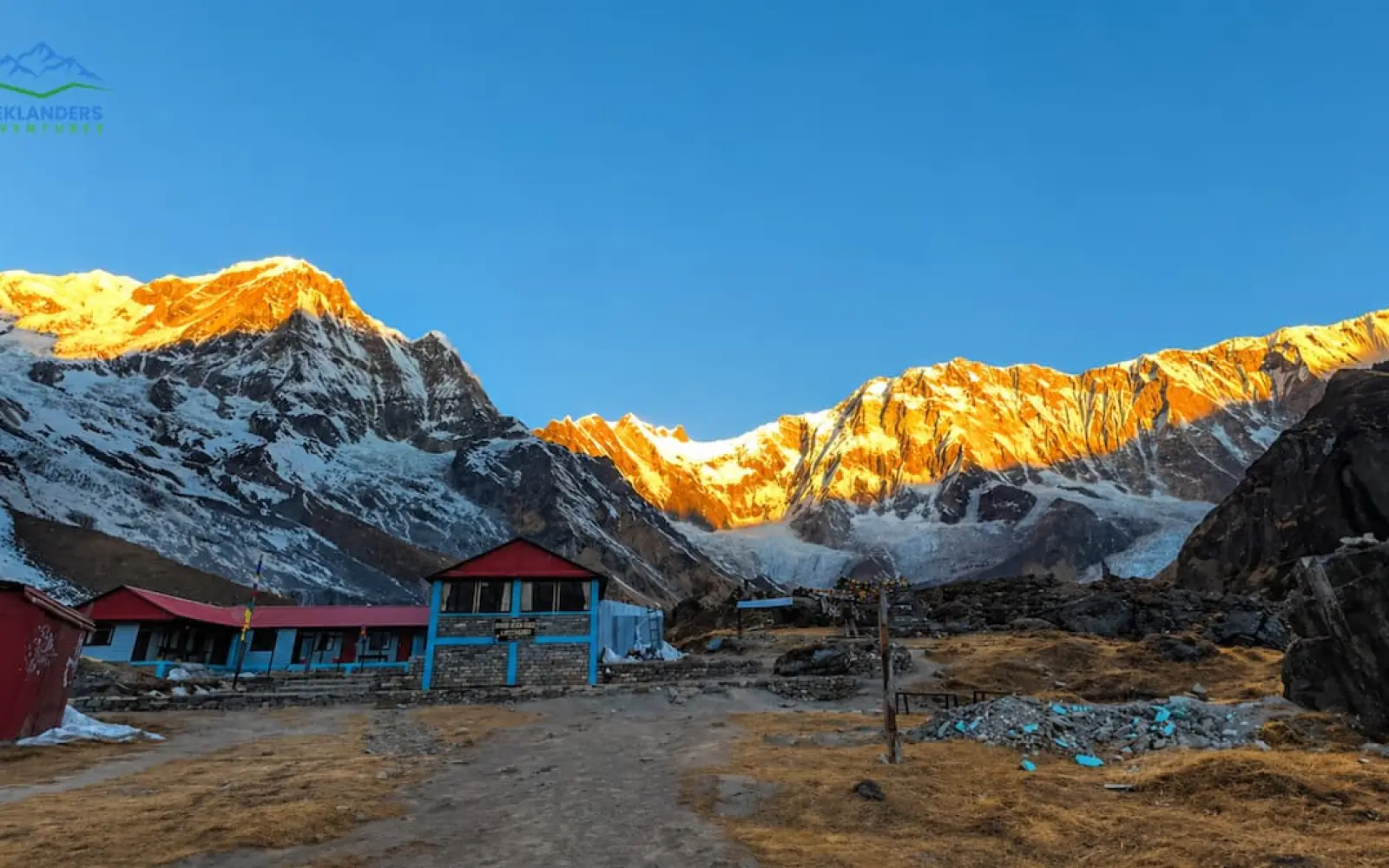
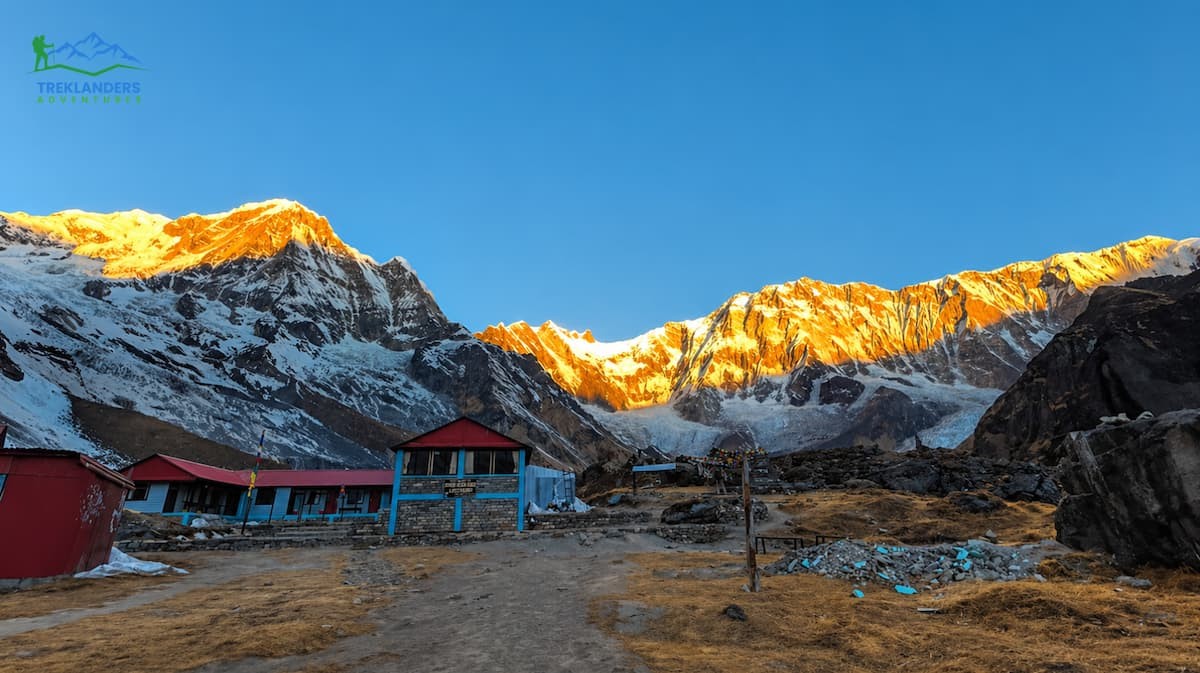
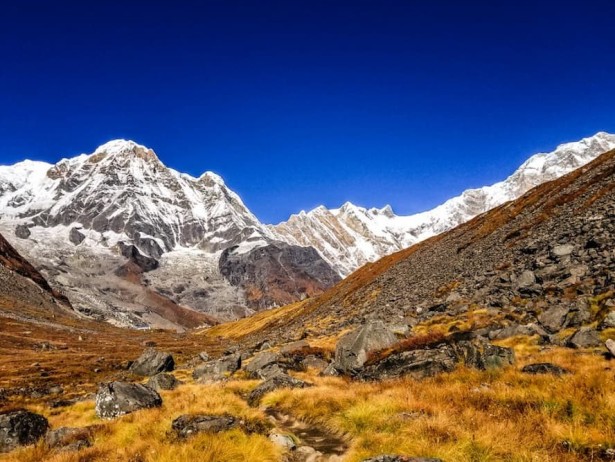
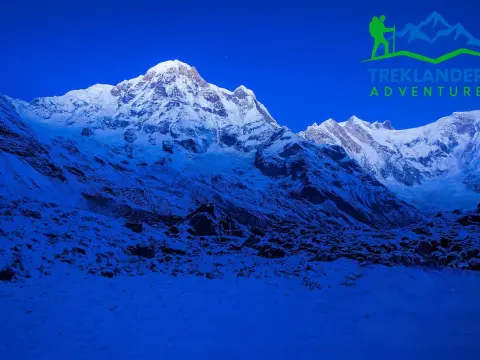
Breathtaking sunrise over the Annapurna range as seen from Annapurna Base Camp
From jungly rhododendron forests and Gurung villages to turquoise river gorges and mountaintop views of the world’s 10th highest peak (8,091 m), the Annapurna Base Camp Trek (ABC Trek) has become Nepal’s most popular trekking route for good reason. It conveniently ticks all the boxes: natural beauty, cultural interaction, stunning views, glacier panoramas, and firsthand access to Mt. Annapurna itself all within a single itinerary that’s completely logistically possible from Pokhara.
However, this is usually where most travellers get stuck when planning their Nepal trek: how long should I spend on the ABC Trek?
As with all good travel questions, the answer depends on the situation. At Treklanders Adventures, we actually offer 3 different core itineraries for the Annapurna Base Camp Trek. There’s our popular 7-Day Annapurna Base Camp Trek from Pokhara starting at USD 420 per person (for groups). There’s also our 10-Day Annapurna Base Camp Trek, which allows you to witness the sunrise from Poon Hill before continuing onto ABC. Finally, there’s our 11-Day Annapurna Base Camp Trek option, which is typically what most other trekking agencies offer (just note that many also market this as a 12-day trip when you include transfer days in and out of Kathmandu). It’s Treklanders’ most relaxed, best-acclimatized schedule for completing the full ABC Trek route.
Need help deciding which itinerary is right for you? We’ve broken down each option in detail below, complete with daily schedules, altitude profiles, difficulty ratings, cost comparisons, and guidance on who each schedule is best-suited for.
What You Need to Know About the ABC Trek Before Choosing a Duration?
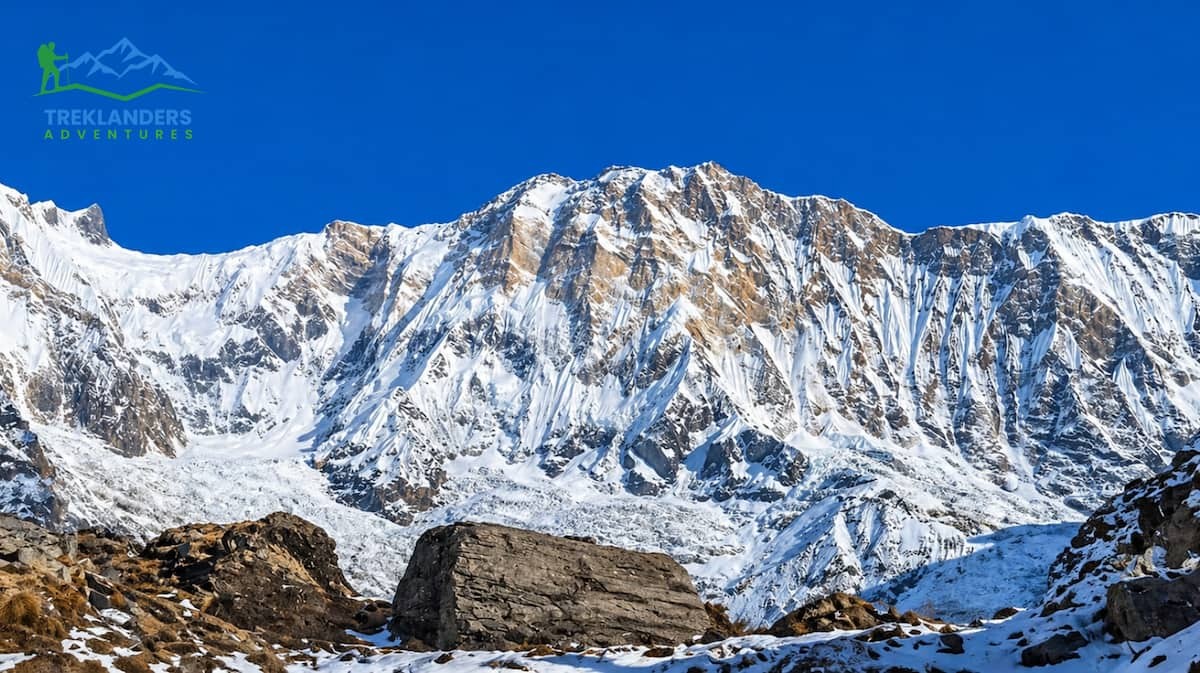
Mt. Annapurna I
Know the facts of the itinerary before comparing them.
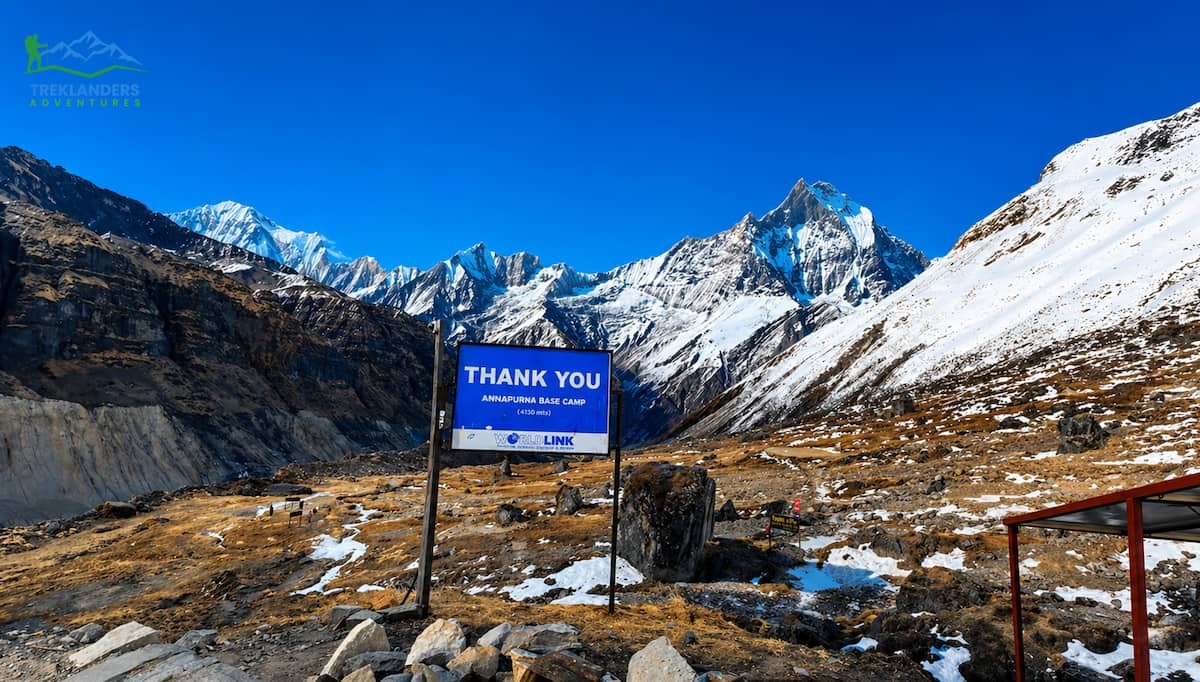
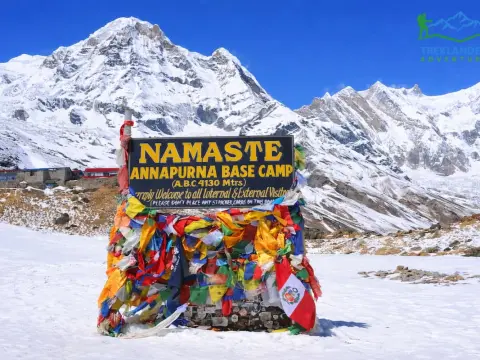
Highest altitude on trek: Annapurna Base Camp – 4,130 m (13,550 ft) above sea level.
Starting point: Trailhead at Jhinu Danda or Nayapul reached after a 3-hour drive from Pokhara (860 m above sea level).
Major overnight stops: Chhomrong (2,170 m), Bamboo (2,310 m), Dovan (2,505 m), Himalayan Hotel (2,920 m), Deurali (3,230 m),
Machhapuchhre Base Camp or MBC (3,700 m), Annapurna Base Camp (4,130 m).
Length of hiking: Roughly 70 km (round trip)
Hours walked per day: Depending on itinerary, 5 to 7 hours.
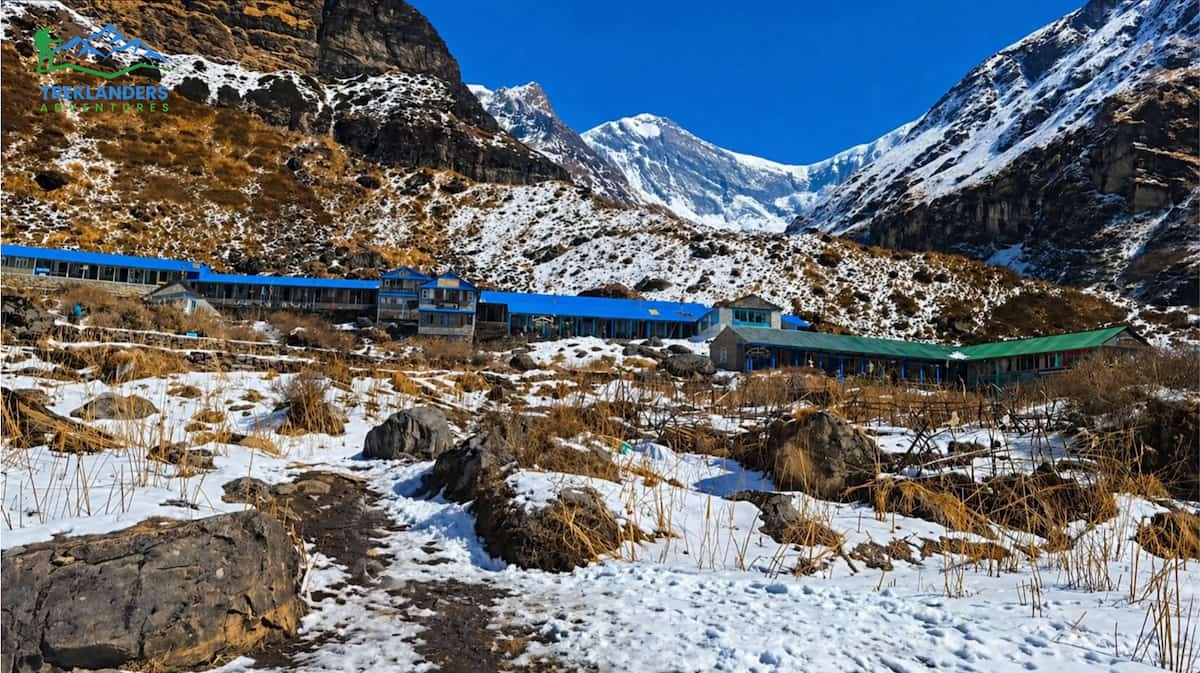
Accommodation: Teahouse lodges owned by local families. These get more rustic as you go higher from Chhomrong. Shared bathrooms. Solar-heated hot showers available for an extra fee.
Required permits: ACAP (Annapurna Conservation Area Permit, NPR 3,000) and TIMS (Trekkers' Information Management System) card. Available in Kathmandu or Pokhara.
Best seasons: Spring (Mar-May) and Fall (Sept-Nov). Spring has the rhododendrons blooming. There are lots of species/varieties of rhododendrons, and they bloom at different elevations, so you can see them throughout the hike. Fall has the most consistent weather, and the mountains are crisply visible. Winter (Dec-Feb) is doable, but nights are cold. You may see snow, and there will be fewer other trekkers.
Altitude sickness: The highest elevation is 4,130 m (13,505'). Altitude sickness can happen above 2,500-3,000 m (8,202-9,843'). Symptoms of altitude sickness are headaches, nausea, dizziness, and fatigue. Trekking itineraries that are shorter give your body less time to acclimatize. This is the most important factor in choosing your duration.
Guide requirement: As of April 2023, solo trekking without a licensed guide is no longer permitted in most Annapurna trekking areas.
The 7-Day Annapurna Base Camp Trek
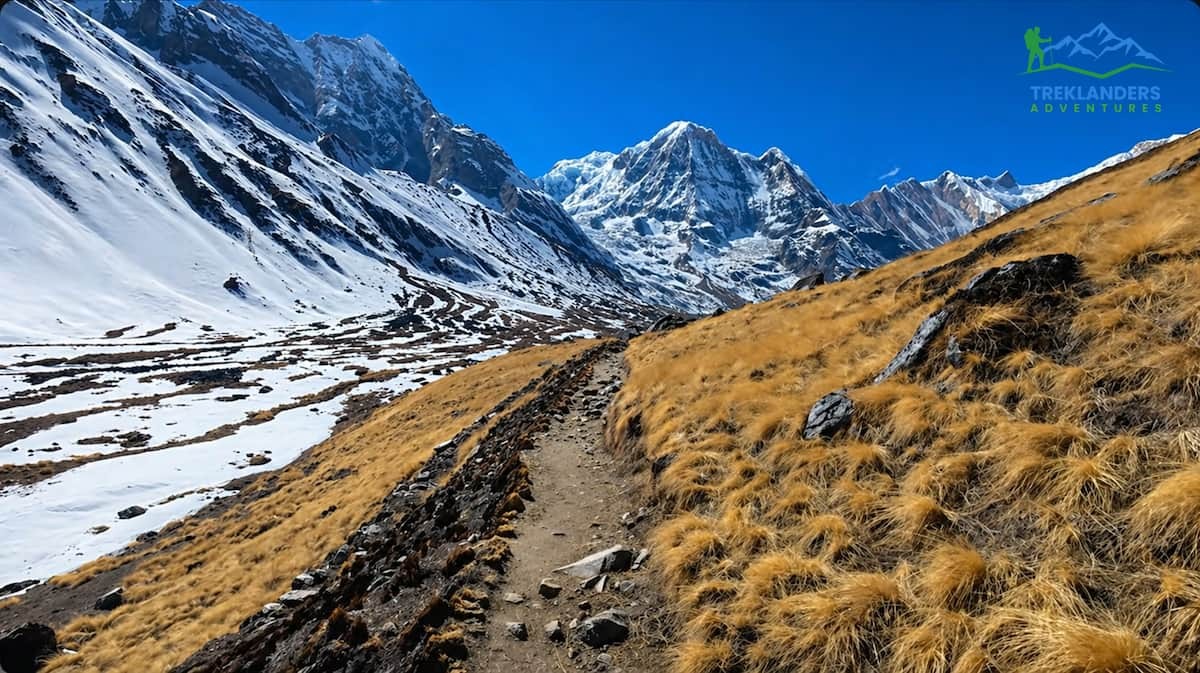
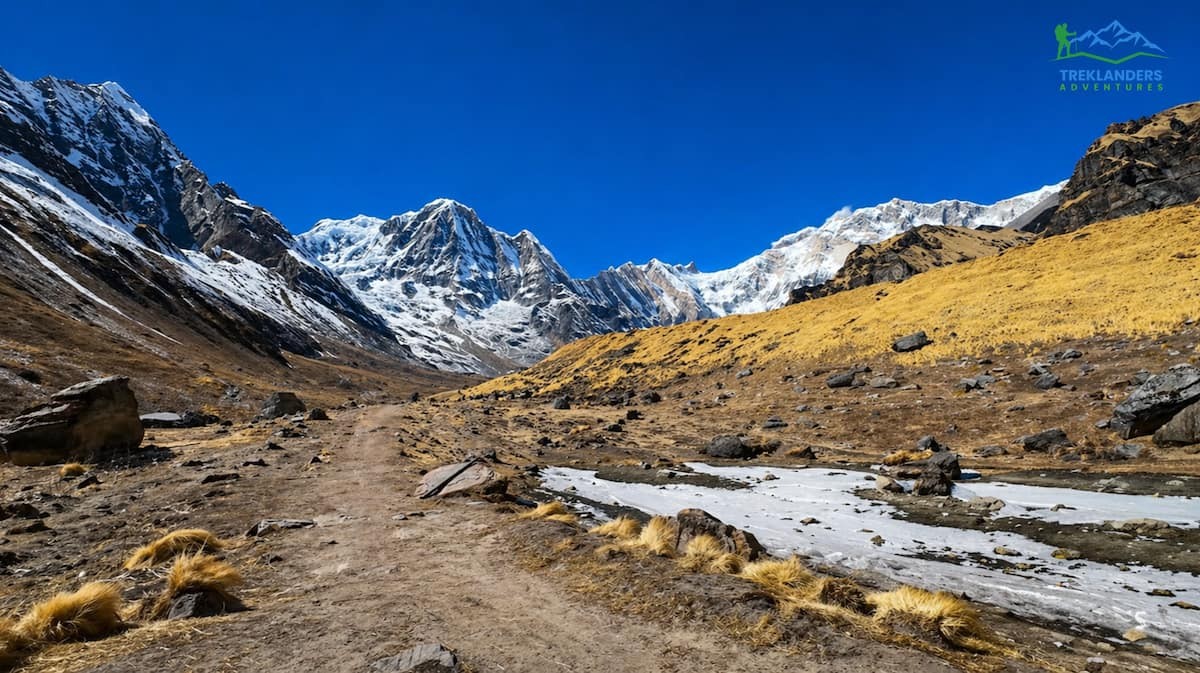
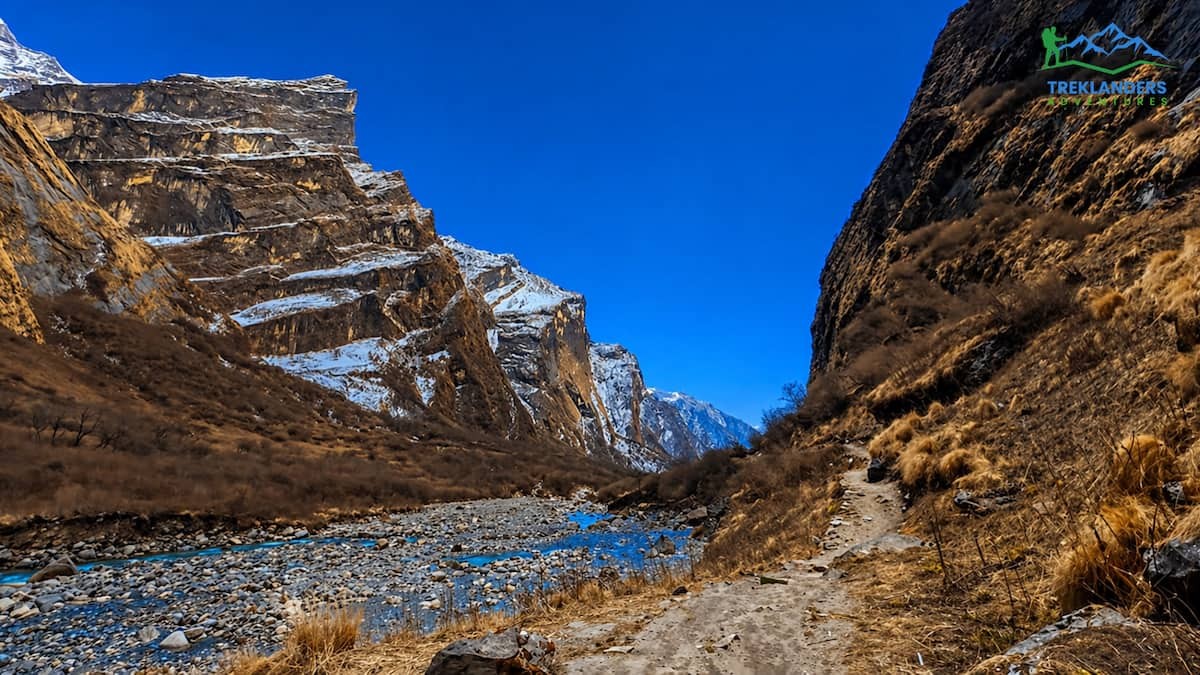
Scenic trail along the Annapurna Base Camp Trek.
Who is this trek for?
The 7-day Annapurna Base Camp trek is the shortest and most compact choice for Treklanders. It is a loop trek from Pokhara to Pokhara and costs starting at around USD 420 per person for groups of 9 to 30, or USD 795 for individuals. This route is designed for veteran trekkers who are pressed for time. Unfortunately, it is not a great first altitude trekking option. Your body rises in altitude rapidly, and there is no break day for acclimatization or bad weather.
Essentially, you will be walking 5 to 6 hours daily with no leeway for anything else. If you are a really fit person, have done trekking at moderate altitude before, and it is a matter of a week only that you simply cannot spare, then this plan will be able to accomplish the ABC part and back for you. Any other type of trekker should look at the 10-day or 12-day option.
7-Day Annapurna Base Camp Trek from Pokhara | 7 days
Day 1: Drive from Pokhara Jhinu and trek to Chhomrong (2,170 m)
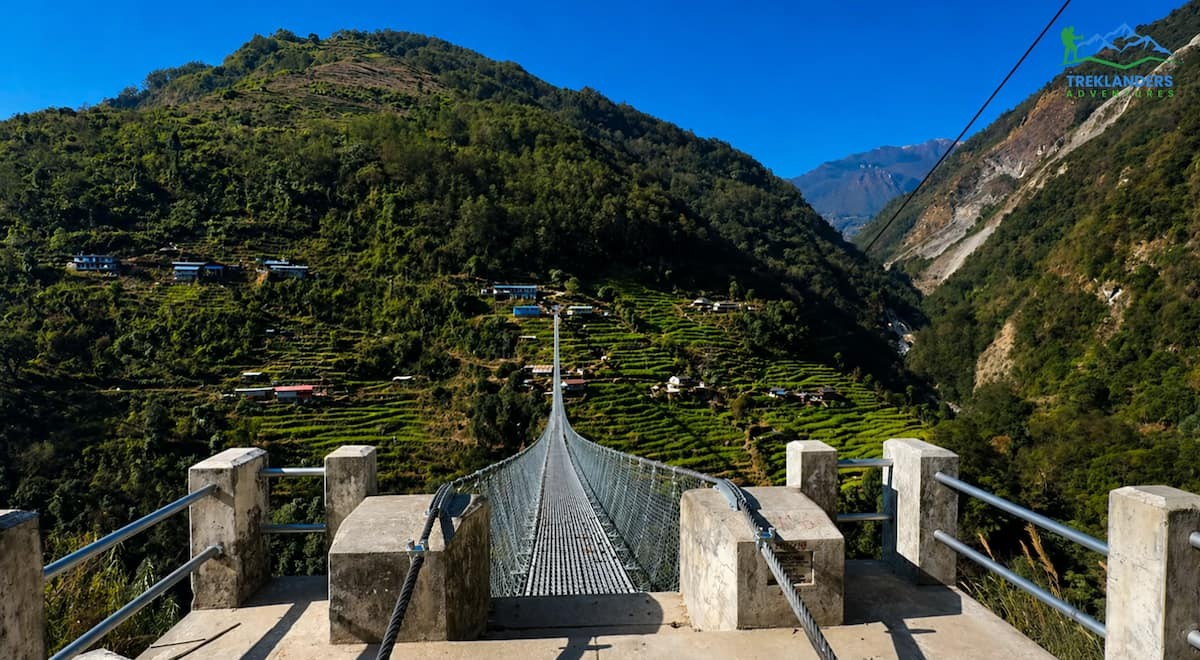
Jhinu Suspension Bridge on the Annapurna Base Camp Trek.
The day begins with a 3-hour drive from Pokhara to a point along the Baglung Beni highway near the Modi River, from where the trek starts, heading to the Jhinu Village. After crossing a suspension bridge, you first climb up a high ridge but then descend into Chhomrong. Chhomrong is the last permanent village before the Annapurna Sanctuary. It is home to the Gurung people, the main tribal community of the southern Annapurna hills, who, along with their ancestor Bon religion, practice the Buddhist ways. The village has a few good guesthouses that offer views of the Annapurna peaks. Approximate walking time: 3 hours.
Day 2: Trek from Chhomrong to Dovan (2,505 m)
From Chhomrong, the trail goes down to the Chhomrong River. After crossing a bridge, you have to climb the stone steps for around one hour to Sinuwa Danda. Then, you will be surrounded by dense rhododendron and pine forest before you go down to Bamboo on the Modi River gorge (where you can have your lunch). The next part of the day is spent walking slowly and gradually uphill through the forest, which is cool because it is in the shade of Dovan. Walking time: 6 hours.
Day 3: Trek from Dovan to Machhapuchhre Base Camp (3,700 m).
The path gradually ascends towards the Hinko cave, which is a gigantic overhanging rock shelter. You will encounter the Himalayan Hotel settlement and cross the Modi River before you get to the flat area of Deurali. The climb after lunch becomes quite steep as you walk through the bamboo forest before you can see the ridge at MBC. Machhapuchhre (6,997 m), the sacred Fishtail Peak, is the main feature of the view. Walking time: 6 hours. The altitude gain here is quite big (around 1,590 m from Dovan).
Day 4: Trek from MBC to Annapurna Base Camp (4,130 m).
Trail from MBC to Annapurna Base Camp
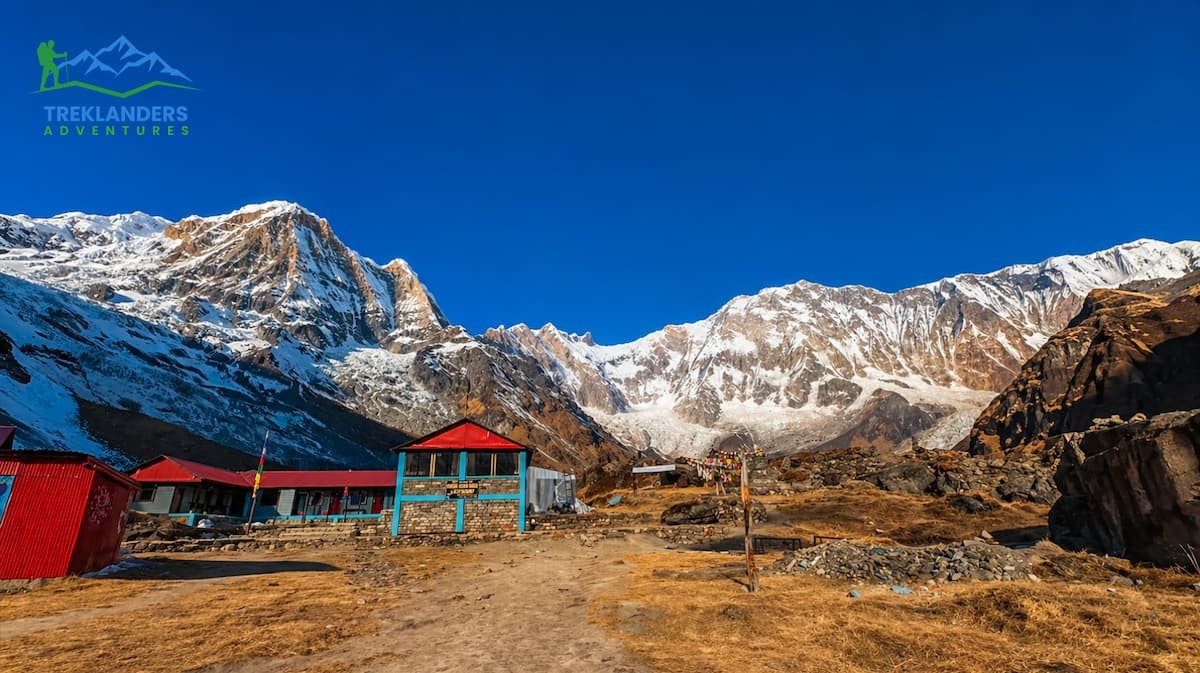
Actually, this is the shortest walk of the whole trek: about 3 hours. Your day starts with the sight of Annapurna I, Annapurna South, and Hiunchuli from the back of your lodge. The path leads you into the Annapurna Sanctuary, a very high glacier basin surrounded by 7,000 m and 8,000 m peaks. You will have lunch at ABC. Afternoon is yours to roam the sanctuary, take photos of the peaks, and be awe of the vastness of the terrain. You will be staying at ABC lodges.
Day 5: Trek from ABC to Bamboo (2,310 m)
A lengthy uphill walk was followed by going downhill; now a long descent takes you back through the same places you had passed on the way up. Starting from ABC, you would also pass-through MBC Deurali Himalayan Hotel, and finally down to Bamboo. The descent of about 6 hours will be very hard on your knees. This drop of more than 2,000 m within a day is also one of the biggest challenges of the 7-day ABC itinerary.
Day 6: Trek from Bamboo to Jhinu Danda (1,780 m)
The trek goes up inside a forest to Sinuwa Danda, then down to the Chhomrong Khola, after which it makes a sharp climb to Chhomrong, where you will have your lunch. Later in the afternoon, you will reach Jhinu Danda. Jhinu is well known for its natural hot springs, which are about 40 minutes’ walk from the lodge situated on the banks of the Modi River. Walking time: 6 hours.
Day 7: Drive from Jhinu to Pokhara (860 m)
A brief descent leads to a suspension bridge and then to the road, after which you will get a drive to Pokhara. Walk time: around 1 hour. Drive: 3 hours.
Altitude Profile Summary
Day
Destination
Altitude
1
Chhomrong
2,170 m
2
Dovan
2,505 m
3
MBC
3,700 m
4
ABC
4,130 m
5
Bamboo
2,310 m
6
Jhinu Danda
1,780 m
7
Pokhara
860 m
Key Observation
The jump from Dovan (2,505 m) to MBC (3,700 m) on day 3 is an altitude gain of 1,205 m. This is a very steep climb by any acclimatisation standard. A safe guideline for trekking at altitudes above 3,000 m is to gain no more than 300 to 500 m per day. The 7-day itinerary compresses this hugely. Your body is capable of coping with it if you are fit and can acclimatize well; however, the chance of getting altitude sickness here is higher than on any longer route. Diamox should only be carried if your doctor has prescribed it to you, and you should hydrate very well (3-4 liters per day). Immediately tell your guide if you have any symptoms of altitude sickness.
What is included?
The 7-day package with Treklanders offers every single teahouse stay breakfast, lunch, and dinner while trekking, a licensed guide and porter (1 porter per 2 trekkers), road transportation from Pokhara to Jhinu and back, a first aid kit, national park entrance fees, all government duties, guide and porter staff's food, salary, and insurance. Excluded: travel insurance, personal equipment, and crew tips.
Cost
Solo (1 person): USD 795
Small group (2-3): USD 585 per person
Standard group (4-8): USD 495 per person
Large group (9-30): USD 420 per person
The 10-Day Annapurna Base Camp Trek (with Ghorepani Poon Hill)
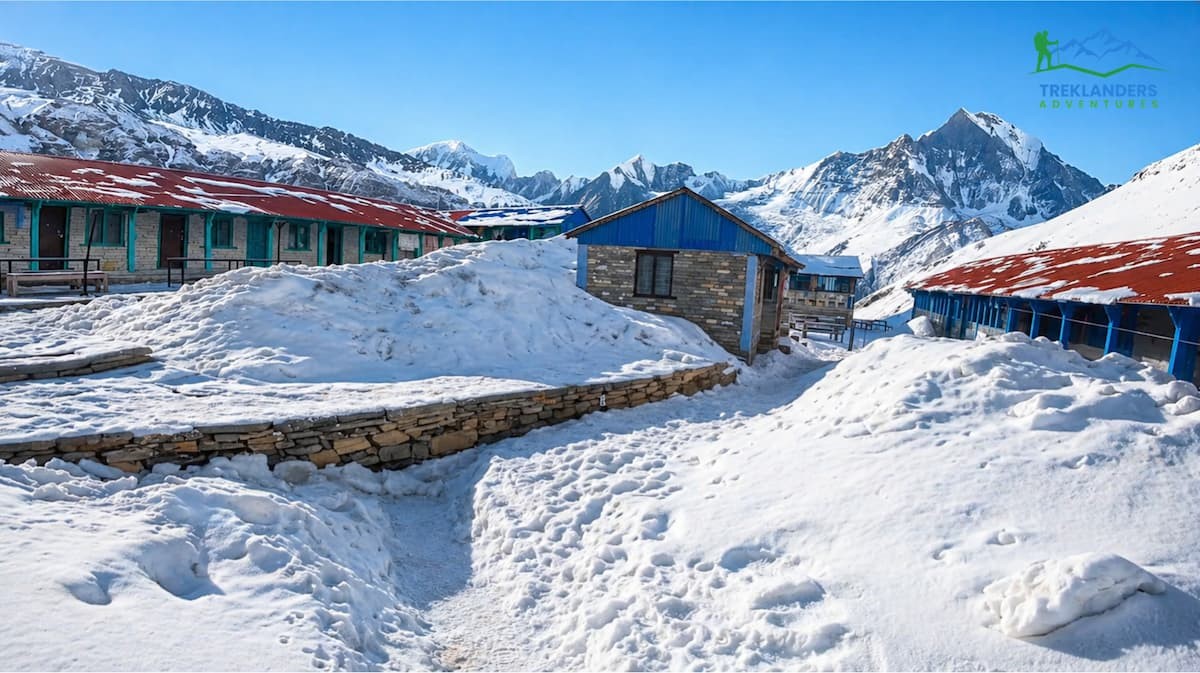
Teahouse lodges at Annapurna Base Camp.
Who Is This For?
Treklanders' 10-day Annapurna Base camp package is a perfect blend of the Ghorepani Poon Hill Trek and the Annapurna Base Camp Trek. This is the ideal option for those who are not satisfied with just the base camp of the Himalayas. You get to see the sunrise from Poon Hill (one of the most famous spots in Nepal at 3,210 m) and also have the opportunity to fully enjoy the ABC trek, all within 10 days. Besides, this itinerary is better for acclimatization than the 7-day one, as the Ghorepani part of the route takes you through lower to mid altitude areas before the sanctuary climb, which means your body gets more time to adjust.
It's great for moderate level trekkers, second-time visitors to Nepal, and anyone who has time but wants a richer itinerary rather than just a faster one. The route meets at Chhomrong village and then follows the same path as the standard ABC itinerary.
10-Day Ghorepani Poonhill with Annapurna Base Camp Trek | 10 days
Day 1: Drive to Nayapul from Pokhara and trek to Ulleri via Thirkhedhunga (2,050 m)
You will leave Pokhara by car, and after a 3-hour journey, you will reach Thirkhedhunga. The road is along the rivers, and it passes through some villages. From here, you will hike uphill for quite some time. The route is mainly made of stone steps. You will keep climbing gradually for 2 hours or so and eventually reach Ulleri village. The village is inhabited by Magar people with their traditional houses and is surrounded by hills. The short trekking time is good for your body as it gets accustomed to the journey.
Day 2: Trek from Ulleri to Ghorepani (2,885 m)
Starting early in the morning, you will walk through thick rhododendron and oak woods. The path continues to rise slowly. Around 4 hours later, you will arrive at Ghorepani. This village is located on a ridge and provides a major stopover for trekkers to Poon Hill. At this altitude, the weather can be quite unpredictable.
Day 3: Trek from Poon Hill hike and trek to Tadapani (2,640 m)
You will hike Poon Hill (3,210 m) before sunrise. The ascent is around 45 60 minutes. The view from the top is a vast Himalaya range, including Annapurna I and Dhaulagiri. After coming down to Ghorepani for breakfast, you will proceed to Tadapani by trekking. The route goes through forests and ridgelines. The total walking time is approximately 6 hours.
Day 4: Trek from Tadapani to Chhomrong (2,170 m)
First, you take the downhill route through the forest. Then, climbing after crossing the streams. There are several hills to climb and descend on the way. You reach Chhomrong after 6 hours or so. It is the last big Gurung village on this line. One can have a very good view of Machhapuchare from there.
Day 5: Trek from Chhomrong to Dovan via Bamboo (2,505 m)
Initially, you drop sharply on the stone steps by the river, and then you go up again through a thick bamboo forest. Eventually, the path gets very narrow and the air is very damp. You go through the Bamboo village (2,050 m) and then proceed to Dovan. Walking time will be 6 hours. The open hills give way to the deep forest of the valley.
Day 6: Trek from Dovan to Machhapuchare Base Camp (3,700 m).
Machhapuchare Base Camp
You are climbing higher all the time. Trees are getting scarce. The valley is getting bigger, and the fields are in the form of rocks. You get to Machhapuchare Base Camp after 6 hours of walking. Mountains covered with snow are all around. Due to reduced oxygen levels, the pace is slow and steady.
Day 7: Machhapuchare Base Camp to Annapurna Base Camp (4,130 m)
It is a shorter day, but the significance of it should not be overlooked. You continue to walk for about 3 hours to get to Annapurna Base Camp. The inclination of the path is very gentle. You find yourself in a natural amphitheatre, which is surrounded by towering peaks. Directly above, you can see Annapurna I. This will be the highest altitude that you will reach during the trek.
Day 8: Annapurna Base Camp Bamboo (2,310 m)
You head down the same trail on the way back. Decreasing the altitude takes the edge off your tiredness. You make your way back past Machhapuchare Base Camp and Dovan before finally reaching Bamboo. In total, the trek lasts about 6 hours.
Day 9: Bamboo to Jhinu Danda (1,780 m)
The hike is a steady descent with a mixture of forest and stone steps. It is approximately a 6-hour walk to Jhinu Danda. This area is famous for its natural hot springs by the river, which helps to rejuvenate after long days of trekking.
Day 10: Jhinu Danda to Pokhara (860 m)
You leisurely walk for a while and then get into a vehicle to go back to Pokhara. The driving time is approximately 3 hours. Your trek finishes here with the availability of transport, accommodation, and other facilities.
Why the 10-Day Format Stands Out?
This plan allows you to enjoy two distinct trekking experiences rather than just one; In fact, Poon Hill is an entirely different cultural and scenic loop from the Ghorepani side, which passes through villages like Ulleri, Ghorepani, and Tadapani that the standard ABC route never comes near. You get to see Dhaulagiri (8,167 m) multi-sided and at sunrise, stand on Poon Hill for what many consider the most spectacular mountain panoramas in the world.
This schedule, on the other hand, lets the body get used to the altitude more naturally. When you get to Chhomrong on Day 5, your body has already gone through four days of almost adjusting to living at altitudes (2,000 to 3,200 m) before the big push to the sanctuary starts. If you are a first-time trekker in Nepal with reasonable fitness and have 10 days free, this is the most comprehensive single itinerary that Treklanders can offer you in the Annapurna region.
4-Day Ghorepani Ponnhill Trek from Pokhara | 4 days
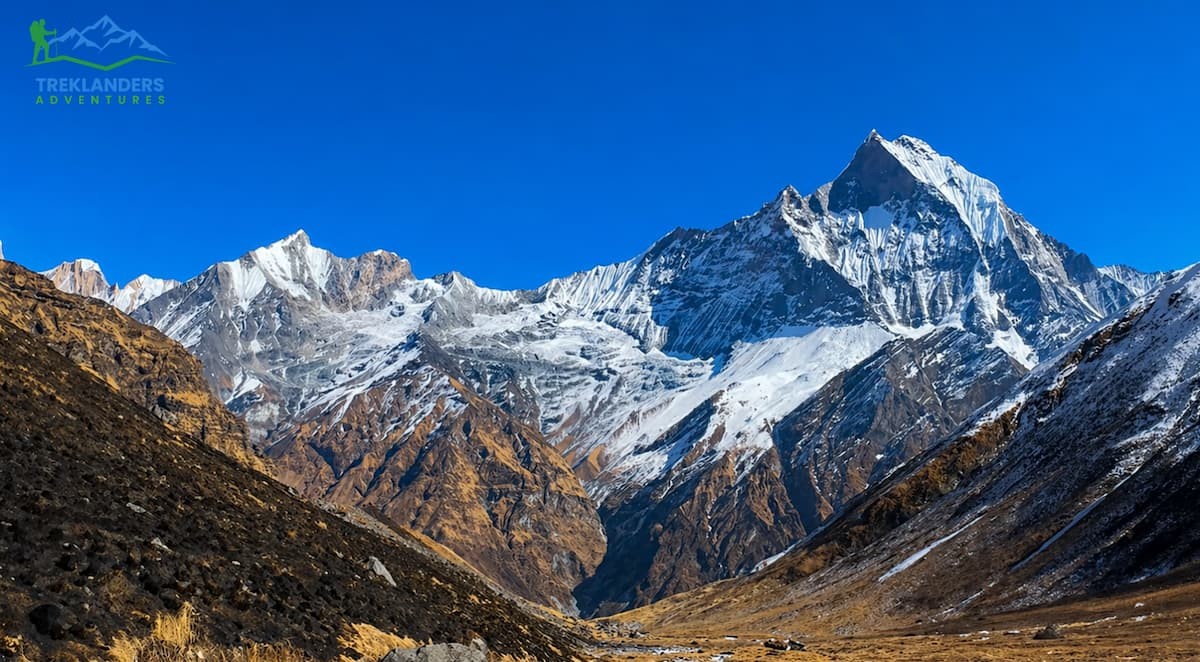
Beautiful view of Machhapuchhre (Fishtail Mountain) as seen from Annapurna Base Camp.
Day-by-Day Overview
Day 1: Arrive Kathmandu (1,400 m)
When you arrive in Kathmandu, a staff member will be waiting for you at Tribhuvan International Airport with a traditional welcome. You will then be transferred to your hotel in Kathmandu. Once you have checked in, you will get a trek briefing where you will be informed of the itinerary, walking hours, altitude progression, safety measures, and emergency procedures. Besides that, you will have a welcoming group dinner at an authentic Nepali restaurant.
Day 2: Kathmandu to Pokhara (860 m)
You will drive to Pokhara on a very beautiful highway (6-7 hours) along which you can see river valleys, rolling hills, and terraced farmlands. You can also fly from Kathmandu for the extra cost of a 25-minute domestic flight. Upon arrival, you will be transferred to a hotel on the shores of Phewa Lake. You will have your free time in the afternoon.
Day 3: Pokhara to Ghandruk (1,940 m)
At breakfast time, you will be taken along the Pokhara Baglung Beni Road to Nayapul. Next, you will walk along the Modi River, passing Bhirethati, to the small farm village of Syali. The walk starts from here, heading up through the rice fields and farm settlements, going past Kimche village, and finally arriving at the major Gurung village of Ghandruk. There is a Gurung cultural museum in Ghandruk that you can visit. If the sky is clear in the evening, from your teahouse terrace, Hiunchuli and Machhapuchhre are visible. Walking time: 4-5 hours.
Day 4: Ghandruk to Chhomrong (2,170 m)
Starting at Ghandruk, the path gradually ascends to Kimrong Danda, a tiny village perched on a ridge with stunning views of Annapurna South, Hiunchuli, Machhapuchhre, and Gangapurna. From Kimrong Danda, there is a very steep descent of 400 m through oak and rhododendron forests down to the Kimrong Khola valley floor. After crossing the river, the path goes up through the lower Kimrong village and then proceeds to Chhomrong, which is the last major village before reaching the Annapurna Sanctuary. Walking time: 5-6 hours.
Day 5: Chhomrong to Dovan (2,505 m)
Leave Chhomrong by going down to Chhomrong Khola and crossing the suspension bridge. From Sinuwa Danda, a stone staircase leads you up and then you step into a dense forest of rhododendron and pine trees. Your next short descent will lead you to the very small settlement of Bamboo, which is located on the Modi River gorge. The village is set among thick bamboo groves. Walking time: 4-5 hours.
The climb is slow but steady, and you will be walking all the time through the shady forest that keeps you cool as you travel along the Modi River gorge. As you move further, the changes in the landscape become more and more striking as the valley walls close in. Dovan is a small group of lodges situated above the river. The river's sound is there with you all night. Walking time: 4-5 hours. This is a shorter day by design, letting your body adjust before the significant altitude gain ahead.
Day 6: Dovan to Machhapuchhre Base Camp (3,700 m)
From Dovan, the trail climbs into denser vegetation past the large overhanging Hinku Cave. You pass the Himalayan Hotel settlement (2,920 m), cross the Modi River, then climb through smaller bamboo stalks to Deurali (3,230 m) for lunch. The final steep push reaches the ridge at MBC. The sacred Machhapuchhre (Fishtail, 6,997 m) dominates the view from your lodge. Walking time: 6 hours.
Day 7: MBC to Annapurna Base Camp (4,130 m)
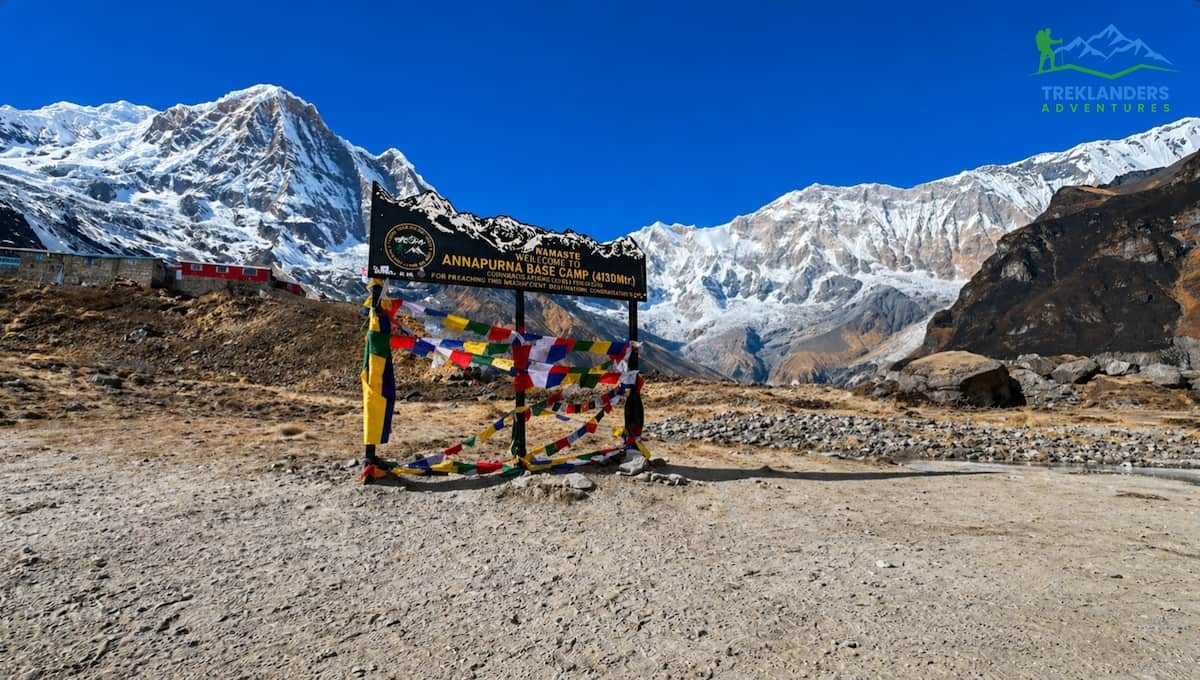
Annapurna Base Camp
The morning opens with views of Annapurna I, Annapurna South, and Hiunchuli. The trail enters the Annapurna Sanctuary, a glacial amphitheatre enclosed by some of the highest walls of rock and ice on Earth. You cross the right lateral moraine of the Annapurna Glacier and walk directly toward the base of the massif. Annapurna I (8,091 m) fill the skyline directly ahead. To the east stand Khangsar Kang, Gangapurna, and Annapurna III. You reach ABC for lunch. The afternoon is free to explore and photograph. You overnight at ABC, the highest point of the trek. Walking time: 3 hours.
Day 8: ABC to Bamboo (2,310 m)
Wake early for sunrise over the sanctuary peaks. Then begin the long descent, retracing the route through MBC, Deurali, Himalayan Hotel, and down to Bamboo. The descent drops over 1,800 m in a single day. It is hard on the knees; trekking poles help significantly. Walking time: 6-7 hours.
Day 9: Bamboo to Jhinu Danda (1,780 m)
From Bamboo, climb to Kuldhigar (where the ACAP visitor center is located), then descend to the Chhomrong Khola bridge. Cross the bridge and climb through Chhomrong for lunch. A steep afternoon descent brings you to Jhinu Danda. The natural hot springs at Jhinu are 15-20 minutes downhill from the village on the banks of the Modi River. Three pools of naturally heated water after 8 days of trekking. Walking time: 5-6 hours.
Day 10: Jhinu Danda to Pokhara (860 m)
Cross the suspension bridge over the Modi River and follow the trail through the bamboo forest and small settlements to Siwai village, then drive back to Pokhara on the main highway. Afternoon free at Phewa Lake. Walking time: 2-3 hours. Drive: 3 hours.
Day 11: Pokhara to Kathmandu (1,400 m)
Scenic overland drive (6-7 hours) or domestic flight (25 minutes) back to Kathmandu. Evening free for last-minute shopping or a farewell dinner. Overnight in Kathmandu.
Day 12: Departure
Transfer to Tribhuvan International Airport for your international flight. Staff see you off.
A Note on Days Treklanders lists this as their standard Annapurna Base Camp Trekking package at 14 days, which includes an optional extra rest day in Kathmandu for those who want it. The core trekking structure is 13 days, Kathmandu to Kathmandu, with 9 active trekking days. For this comparison, we refer to it as the 12-day format because most trekkers count from Pokhara as the practical start of the mountain journey.
You should have some previous experience with trekking at altitude. Good cardiovascular fitness is required. Treklanders asks that trekkers incorporate 4-5 days of hill running, stair climbing, or cycling into the 3-4 months preceding the trek. Strength training for the legs is also important. A load of your trekking backpack (8-12 kg) for 3-hour hikes is recommended before your departure date.
10-Day Annapurna Base Camp Trek
While not as physically demanding as the 7-day trek, having a moderate level of fitness is all that is required for the 10-day trek. You have more time to trek at a comfortable pace in this trek. The initial trek to Poon Hill will warm up your body before ascending to higher altitudes. Regular cardio exercises done 3-4 times per week for the 2-3 months preceding your departure are all that is required to prepare for the trek.
12-Day Annapurna Base Camp Trek
This itinerary suits most fitness levels, even those who are trekking for the first time. You would be doing the same cardio and leg strength training to prepare for the trek, but you have a bigger breathing space. You can even go on a slower pace throughout the 12 days and still not mess up the total schedule. Each version of this trip includes a certified guide. Your guide is the one who decides the speed, looks after your health, takes care of any emergencies, and deals with permit and lodge arrangements. Follow your guide's advice on pacing and acclimatization.
You need two permits for the ABC trek ACAP (Annapurna Conservation Area Permit) NPR 3,000 per person (approx. USD 25). It allows you to enter the Annapurna Conservation Area, the whole area in which the ABC route goes. You will be checked at the checkpoint in Bhirethati.
TIMS Card (Trekkers' Information Management System) Needed for all trekkers. Located in Kathmandu at the Nepal Tourism Board office or in Pokhara.
The two permits can be ordered through Treklanders as part of your package (included in the national park entrance fees line item). If your arrival in Nepal is only a short time before the trek, check the permit status with your agency when booking.
Nepal Tourist Visa: You can get it upon arrival at Tribhuvan International Airport in Kathmandu. The price is USD 25 for 15 days and USD 40 for 30 days. Carry a passport-size photo and USD cash. It will take 15 30 minutes for processing.
Season: When to go for each itinerary?
Trail along the Annapurna Base Camp
Spring (March to May)
The most vibrant season. Different species of rhododendrons produce spectacular forests in red, pink, and white. Temperatures are comfortable: somewhat chilly in the mornings, lots of sunshine with strong UV rays in the afternoons. Some cloud and slight snowfall cannot be excluded at altitudes over 3,000 m. Spring visually is the greatest season.
Autumn (September to November)
The most liked and possibly the best season overall. The closure of the monsoon in late September results in fresh washed skies and clear mountain scenes. The weather is cold in the mornings and evenings, the trail is dry. Dashain and Tihar, Nepal's biggest festivals, happen during this time and so add a cultural dimension to your stays in Kathmandu or Pokhara.
Winter (December to February)
Annapurna Base Camp in winter
The sky is bright, and the mountains are well seen, but the weather is much colder. MBC and ABC during the night time drop to temperatures well under zero Celsius. Owing to snowfall, some of the higher trails may get blocked especially in February, and therefore changes to the itinerary should be anticipated. With fewer trekkers, there will be more tranquility on the trail. This season is appropriate for the 12-day format which has its buffer days; however, it is not suitable for the 7-day format.
Monsoon (June to August)
Trailing paths get very slippery, visibility diminishes, and leeches in the lower forests are very active. Most of the trekkers stay away from this season.
Altitude Sickness: The Factor That Should Drive Your Decision
If there is one factor that should determine your itinerary length, it is how your body handles altitude. Above 3,000 m, the air has roughly 30% less oxygen than at sea level. Your body compensates by breathing faster, increasing heart rate, and producing more red blood cells over time. This adaptation takes time. When you gain altitude faster than your body can adapt, altitude sickness follows.
Mild altitude sickness includes headache, nausea, fatigue, dizziness, and disturbed sleep. Most people experience some version of these symptoms above 3,500 m on a fast ascent. Ignoring them and continuing to climb causes High Altitude Pulmonary Edema (HAPE) or High Altitude Cerebral Edema (HACE), both of which are life-threatening.
The 7-day format reaches 3,700 m on Day 3 with limited acclimatization time. The 12-day format reaches the same altitude on Day 7, after six days of progressive ascent through Ghandruk, Chhomrong, Bamboo, and Dovan. The difference is four extra days of gradual adjustment before the high-altitude zone.
Acclimatization cannot be rushed or compensated for by fitness. Athletes get altitude sickness just as often as casual trekkers. Age has little correlation with susceptibility. Your individual physiology is the variable, and you cannot know how you will respond until you are there.
Treklanders' guides monitor trekkers for symptoms throughout the route. Key acclimatization stops where the body benefits from a dedicated overnight include Chhomrong (2,170 m), Dovan (2,505 m), and MBC (3,700 m). The 12-day itinerary gives each of these stops its own night. The 7-day format does not.
Some steps to reduce risk
Drink a minimum of 3 to 4 liters of water daily; if your urine is dark colored, it indicates that you may be dehydrated. You should consume carbohydrate-rich meals at regular intervals, even if your desire for food is decreased. Refrain from alcohol, particularly if you are over 3000 m. Take a slow, regulated walk with deep breathing. Inform your guide at once if you have a persistent headache or your condition becomes significantly worse than the previous day. If symptoms get severely worse, do not hesitate to go down; no view is worth trading HACE or HAPE.
Conclusion
Beautiful view of Annapurna I as seen from Annapurna Base Camp.
If you have previous experience in high altitude trekking, only get one week of annual leave, are in excellent cardio shape, and are made aware of and accept the risks of high altitude, then book the 7-day ABC trek.
Moderate fitness level, desire to see more in the Annapurna region than just the base camp, willingness to walk for 10 days, and desire for better acclimatization than 7 days without the entire scope of 12 days are the reasons for booking the 10-day Ghorepani Poon Hill and ABC trek combination.
If this is your first time trekking to high altitude, you would rather a slow and detailed experience than a quick one, you want days left to be used as weather or rest days, or you simply want to visit Ghandruk and Dovan and walk the full route on its own terms, then book the 12-day ABC trek. We at Treklanders offer our Annapurna Base Camp Trekking package starting at USD 845, which includes this entire route.
The team at Treklanders is always glad to help you with your questions and even tailor your itineraries to suit your needs. Communicate with them through WhatsApp at +977 9851019683 or by email at info@treklanders.com. Besides the usual itineraries, they also give a custom Plan My Trip option if none of the standard ones aligns with your time or goals.
One thing is certain: Annapurna Base Camp will still be there no matter how many days it took you to get there. So, the question is: how do you want to experience the journey?