[{"name":"Everest Base Camp Trek","duration":"16","image_url":"https:\/\/www.treklanders.com\/storage\/trip-galleries\/1\/thumb_419a755c003cc609f3030ee332965ebe.jpg","offer_price":1405,"url":"https:\/\/www.treklanders.com\/trips\/everest-base-camp-trek"},{"name":"Gokyo Valley Trekking","duration":"16","image_url":"https:\/\/www.treklanders.com\/storage\/trip-galleries\/2\/thumb_676d1021b574aeba4d19d3f2a0b04ed2.webp","offer_price":1205,"url":"https:\/\/www.treklanders.com\/trips\/gokyo-valley-trekking"},{"name":"Annapurna Circuit Trek","duration":"23","image_url":"https:\/\/www.treklanders.com\/storage\/trip-galleries\/3\/thumb_2a9a92ea23c62f41de27b37f5e3e8c17.webp","offer_price":1495,"url":"https:\/\/www.treklanders.com\/trips\/annapurna-circuit-trek"},{"name":"Everest Panorama Trek","duration":"12","image_url":"https:\/\/www.treklanders.com\/storage\/trip-galleries\/4\/thumb_35c9f677ea2e88b1ff11a9f43daa3ddb.jpg","offer_price":1100,"url":"https:\/\/www.treklanders.com\/trips\/everest-panorama-trek"},{"name":"Everest Base Camp Trekking from Jiri","duration":"22","image_url":"https:\/\/www.treklanders.com\/storage\/trip-galleries\/6\/thumb_14763592492417b294aa66bf0ebf4e64.webp","offer_price":1400,"url":"https:\/\/www.treklanders.com\/trips\/everest-base-camp-trekking-from-jiri"},{"name":"Everest Base Camp via Cho la Pass from Gokyo Valley Trekking","duration":"18","image_url":"https:\/\/www.treklanders.com\/storage\/trip-galleries\/7\/thumb_d4e470e98d4e9e2ab8e93e39b8b7d252.jpg","offer_price":1405,"url":"https:\/\/www.treklanders.com\/trips\/everest-base-camp-via-cho-la-pass-from-gokyo-valley-trekking"},{"name":"Everest Three Passes Trekking","duration":"22","image_url":"https:\/\/www.treklanders.com\/storage\/trip-galleries\/8\/thumb_b413b221e913171500bb3dfd5c08ceea.jpg","offer_price":1635,"url":"https:\/\/www.treklanders.com\/trips\/everest-three-passes-trekking"},{"name":"Annapurna Base Camp Trekking","duration":"14","image_url":"https:\/\/www.treklanders.com\/storage\/trip-galleries\/9\/thumb_2e71f2ffe116c659fa66b01c2d571b4e.webp","offer_price":845,"url":"https:\/\/www.treklanders.com\/trips\/annapurna-base-camp-trekking"},{"name":"Mardi Base Camp Trekking","duration":"14","image_url":"https:\/\/www.treklanders.com\/storage\/trip-galleries\/10\/thumb_d7b2d2dc638f6bbf2c31c167ac68029d.webp","offer_price":845,"url":"https:\/\/www.treklanders.com\/trips\/mardi-base-camp-trekking"},{"name":"Mohare Danda Trekking","duration":"12","image_url":"https:\/\/www.treklanders.com\/storage\/trip-galleries\/11\/thumb_a384c8d35d789d29b19991c1d675c910.webp","offer_price":755,"url":"https:\/\/www.treklanders.com\/trips\/mohare-danda-trekking"},{"name":"Khopra Ridge & Khair Lake Trekking","duration":"15","image_url":"https:\/\/www.treklanders.com\/storage\/trip-galleries\/12\/thumb_c0f50461ddc74acfb553ba85be00fab0.webp","offer_price":855,"url":"https:\/\/www.treklanders.com\/trips\/khopra-ridge-khair-lake-trekking"},{"name":"Upper Mustang Trekking","duration":"17","image_url":"https:\/\/www.treklanders.com\/storage\/trip-galleries\/13\/thumb_7aa4dfdb69186b0f224a303d80a25c95.jpg","offer_price":1715,"url":"https:\/\/www.treklanders.com\/trips\/upper-mustang-trekking"},{"name":"Langtang Valley Trek","duration":"12","image_url":"https:\/\/www.treklanders.com\/storage\/trip-galleries\/14\/thumb_8650b4b1a3c160cff75da65369398353.webp","offer_price":735,"url":"https:\/\/www.treklanders.com\/trips\/langtang-valley-trek"},{"name":"Gosainkunda Lake Trek","duration":"11","image_url":"https:\/\/www.treklanders.com\/storage\/trip-galleries\/15\/thumb_bfe94c14e760c48234e117021105be84.webp","offer_price":735,"url":"https:\/\/www.treklanders.com\/trips\/gosainkunda-lake-trek"},{"name":"Chisapani-Nagarkot to Dhulikhel Hiking","duration":"7","image_url":"https:\/\/www.treklanders.com\/storage\/trip-galleries\/16\/thumb_468defe9a4000ee3129cd7e6421ee105.webp","offer_price":565,"url":"https:\/\/www.treklanders.com\/trips\/chisapani-nagarkot-to-dhulikhel-hiking"},{"name":"Kanchenjunga Trek","duration":"23","image_url":"https:\/\/www.treklanders.com\/storage\/trip-galleries\/17\/thumb_51f43fa4203106cc49aaedc89d76e01d.jpg","offer_price":1725,"url":"https:\/\/www.treklanders.com\/trips\/kanchenjunga-trek"},{"name":"Helambu Trek","duration":"12","image_url":"https:\/\/www.treklanders.com\/storage\/trip-galleries\/18\/thumb_0fe8e3fa1299d2e43bf1fb5977875ce2.jpg","offer_price":685,"url":"https:\/\/www.treklanders.com\/trips\/helambu-trek"},{"name":"Upper Dolpo Trek","duration":"26","image_url":"https:\/\/www.treklanders.com\/storage\/trip-galleries\/19\/thumb_d6080d490e1db83b0a711e7304000864.jpg","offer_price":3005,"url":"https:\/\/www.treklanders.com\/trips\/upper-dolpo-trek"},{"name":"Manaslu Circuit Trek","duration":"18","image_url":"https:\/\/www.treklanders.com\/storage\/trip-galleries\/20\/thumb_1fdd224e849f4f328e73d2d12b3d282d.jpg","offer_price":1225,"url":"https:\/\/www.treklanders.com\/trips\/manaslu-circuit-trek"},{"name":"Tilicho Lake Base Camp Trek","duration":"19","image_url":"https:\/\/www.treklanders.com\/storage\/trip-galleries\/21\/thumb_eba8ac5e029e6543e0c17630ebd9e2fb.jpg","offer_price":1220,"url":"https:\/\/www.treklanders.com\/trips\/tilicho-lake-base-camp-trek"},{"name":"Nar-Phu Valley With Thorang-La Pass Trek","duration":"21","image_url":"https:\/\/www.treklanders.com\/storage\/trip-galleries\/22\/thumb_43597423a5a366fe9c8937fb30d2fe2a.jpg","offer_price":1315,"url":"https:\/\/www.treklanders.com\/trips\/nar-phu-valley-with-thorang-la-pass-trek"},{"name":"Nepal Round Trip of Kathmandu-Pokhara-Lumbini and Chitwan Tour","duration":"10","image_url":"https:\/\/www.treklanders.com\/storage\/trip-galleries\/23\/thumb_32497d170b2ab340b0a1b3310e91e784.webp","offer_price":845,"url":"https:\/\/www.treklanders.com\/trips\/nepal-round-trip-of-kathmandu-pokhara-lumbini-and-chitwan-tour"},{"name":"Nagarkot Day Hike","duration":"2","image_url":"https:\/\/www.treklanders.com\/storage\/trip-galleries\/24\/thumb_a5a654930fd8ba7852e41738105bacfc.webp","offer_price":105,"url":"https:\/\/www.treklanders.com\/trips\/nagarkot-day-hike"},{"name":"Nagarkot Sunrise Tour","duration":"1","image_url":"https:\/\/www.treklanders.com\/storage\/trip-galleries\/25\/thumb_17dc28a29cfa44381ad503f0a75ee84f.webp","offer_price":22,"url":"https:\/\/www.treklanders.com\/trips\/nagarkot-sunrise-tour"},{"name":"Namobuddha Day Tour with Shiva Statue","duration":"1","image_url":"https:\/\/www.treklanders.com\/storage\/trip-galleries\/26\/thumb_beeb34202f9077764aa08c67ef2867f9.webp","offer_price":45,"url":"https:\/\/www.treklanders.com\/trips\/namobuddha-day-tour-with-shiva-statue"},{"name":"Kathmandu Full Day Sightseeing Tour","duration":"1","image_url":"https:\/\/www.treklanders.com\/storage\/trip-galleries\/27\/thumb_d045fc0f1acee2cfa6b3c95f3c656d18.jpg","offer_price":30,"url":"https:\/\/www.treklanders.com\/trips\/kathmandu-full-day-sightseeing-tour"},{"name":"Patan and Bhaktapur Sightseeing Tour","duration":"1","image_url":"https:\/\/www.treklanders.com\/storage\/trip-galleries\/28\/thumb_750eacac3424b5dba686dd93656ab87c.jpg","offer_price":30,"url":"https:\/\/www.treklanders.com\/trips\/patan-and-bhaktapur-sightseeing-tour"},{"name":"Upper Mustang Heli Tour","duration":"1","image_url":"https:\/\/www.treklanders.com\/storage\/trip-galleries\/29\/thumb_0b785f69a15557f8660c805c76fda14e.webp","offer_price":1250,"url":"https:\/\/www.treklanders.com\/trips\/upper-mustang-heli-tour"},{"name":"Everest Heli Tour","duration":"1","image_url":"https:\/\/www.treklanders.com\/storage\/trip-galleries\/30\/thumb_dc45f2beb36a3699e0decf0de41a6f17.jpg","offer_price":1495,"url":"https:\/\/www.treklanders.com\/trips\/everest-heli-tour"},{"name":"Island Peak Trek & Climb","duration":"21","image_url":"https:\/\/www.treklanders.com\/storage\/trip-galleries\/31\/thumb_a0f3e3468c92a8e436045cf8b2fbf361.jpg","offer_price":2295,"url":"https:\/\/www.treklanders.com\/trips\/island-peak-trek-climb"},{"name":"Mera Peak Trek & Climb","duration":"18","image_url":"https:\/\/www.treklanders.com\/storage\/trip-galleries\/32\/thumb_3e8128a23c36f02fa38135475e811b9e.jpg","offer_price":2815,"url":"https:\/\/www.treklanders.com\/trips\/mera-peak-trek-climb"},{"name":"Chandragiri Cable Car Tour","duration":"1","image_url":"https:\/\/www.treklanders.com\/storage\/trip-galleries\/33\/thumb_faa70b716449eada6d7f1450335edbb3.jpg","offer_price":30,"url":"https:\/\/www.treklanders.com\/trips\/chandragiri-cable-car-tour"},{"name":"Everest Base Camp Trek and Returning via Heli","duration":"13","image_url":"https:\/\/www.treklanders.com\/storage\/trip-galleries\/34\/thumb_11190941866206e1d578db11986ebc73.webp","offer_price":2100,"url":"https:\/\/www.treklanders.com\/trips\/everest-base-camp-trek-and-returning-via-heli"},{"name":"Annapurna Semi Circuit Trek","duration":"15","image_url":"https:\/\/www.treklanders.com\/storage\/trip-galleries\/35\/thumb_30ddd8ba818cdcb52efd5eb0a017bcdb.jpg","offer_price":965,"url":"https:\/\/www.treklanders.com\/trips\/annapurna-semi-circuit-trek"},{"name":"Everest Base Camp Luxury Trek","duration":"14","image_url":"https:\/\/www.treklanders.com\/storage\/trip-galleries\/39\/thumb_6079aea3c5dd83e745a16fd6162270dc.jpg","offer_price":2685,"url":"https:\/\/www.treklanders.com\/trips\/everest-base-camp-luxury-trek"},{"name":"Mt. Kailash & Lake Manasarover Tour","duration":"15","image_url":"https:\/\/www.treklanders.com\/storage\/trip-galleries\/41\/thumb_cf3fededfd7dd2b40399af399e04f95a.jpg","offer_price":2205,"url":"https:\/\/www.treklanders.com\/trips\/mt-kailash-lake-manasarover-tour"},{"name":"Ghorepani Poonhill Trek","duration":"11","image_url":"https:\/\/www.treklanders.com\/storage\/trip-galleries\/43\/thumb_602d9a56976e1b836ba8adc69b8d09c5.webp","offer_price":720,"url":"https:\/\/www.treklanders.com\/trips\/ghorepani-poonhill-trek"},{"name":"11 Days Gokyo Valley Trekkking","duration":"11","image_url":"https:\/\/www.treklanders.com\/storage\/trip-galleries\/45\/thumb_ab552c3c91de392f94230a937b1c4801.jpg","offer_price":900,"url":"https:\/\/www.treklanders.com\/trips\/11-days-gokyo-valley-trekkking"},{"name":"9-Day Everest Base Camp Trekking with Helicopter Return","duration":"9","image_url":"https:\/\/www.treklanders.com\/storage\/trip-galleries\/46\/thumb_9a8ba2b582500cd86786be056902c31a.webp","offer_price":1990,"url":"https:\/\/www.treklanders.com\/trips\/9-day-everest-base-camp-trekking-with-helicopter-return"},{"name":"12-Day Everest Base Camp Trek","duration":"12","image_url":"https:\/\/www.treklanders.com\/storage\/trip-galleries\/47\/thumb_d12c9ef776c0b395ceea817fe05c5892.jpg","offer_price":1000,"url":"https:\/\/www.treklanders.com\/trips\/12-day-everest-base-camp-trek"},{"name":"8-Day Everest Panorama Trek","duration":"8","image_url":"https:\/\/www.treklanders.com\/storage\/trip-galleries\/49\/thumb_c81ae3a8ac757a317a9362e6872e2dcb.jpg","offer_price":850,"url":"https:\/\/www.treklanders.com\/trips\/8-day-everest-panorama-trek"},{"name":"7-Day Langtang Valley Trek","duration":"7","image_url":"https:\/\/www.treklanders.com\/storage\/trip-galleries\/50\/thumb_99c2904df5475ab028c9e3633ea95ef3.jpg","offer_price":420,"url":"https:\/\/www.treklanders.com\/trips\/7-day-langtang-valley-trek"},{"name":"4-Day Trekking Adventure near Kathmandu","duration":"4","image_url":"https:\/\/www.treklanders.com\/storage\/trip-galleries\/51\/thumb_594681060514dc57be1959236a6996d0.jpg","offer_price":275,"url":"https:\/\/www.treklanders.com\/trips\/4-day-trekking-adventure-near-kathmandu"},{"name":"4-Day Ghorepani Ponnhill Trek from Pokhara","duration":"4","image_url":"https:\/\/www.treklanders.com\/storage\/trip-galleries\/53\/thumb_eede04edac01f983d9af2c16f55d03e8.webp","offer_price":500,"url":"https:\/\/www.treklanders.com\/trips\/4-day-ghorepani-ponnhill-trek-from-pokhara"},{"name":"7-Day Annapurna Base Camp Trek from Pokhara","duration":"7","image_url":"https:\/\/www.treklanders.com\/storage\/trip-galleries\/55\/thumb_547e91c74088c491111ebe31a759cfbb.jpg","offer_price":420,"url":"https:\/\/www.treklanders.com\/trips\/7-day-annapurna-base-camp-trek-from-pokhara"},{"name":"13-Day Manaslu Circuit Trekking","duration":"13","image_url":"https:\/\/www.treklanders.com\/storage\/trip-galleries\/56\/thumb_aef1af4f0c4a2a9622d518ad5959542b.jpg","offer_price":1050,"url":"https:\/\/www.treklanders.com\/trips\/13-day-manaslu-circuit-trekking"},{"name":"5-Day Mardi Himal Trek from Pokhara","duration":"5","image_url":"https:\/\/www.treklanders.com\/storage\/trip-galleries\/57\/thumb_dcd598d556c14835f0a18169afafcbc6.webp","offer_price":420,"url":"https:\/\/www.treklanders.com\/trips\/5-day-mardi-himal-trek-from-pokhara"},{"name":"Nagarkot Sunrise Tour with Day Hike","duration":"1","image_url":"https:\/\/www.treklanders.com\/storage\/trip-galleries\/58\/thumb_7cdfa1f16719486da2a0718da45b1f2f.webp","offer_price":30,"url":"https:\/\/www.treklanders.com\/trips\/nagarkot-sunrise-tour-with-day-hike"},{"name":"Seven Unesco Heritage Sites Day Tour in Kathmandu","duration":"1","image_url":"https:\/\/www.treklanders.com\/storage\/trip-galleries\/59\/thumb_92aed7b9c67e76740000aab9313dced7.jpg","offer_price":40,"url":"https:\/\/www.treklanders.com\/trips\/seven-unesco-heritage-sites-day-tour-in-kathmandu"},{"name":"10-Day Ghorepani Poonhill with Annapurna Base Camp Trek","duration":"10","image_url":"https:\/\/www.treklanders.com\/storage\/trip-galleries\/60\/thumb_d4c2c089497950ccb5f8541d76e1269b.webp","offer_price":835,"url":"https:\/\/www.treklanders.com\/trips\/10-day-ghorepani-poonhill-with-annapurna-base-camp-trek"},{"name":"3-Day Chitwan Wildlife Tour","duration":"3","image_url":"https:\/\/www.treklanders.com\/storage\/trip-galleries\/61\/thumb_7963c9033b4ecfb5d29583fb0965d521.webp","offer_price":150,"url":"https:\/\/www.treklanders.com\/trips\/3-day-chitwan-wildlife-tour"},{"name":"3-Day Pokhara Sightseeing Tour","duration":"3","image_url":"https:\/\/www.treklanders.com\/storage\/trip-galleries\/62\/thumb_61542f3c38329bcce9d2771c96f265a4.jpg","offer_price":230,"url":"https:\/\/www.treklanders.com\/trips\/3-day-pokhara-sightseeing-tour"},{"name":"7-Day Kathmandu Pokhara and Chitwan wildlifeTour","duration":"7","image_url":"https:\/\/www.treklanders.com\/storage\/trip-galleries\/63\/thumb_803b98ae15f14366124ebb109a32f49d.webp","offer_price":545,"url":"https:\/\/www.treklanders.com\/trips\/7-day-kathmandu-pokhara-and-chitwan-wildlifetour"},{"name":"Nagarjun Jamacho Day Hiking","duration":"1","image_url":"https:\/\/www.treklanders.com\/storage\/trip-galleries\/64\/thumb_85867eb85c60c8228e44f927341f67d1.jpg","offer_price":30,"url":"https:\/\/www.treklanders.com\/trips\/nagarjun-jamacho-day-hiking"},{"name":"Everest Mountain Flight from Kathmandu","duration":"1","image_url":"https:\/\/www.treklanders.com\/storage\/trip-galleries\/65\/thumb_1a66526d340ec175023842c38efd8a95.webp","offer_price":120,"url":"https:\/\/www.treklanders.com\/trips\/everest-mountain-flight-from-kathmandu"},{"name":"One Day Trishuli River Rafting Adventures","duration":"1","image_url":"https:\/\/www.treklanders.com\/storage\/trip-galleries\/66\/thumb_55ba0ea676c9c625f99f3d41bda224fb.jpg","offer_price":35,"url":"https:\/\/www.treklanders.com\/trips\/one-day-trishuli-river-rafting-adventures"},{"name":"13-Day Annapurna Circuit Trek","duration":"13","image_url":"https:\/\/www.treklanders.com\/storage\/trip-galleries\/67\/thumb_859e7a1fbb468a9252d365cab8379f10.jpg","offer_price":815,"url":"https:\/\/www.treklanders.com\/trips\/13-day-annapurna-circuit-trek"},{"name":"15-Day Tilicho Base Camp with Thorong-La Pass Trekking","duration":"15","image_url":"https:\/\/www.treklanders.com\/storage\/trip-galleries\/68\/thumb_56a5fd1506c9b9f1f83844353dc55edf.jpg","offer_price":920,"url":"https:\/\/www.treklanders.com\/trips\/15-day-tilicho-base-camp-with-thorong-la-pass-trekking"},{"name":"Cooking Class in Thamel-Full Course Meal","duration":"1","image_url":"https:\/\/www.treklanders.com\/storage\/trip-galleries\/69\/thumb_ed5cfbc0d94b624642d347c0776d36bb.webp","offer_price":30,"url":"https:\/\/www.treklanders.com\/trips\/cooking-class-in-thamel-full-course-meal"},{"name":"Cooking Class in Thamel-Full Course","duration":"3 Hours 30 Minutes","image_url":"https:\/\/www.treklanders.com\/img\/default.gif","offer_price":30,"url":"https:\/\/www.treklanders.com\/trips\/cooking-class-in-thamel-full-course"},{"name":"Cooking Class in Thamel-Full Course Meal","duration":"3 Hours 30 Minutes","image_url":"https:\/\/www.treklanders.com\/img\/default.gif","offer_price":30,"url":"https:\/\/www.treklanders.com\/trips\/cooking-class-in-thamel-full-course-meal"},{"name":"Momo Making Class in Thamel","duration":"1","image_url":"https:\/\/www.treklanders.com\/storage\/trip-galleries\/72\/thumb_a36e5ceca4d5c4cb0ecda367505b31d3.webp","offer_price":20,"url":"https:\/\/www.treklanders.com\/trips\/momo-making-class-in-thamel"},{"name":"8 Days Bhutan Tour from Kathmandu","duration":"8","image_url":"https:\/\/www.treklanders.com\/storage\/trip-galleries\/73\/thumb_df319d7d3ac21bcd9cf728cb1a70ea09.webp","offer_price":2275,"url":"https:\/\/www.treklanders.com\/trips\/8-days-bhutan-tour-from-kathmandu"},{"name":"10 Days Bhutan Tour with Druk path Trek","duration":"10","image_url":"https:\/\/www.treklanders.com\/storage\/trip-galleries\/74\/thumb_c7d4a4b89aceaf5d3aac313265729bb3.webp","offer_price":5715,"url":"https:\/\/www.treklanders.com\/trips\/10-days-bhutan-tour-with-druk-path-trek"},{"name":"9 -Day Langtang Valley Trek","duration":"9","image_url":"https:\/\/www.treklanders.com\/storage\/trip-galleries\/75\/thumb_65e69cec8917e39091c9e40ae06df3da.webp","offer_price":620,"url":"https:\/\/www.treklanders.com\/trips\/9--day-langtang-valley-trek"},{"name":"14 Day Everest Base Camp Trek","duration":"14","image_url":"https:\/\/www.treklanders.com\/storage\/trip-galleries\/76\/thumb_446e7f33a5f43896c9cdf470cd7be947.webp","offer_price":1175,"url":"https:\/\/www.treklanders.com\/trips\/14-day-everest-base-camp-trek"},{"name":"Lhasa Tour from Kathmandu: 10-Day Tibet Overland Journey via Gyirong","duration":"10","image_url":"https:\/\/www.treklanders.com\/img\/default.gif","offer_price":null,"url":"https:\/\/www.treklanders.com\/trips\/lhasa-tour-from-kathmandu-10-day-tibet-overland-journey-via-gyirong"},{"name":"13 Day Lhasa Tour from Kathmandu via Everest Base Camp","duration":"13","image_url":"https:\/\/www.treklanders.com\/storage\/trip-galleries\/78\/thumb_8a2bfb2abd99ba9ddc902b768e7b0759.webp","offer_price":2565,"url":"https:\/\/www.treklanders.com\/trips\/13-day-lhasa-tour-from-kathmandu-via-everest-base-camp"},{"name":"11 Day Annapurna Base Camp Trek","duration":"11","image_url":"https:\/\/www.treklanders.com\/storage\/trip-galleries\/79\/thumb_4e48a19c538c00cc8c36160ca97c5f21.webp","offer_price":720,"url":"https:\/\/www.treklanders.com\/trips\/11-day-annapurna-base-camp-trek"},{"name":"9 Day Mardi Himal Trek","duration":"9","image_url":"https:\/\/www.treklanders.com\/storage\/trip-galleries\/80\/thumb_8214945c5614ac9a84e5ca0b58b1f5a3.webp","offer_price":735,"url":"https:\/\/www.treklanders.com\/trips\/9-day-mardi-himal-trek"},{"name":"14 Day Manaslu Circuit Trek","duration":"14","image_url":"https:\/\/www.treklanders.com\/storage\/trip-galleries\/81\/thumb_b3ec98cd4036da5cb6e92250afa0d59e.webp","offer_price":1085,"url":"https:\/\/www.treklanders.com\/trips\/14-day-manaslu-circuit-trek"},{"name":"20 Day Manaslu Circuit with Tsum Valley Trek","duration":"20","image_url":"https:\/\/www.treklanders.com\/storage\/trip-galleries\/82\/thumb_b8c202cf8e16197517811d535f2a6795.webp","offer_price":1765,"url":"https:\/\/www.treklanders.com\/trips\/20-day-manaslu-circuit-with-tsum-valley-trek"},{"name":"15 Day Langtang Gosaikunda Lake Helambu Trek","duration":"15","image_url":"https:\/\/www.treklanders.com\/storage\/trip-galleries\/83\/thumb_a9c7bbb74f733cdc9a3469a448df7109.webp","offer_price":985,"url":"https:\/\/www.treklanders.com\/trips\/15-day-langtang-gosaikunda-lake-helambu-trek"},{"name":"14 Day Tamang Heritage with Langtang Valley Trek","duration":"14","image_url":"https:\/\/www.treklanders.com\/storage\/trip-galleries\/84\/thumb_57fe1b0ad2b7d0489273633b906d2f43.webp","offer_price":895,"url":"https:\/\/www.treklanders.com\/trips\/14-day-tamang-heritage-with-langtang-valley-trek"},{"name":"6 Day Pikey Peak Trek","duration":"6","image_url":"https:\/\/www.treklanders.com\/storage\/trip-galleries\/85\/thumb_f69c5c05ac7a2100c9010f66292efc86.webp","offer_price":550,"url":"https:\/\/www.treklanders.com\/trips\/6-day-pikey-peak-trek"},{"name":"Everest Base Camp Trek with Lobuche East Peak Climbing Expedition","duration":"17","image_url":"https:\/\/www.treklanders.com\/storage\/trip-galleries\/86\/thumb_9e7f330ecdbd7f74fe6f16202d3fed28.webp","offer_price":2295,"url":"https:\/\/www.treklanders.com\/trips\/everest-base-camp-trek-with-lobuche-east-peak-climbing-expedition"}]
10 Best Viewpoints of the Annapurna Circuit Trek: Scenic Stops, Altitude, Difficulty & Best Time
10 Best Viewpoints of the Annapurna Circuit Trek: Scenic Stops, Altitude, Difficulty & Best Time
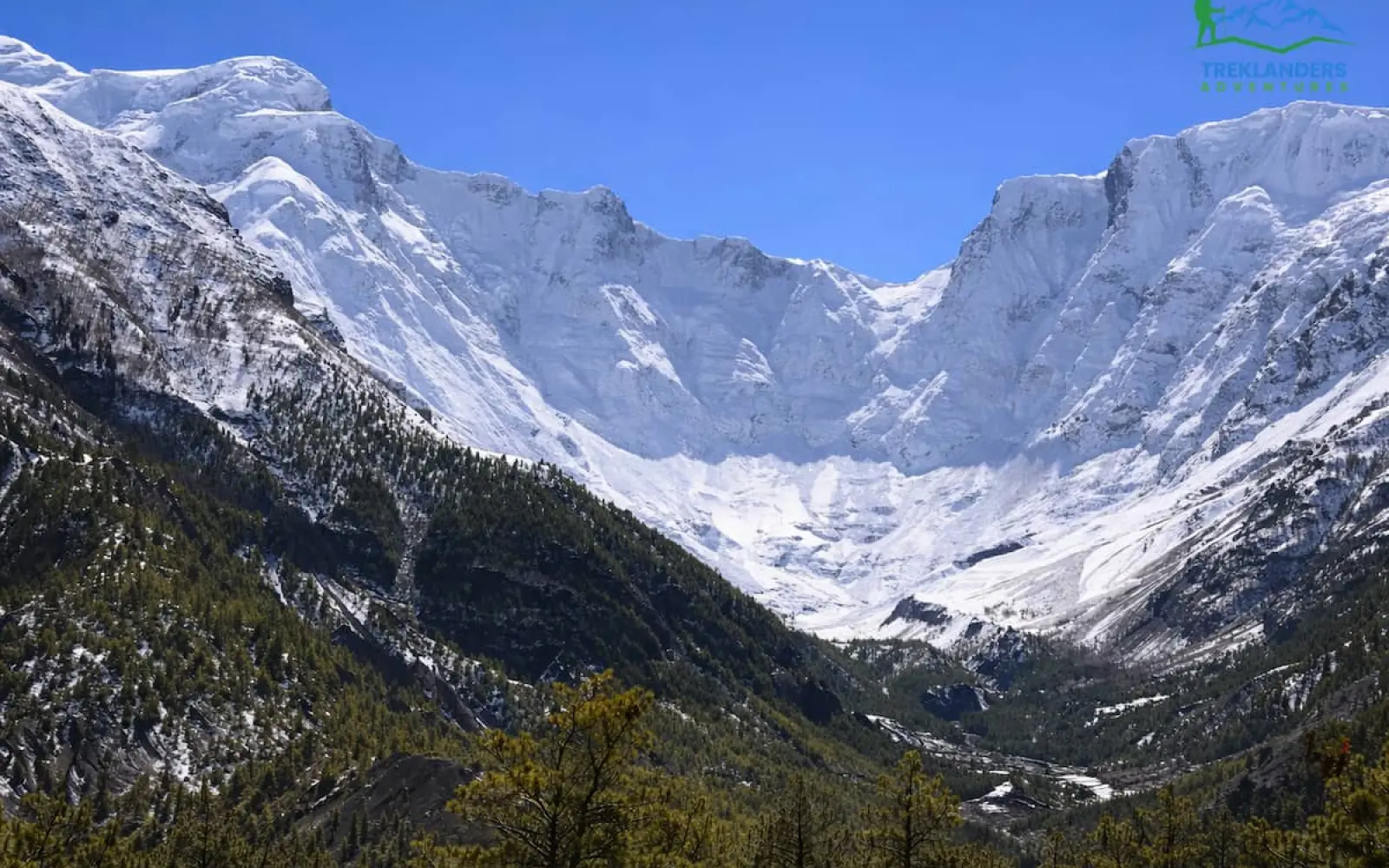
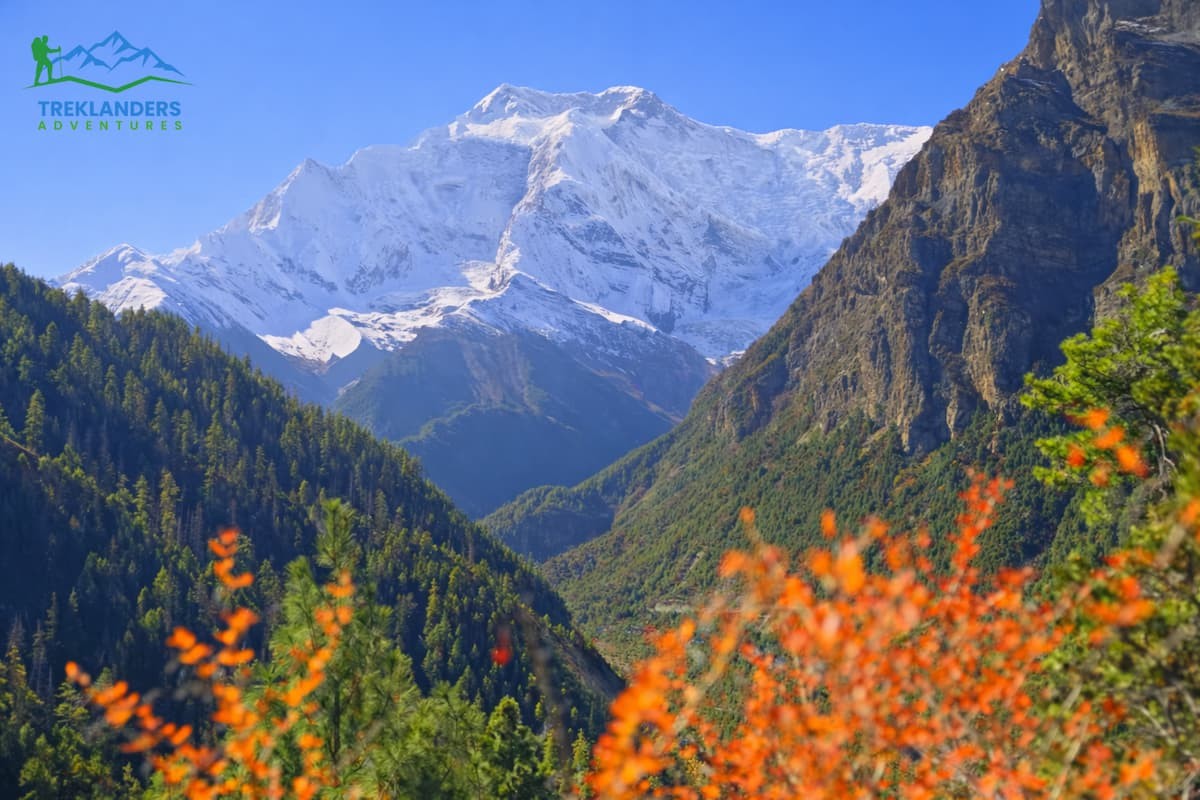
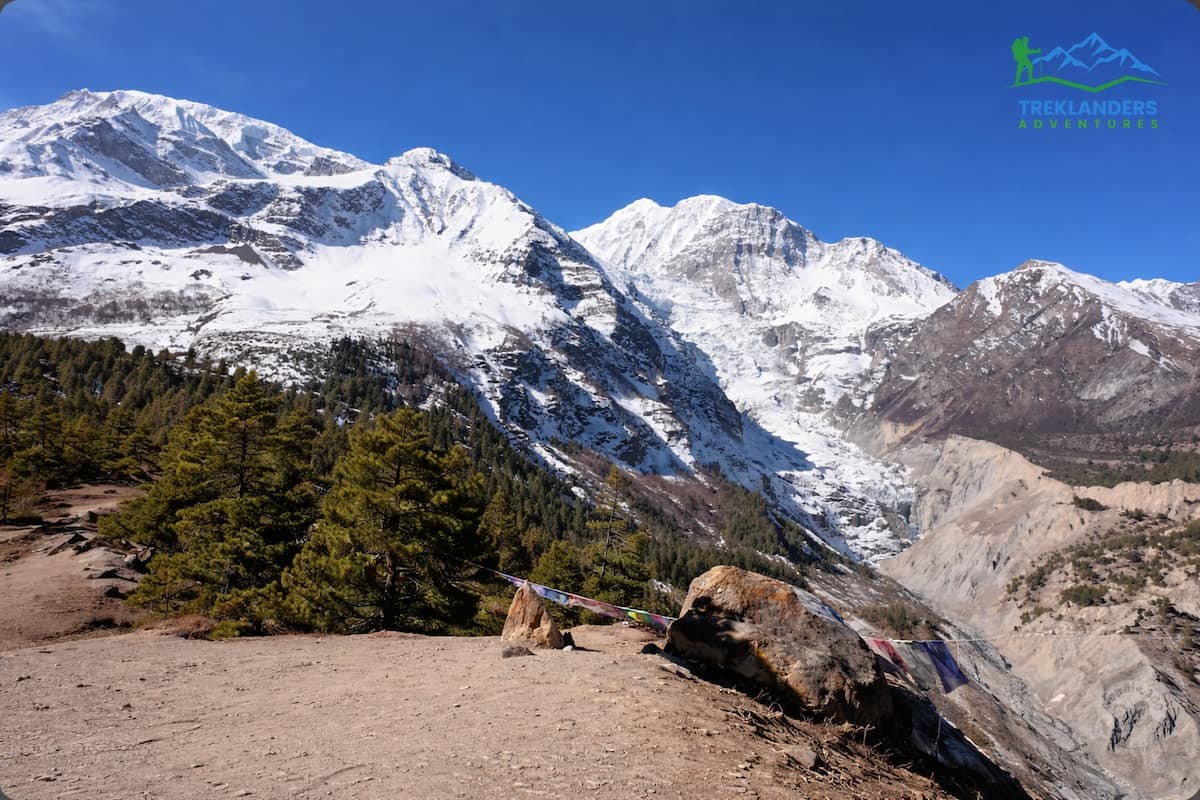
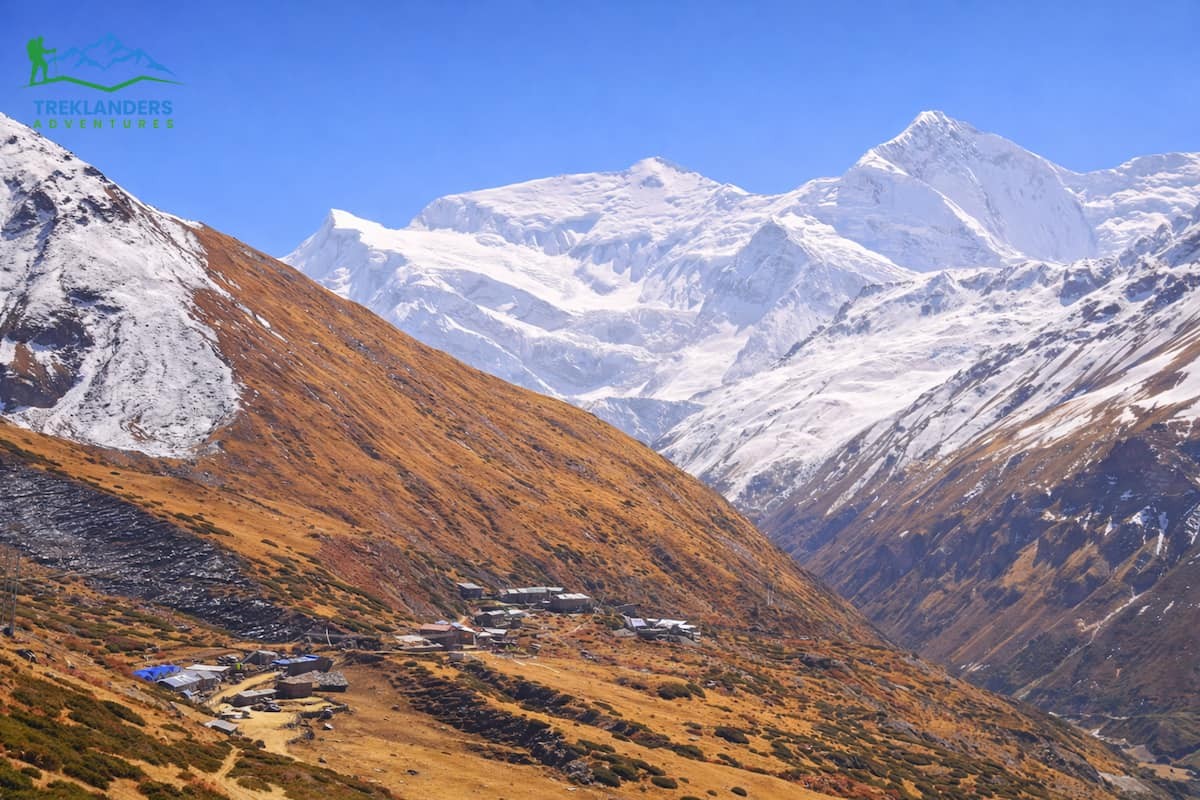
Breathtaking mountain views during the Annapurna Circuit Trek.
The Annapurna Circuit Trek stands out for its incredible Himalayan viewpoints, as well as its diverse landscapes and cultural richness. The trek from the lush Lamjung lowlands to the barren alpine deserts of Mustang showcases a continuously changing view of some of the most spectacular mountain scenery on Earth. The Annapurna Circuit is unique in that these stunning views are not secluded detours; instead, they come along the trekking route, thus, day after day, the trekkers are rewarded with incredible visual experiences.
The first part of the trip follows the Marsyangdi River valley, where the impressive natural scenery of deep gorges, waterfalls, and terraced hill slopes unfolds powerfully. Going up the trail towards Chame and Pisang, the mountains are more and more imposing, revealing the close-up scenes of Lamjung Himal and the Paungda Danda great rock face this is one of the most remarkable geological formations of the area. The viewpoints along the way give an idea to trekkers of the enormity of the Annapurna range.
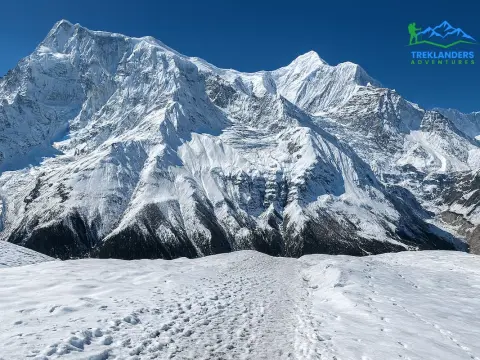
Up to the Upper Pisang and Manang parts, the trek features some of the most beautiful mid-altitude panoramas. The vibe is very much dominated by the majestic Annapurna II, Annapurna III, Gangapurna, and Tilicho Peak, while the glacial lakes and the vast valleys bring a layer of richness and variation to the landscape. Around Manang, the acclimatization walks, to the viewpoint above the village, for example, offer the kind of elevated views that, for some, are considered to be the most picturesque on the whole circuit.
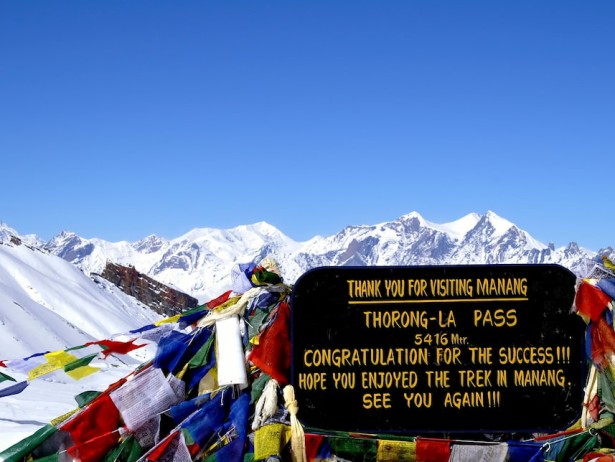
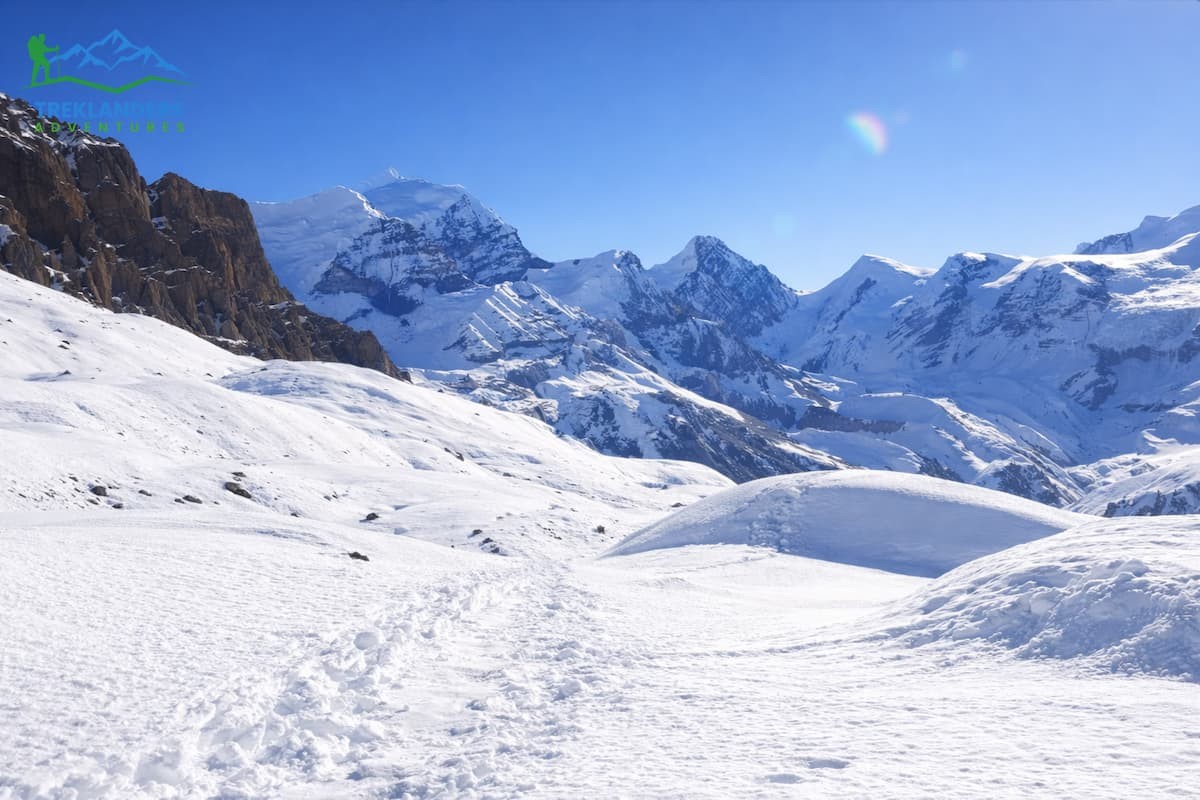
As the trek gradually ascends to the high-altitude areas of Yak Kharka and Thorong High Camp, nature takes on a sharp, bare, and grand look. This is where one can only notice large horizons, the thin air, and the overwhelming feeling of the Himalayan wilderness. The peak moment is at Thorong La Pass (5,416 m), the highest point of the trek, where a 360-degree view is a revelation of the snow-capped peaks running along the Annapurna and Dhaulagiri ranges. This particular view is considered by many to be one of the most spectacular high mountain passes in Nepal.
After entering the Kali Gandaki valley, the landscape once again changes, providing glimpses of the world's deepest gorge and, finally, the typical sunrise scene from Poon Hill. Altogether, these ten viewpoints tell the entire narrative of the Annapurna Circuit visually, thus making it one of the most beautiful long-distance treks in the Himalayas.
Best Annapurna Circuit Trek Viewpoints
1. Marsyangdi River Gorge Viewpoint
Altitude: -1,500 m
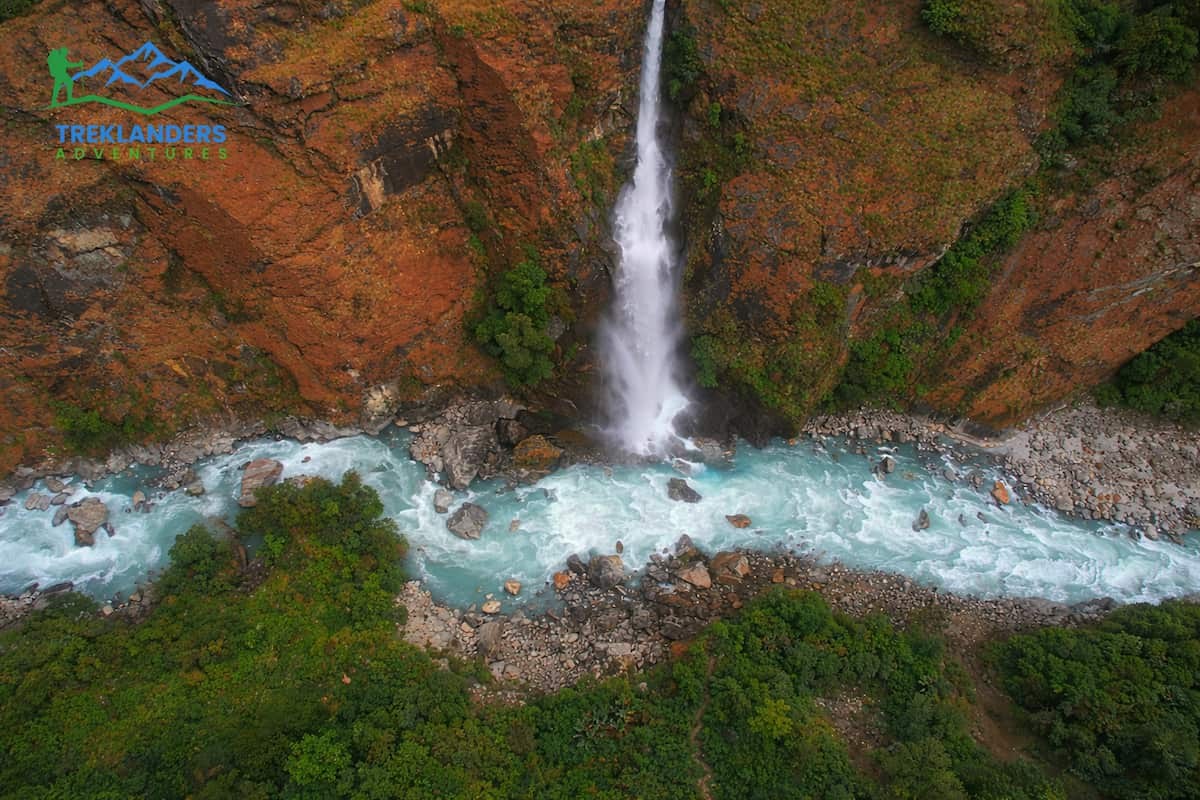
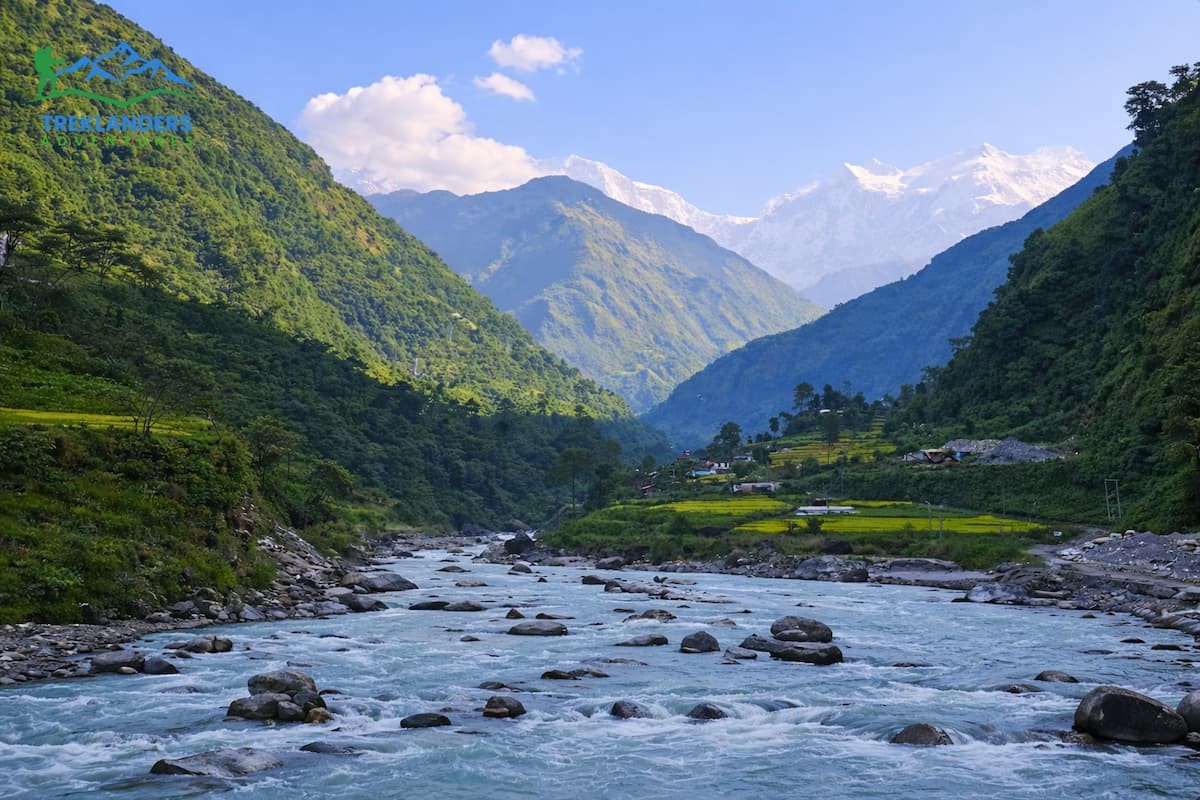
Scenic waterfall cascading into the Marsyangdi River during the Annapurna Circuit Trek.
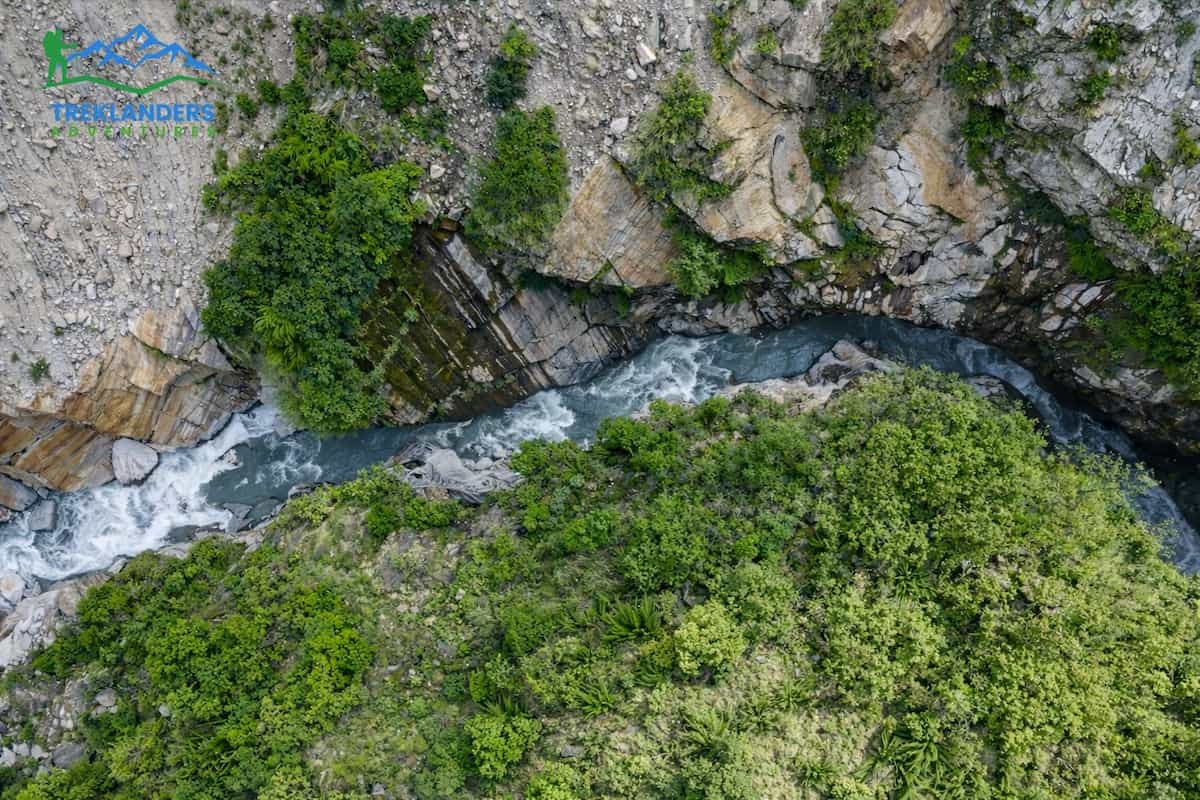
The Marsyangdi River Gorge Viewpoint unveils the itinerary's first breathtaking natural spectacle of the Annapurna Circuit Trek. From Besisahar to Dharapani, the road rises, and the Marsyangdi River, like a sharp knife, slices through the hillsides, creating an amazing and powerful gorge that is decorated with waterfalls, suspension bridges, and terraced farmland. The viewpoint that is located at an approximate height of 1,500 meters depicts the change from the lowland river valleys up to the Himalayan foothills. The tumultuous river down in the gorge is a striking contrast to the quiet mountain villages up on the hill, which is an early sign of the raw natural energy that characterizes the region. When the weather is clear, the cliffs surrounding the viewpoint and the slopes covered with trees are shining with a deep shade of green, while the mist that is coming from the river is giving an extra touch. This is the viewpoint that determines the mood of the hike as it acquaints the trekkers with the dimensions, geology, and hydrology that have been shaping the area of Annapurna even before the snow-capped mountains have taken over the skyline.
2. Lamjung Himal Viewpoint
Altitude: ~2,700 m
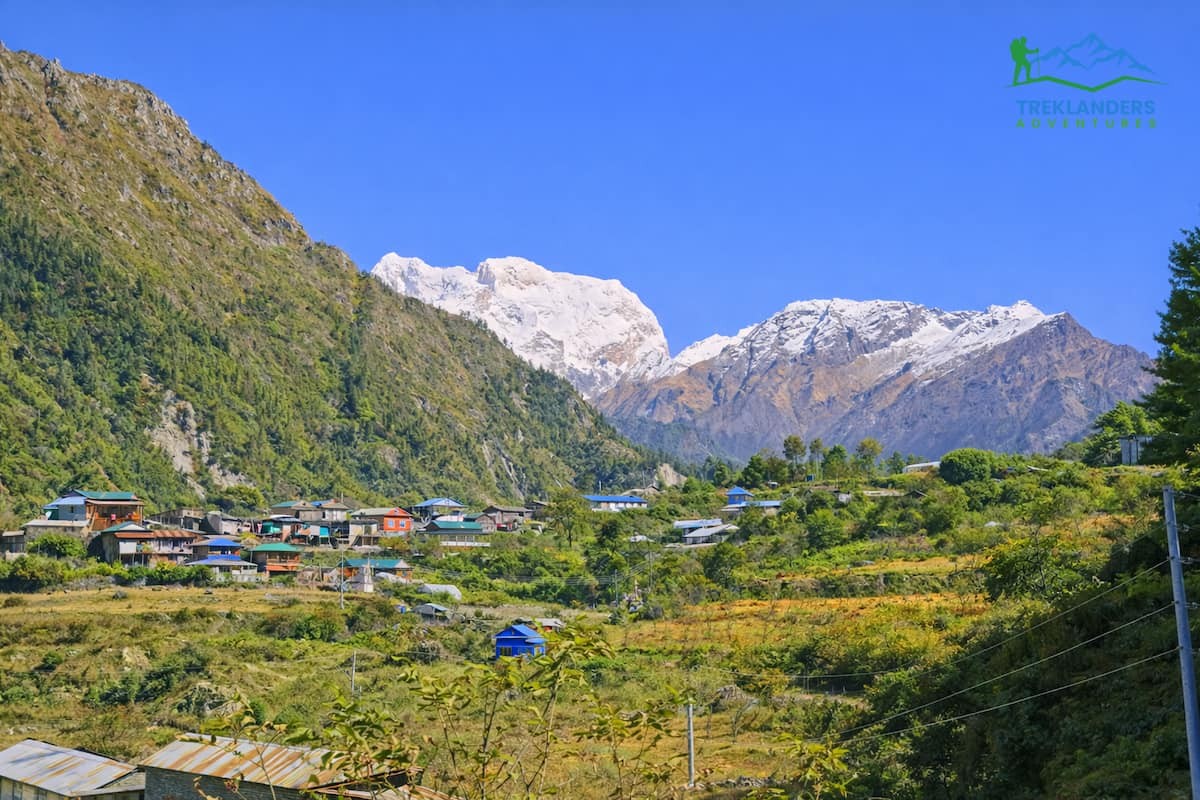
Beautiful mountain scenery alongside a village
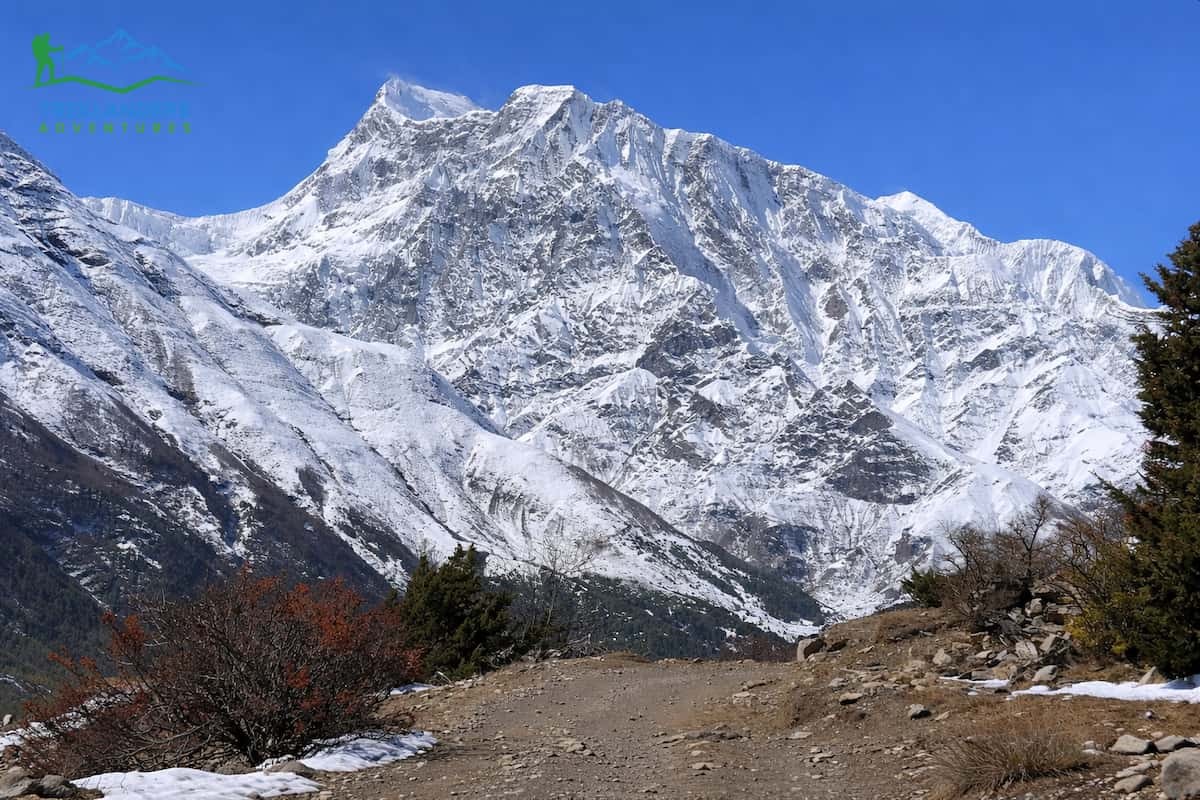
One of the fascinating landmarks along the Annapurna Circuit is the first true Himalayan mountain vista at the Lamjung Himal Viewpoint, which is near Chame. At this elevation of about 2,700 meters, the view at this point is striking as it presents Lamjung Himal towering over the pine forests and the Marsyangdi Valley. The huge icy face of the mountain beautifully contrasts with the green valley floor below, giving the trekkers the first sustained views of snow-covered peaks. The area around Chame is very picturesque, and the addition of prayer wheels, Mani walls, and forested trails to the natural setting makes it even more culturally appealing. It is not unusual that in the early morning, one enjoys the beauty of crystal-clear skies; hence, this viewpoint is perfect for taking photos. Apart from its aesthetic value, the Lamjung Himal Viewpoint is a psychological milestone for most, as it is here that many feel the high Himalayas are really within their reach, thus heralding a renewed sense of excitement and anticipation for the days ahead.
3. Paungda Danda Rock Face
Altitude: ~3,100 m
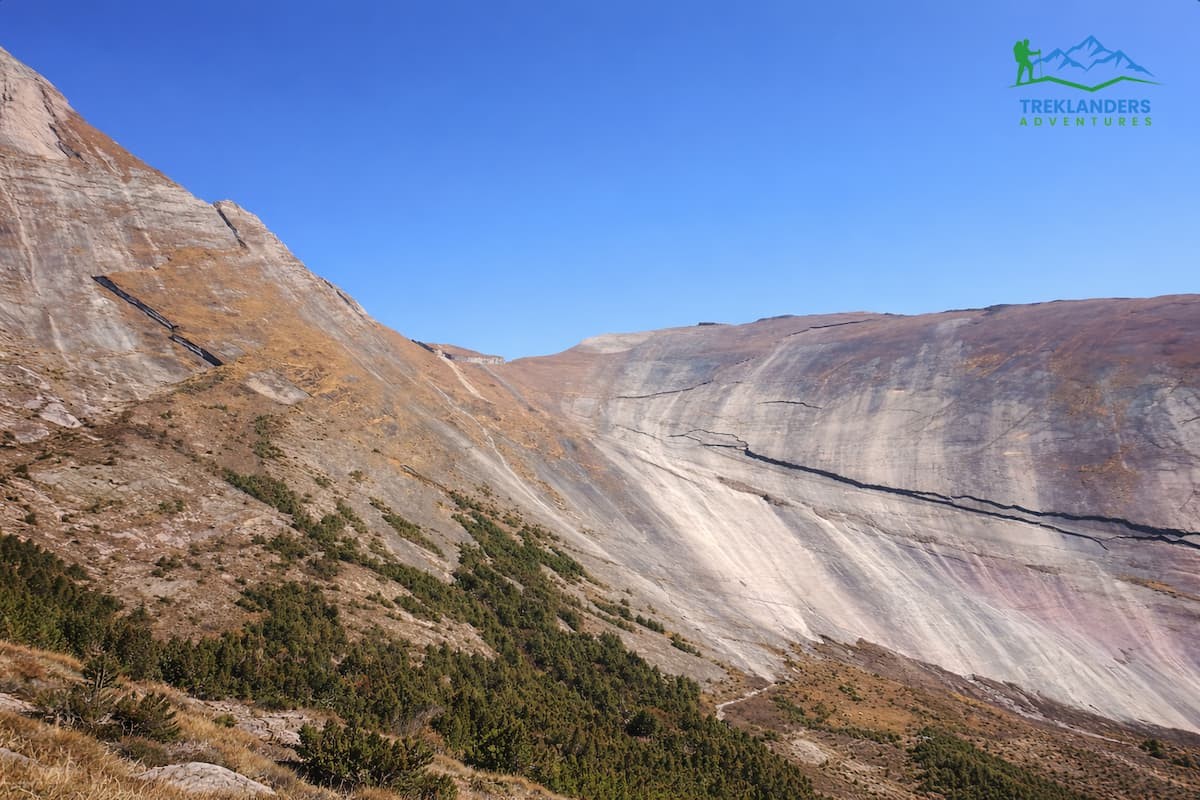
Paungda Danda-Swarga Dwari
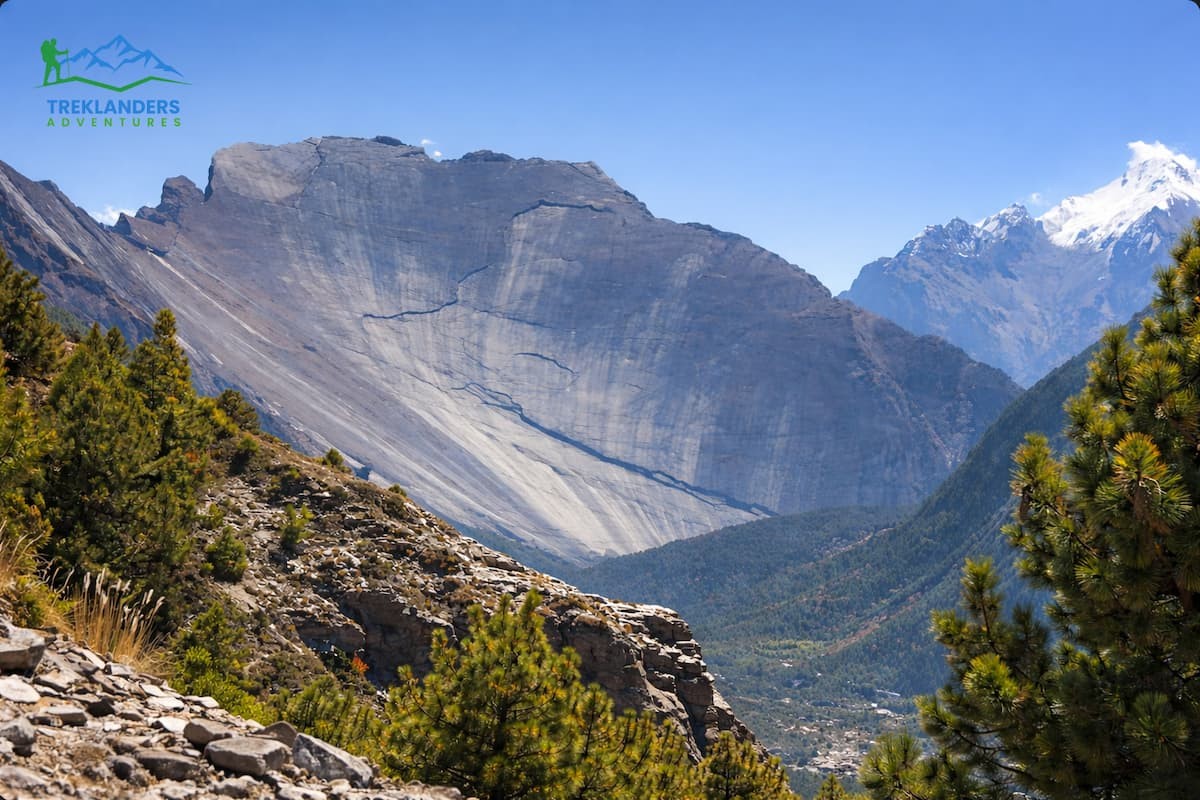
The viewpoint of the Paungda Danda Rock Face is among the most spectacular geological sights along the Annapurna Circuit. Almost 1,500 meters high, this gigantic curved rock wall is the main feature of the landscape near Pisang at about 3,100 meters above sea level. Local people call it "Paungda Danda" or "Swarga Dwari," and it is believed that the rock wall, which looks almost vertical, is sacred to the local communities. A very large and almost vertical rock face, its monumental dimensions and rarity of the formation have made it one of the most photographed places along the trekking route. Through the day as the sun moves, the rock surface varies its hue from a silver-gray to a rich golden, thus providing a continually changing visual treat. The snow-capped peaks of Annapurna II and Pisang Peak can be seen in the background, which completes the picture with depth and color contrast. This spot with a spectacular viewpoint vividly shows the powerful natural forces that created the Annapurna area.
4. Upper Pisang Annapurna Viewpoint
Altitude: ~3,300 m
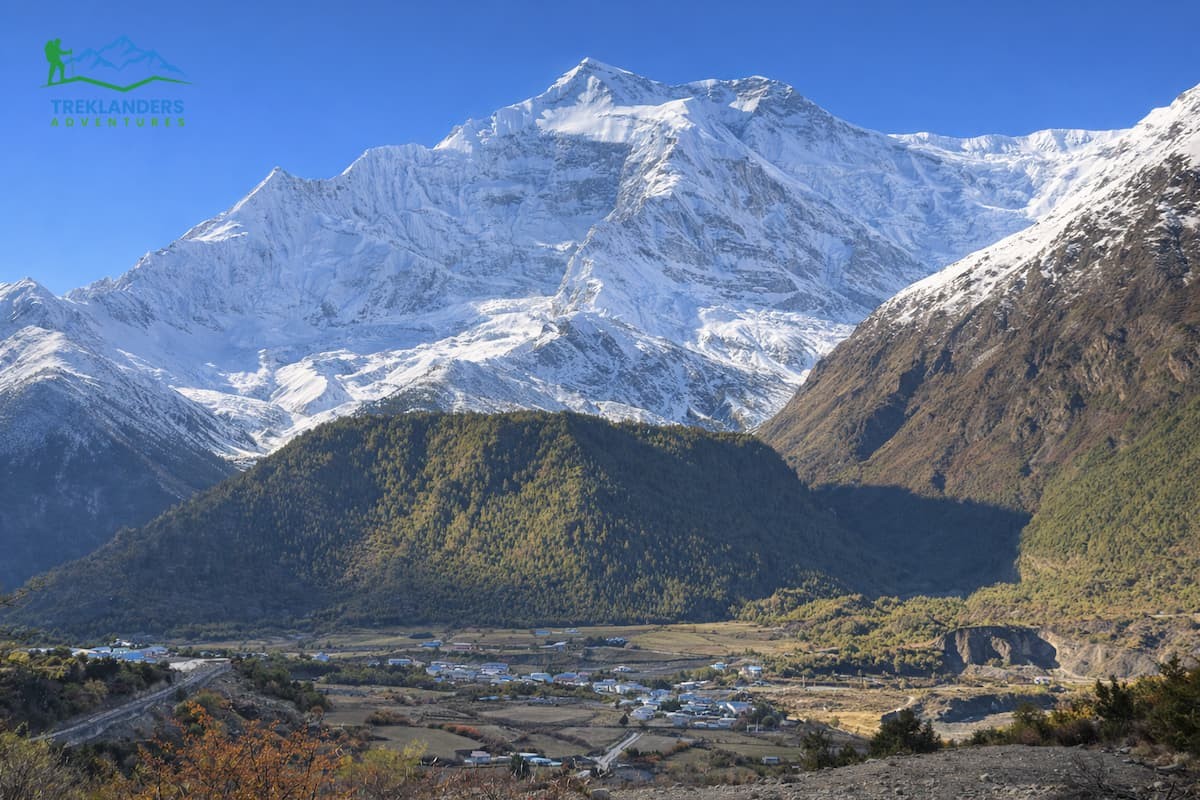
Panoramic mountain scenery as seen from Upper Pisang
The Upper Pisang Annapurna Viewpoint is generally recognized as the best mid-altitude viewpoint along the Annapurna Circuit. Located at about 3,300 meters, this spot gives trekkers who follow the upper route spectacular panoramic views of Annapurna II, Annapurna III, Gangapurna, Tilicho Peak, and Pisang Peak. The wide, open valley and dry alpine landscape allow for unobstructed views, making the mountains appear very close and huge. Traditional Tibetan-style villages, old monasteries, and prayer flags provide a cultural layer to the setting. The combination of elevation, dry weather, and wide-open spaces gives this vantage point a truly Himalayan atmosphere. Most seasoned hikers argue that this part is better than the lower route because of its visual appeal. It is a must-see that reveals the Annapurna range's magnificence and enormity in the most complete way.
5. Gangapurna Lake
Altitude: ~3,540 m
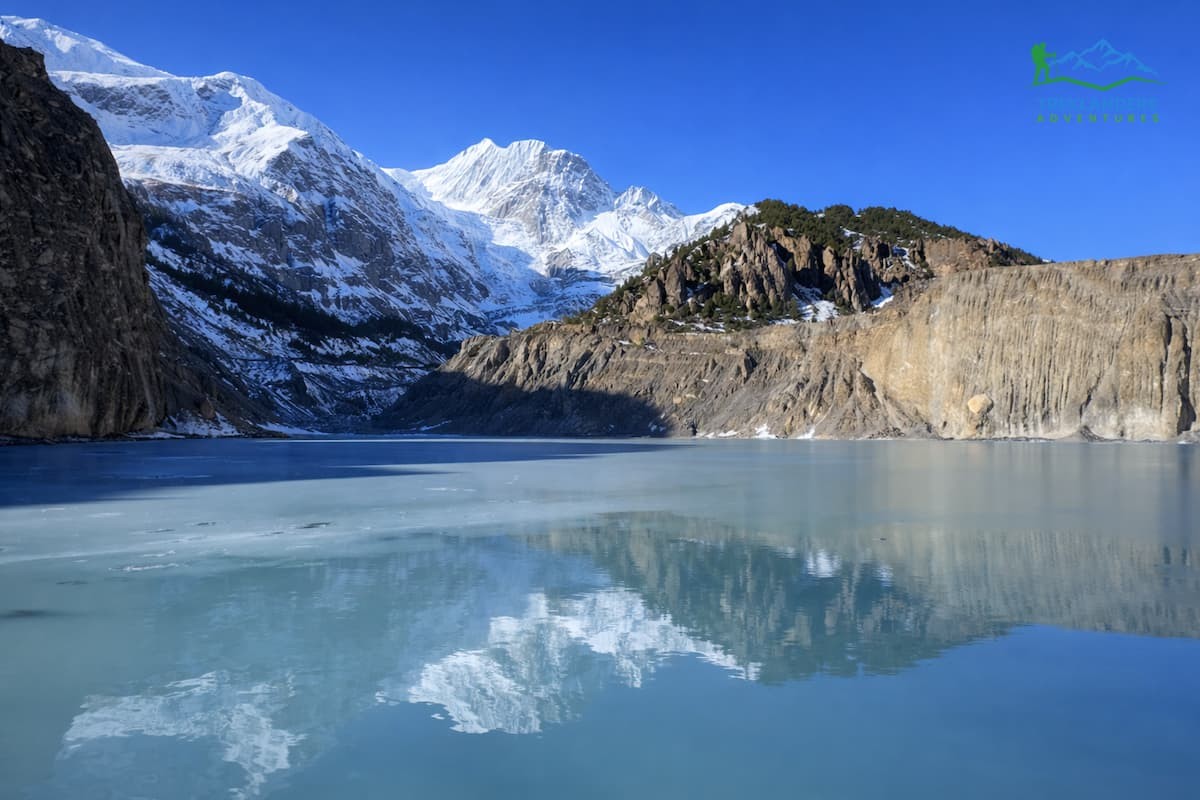
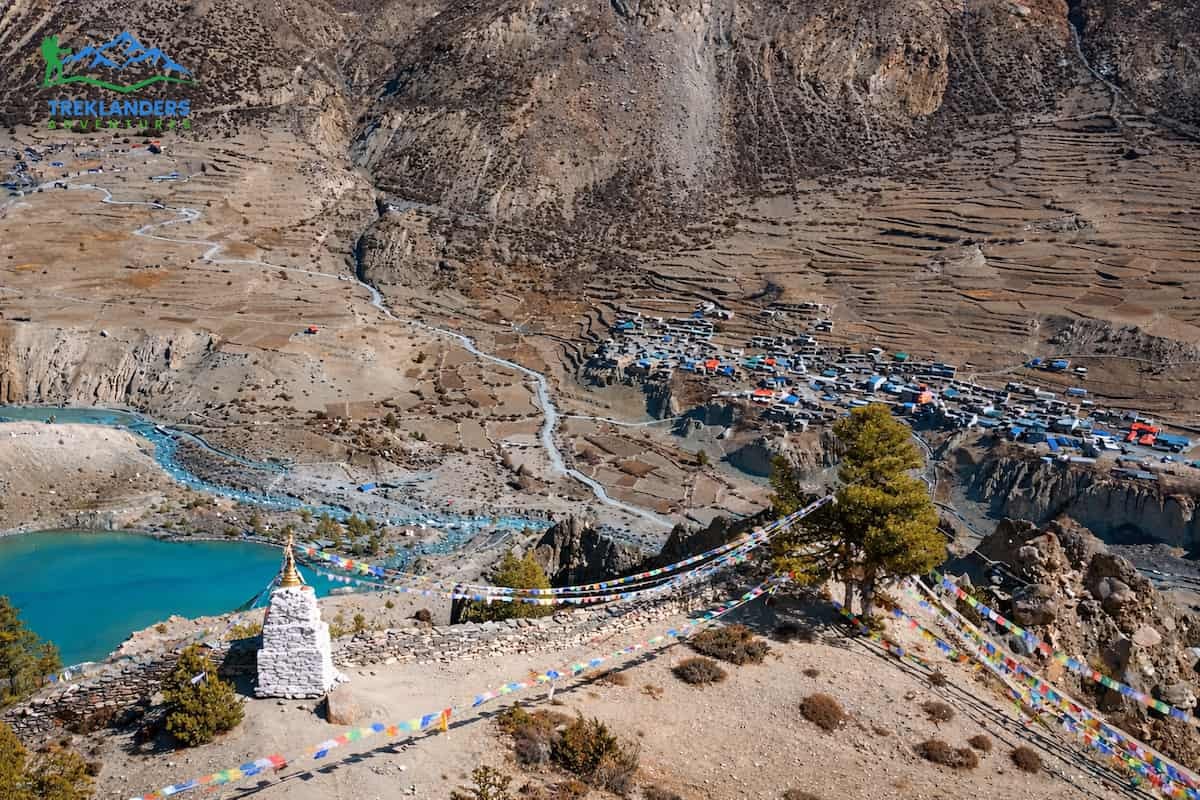
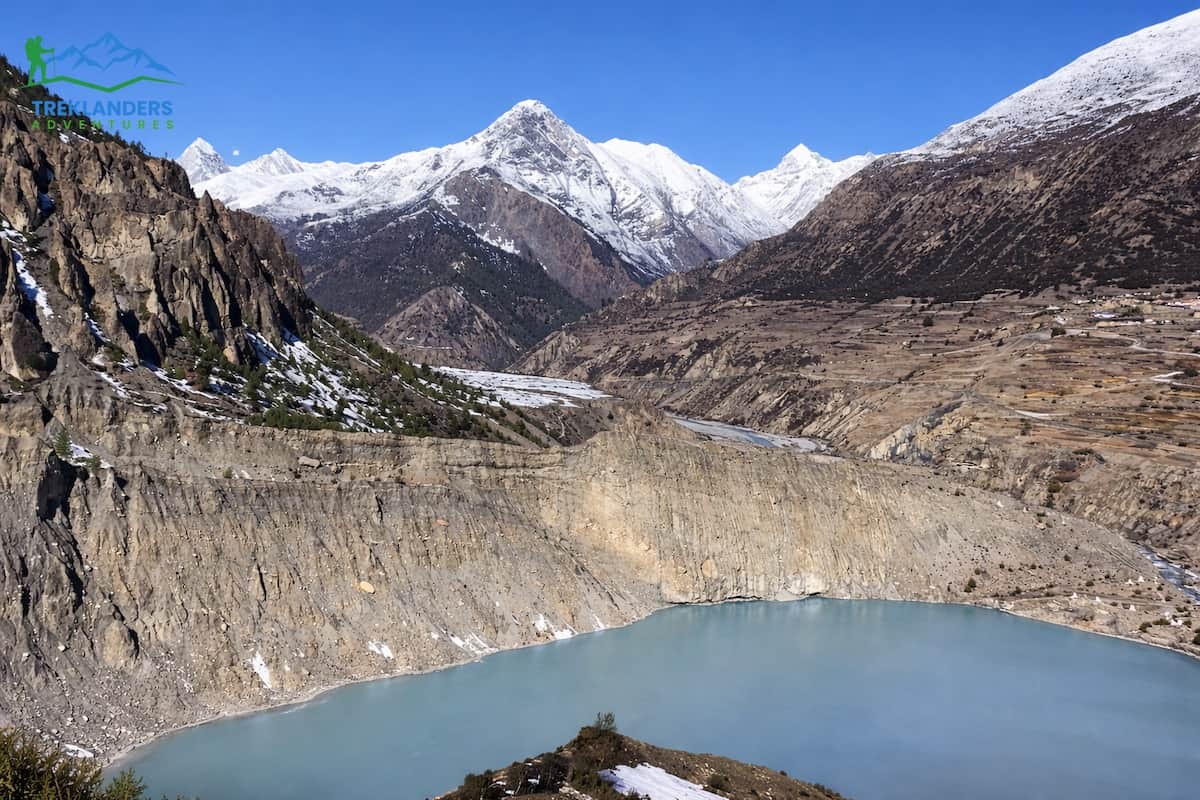
Gangapurna Lake - Annapurna Circuit Trek
Gangapurna Lake Viewpoint is located above Manang village, at an elevation of around 3,540 meters, and is one of the highlights of an acclimatization day. This magnificent turquoise glacial lake lies at the foot of Gangapurna Mountain, and on still days, it mirrors the snow peaks around it. The viewpoint presents a tranquil, yet grandiose, Himalayan scene, where ice, rock, and water are in perfect harmony and balance. Short hiking trips to the Gangapurna lake are great for acclimatization as they help trekkers slowly gain elevation while still being able to enjoy stunning views. From the viewpoint, Annapurna III and Gangapurna are very prominent, while glaciers descend the mountainsides towards the lake. The stark contrast between the arid Manang valley and the icy lake setting illustrates the climatic diversity of the area. Not only is Gangapurna Lake breathtaking, but it is also very conducive to taking a break, meditating, and getting ready for the higher altitudes.
6. Chongkor Viewpoint
Altitude: ~3,800 m
Breathtaking mountain scenery seen from Chongkor Viewpoint.
One of the best acclimatization spots on the Annapurna Circuit is Chongkor Viewpoint, located above Manang village at about 3,800 meters. The gradual uphill hike to the viewpoint gives a fantastic view of the whole Manang Valley. There are several peaks visible from the Chongkor viewpoint-- Annapurna III, Gangapurna, Tilicho Peak, and the glaciers in the vicinity, all in one wide-angle panorama. The lofty location gives one a feeling of being in the midst of a spectacular, yet lonely wilderness, the characteristics of high Himalayan trekking. The oxygen is less, the terrain rougher, and the quietness more intense. Chongkor Viewpoint is mostly cherished for acclimatization as it enables trekkers to ascend in height during the day and come down to sleep at a lower altitude. This safety and beauty combination makes it not only a very worthwhile short hike, but also one of the most rewarding hikes of the entire trek.
7. Yak Kharka Alpine Viewpoint
Altitude: -4,110 m
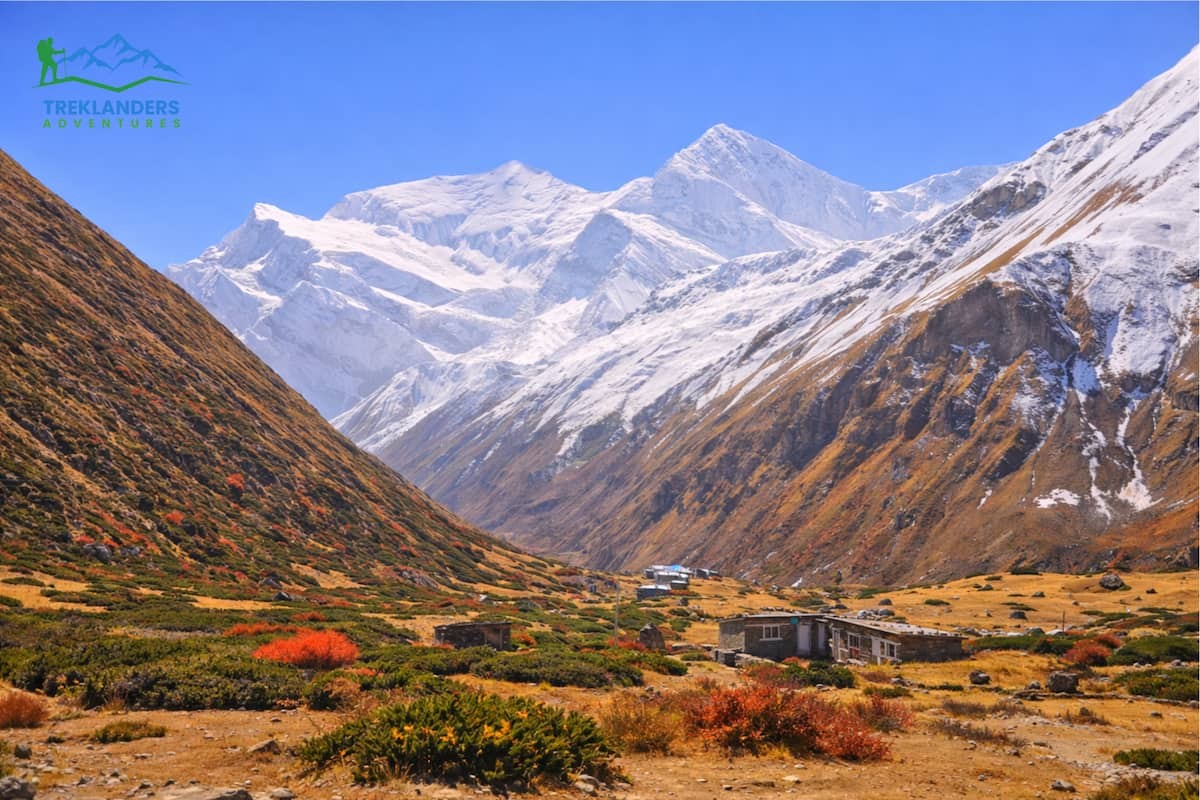
Panoramic Annapurna Range views from the Yak Kharka area
The Yak Kharka Alpine Viewpoint is the place where the true high-altitude Himalayan terrain starts. This viewpoint is at an elevation of approximately 4,110 meters, and it is characterized by wide alpine pastures, yaks grazing, and vast open skies. As the vegetation becomes scarce, the scenery takes on a stark, rugged beauty. From Yak Kharka, trekkers get to see Annapurna III, Gangapurna, and Chulu peaks towering above rolling highland slopes without any obstruction. What you get to experience here is a huge sense of space, with long sight-lines and dramatic cloud formations enhancing this. This vantage point shows the raw, wild nature of the upper Annapurna area. Due to the slower pace, which is necessary at this altitude, trekkers are naturally drawn to notice the little things the wind, the silence, and the grandeur of the mountains. Yak Kharka provides a serene yet magnificent Himalayan view that mentally and physically equips trekkers for the pass crossing ahead.
8. Thorong High Camp Viewpoint
Altitude: ~4,900 m
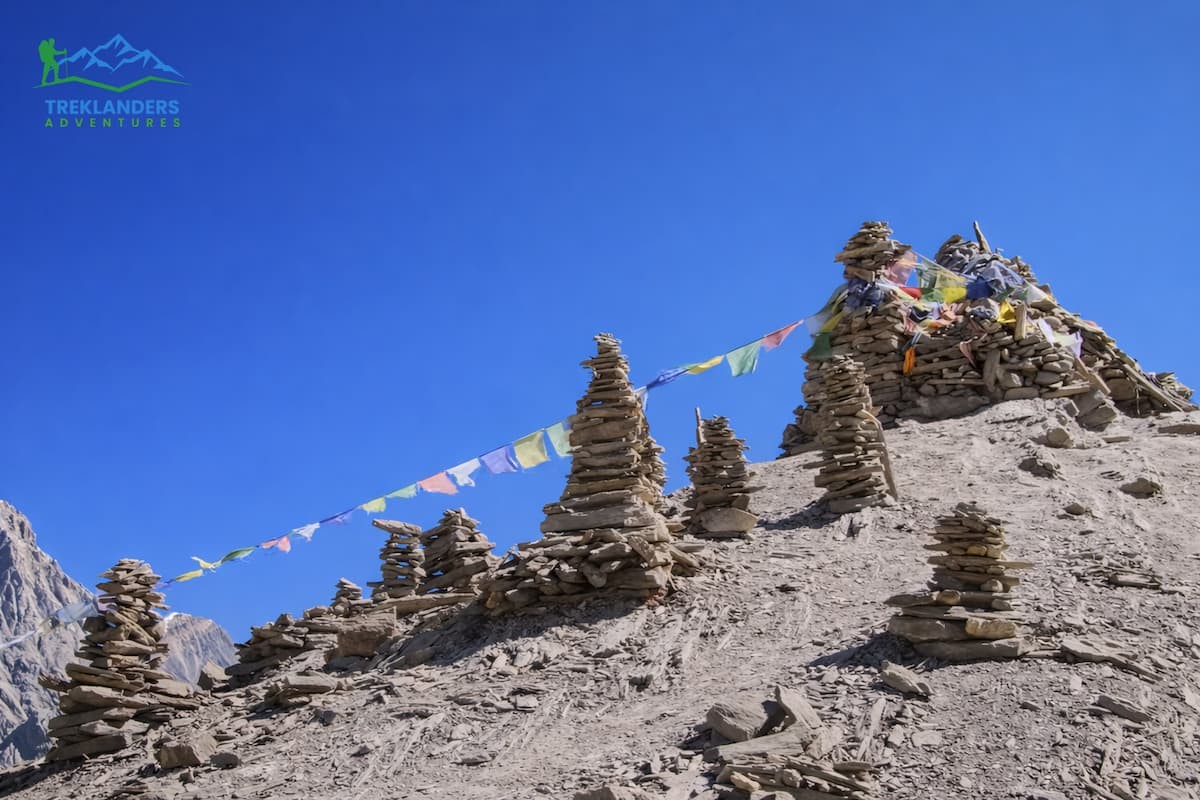
Thorong High Camp Viewpoint
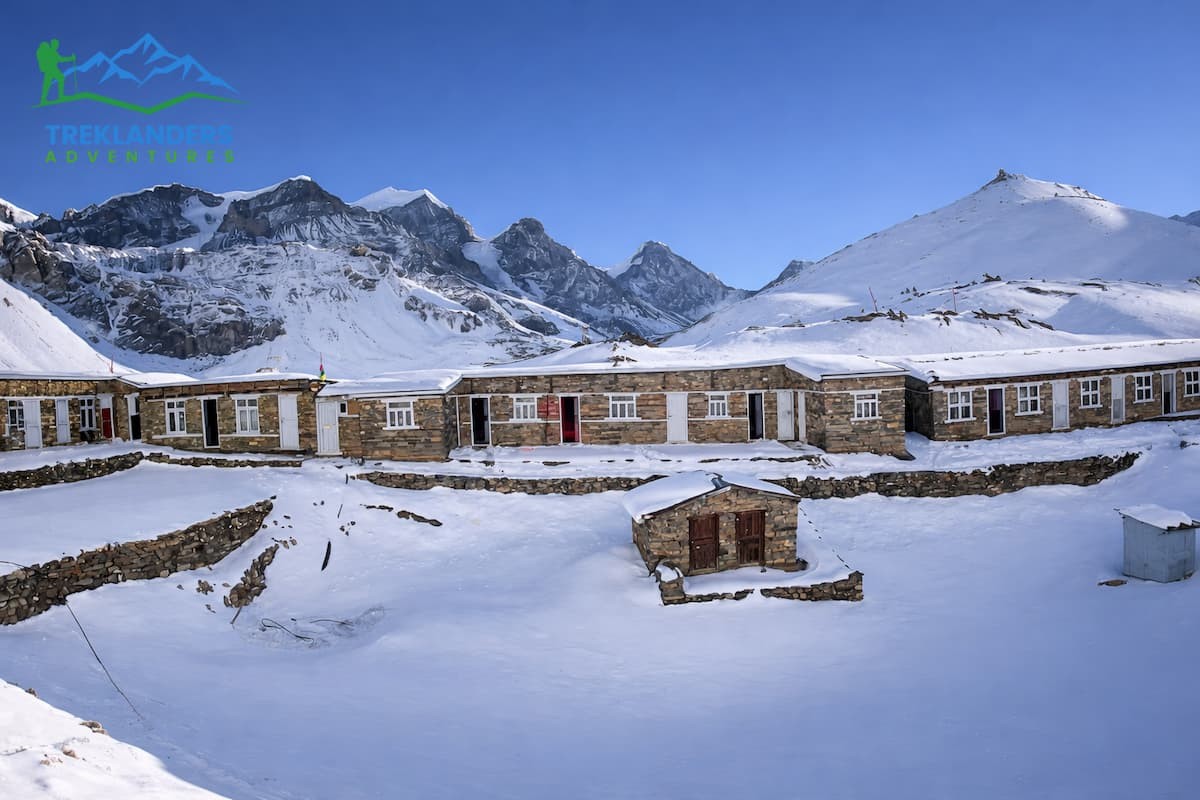
The Thorong High Camp Viewpoint at around 4,900 meters is a place that offers a very powerful high-altitude Himalayan experience. From this spot, trekkers are literally surrounded by the naked slopes, ridges covered in snow, and the looming way to Thorong La Pass. The mountains are almost at hand and quite imposing, with the sun casting dramatic shadows on the landscape at different times. The air, of course, is much thinner, which adds to the seriousness and excitement of crossing the next day. The viewpoint gives a spectacular view, and the lining is absolutely perfect when the sky clears in the early evening. The peaks of the Annapurna range and the nearby high ridges make a desolate and yet lovely scene. This viewpoint is the last step before the summit of the trek and a place where you can really feel the sense of achievement and inspiration.
9. Thorong La Pass
Altitude: 5,416 m
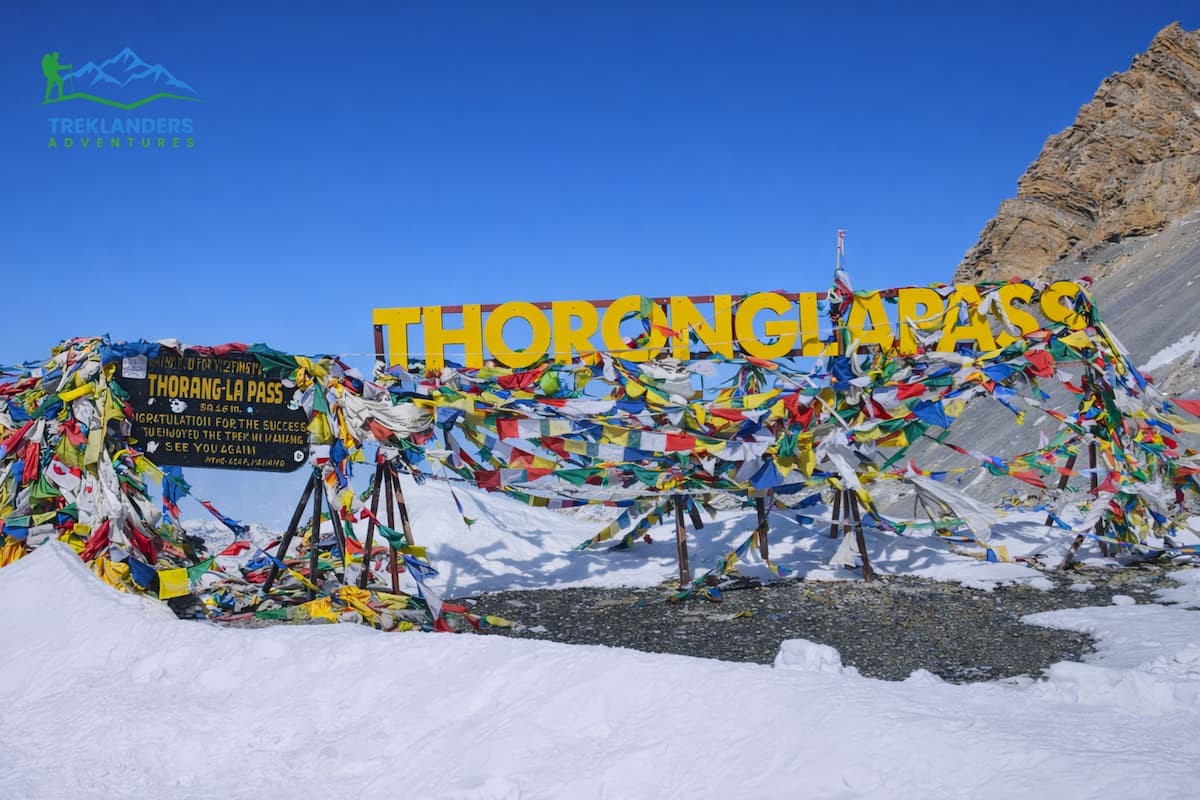
Thorong La Pass- Annapurna Circuit Trek
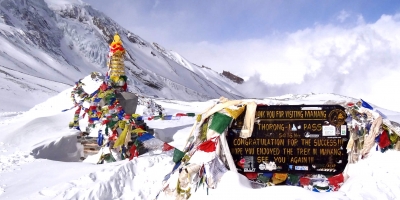
Thorong La Pass Viewpoint is undoubtedly a great showcase of the Annapurna Circuit Trek and one of the highest trekking passes in Nepal. At 5,416 meters, this viewpoint offers the rare opportunity of a 360-degree Himalayan panorama. The range of snow-capped mountains extends from Annapurna to Dhaulagiri while prayer flags wave in the thin mountain air. Getting to this point involves a long, pre-dawn walk, which makes the sight even more satisfying. The feeling of accomplishment is tremendous as the trekkers are standing above the valleys on both sides of the Himalayas. Changes in the weather can be quick, which can add excitement and intensity to the experience. Thorong La is more than just a beautiful lookout; it is a key moment of strength, endurance, and mountaineering adventure that trekkers remember for a long time after the journey is over.
10. Kali Gandaki Gorge
Altitude: ~1,200 m
Kali Gandaki Gorge - Annapurna Circuit Trek
The Kali Gandaki Gorge Viewpoint presents one of the most breathtaking landscapes on the planet. Situated at about 1,200 meters near Tatopani, this viewpoint exhibits the incredible depth of the canyon that has been cut between Annapurna and Dhaulagiri two of the tallest mountain massifs in the world. Below flows the Kali Gandaki River, contributing to the visual impact of the near-vertical cliffs that rise on either side. Feeling the drop in altitude and change in climate after being in high alpine places can be quite dramatic. This part is distinguished by subtropical vegetation, warmer air, and powerful views of the river. The gorge is a total geographical contrast to the summit pass, thus emphasizing the great diversity of the Annapurna Circuit. It is a magnificent finale of the Himalayan journey.
Difficulty level to reach each viewpoint
1. Marsyangdi River Gorge Viewpoint
Difficulty Level: Easy
It is a leisure activity for anyone who reaches the Marsyangdi River Gorge Viewpoint. It is quite simple, and hardly any trekking efforts are needed. You can see the viewpoint while driving from Besisahar to Dharapani on the 2nd day. Most of the journey is taken in a vehicle, with just a few chances to get out for photos. At this point, there is no altitude threat as the height is less than 1,800 meters. The problems are mainly the roads, which in some places can be bumpy or dusty, especially after rain. You do not need to be physically fit, so the viewpoint is open to all kinds of travelers, beginners as well as older trekkers. Thanks to the easy access, the trekkers can admire the spectacular gorge scenes without being tired, thus, it can be a gentle start to the Annapurna Circuit for the first time trekkers before the real trekking begins.
The Lamjung Himal Viewpoint is one of the stops on the trek to Chame, and the level of difficulty is moderate. The route comprises moderate climbs through pine forests and along the river valleys. There are some steep sections, but no difficult terrain. At about 2,700 meters altitude, most people do not have to worry too much about altitude sickness, but it is still advisable to keep a steady pace. The total time of daily walking is around five hours, so it is the endurance that counts here, not the strength. The trail is quite popular, there is no danger, and it is a perfect choice for those who have a basic fitness level. By staying hydrated and having a rest from time to time, even a beginner can comfortably handle going up to this viewpoint. Actually, what makes it more difficult is the distance, rather than the ground, so it is an easy but very pleasant viewpoint for the initial part of the trek.
3. Paungda Danda Rock Face
Difficulty Level: Moderate
Paungda Danda Rock - Annapurna Circuit Trek
The Paungda Danda Rock Face Viewpoint can be reached by a moderately difficult trek to Pisang. The trail is a combination of gentle climbs and leveled parts until very close to 3,100 meters altitude, where it starts getting a bit steeper. The walkway does not involve technical challenges; however, longer hiking hours and gradual altitude ascent can bring a slight tiredness. Besides that, the weather, such as wind or sun exposure, may contribute to the difficulty level. Climbers should keep a steady pace and not rush. There is no climbing or dangerous steep drops, so the route suits the majority of climbers. With a decent level of fitness and some walking experience, this viewpoint is doable without any pressure, and it is a great way to feel the change in the surrounding high Himalayan landscape.
4. Upper Pisang Annapurna Viewpoint
Difficulty Level: Moderately Challenging
The Upper Pisang Annapurna Viewpoint trail is more demanding than the lower one, and the challenge level is moderately challenging. The path is a continuous uphill one with an altitude of 3,300 meters being reached gradually. The air is getting slightly thinner, and walking may become slower and breathless. Yet, the path is still safe and non-technical. The main reason for the hike's difficulty is the altitude gain and not the terrain. Only endurance hikers will get the full advantage of this trail, as the beauty of the views is overwhelming. However, even the novices, if they pace and rest themselves well, can overcome this section. A decision to take the upper route is an indication that one prefers the scenic view and is a step closer to the higher elevations ahead.
5. Gangapurna Lake
Difficulty Level: Easy to Moderate
The road to the Gangapurna Lake Viewpoint is simple and a perfect choice for getting used to the altitude. From Manang village at 3,540 meters, a short, gentle, and well-marked hike leads to the Gangapurna Lake Viewpoint. Although the altitude is greater, the time spent walking is so low that a person hardly feels the pressure. Along the trail, there are only gentle uphill sections, and the trek is generally without any exposed or difficult parts. Some people may experience a slight shortness of breath because of the altitude, but the hike becomes easy if you take breaks frequently. Here, the viewpoint is very accessible for everyone, even beginners at high altitude. In fact, its function is not to be a challenge for one's endurance but to facilitate safe acclimatization without losing the beauty of the mountains.
6. Chongkor Viewpoint
Difficulty Level: Moderately Challenging
The main factor that makes the Chongkor Viewpoint hike moderately difficult is altitude rather than distance. The route ascends above Manang up to around 3,800 meters, and there are some steep sections without stops. Even though the length of the trek is brief, it might seem harder to breathe with less oxygen available at higher altitudes. For this reason, hikers have to proceed slowly and keep the pace steady. There are no hidden dangers or technical difficulties on the way as the track is secure and visible, but one can get tired quite easily. This walk is a typical acclimatization one, developed with the idea of the hiker, the exertion should be expected. Those who feel discomfort, even if the symptoms are very mild, should lower their altitude without delay. By monitoring one's pace and being cautious, nearly everyone on this trek can safely get to this spot and experience a sense of achievement that will help them tackle the next days of higher elevation.
15-Day Tilicho Base Camp with Thorong-La Pass Trekking | 15 days
The challenge of reaching Yak Kharka Alpine Viewpoint lies mainly in the high altitude, which is more than 4,000 meters. The ground underfoot is rather easy with the gentle undulating tracks and meadow areas; however, the biggest difference is in the air that contains considerably less oxygen. One starts feeling more tired and has to take more breaks. The body has to exert more effort even going up very short inclines. No technical climbing is involved; hence, physical strength and mental concentration play the main roles. Trekkers need to be very careful about drinking and eating to keep their energy up. This part of the route is more about how well a person copes with the altitude rather than the strength. Generally, those who have done a proper acclimatization in Manang can get through this stage without any problem, but it is still very important to be cautious and patient.
8. Thorong High Camp Viewpoint
Difficulty Level: Challenging
Because of the steep climb and the extremely high altitude of nearly 4,900 meters, Thorong High Camp Viewpoint is a very challenging destination. From Thorong Phedi, the path ascends steeply, sometimes on unstable ground. As the amount of oxygen in the air is very small, the body gets tired very quickly. Even physically fit people become exhausted here. Walking needs to be done by taking slow consideration steps and resting very often. Just as necessary as physical strength is mental determination. Change in weather is another factor that can influence the level of difficulty. Despite it being technically a safe passage, the climb and descent should always be done at a level of respect for the altitude and the body's signals. Successfully reaching this viewpoint means that a trekker is very likely to be ready for the Thorong La Pass crossing.
9. Thorong La Pass
Difficulty Level: Challenging
Thorong La Pass is the most difficult part of the Annapurna Circuit. At 5,416 meters, extreme altitude, low temperatures, and lengthy hours of walking together make it a really tough physical challenge. The climb starts before dawn and can take 4-5 hours going uphill. It's hard to breathe, your energy is used up fast, and you can be at the mercy of the weather. There is no technical climbing involved, but it is very important that you have good endurance, are well-acclimatized, and have strong mental strength. Proper pacing, warm clothing, and hydration are essential. This viewpoint is not recommended without prior acclimatization. Successfully reaching Thorong La is a huge accomplishment and the highlight of the trek.
10. Kali Gandaki Gorge
Difficulty Level: Easy to Moderate
The Kali Gandaki Gorge Viewpoint is easy to moderate level as it can be accessed by vehicle while driving to Tatopani. Physical movement is quite limited, especially after crossing Thorong La. The major factor is the condition of the road, which can be either rough or winding. The altitude is low, about 1,200 meters, which allows the body to recuperate quickly. Short walks or stops for viewing do not require trekking effort. After several days of high-altitude challenge, this viewpoint feels like a kind of rest and being comfortable. It offers spectacular scenery without any effort, thus it is a perfect scenic transition near the end of the trek.
This viewpoint can be enjoyed to the fullest if you visit it in spring or autumn, as these two seasons offer generally clear skies and stable weather. Besides the vibrant green scenery, waterfalls, and flowering plants will surely charm you during the spring (March to May) season. During autumn (September to November), the climate is cooler with less humidity, and the lighting conditions for taking pictures are very good. Landslides and slippery roads may occur during the rainy season, so it is not very safe to go there, and weather visibility may also be affected. Winter mornings can be foggy. Since you can reach this viewpoint by a vehicle, harsh cold will not be a problem, so, except for the heavy monsoon months, you can have a nice time even during winter.
2. Lamjung Himal Viewpoint
Best Time: April-May & September-November
If you want to see the Lamjung Himal Viewpoint at its best, you should head there around late spring or autumn, as the skies in these seasons tend to be clear and therefore the visibility of the mountains is at its highest level. In April and May, you can find the amazing brightness of the morning combined with the contrast of the snow still present on Lamjung Himal and the colorful forested valleys. October is just perfect due to the milder weather, hardly any clouds, and sharply defined mountains. It is also quite common for the woods to be covered by clouds during the monsoon, when it is especially cold, and there is little daylight during the winter. It is best to rise early all year to avoid the cloud buildup and to get stunning views.
3. Paungda Danda Rock Face
Best Time: April-May & September-October
Paungda Danda Rock Face Viewpoint is definitely the most beautiful when it is spring and the beginning of autumn, as the light emphasizes the incredible height of the rock formation. In April and May, the sunlight brings out the features and color of the gigantic cliff, while the surrounding peaks are still covered with snow. September and October have dry air and excellent visibility, so the rock face, together with the bright sky, creates an intense contrast. During the monsoon, the clouds are often wrapped around the cliff, so it is only partly visible. Winter can be clear too, although colder, with less daylight. Daylight from the middle of the day gives the greatest contrast to the eye.
4. Upper Pisang Annapurna Viewpoint
Best Time: April-May & October-November
The Upper Pisang Annapurna Viewpoint is the loveliest place to go in spring and autumn, when you can see the Himalayan mountain range very well. April and May are great if you want to see the snow on the peaks and also have nice and warm conditions for walking, so it is very rewarding to do the upper route. October and the beginning of November bring crystal-clear skies, almost no wind, and excellent long-distance visibility of Annapurna II, III, and Tilicho Peak. Clouds coming with the monsoon often block the views, while winter snow can make the trails colder and less comfortable. Since the clouds often form later in the day at this altitude, the morning hours are perfect for a visit.
5. Gangapurna Lake
Best time: April - May & October
Gangapurna Lake Viewpoint is at its most beautiful in spring and autumn when the lake perfectly reflects the surrounding peaks on a clear and calm day. In April and May, glaciers melting supply the lake with turquoise waters while Gangapurna and Annapurna III are still covered with snow. In October, the weather is cool and dry with cold nights, which, combined with the absence of wind, enables the water to turn into a perfect mirror. The lake can be quite dull during the monsoon, when it is mostly covered by clouds. Winter can freeze some parts of the lake. Late morning is usually the right time to go, as by then the basin gets illuminated by the sun.
6. Chongkor Viewpoint
Best Time: April - May & October
Chongkor Viewpoint - Annapurna Circuit Trek
The best time to visit Chongkor Viewpoint is spring and autumn, the two seasons of acclimatization, when the weather is stable, and the condition of the trail for hiking is safe. The main advantage of April and May is that the temperature during the day is warm and the air is so clear that one can see the mountains - all this provides a perfect environment for altitude acclimation. October is equally favorable, with dry trails and excellent visibility across the Manang Valley. It is also possible to go in winter, but it will be colder, while during the monsoon, the clouds frequently obscure the view. It is advisable to go for early morning or late afternoon hikes because during spring at this altitude, the sunlight at midday can be very intense.
7. Yak Kharka Alpine Viewpoint
Best Time: Late April -May & October
Yak Kharka Alpine Viewpoint should be planned during late spring and autumn as these seasons offer manageable snow levels and weather conditions that are not too bad. In late April and May, the conditions at high altitude are warmer, and you can enjoy the broad alpine scenery along with the clear views of the surrounding peaks. October gives the advantage of fresh air and great visibility, and the temperatures go down quite fast after sunset. Winter means that you will have to face intense cold, and the monsoon season brings more cloud cover, and the trail condition becomes risky. It's best to have clear mornings since the weather at this elevation can change very fast in the afternoon.
8. Thorong High Camp Viewpoint
Best Time: May & Early October
Due to the extreme altitude and weather sensitivity, the Thorong High Camp Viewpoint must be visited only during the peak trekking seasons. May and early October are the months that are the safest and most reliable, with relatively stable conditions and manageable snow levels. In these months, visibility is generally very good in the late afternoon and early evening. Dangerously low temperatures can be expected in winter, while the monsoon season leads to increased snow and cloud cover. Here, precise timing is very important. Clear weather is not only essential for safety but also for getting mentally and physically ready for the pass crossing the next day.
9. Thorong La Pass
Best Time: May and Early October
Thorong La Pass Viewpoint is a great place to visit in May or early October, as these are the times when the weather is most suitable for outdoor activities. In May, you also get more daylight and less snow on the ground, and in early October, the air is fresh, and the view is stunning. Additionally, the risk of snowstorms and extremely low temperatures makes winter crossings very dangerous. The monsoon season brings heavy snow and low visibility. Therefore, the crossing should always be done early in the morning to avoid strong winds and sudden weather changes, which are very common later in the day.
10. Kali Gandaki Gorge
Best Time: March to May & September to November
The Kali Gandaki Gorge Viewpoint is best reached in spring and autumn, which are the two seasons of the year with the clearest skies, and when the depth of the gorge is most visible. You will enjoy warm weather and greenery from March to May, and the cool, dry weather with crisp mountain air from September to November. The monsoon season can bring a lot of rain that lowers visibility and makes the roads slippery and hard to drive on. However, the beauty of the gorge can be enjoyed at any time of the year. Also, at this lower altitude, winters are generally not too cold, so it's possible to visit the viewpoint even in the colder months. The dramatic scale of the gorge is often enhanced by the afternoon light.
The journey begins with a scenic drive from Kathmandu to Besisahar in Lamjung District, the traditional starting point of the Annapurna Circuit. The route passes rivers, terraced farmland, and mid-hill landscapes, gradually introducing Nepal’s rural countryside. This day is purely for travel and preparation, with no major viewpoints, allowing trekkers to rest and adjust before heading deeper into the mountains.
Day 2: Drive to Dharapani – 1,860 m (4 hours)
Marshyandi River
An adventurous drive follows the Marsyangdi River upstream through narrow valleys, waterfalls, and suspension bridges to Dharapani village.
Viewpoint encountered: Marsyangdi River Gorge Viewpoint. This viewpoint highlights the dramatic river gorge carved deep between steep hillsides, offering the first striking natural scenery of the trek.
Day 3: Trek to Chame – 2,710 m (5 hours)
The trek officially begins, passing through pine forests and traditional villages along the Marsyangdi Valley. The air becomes cooler, and the mountain environment becomes more pronounced.
Viewpoint encountered: Lamjung Himal Viewpoint. From near Chame, trekkers enjoy their first clear Himalayan panorama, with Lamjung Himal rising prominently above the valley.
Day 4: Trek to Pisang – 3,120 m (5 hours)
The trail climbs steadily through forested paths and open valleys, with dramatic rock formations appearing along the way.
Viewpoint encountered: Paungda Danda Rock Face. This massive, curved rock wall dominates the landscape near Pisang and is one of the most visually striking geological features of the Annapurna Circuit.
Day 5: Trek to Manang – 3,540 m (4 hours)
Taking the Upper Pisang route, the trek offers superior scenery and a gradual ascent into the rain-shadow region of Manang.
Viewpoint encountered: Upper Pisang Annapurna Viewpoint. This viewpoint provides sweeping panoramas of Annapurna II, Annapurna III, Gangapurna, and Tilicho Peak.
Day 6: Acclimatization Day at Manang – 3,540 m
Gangapurna Lake - Annapurna Circuit Trek
A rest and acclimatization day with short hikes helps the body adjust to altitude while offering exceptional scenery.
Viewpoints encountered:
Gangapurna Lake – A turquoise glacial lake beneath Gangapurna Peak.
Chongkor Viewpoint – A higher panoramic viewpoint overlooking the entire Manang Valley and surrounding peaks.
Day 7: Trek to Yak Kharka – 4,110 m (4 hours)
The trail ascends gradually through alpine terrain and yak pastures as vegetation becomes sparse.
Viewpoint encountered: Yak Kharka Alpine Viewpoint. This viewpoint showcases vast high-altitude landscapes and open Himalayan horizons.
Day 8: Trek to Thorong High Camp – 4,900 m (4 hours)
High Camp - Annapurna Circuit Trek
A short but steep climb brings trekkers closer to the Thorong La crossing.
Viewpoint encountered: Thorong High Camp Viewpoint. Here, trekkers experience stark, dramatic mountain scenery and prepare for the highest point of the trek.
Day 9: Cross Thorong La pass – 5,416 m → Muktinath – 3,800 m (7 hours)
An early start leads to the highest point of the Annapurna Circuit, followed by a long descent into Mustang.
Viewpoint encountered: Thorong La Pass. This iconic high pass offers a 360-degree Himalayan panorama and is the defining highlight of the trek.
Day 10: Drive to Tatopani – 1,200 m (4 hours)
The drive descends through the Kali Gandaki Valley, transitioning from alpine desert to subtropical landscapes.
Viewpoint encountered: Kali Gandaki Gorge This viewpoint reveals the world’s deepest gorge between Annapurna and Dhaulagiri.
Day 11: Trek to Ghorepani – 2,880 m (6 hours)
A scenic uphill trek through rhododendron forests and traditional villages, marking a cultural and ecological shift in the trek,
Day 12: Hike to Poon Hill – 3,210 m → Ulleri – 2,050 m → Drive to Pokhara – 860 m (6 hours)
An early morning hike rewards trekkers with sunrise Himalayan views before descending and driving to Pokhara.
Day 13: Drive to Kathmandu and Transfer to Hotel
A comfortable return drive concludes the Annapurna Circuit Trek.
Scenic trail leading to Thorong La Pass
Altitude and Acclimatization
Altitude management and good acclimatization are two of the most important factors that ensure the Annapurna Circuit Trek is done both safely and successfully. The trek starts at a pretty low altitude level in Besisahar (760 m) and then continues in a gently ascending manner following the Marsyangdi River valley. Because of this fairly steady increase, hikers can get acclimatized in a natural way as they go through Dharapani, Chame (2,710 m), and Pisang (3,120 m), where the altitude effects are usually minor, but a few people can feel them. It is a good idea to keep your pace slow, drink plenty of water, and not overwork yourself during the first days.
One of the highlights of the acclimatization schedule is the stopover in Manang (3,540 m), and you should definitely take a rest day here. At this altitude, there is quite a bit less oxygen than at sea level, and the body requires time to get used to it. Going for an acclimatization walk, for instance, to Gangapurna Lake or some higher vantage points in the village, will serve two purposes: first, it will increase your blood red cell count, and second, it will let you spend the night at a lower altitude. The climb high, sleep low method is, in fact, a very good way to avoid altitude sickness.
Past the point where the altitude stays at the level of Manang, the trek leads you into the territory of very high altitude, and the two nights you sleep on the way are at Yak Kharka (4,110 m) and Thorong High Camp (4,900 m). At these heights, the pace of your progress on foot will have to be much slower, you will find it harder to breathe, and you will get tired more quickly. If trekkers stay alert to how their bodies react and watch out for symptoms of Acute Mountain Sickness (AMS), which include headache, nausea, dizziness, or loss of appetite, they will be able to keep themselves safe. Staying adequately hydrated, frequently taking short breaks, and having a diet rich in carbohydrates at this time are crucial factors.
Thorong La Pass (5,416 m) is the highest point of the trek, and an early morning crossing is planned to avoid bad weather and the difficulties caused by the physical effort. It is crucial to be well acclimated after the previous days in order to safely reach this altitude. After the pass, one quickly descends to Muktinath (3,800 m) and continues to lower elevations, which greatly lessens the altitude sickness and enables the body to get back to normal rapidly.
Indeed, a well-paced itinerary including a day for acclimatization and gradual increases in altitude is the key to keeping the Annapurna Circuit Trek a safe high-altitude adventure that is still quite challenging for fit trekkers.
Nar-Phu Valley With Thorang-La Pass Trek | 21 days
Weather to Expect: This lower-altitude viewpoint experiences a mild, subtropical to temperate climate. Spring and autumn are generally warm during the day (15–25°C) with cooler mornings. Monsoon months bring heavy rain, mist, and occasional landslides that may affect road conditions. Winter is cooler but still comfortable, with daytime temperatures often above 10°C. Humidity can be high in summer, while autumn offers the clearest visibility and most stable weather.
Lamjung Himal Viewpoint
Weather to Expect: The weather here is cooler and more alpine. Spring and autumn offer clear skies and daytime temperatures between 10 and 15 °C. Nights can drop close to freezing. Clouds often build up in the afternoon, especially in spring. Winter mornings are very cold, sometimes below –5°C, while the monsoon season brings cloud cover and limited mountain visibility.
Paungda Danda Rock Face
Weather to Expect: This area lies in a partial rain-shadow, resulting in drier conditions. Days are usually sunny with strong sunlight, while nights are cold. Spring and autumn offer excellent clarity and moderate daytime temperatures (8–15°C). Winds can increase in the afternoon. Winter is cold and dry, with occasional snow at higher elevations nearby.
Upper Pisang Annapurna Viewpoint
Upper Pisang Annapurna Viewpoint
Weather to Expect: Expect dry, crisp conditions with strong sunlight during trekking seasons. Daytime temperatures range from 5–12°C in spring and autumn, while nights fall below freezing. Winds are common, especially after midday. Monsoon clouds are less frequent here, but visibility can still fluctuate.
Gangapurna Lake
Weather to Expect: Manang has a cold, dry climate. Spring days are cool and clear, while autumn brings sharp visibility and chilly nights. Daytime temperatures average 5–10°C. Winter is very cold, with frequent freezing conditions. Wind chill near the lake can make temperatures feel lower.
Chongkor Viewpoint
Weather to Expect: The weather is colder and windier than in Manang village. Expect thin air, strong sun, and cool daytime temperatures. Clouds may roll in quickly. Autumn offers the clearest views, while spring can have occasional afternoon haze. Winter conditions are harsh and very cold.
Yak Kharka Alpine Viewpoint
Weather to Expect: This high-alpine zone is cold and exposed. Daytime temperatures range from 0 to 8°C in trekking seasons, dropping well below freezing at night. Wind is frequent, and the weather can change rapidly. Snow is possible in early spring and late autumn.
Thorong High Camp Viewpoint
Weather to Expect: Expect very cold, thin-air conditions. Daytime temperatures often stay below 0°C, with strong winds and rapid weather shifts. Clear evenings are common in peak seasons, but snow and wind can arrive suddenly. Winter conditions are severe and risky.
Thorong La Pass
Weather to Expect: Extreme alpine weather dominates here. Early mornings are freezing (–10°C to –20°C), with strong winds. Clear weather is critical, as storms and whiteouts can occur quickly. The best conditions are limited to May and early October.
Kali Gandaki Gorge
Weather to Expect: Descending into the gorge brings warmer temperatures and drier air. Daytime conditions are mild to warm (15–25°C), especially near Tatopani. Strong afternoon winds are common. Monsoon season brings rain but less cold-related risk.
Conclusion
Yak Kharka
The Annapurna Circuit Trek is a Himalayan trek that offers a great combination of spectacular scenery, changing altitude, diverse climate, and amazing viewpoints of Nepal. Each stage of the trek differs in terms of weather, physical stress, and sights, from the hot Marsyangdi river valley to the very high Thorong La Pass. It is crucial to know how altitude, acclimatization, weather, and terrain affect each viewpoint when trekking safely and having fun.
By gradual altitude gain, taking an acclimatization day in Manang, and good timing for Thorong High Camp and Thorong La Pass as the highest points, the risk of altitude sickness and bad weather can be reduced to a minimum. One should be aware of the seasons; spring and autumn are the times when the atmosphere is the clearest, most stable, and safest for trekking at all viewpoints.
However, what makes the Annapurna Circuit so special is the way the different views of the Himalayas reveal themselves naturally one after the other along the trail, from the deep ravines and alpine meadows to the glacial lakes and mountain passes. By being well-prepared, having a feasible pace, and respecting the way conditions change, trekkers get the chance to a five-sense Himalayan experience that is really unforgettable and one of the world's best long-distance hiking trails.