
Top 7 Group Treks in Nepal: The Ultimate Guide for Adventure Seekers in 2026
13 May 2026
Explore the top 7 group treks in Nepal with expert trekking tips from Treklanders Adventures.

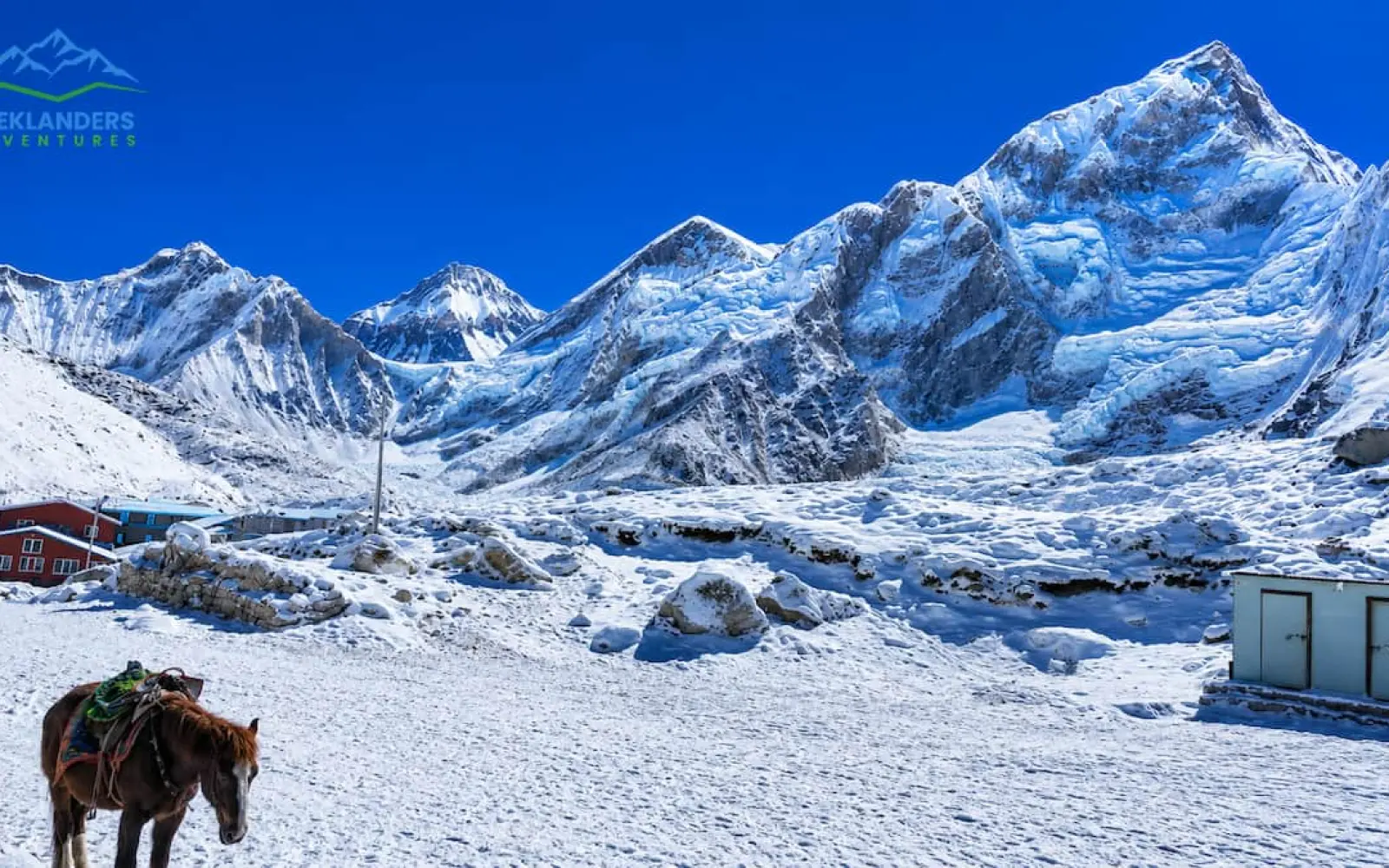
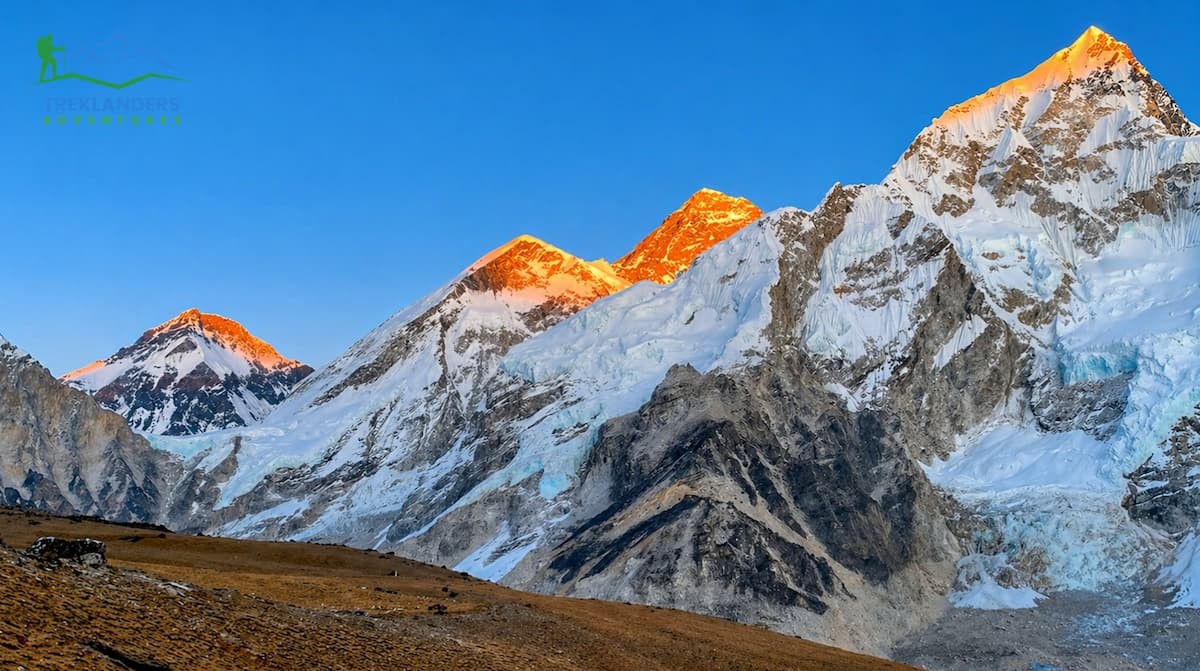
Everest Base Camp is located at an altitude of 5,364 meters (17,598 feet). The trek is approximately 130 kilometers (around trip) and takes 12-14 days. You will ascend and descend thousands of meters in elevation, lug a daypack over rocky and uneven ground, and slog through air that contains just half of the oxygen found at sea level.
It’s not a walk in the park. But it is definitely doable, even if you’ve never done anything like it before.
The difference between struggling trekkers and conquering trekkers is not talent or genetics. It’s preparation. Specifically, having a detailed Everest Base Camp training regimen that begins months ahead of your trek and focuses on preparing the proper systems.
In this training guide, you’ll learn everything from how many months you should train before your trek, what types of workouts you should be focusing on, how to train for altitude, what equipment you should be training with, and how to mentally condition yourself to push through when your body is telling you to stop.
Yes, You do not have to be a world-class athlete. You do not need to be experienced in climbing.
Each year, thousands of people who have never done a trek before conquer the trek to Everest Base Camp. What you need is a realistic appraisal of your current situation and the lead time to develop your fitness. If you're an active person already and aiming to pack on muscle, then 4-6 months of structured training is realistic.
If you are starting from zero. Then plan for at least 6-9 months. The trek is one continuous aerobic effort with no dismounts. The difficulty will be in the repetitive load of distance, altitude, time, and height. This is also favorable to steady progression rather than the 'quick hit' of a technical climb.
Aerobic and leg strength adaptations will be built over time.
You can't force a month's worth of training adaptation into a short 3-week period without risk of injury.
The training stages below assume 6 months to get ready. If you have less time, you can compress stages 1 and 2 but never avoid them.

In this phase, the objective is to keep it simple, build a base you can train on without injury.
Many first-timers miss this stage and begin taking long, hard sessions too early, paying for it with overuse injuries and burnout.
Cardio at zone 2. That is, it is a pace at which you can hold a conversation without losing your breath. It is so easy that it feels almost unnatural.
Which is the whole idea. Zone 2 is where you train your aerobic engine at a mitochondrial level. It allows you to lay the foundation for consistent output required to have a good 8 to 10-hour day on the trail.
Do not let ego push you out of Zone 2. Faster is not better here.
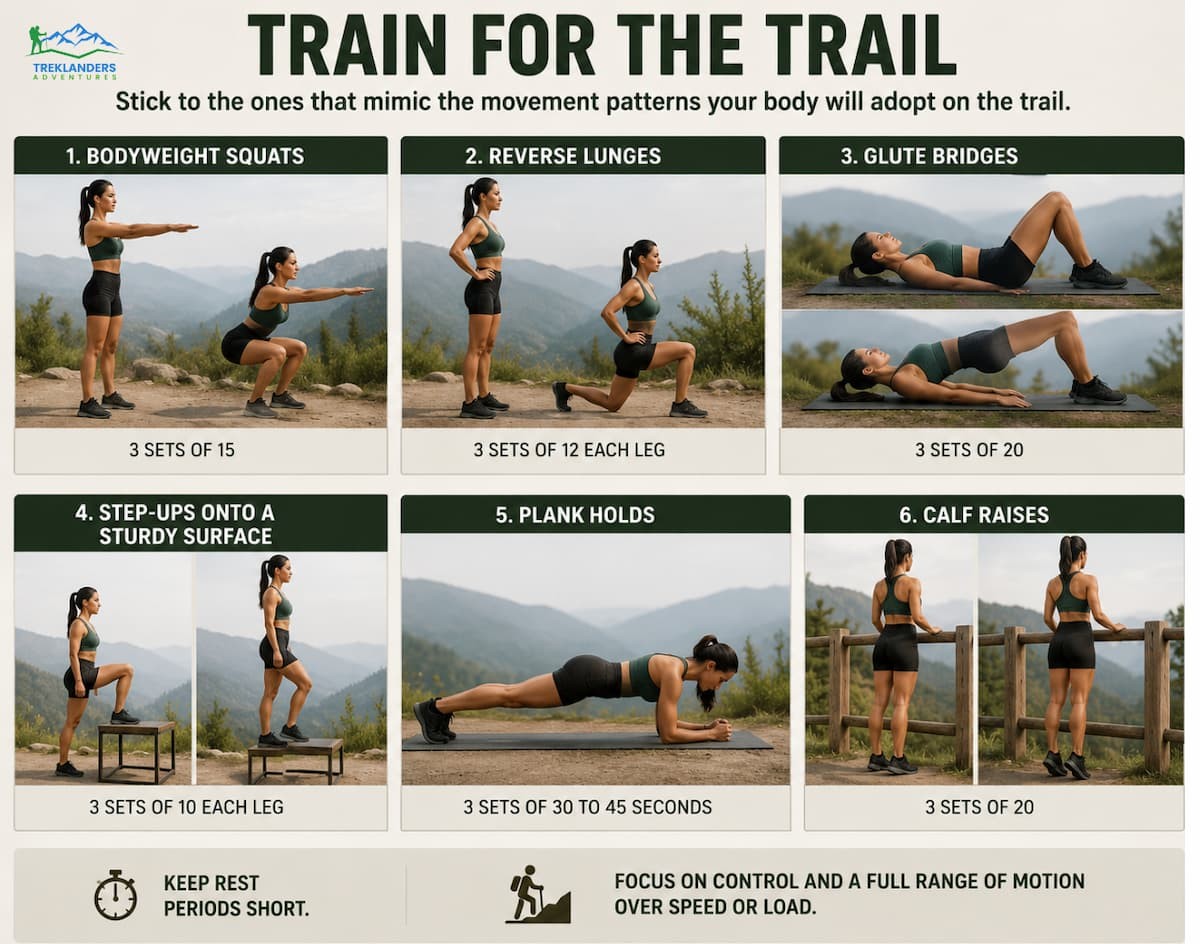
Not ready for brutal gym workouts yet.
Stick to the ones that mimic the movement patterns your body will adopt on the trail.
Keep rest periods short. Focus on control and a full range of motion over speed or load.
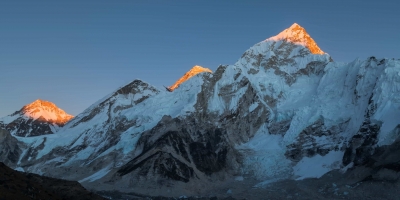
This cannot wait. Blisters caused by stiff, unbroken boots have ended more treks than poor fitness. Start wearing your actual trekking boots during Phase 1.
Walk in them daily. Graduate weekend hikes of 5 to 10 kilometers. Your feet need weeks of adaptation, not days.
Then increase the volume and intensity; if you are more developed using regular weights, this means that your aerobic base will allow you to use higher intensities.
Your joints become stronger, and now you develop the specific fitness that an EBC trek needs.
Increase your ZONE 2 sessions to 60 to 90 minutes. And even more critically, begin to include elevation gain in your training.
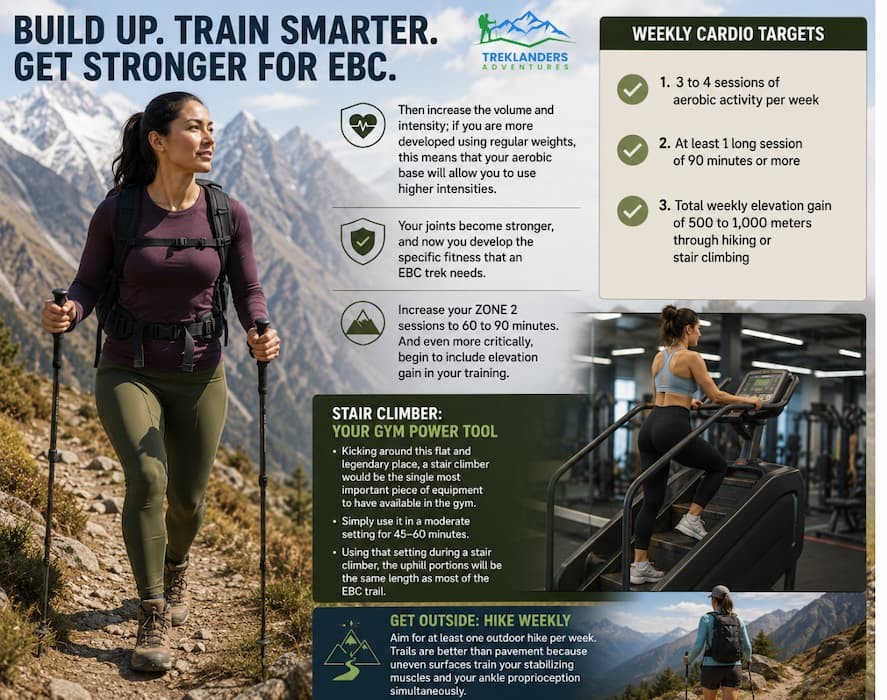
Kicking around this flat and legendary place, a stair climber would be the single most important piece of equipment to have available in the gym.
Simply use it in a moderate setting for 45-60 minutes.
Using that setting during a stair climber, the uphill portions will be the same length as most of the Everest Base Camp trail.
Aim for at least one outdoor hike per week. Trails are better than pavement because uneven surfaces train your stabilizing muscles and your ankle proprioception simultaneously.
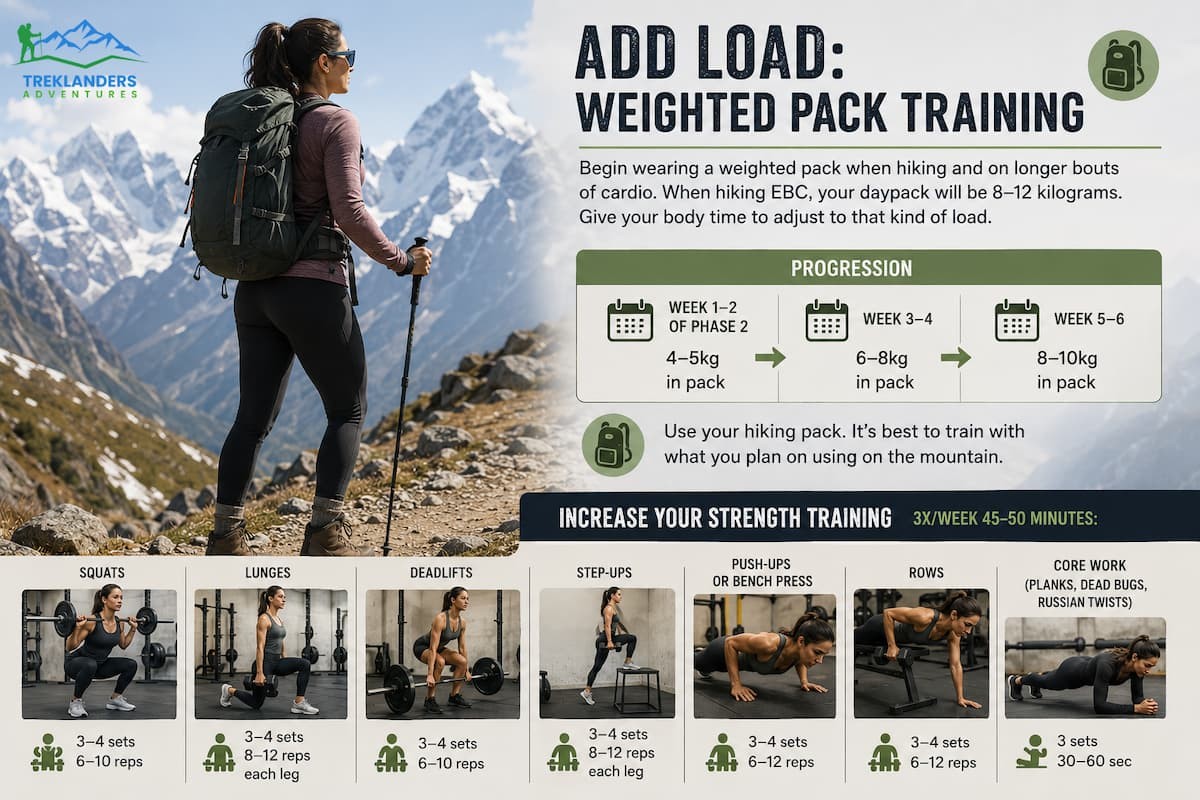
Begin wearing a weighted pack when hiking and on longer bouts of cardio. When hiking Everest Base Camp, your daypack will be 8-12 kilograms. Give your body time to adjust to that kind of load.
Week 1-2 of Phase 2: 4-5kg in pack
Week 3-4: 6-8kg
Week 5-6: 8-10kg
Use your hiking pack. It’s best to train with what you plan on using on the mountain.
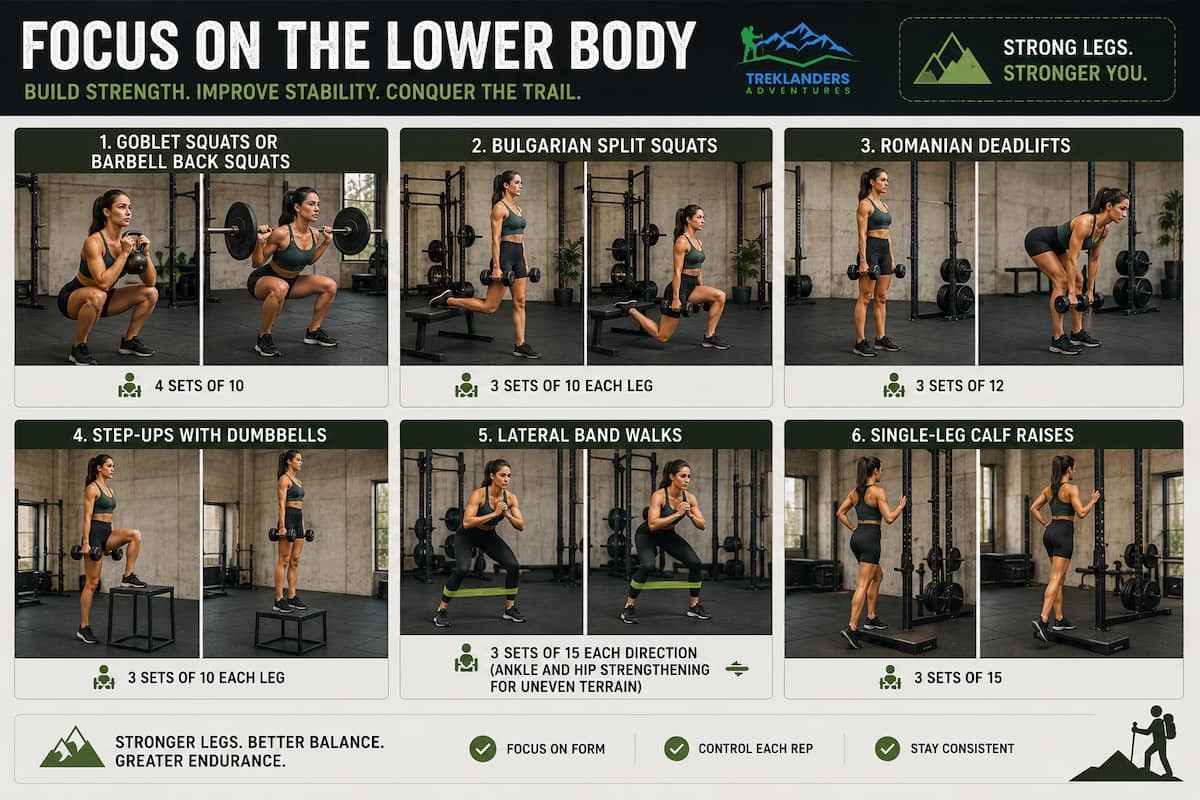
Increase Your Strength Training
3x/week 45-50 minutes:

Your core is a great equalizer. A strong core transfers force from your legs to your upper body and vice versa.
It also keeps your body upright and working efficiently when you are tired, the time when most injuries occur.
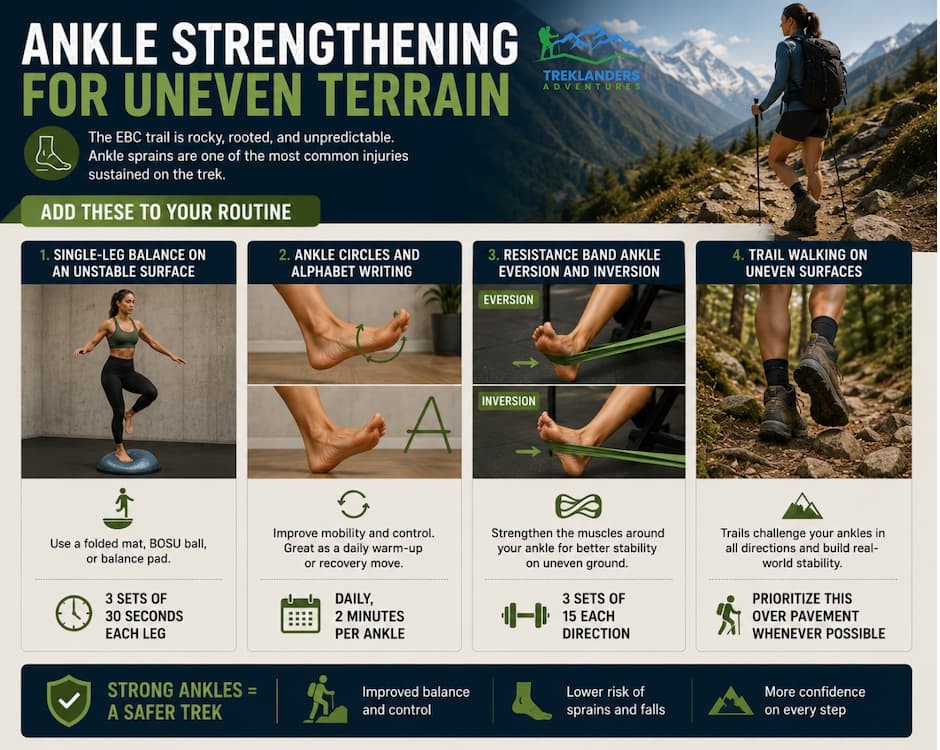
The Everest Base Camp trail is rocky, rooted, and unpredictable. Ankle sprains are one of the most common injuries sustained on the trek.
Add these to your routine
This is your most challenging training block. Training volume and load are both elevated quite a bit. Your training should challenge you without leaving you totally drained.
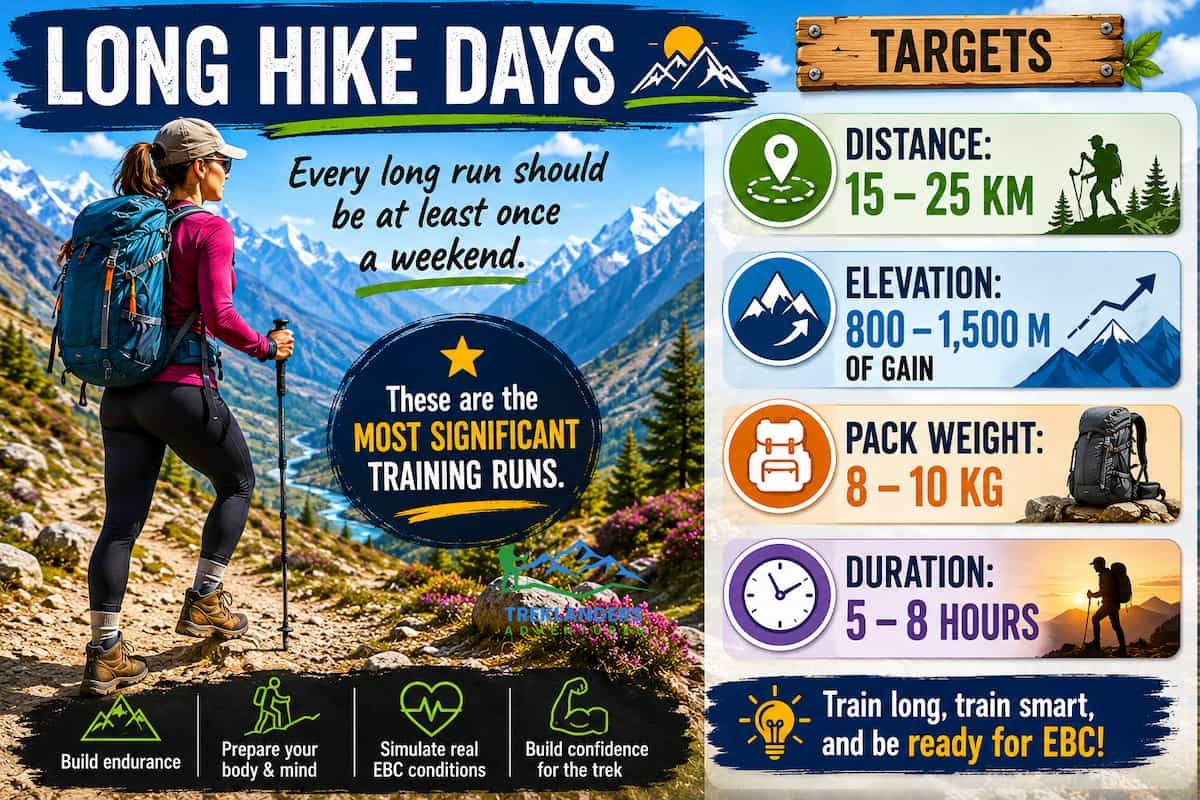
Every long run should be at least once a weekend. These are the most significant training runs. Targets
Distance: 15 to 25 kilometers
Elevation: 800 to 1,500 meters of gain
Pack weight: 8 to 10 kilograms
Duration: 5 to 8 hours
These long hikes work all your aerobic system, your legs, your joints, your mental toughness, and your gear all at once. There is simply no substitute. No gym workout mimics a whole day on the trail.
If you cannot get mountains (or big hills), then use your stair climber for 60 minutes to 90 minutes instead, then on the same day or the next day, follow this with a big flat long walk of 20 to 25 km.
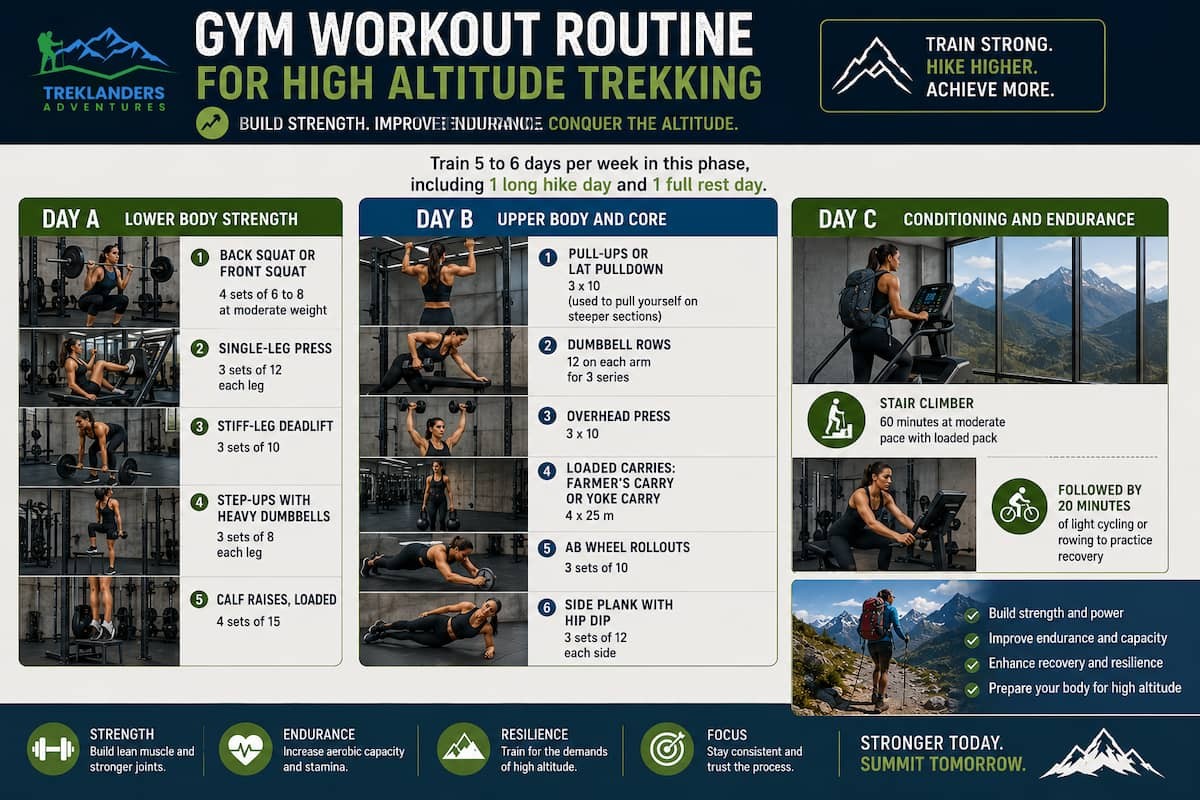
By this phase, your gym sessions should look like this:
Train 5 to 6 days per week in this phase, including 1 long hike day and 1 full rest day.

In the final 4 to 6 weeks, schedule back-to-back long hiking days. One day of 4 to 5 hours, then another 4-hour hike the following day. This simulates the accumulated fatigue of consecutive trekking days on the EBC itinerary.
Your legs will feel heavy on day two. That is the point. You are training your body to keep moving when it is already fatigued. That ability becomes essential around day 8 or 9 of the trek when fatigue compounds.
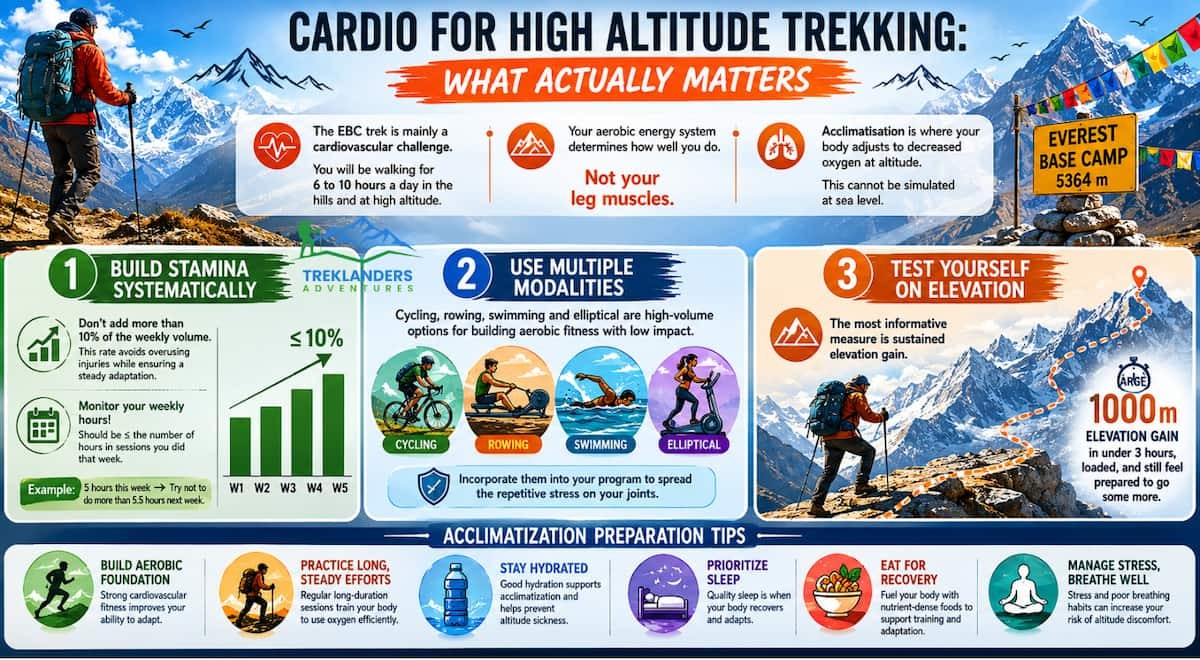
The Everest Base Camp trek is mainly a cardiovascular challenge. You will be walking for 6 to 10 hours a day in the hills and at a high altitude. Your aerobic energy system determines how well you do. Not your leg muscles.
Hiking endurance training could be summed up in a short term: Don't add more than 10% of the weekly volume. This rate avoids overusing injuries while ensuring a steady adaptation. Monitor your weekly hours!
Should be less than or equal to the number of hours in sessions you did that week (if 5 hours this week, try not to do more than 5.5 next week).
Cycling, rowing, swimming and elliptical are also high-volume options for building aerobic fitness with low impact on your joints.
Incorporate them into your program to spread the repetitive stress on your joints.
The most informative measure is sustained elevation gain. If you are able to hit 1000m of gain in under 3 hours, loaded, and still feel prepared to go some more, your fitness is ready for Everest Base Camp.
Acclimatisation is where one's body adjusts to decreased oxygen at altitude. This cannot be simulated at sea level.Though you can provide the body with the best possible conditions to acclimatize.
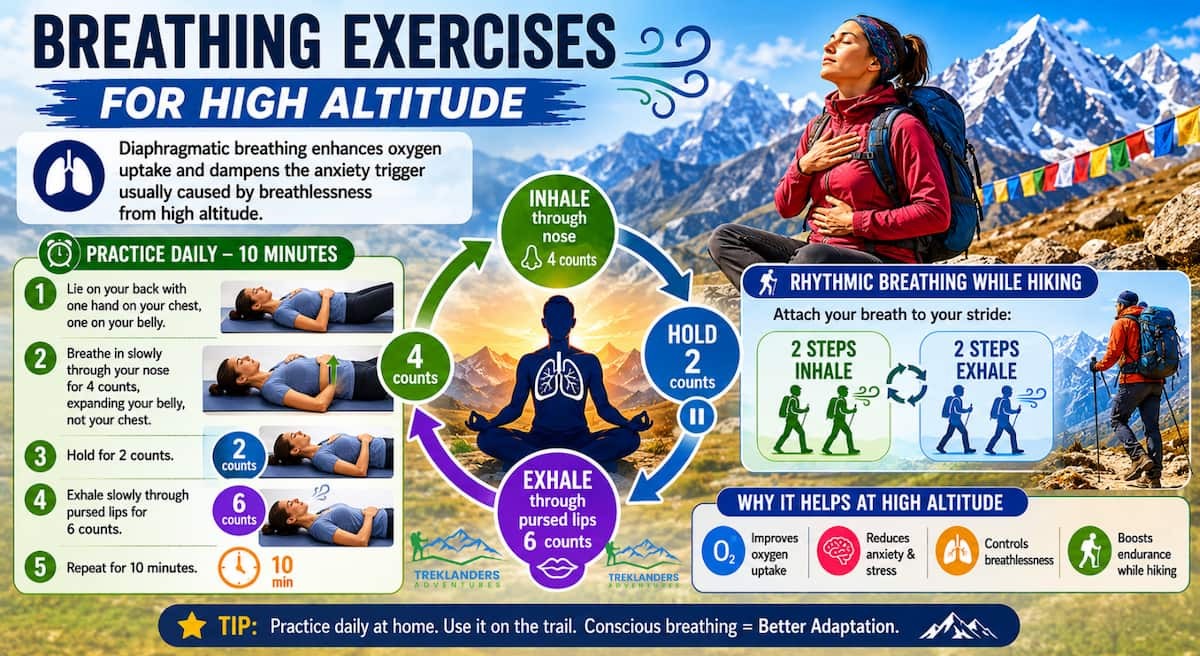
Diaphragmatic breathing. Enhances oxygen uptake and dampens the anxiety trigger usually caused by breathlessness from high altitude.
Practice daily, 10 minutes:
Practice rhythmic breathing too when hiking in the mountains, etache your breath to your stride: two steps per inhale; two steps per exhale- and focusing consciously on breathing helps when breathing gases are partially depleted.
Use an altitude tent or hypoxic training center if you can, during the last 4-6 weeks of training. Sleeping at a simulated altitude of 2,500 to 3,500 meters stimulates erythropoiesis and cardio-vascular adaptation.
This is not necessary for most trekkers, but it is a significant benefit if it is easily accessible and affordable.
If you have no altitude equipment, then train at every opportunity you get above 2000m.
Weekend trips to a mountain environment are excellent for this, providing genuine acclimatization as well as practice of coping with the environment.
Fitness gets you to the mountain. Mental tenacity gets you through the hard days. The 9 th day of a 14-day EBC trek is probably the most mentally difficult. You are exhausted.
The altitude is at its worst. The terrain is at its roughest. You still are not there. This is where trainers with the right mentality will take the lead.
Build Mental Endurance Through Training. Long training hikes, beyond preparing your muscles, prepare your mind.
They prepare you to know what discomfort is and to keep going despite it. In practicing to go an extra 30 minutes on your training hike when you’re ready to quit, you train to decide under duress.
Just do this consciously. During a long training day, pick a point far in front of you and tell yourself you’ll get there before stopping. Then choose the next. That’s the same approach that has been made in the works on the Khumbu Valley.
Train in the rain. Train in the cold. Train when you didn’t sleep well. Don’t always wait for the perfect conditions.
The EBC trek sure won’t provide perfect conditions. The more you are used to discomfort, the more you lose its power.
Detect your habitual negative thoughts in hard training. “I can’t do this” is readily available. Practice oversimplifying and taking positive action in your mind with an equally invalid presumption so you can find a better thought: “This sucks right now.
Keep going.” This may seem unimportant. But out here with a rock crusher headache, cold feet and 5,000 meters in your lungs, your own internal dialogue might be one of the few areas you can influence.
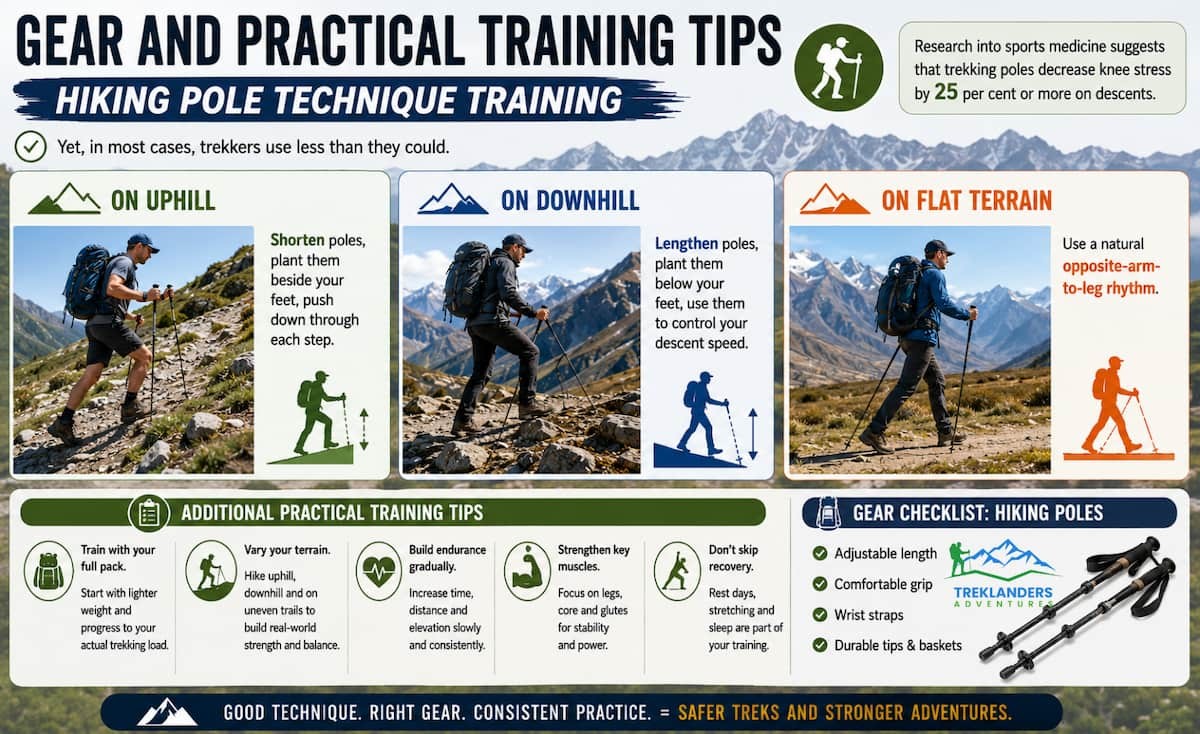
Hiking Pole Technique Training
Research into sports medicine suggests that trekking poles decrease knee stress by 25 per cent or more on descents.
Yet, in most cases, trekkers use less than they could.
You need to incorporate pole work into every practice hike. Think of your poles as an additional appendage: don’t leave them at home!
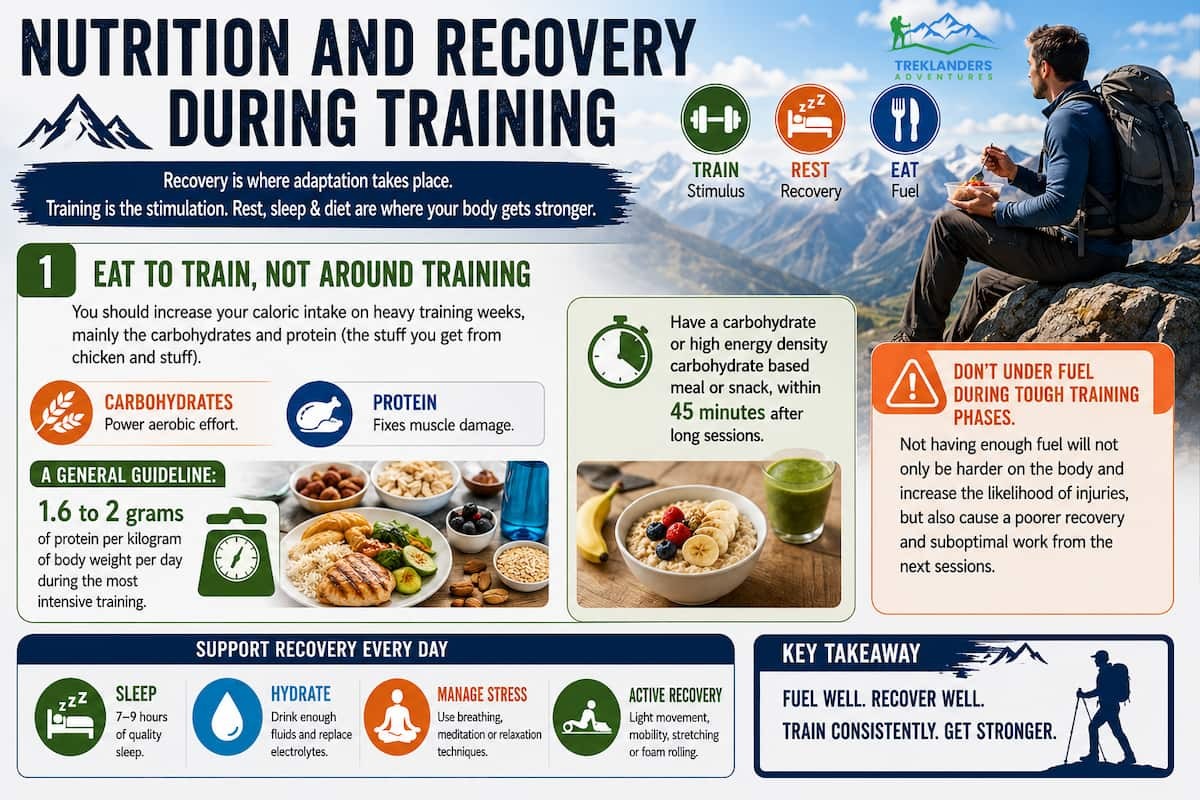
Recovery is where adaptation takes place. Training is the stimulation. Rest, sleep & diet are where your body gets stronger.
You should increase your caloric intake on heavy training weeks, mainly the carbohydrates and protein (the stuff you get from chicken and stuff). Carbohydrates power aerobic effort.
Protein fixes muscle damage. A general guideline:
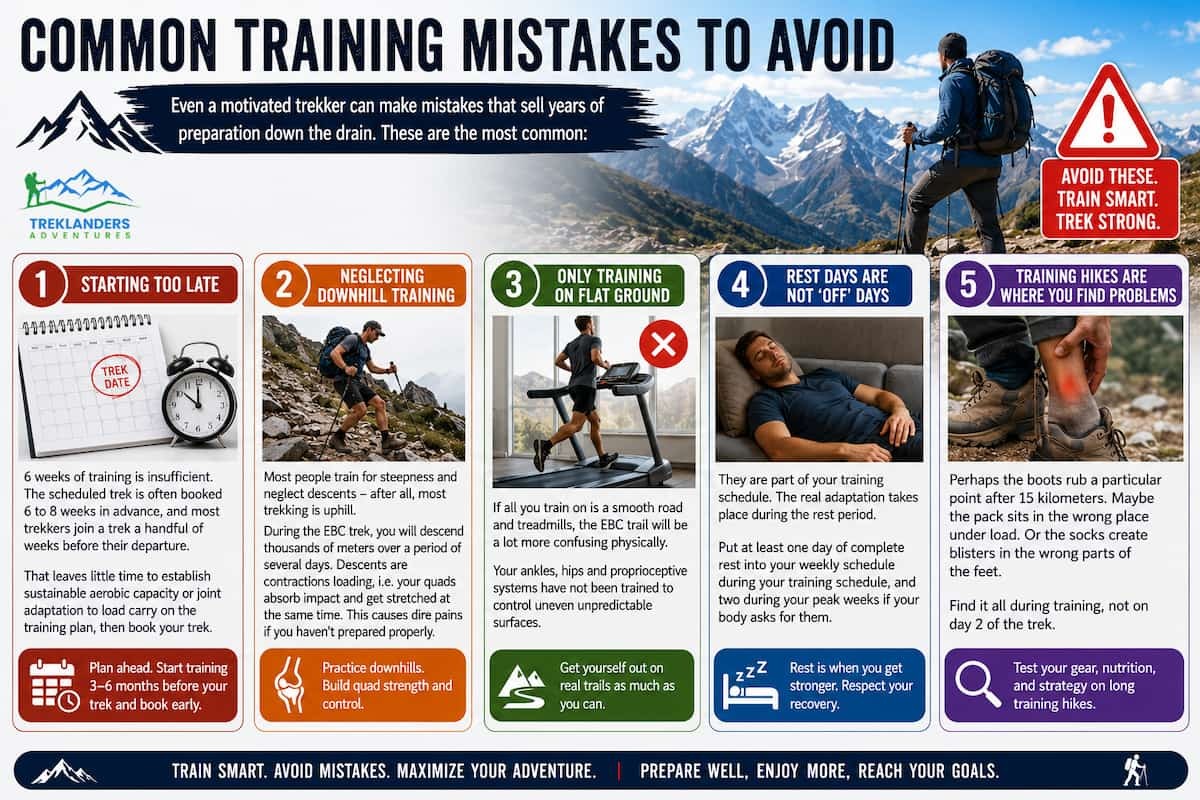
Even a motivated trekker can make mistakes that sell years of preparation down the drain. These are the most common:
6 weeks of training is insufficient. The scheduled trek is often booked 6 to 8 weeks in advance, and most trekkers join a trek a handful of weeks before their departure.
That leaves little time to establish sustainable aerobic capacity or joint adaptation to load carry on the training plan, then book your trek.
Most people train for steepness and neglect descents – after all, most trekking is uphill. During the Everest Base Camp trek, you will descend thousands of meters over a period of several days. Descents are contractions loading, i.e. your quads absorb impact and get stretched at the same time. This causes dire pains if you haven’t prepared properly.
If all you train on is a smooth road and treadmills, the Everest Base Camp trail will be a lot more confusing physically. Your ankles, hips and proprioceptive systems have not been trained to control uneven unpredictable surfaces.
Get yourself out on real trails as much as you can.
They are part of your training schedule. The real adaptation takes place during the rest period.
Put at least one day of complete rest into your weekly schedule during your training schedule, and two during your peak weeks if your body asks for them.
Perhaps the boots rub a particular point after 15 kilometers. Maybe the pack sits in the wrong place under load. Or the socks create blisters in the wrong parts of the feet. Find it all during training, not on day 2 of the trek.
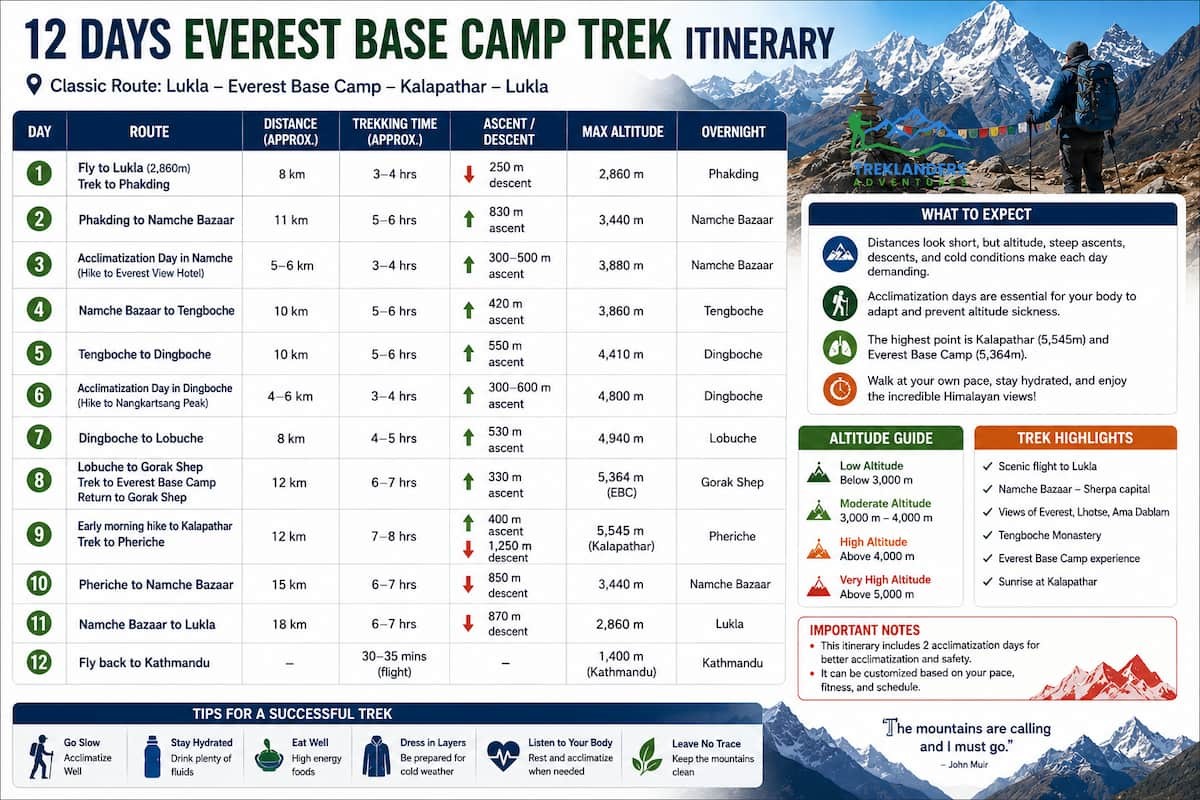
Understanding what the trek actually demands helps you calibrate your preparation.
A typical EBC trek itinerary looks like this:
Most trekkers attempting their first trek in the Everest region take one look at the EBC itinerary, and think that the trek must be an easy one; the distances are so small. It can look fairly easy on paper; 8 to 15 km a day can be compared to your run-of-the-mill hiking holiday. Not so in the Everest region! Altitude, steep ascents and descents, frosty conditions, and back-to-back walking make the distances a long way from representative of the effort required.
The trek generally starts with a flight to Lukla, followed by a short downward walk to Phakding. While the first day is relatively gentle, most first-time trekkers underestimate the amount of energy needed for the rocky trail and frequent altitude changes. Even the walk downhill exerts pressure on your knees and ankles. You are seldom walking flat.
The second day trek from Phakding to Namche Bazaar is the first day of a real challenge. Although the distance is only about 11 km, there is a climb of about 800 meters. Most of the climb occurs fairly late in the day after several suspension bridges have been crossed. Even the most experienced trekkers find their breath slightly heavier after an altitude of about 3,500 meters.
These rest days are not spare! You still walk for a few hours the same day before returning to a lower altitude to sleep. This is very important because your body needs time to adapt to the lower oxygen! Ignoring acclimatization we can prevent coming down and can be afflicted with altitude sickness. Any fit Trekkers may get headaches, nausea dizziness, and fatigue if we climb fast.
Now that the trek goes further to Tengboche, Dingboche and Lobuche the major obstacle is altitude. The higher you go, the more difficult everything becomes. Everything becomes harder: walking up stairs, carrying a pack, putting on your boots, and everything seems more tiring, being cold, breathing mountain air. The day from Lobuche to Gorak Shep and Everest Base Camp is one of the hardest days of your trek.
The trail varies from rocky glacial terrain to uneven ground and thin air at over 5,000 meters. Although the distance is not massive, you will notice it is much harder work trekking at these heights. Most people trek very slowly and cautiously.

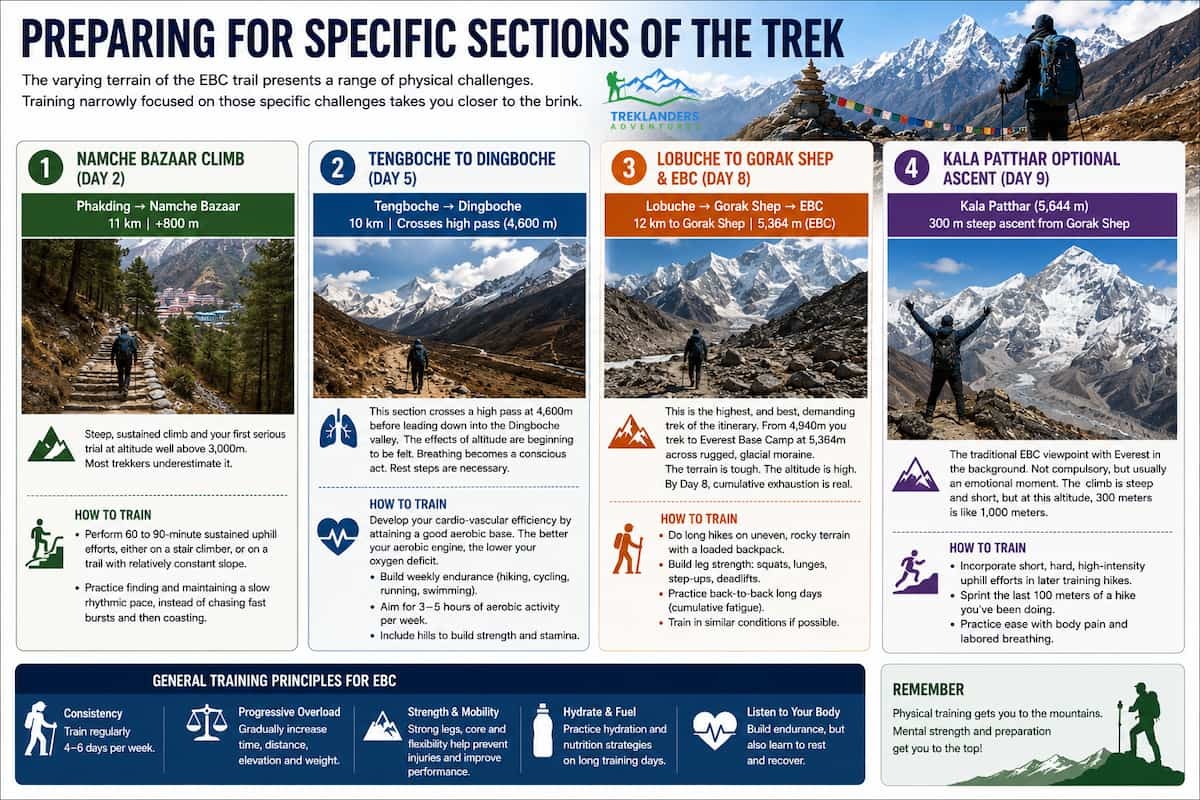
The varying terrain of the EBC trail presents a range of physical challenges. Training narrowly focused on those specific challenges takes you closer to the brink.
Phakding to Namche Bazaar climb 800m over 11 km. It is a steep, sustained climb and your first serious trial at altitude well above 3000m. Most trekkers have been shown to underestimate it.
To train for this, perform 60 to 90-minute sustained uphill efforts, either on a stair climber, or on a trail with relatively constant slope.
Practice finding and maintaining a slow rhythmic pace, instead of chasing fast bursts and then coasting.
This section crosses a high pass at 4,600m before leading down into the Dingboche valley. The effects of the altitude are beginning to be felt. Breathing becomes a conscious act. Rest steps are necessary.
The most effective training you can do for this is to develop your cardio-vascular efficiency by attaining a good aerobic base. The better your aerobic engine, the lower your oxygen deficit.
This is the highest, and best, demanding trek of the itinerary. From 4,940m you trek to Everest Base Camp at 5,364m across rugged, glacial moraine. The terrain is tough.
The altitude is high. And by the time you reach Day 8, the cumulative exhaustion is real.
Seconds everything up, when you get to the top of the Kala Patthar 5,644m the traditional EBC scene with Everest in the background can be seen. It is not compulsory to go to the top, but it is normally an emotional moment for most people. The climb is steep and not very long, about 300 meters climbing from Gorak Shep. At this altitude, 300 meters is equivalent to 1,000 meters.
Replicate this by incorporating short hard high-intensity uphill efforts into your later phase training hikes. Sprint the last 100 meters of a hike you’ve been doing. Practice ease with body pain and labored breathing.
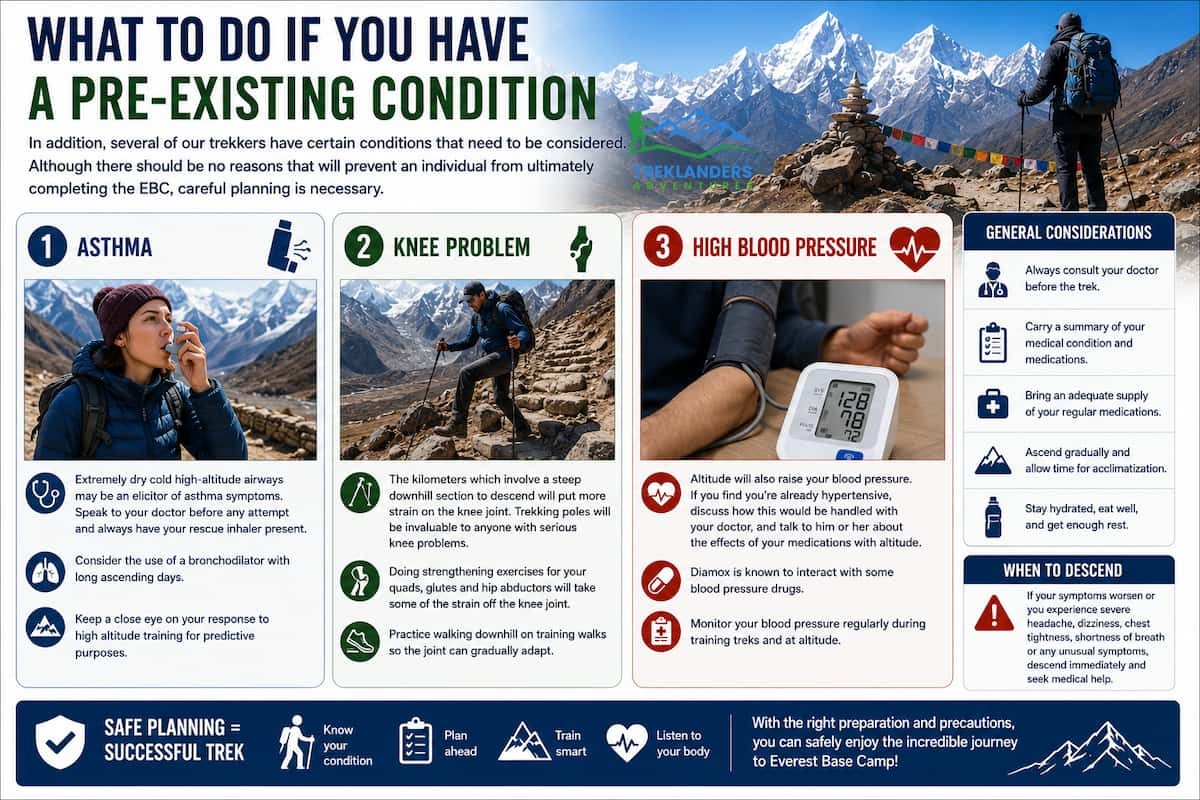
In addition, several of our trekkers have certain conditions that need to be considered. Although there should be no reasons that will prevent an individual from ultimately completing the EBC, careful planning is necessary.
Extremely dry cold high-altitude airways may be an elicitor of asthma symptoms. Speak to your doctor before any attempt and always have your rescue inhaler present.
Consider the use of a bronchodilator with long ascending days. Keep a close eye on your response to high altitude training for predictive purposes.
The kilometeres which involve a steep downhill section to descend will put more strain on the knee joint. Trekking poles will be invaluable to anyone with serious knee problems.
Doing strengthening exercises for your quads, glutes and hip abductors will take some of the strain off the knee joint.
Practice walking downhill on training walks so the joint can gradually adapt.
Altitude will also raise your blood pressure. If you find you’re already hypertensive, discuss how this would be handled with your doctor, and talk to him or her about the effects of your medications with altitude.
Diamox is known to interact with some blood pressure drugs.
If there is any kind of cardiac diagnosis you need clearance from your cardiologist before engaging in high-altitude trekking. Usually, your cardiologist will order a stress test to verify that your heart can tolerate long-term aerobic output in low-oxygen conditions.
The EBC trek is a feasible challenge for many en route if their conditions are well controlled. It is information-driven medical advice that takes us past the gasping point not complete avoidance.
No training guide replaces the judgment of an experienced local guide on the mountain. A knowledgeable guide will monitor your symptoms, manage your pace, make acclimatization decisions in real time, and know when to push and when to pull back.
Choose a guide or guiding company with certified staff and a clear protocol for altitude sickness. A good guide on the EBC trail has seen altitude sickness many times and knows what day 8 fatigue looks like versus something that requires attention.
Your training prepares your body. Your guide manages the mountain variables. The partnership between both is what gets you safely to Everest Base Camp and back.
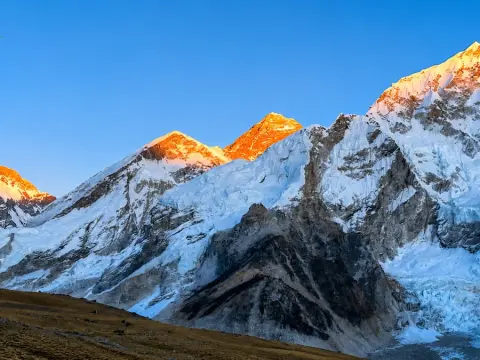
Explore the top 7 group treks in Nepal with expert trekking tips from Treklanders Adventures.
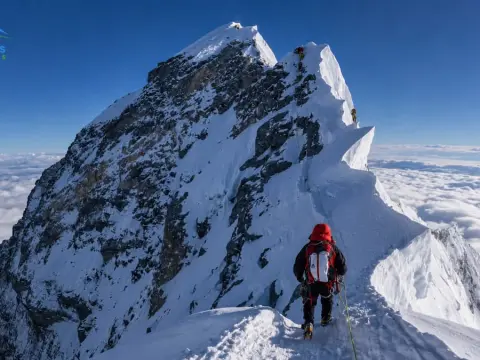
Discover the hidden role Everest Sherpas play in keeping climbers safe and making Everest summits possible.
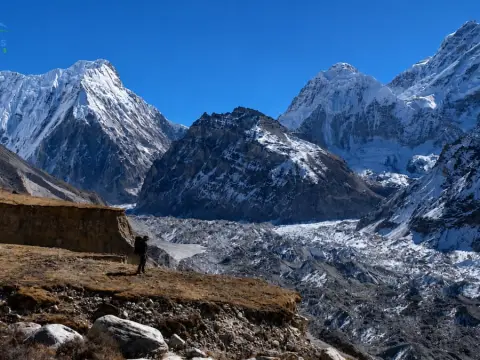
Discover Nepal’s best hidden treks with peaceful Himalayan trails, authentic culture, and breathtaking mountain views away from the crowds.



