
Upper Mustang vs Upper Dolpo Trek: Which Restricted Area Trek in Nepal Is More Remote?
22 Jun 2026
Compare Upper Mustang and Upper Dolpo to discover which of Nepal's most remote treks is right for you.

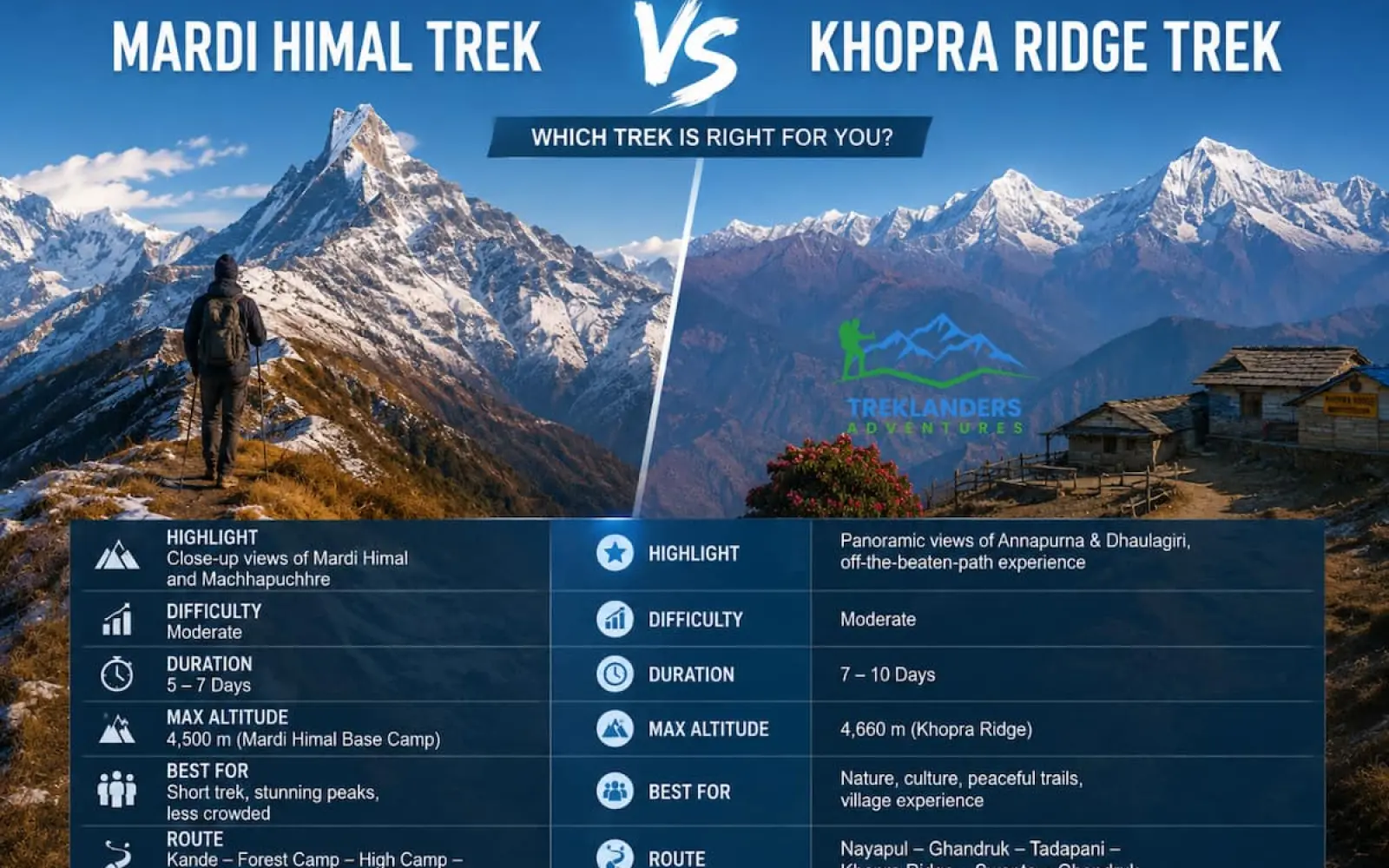
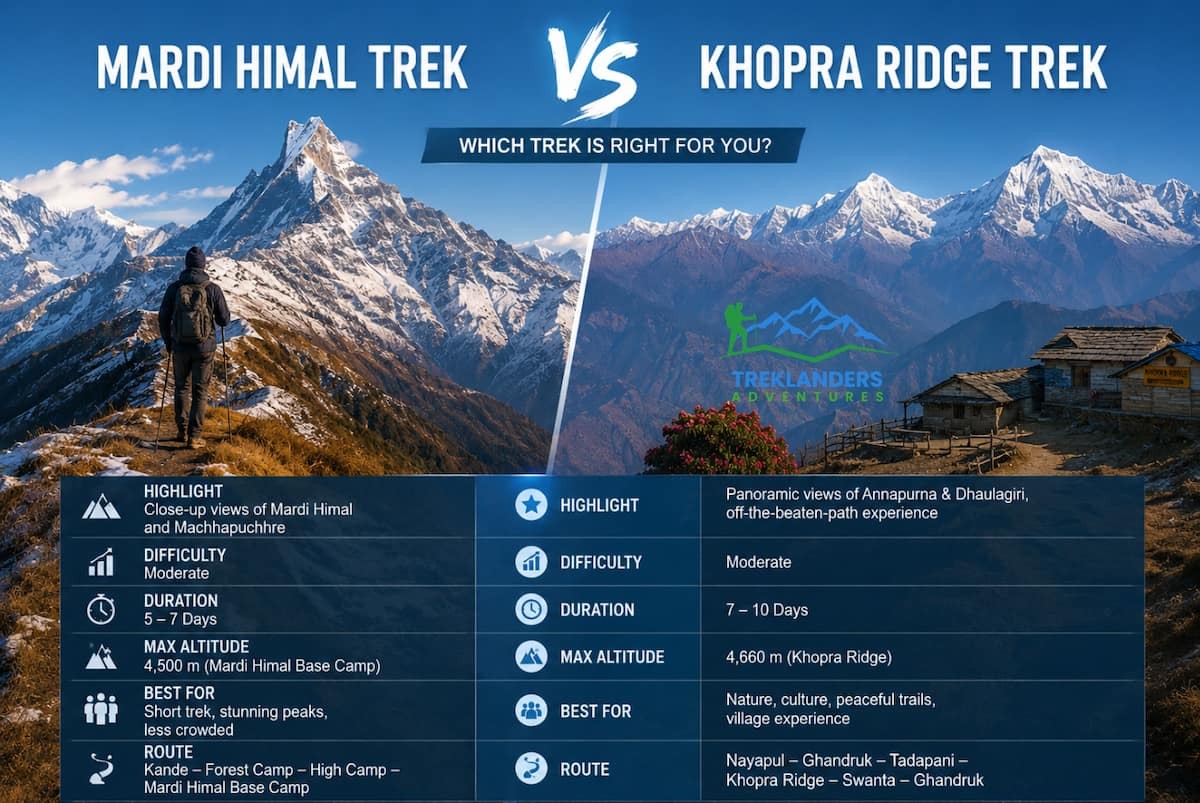
Annapurna is more than just a trekking region; it is full of options that most folks do not realize. When most newbies first hear about a "short Annapurna trek, " their first thought is always the famous Poon Hill. It is a standard recommendation: a trail that offers the most tea houses and gets fully booked every October.
However, three other routes have, almost unnoticed, gained a popularity that equals or even, in a few aspects, surpasses theirs: Mardi Himal and Khopra Ridge.
Both treks are inside the Annapurna Conservation Area. Each of them starts and ends in Pokhara. Each of them offers Himalayan views without sacrificing a whole two weeks. Still, the two experiences are opposites, and getting the wrong one in terms of your fitness level, travel style, or time availability might stay with you as a disappointment.
The number of people searching for these two trails has slowly risen after experienced hikers suggested them to their friends who are in search of something different from the usual paths. Tourists' discussions, boading guides, and trekking companies based in Nepal always include these two trails among the top short and highly worthwhile Annapurna trekking options. That personal recommendation reputation is not a promotional activity. It is the collective outcome of numerous hikers who reached a lookout point, saw mountains that they did not expect to be that near, and spread the word to everyone they know.
This article contrasts them on every aspect that a first timer would be concerned about: level of difficulty, time required, natural beauty, availability of good trails, cultural experiences, and ideal seasons. After reading, you will be perfectly aware of which one fits your preferences the most.
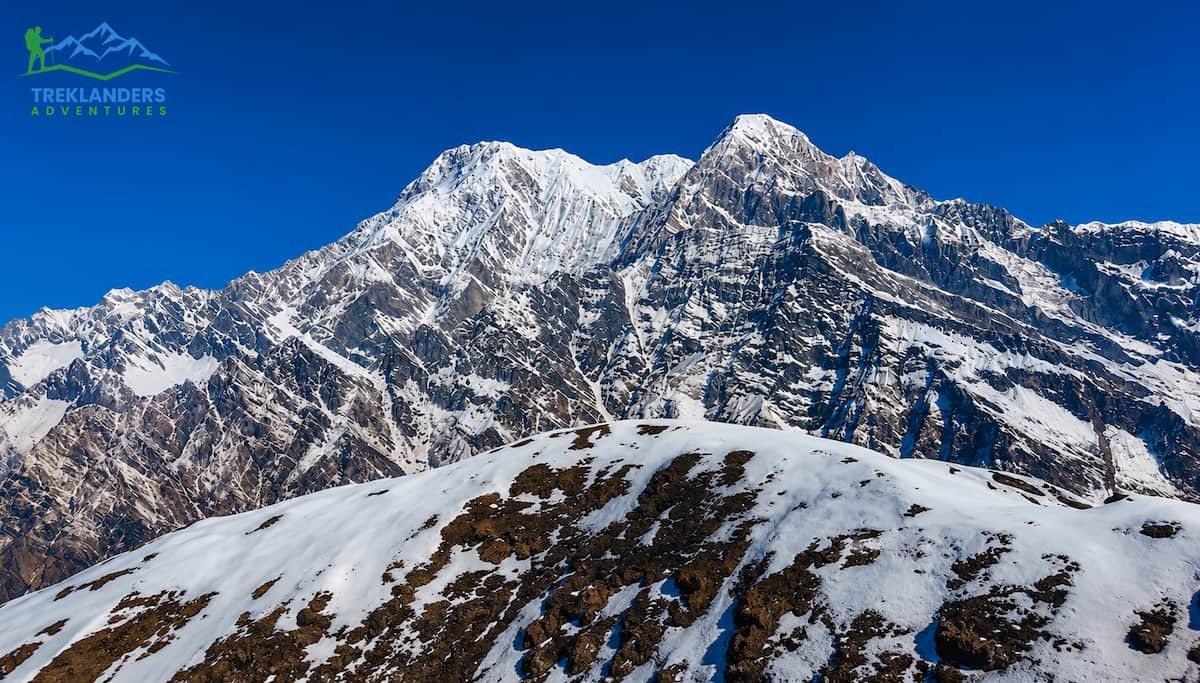
Before pitching them against each other, it is best to get a clear picture of what sets these two trekking paths apart from the older, more traditional ones.
Most people praise the Annapurna Base Camp trek highly; however, it requires 7 to 11 days, and moderate crowds are a part of its main corridor. Poon Hill circuit is a walk refreshing in brevity, but the trail from Ghorepani to Tadapani sees very high foot traffic during the peak season. On the other hand, both Mardi Himal and Khopra Ridge are newly discovered routes that, for the moment, attract fewer visitors.
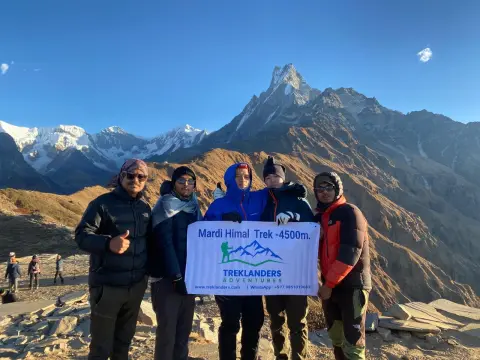
Mardi Himal Trek officially became a trekking route in 2012. Before that, it was mainly a route for shepherds and the rare local hikers. The trail runs almost alongside the Annapurna Base Camp path, but then goes east, along a high ridge to the Mardi Himal viewpoint and base camp. Mardi Himal is a mountain that stands at 5,587 meters. From the ridge, you will be given a very close view of Machhapuchhre (Fishtail Peak), a 6,993-meter mountain that is one of the most photographed peaks in Nepal.
Khopra Ridge or Khopra Danda is located on the western flank of the Annapurna massif. The trek separates near Ghorepani and proceeds north into much quieter areas, going up to a ridge elevation of 3,660 meters that lies between the Kali Gandaki valley and the southern face of Annapurna. From there, a short hike will take you to Khayer Lake at 4,247 meters, a glacial lake with religious importance that is rarely visited by trekkers.
These two routes, in a way, share a key virtue: they give hikers who want to see mountain scenery a chance to do so away from the crowd and without the time to investment of the longer classic treks.
Understanding the basic structure of each trek helps you plan realistically.
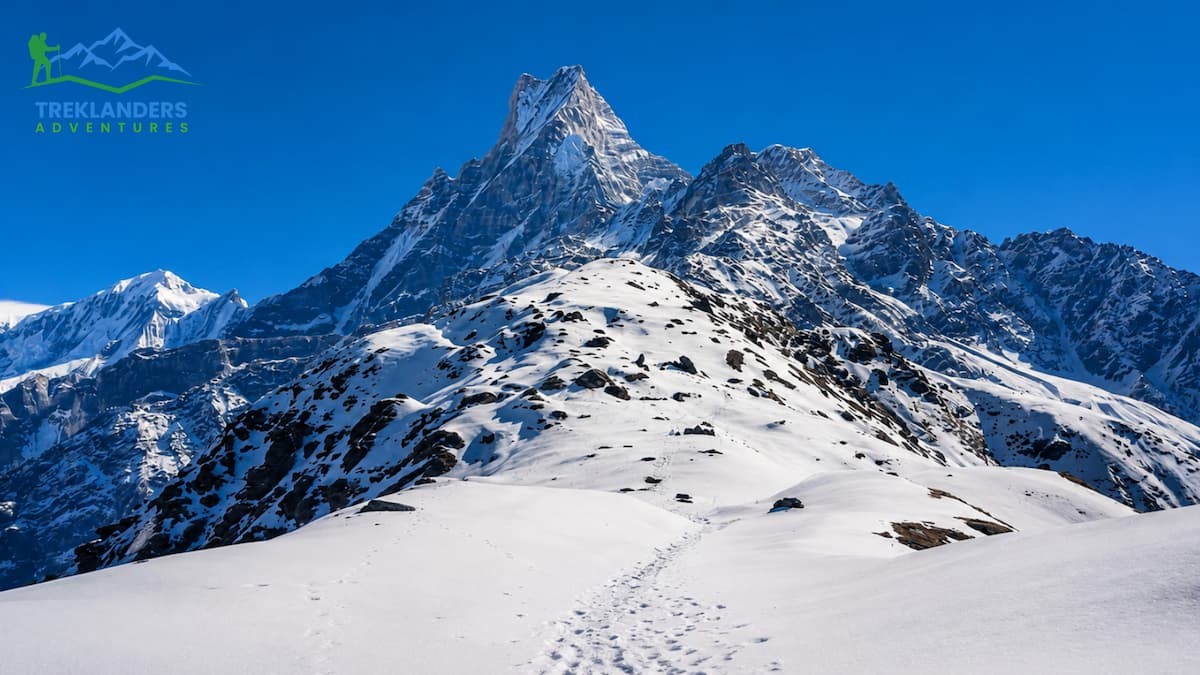
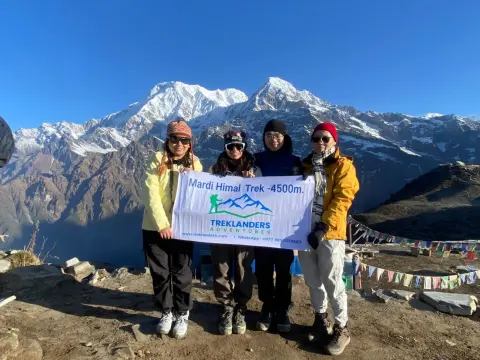
The standard route for a trek takes about 5 to 8 days and starts and ends in Pokhara. The main package of Treklanders includes 8 days and 7 nights. It starts with a drive to Kande or Dhampus, and then the route goes through Australian Camp, Pothana, Forest Camp, Low Camp, and High Camp before the viewpoint at around 4,200 meters and the base camp at 4,500 meters. The descent goes south through Siding village, which offers a different perspective for the return trip.
There is also a 5-day shorter version for those who have limited time, which covers the same area but at a faster speed. The highest night stop is High Camp at 3,700 meters. The 4,200-meter viewpoint is reached by making the push in the morning.
On each day, folks walk for 4 to 7 hours, depending on the day. When you move up in altitude, the terrain changes quite a bit. The lower parts are through deep rhododendron, oak, and bamboo forest. The middle part is around Badal Danda, and the ridge gets misty. The upper part is rocky and alpine, and here you get to see Annapurna South, Hiunchuli, and Machhapuchhre from a wide perspective.
Total ascent across the trek is substantial, but the gradient is gradual enough that most moderately fit beginners to complete it without serious difficulty.
Treklanders' complete Khopra Ridge package includes 15 days in total, with travel from Kathmandu, of which the trekking portion is 8 nights and 9 days from Pokhara. The trail goes via Nayapul, Ulleri, Ghorepani, then turns north, passing through Chitre, Dobato, Chistibung, and finally Khopra Ridge at 3,660 meters. From the ridge, one can do a day hike to Khayer Lake at 4,247 meters.
Average walking hours each day are almost the same as Mardi Himal, from 4 to 7 hours. However, the steepness profile is not the same. Going from the lower villages up to the ridge is made up of steeper, continuous climbs. The path along the ridge is mostly bare and open, as there are very few trees that could keep one safe from the wind.
Usually, the way back descent will be through Swanta village, which is a Magar settlement, and the route gets a totally different cultural flavor by the time you are going down; finally, it merges again to Nayapul and Pokhara.
For someone who is choosing between the two for the first time, the major structural difference is this: Mardi Himal presents a gradually climbing forested path with a spectacular view at the end, whereas Khopra Ridge has steeper climbing days but gives you the most beautiful panoramic views that last for quite a long time from the ridge itself.
Here is one practical detail. The start of Mardi Himal's trail can be reached from various points around Pokhara, such as Kande, Dhampus, and Pitam Deurali. By jeep, one can get to Pitam Deurali at 2100m, which not only saves a couple of hours on the first day but also makes it less physically demanding initially. From Nayapul at 10,70m is the starting point of Khopra Ridge, and one has more time on the trail right from day one. The climb to Ulleri is generally considered one of the steepest initial sections of any Annapurna trek.
Packing tight Schedule? Mardi Himal's minimum duration is less than that of Khopra Ridge, which is one of the main reasons. The 5-day Mardi Himal trek from Pokhara is possible and will still include highlights, such as the viewpoint. Then again, it is difficult to squeeze a full Khopra Ridge circuit without omitting the Khayer Lake outing, which is one of the reasons for doing it.
Both treks are graded moderate to adventurous, which in Nepal trekking terms means they require reasonable fitness but no technical climbing or mountaineering skills.
Khopra stands at the tougher end of the moderate range. The climb from the lower villages to the ridge goes through steeper sections, especially the part to Chistibung and then to Khopra Danda. The path is less frequented, and some parts are not as well-maintained as Mardi Himal's relatively new facilities.
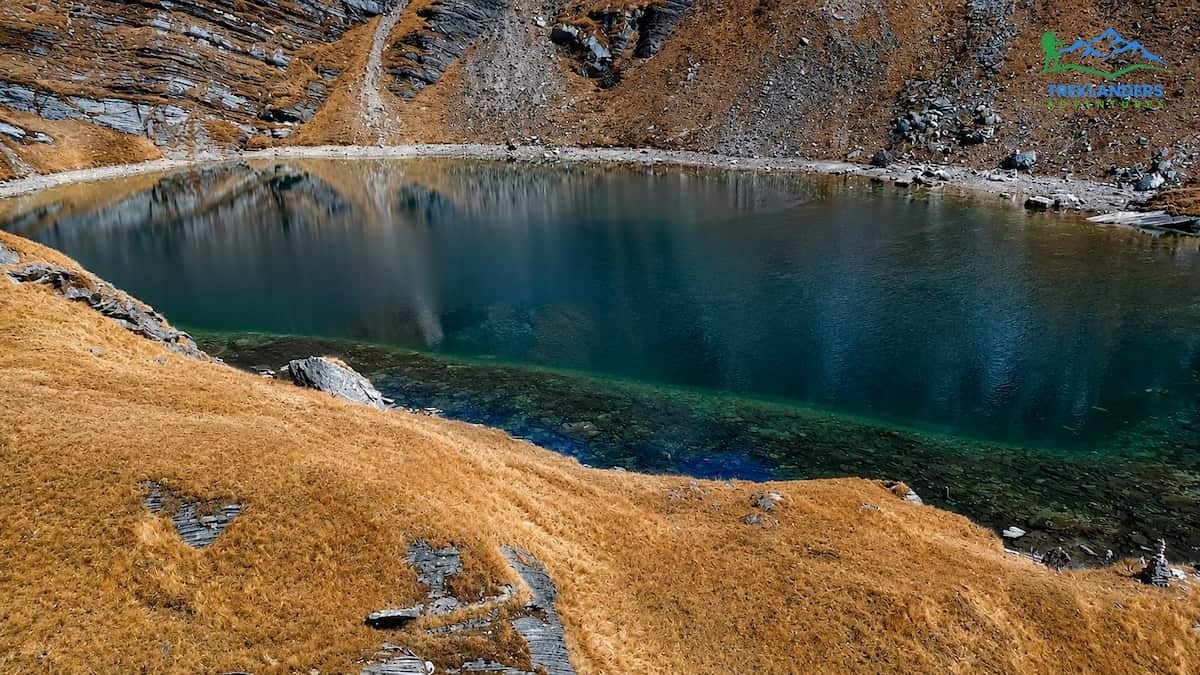
Khayer Lake, the highest location at 4,247 meters, is only accessible with a day hike starting from the ridge. This trip will add 5 to 6 hours of walking in tough, rocky conditions. It is not necessary, but the majority of the trekkers do it as it is one of the major attractions of the route.
The Khopra ridge's exposure itself also makes weather a more significant factor. The wind may get very strong on the exposed ridgeline. When the conditions are bad, the views vanish completely, and the ridge becomes cold and unpleasant.
If you are going hiking for the first time but have some hiking experience, good cardiovascular fitness, and are okay with exposed terrain, Khopra Ridge should be doable for you. However, if you have never gone trekking and altitude might be a problem for you, Mardi Himal Trek is a much safer place for a first-time trekker.
Let me be straightforward: both these treks demand physical effort. The trails in Nepal are not well-maintained with easy slopes. On any trail in the Annapurna region, you are likely to find climbing stone steps, walking on uneven rock surfaces, and long uphill sections. So, the difference between Mardi Himal and Khopra Ridge is not easy vs. hard but moderate vs. moderately strenuous. Acknowledge that difference and prepare for it well.
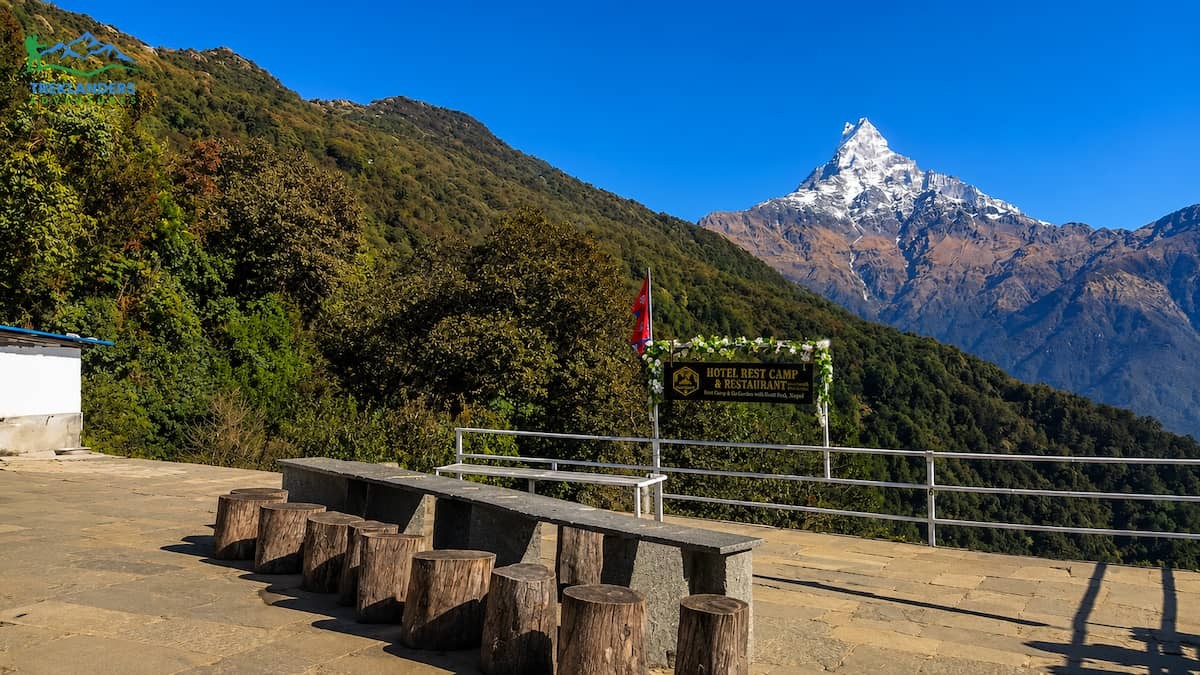
Overall, the trail is graded as moderate. The lower sections through the forest provide a comfortable walking environment, with a steady uphill gradient. However, as you get closer to High Camp, you will find the terrain getting quite steep. On the summit day morning, the section from High Camp to the viewpoint is quite challenging: it is cold, sometimes windy, and on a narrow ridge. But most trekkers who have done some preparation can manage it.
High Camp (3,700 meters) and the viewpoint (4,200 meters) are quite high. Anyone, even those in the best shape, can experience altitude sickness. The schedule includes two nights at High Camp to allow for acclimatization, which is a good way to combat altitude sickness.
If you are completely new and have no high-altitude experience, then Mardi Himal Trek is the easier option. The forest trails are marked well. Lodges are located at places that are not too far apart. The rate of altitude increase is not steep enough to cause problems for most people who drink plenty of water and keep a steady pace.
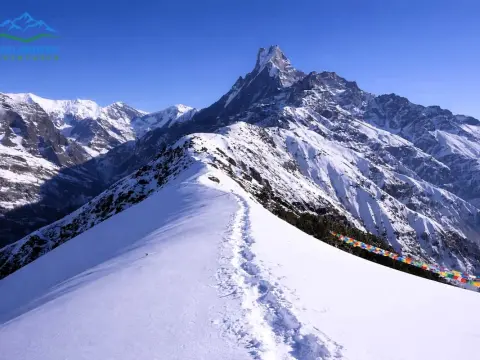
Both treks deliver extraordinary mountain scenery, but the character of the views is different.
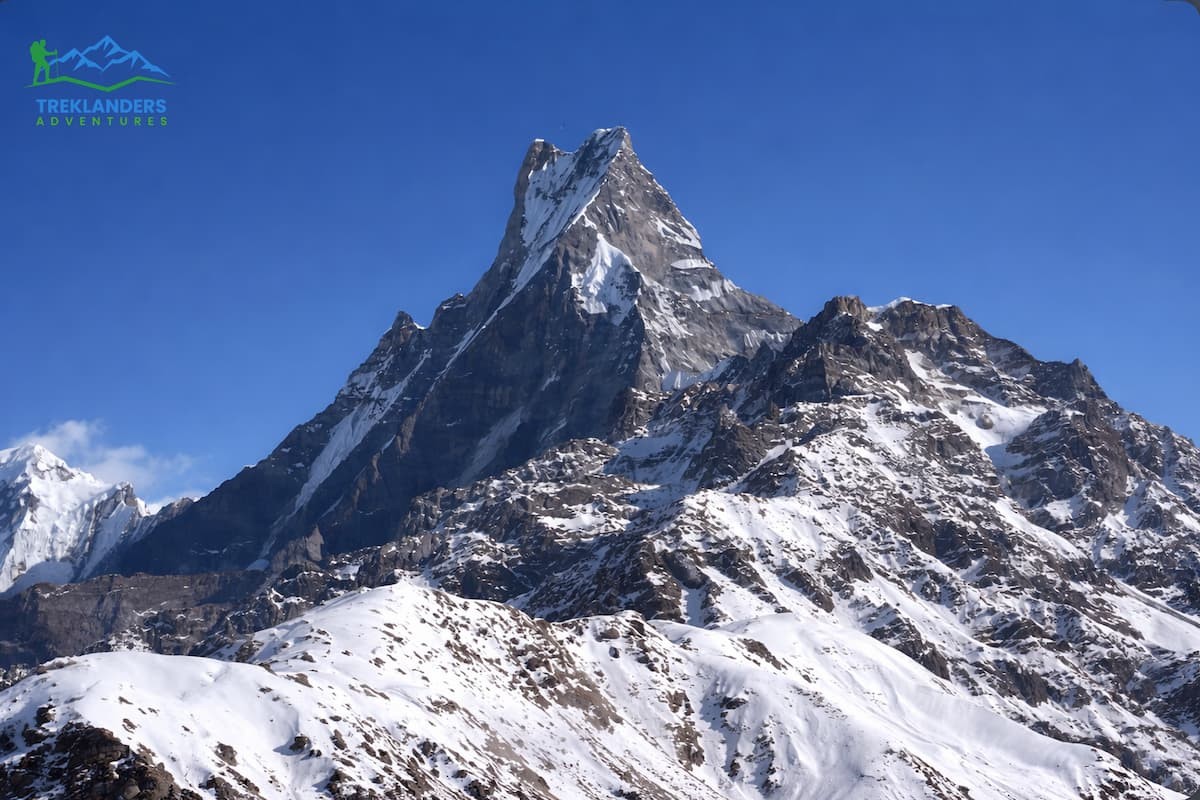
The highlight of the Mardi Himal Trek is being so close to Machhapuchhre. With most Annapurna treks, you only see Fishtail from a distance, usually across a large valley or from a ridgeline that separates you quite a bit from the peak. Mardi Himal, however, places the trail right under the southwestern face of the mountain. At High Camp and the lookout point, the mountain dominates your view to an extent that it feels almost surreal for a trek that doesn't require technical skills.
From the higher parts, you can also see Annapurna South, Hiunchuli, and Mardi Himal. The viewpoint offers a panoramic view of almost 350 degrees, showing both the eastern and western Annapurna ranges without any hindrance.
The wooded parts bring in a new variety of visual appeal. Springtime sees the trail dotted with blossoming rhododendrons from Forest Camp upwards, making red, pink, and white avenues through the woods. The leafy screen laden with moss around Forest Camp offers a tactile and ambient quality that the higher and more open paths do not have.
Witnessing the sun rise from the High Camp or the viewpoint is definitely a highlight for photographers on this hike. Seeing the first rays of sunlight strike Machhapuchhre even while the valley remains in shadow is the production of a very visually compelling scene.
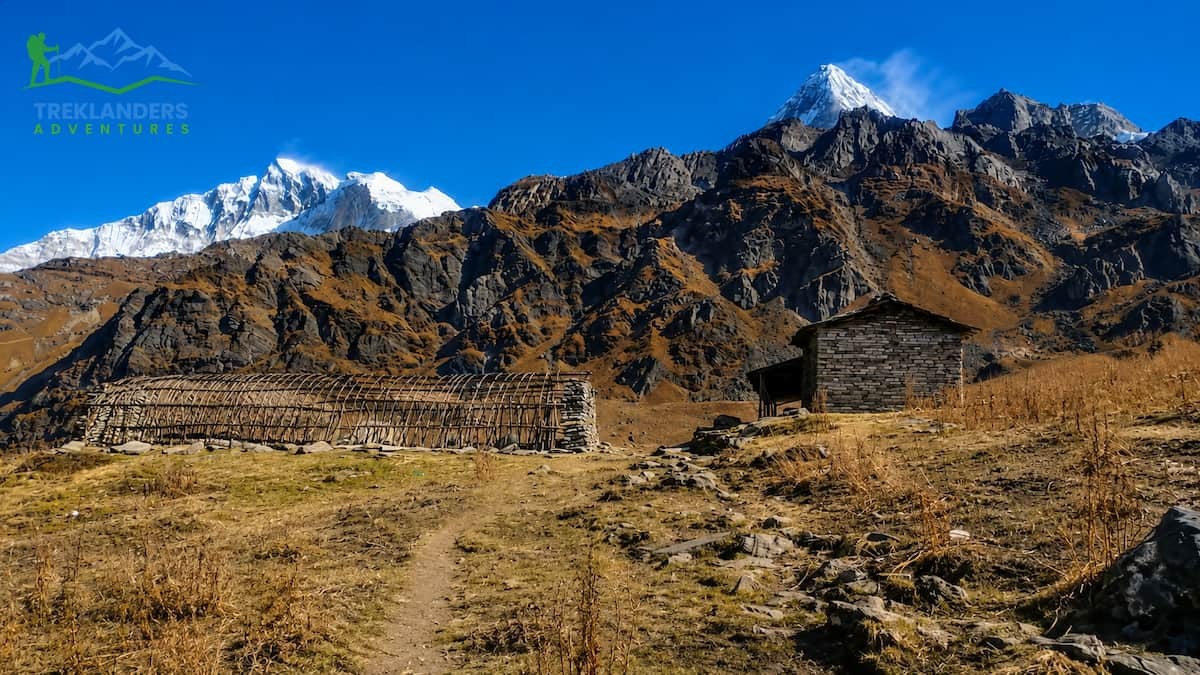
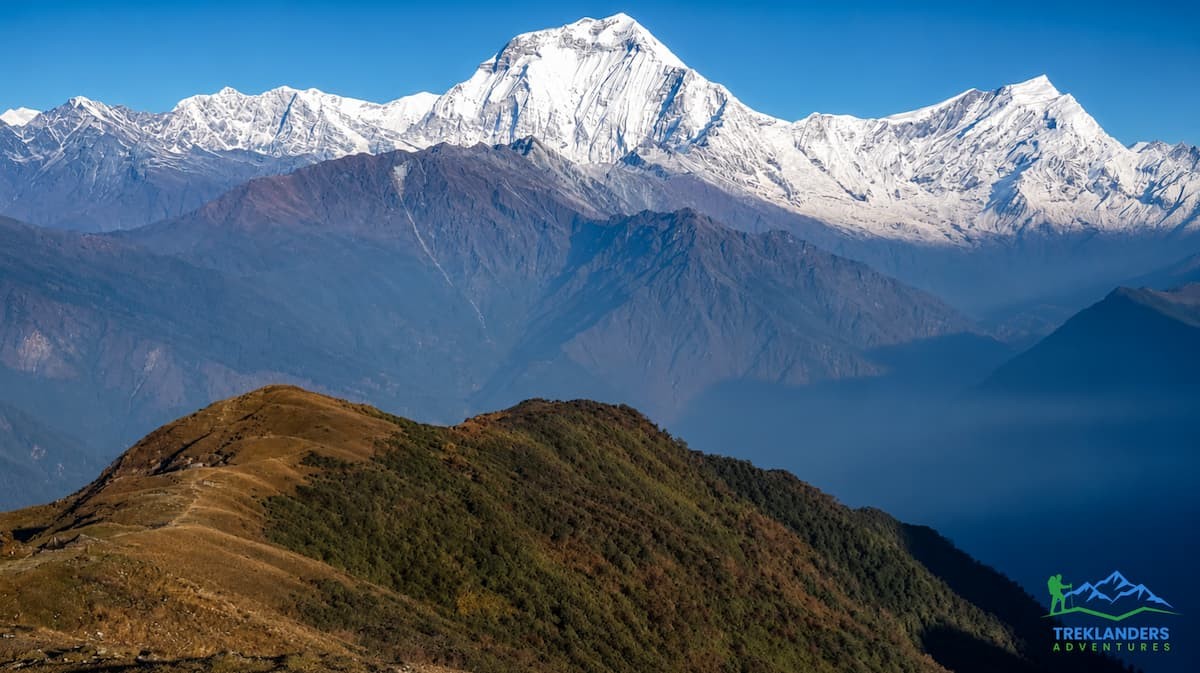
The Khopra Ridge experience is more about the scope of the view than the detail of a single mountain face. At Khopra Danda, 3,660 meters, hikers can view more than 20 separate Himalaya peaks. Dhaulagiri, which is the seventh-highest mountain in the world at 8,167 meters, is to the west, and it visually dominates the entire western horizon. To the east and north is the full line-up of the Annapurna massif, including Annapurna I (8,091 meters), Annapurna South, Gangapurna, and Annapurna II.
Most ridge viewpoints in Nepal give you only one mountain range, but Khopra puts you snugly between two of the world's great mountain ranges at once. You can glance at Dhaulagiri towards the west and to the left with Annapurna without turning much at all. That 360-degree aspect is what causes the usual mountain lovers to rate the view from Khopra Danda as among the best in the whole Annapurna region.
Khayer Lake presents another visual aspect. This lake is situated at 4,247 meters below the south face of Annapurna I. When the sky is clear, the water perfectly reflects the neighboring mountains. Besides its natural beauty, the lake has a spiritual significance as it is a Hindu pilgrimage site, and people visit there during the Janai Purnima festival in August.
If you are inclined to the sensation of being next to a single famous peak, Mardi Himal will be more pleasing. In case you desire to have the greatest panoramic view and through the experience of walking along the multiple 8,000-meter peaks, Khopra Ridge will provide more to you.
One more difference worth noting: the quality of light and the mood of the atmosphere are drastically different between the two paths. Mardi Himal's forest parts bring out a moodier, more secluded visual experience at low elevations. The early fog at Badal Danda, where the clouds frequently gather in the valley below the ridge, gives the upper path the sensation of resting above the world. Khopra Ridge, on the other hand, is quite open from the beginning, so the mountain scenes come in earlier and remain visible for longer periods of each day. So, if you want mountains in your frame the whole time, Khopra brings that to you earlier and more consistently. If you like the interplay of forest immersion and dramatic ridge exposure as a build to the top, Mardi Himal Trek gives you that experience more deliberately.
For a first timer, the quality of accommodation and food along the trail makes a real difference to the overall experience. Struggling with bad lodges when you are already tired and at altitude is demoralizing.
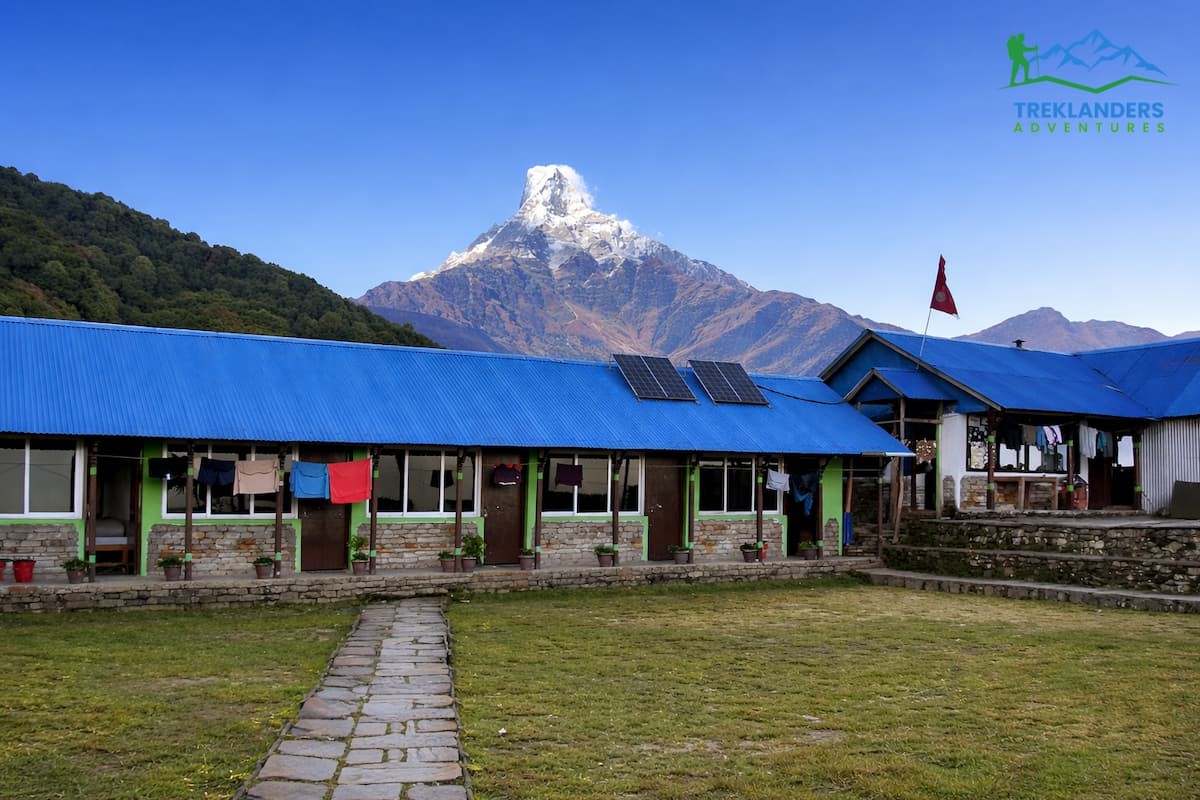
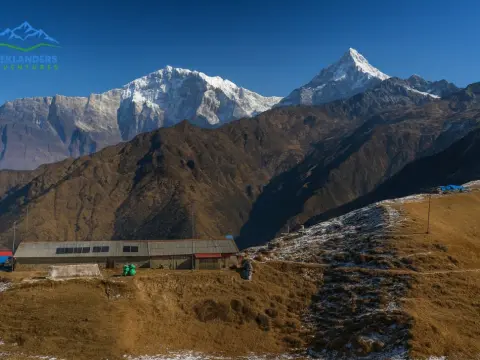
The Mardi Himal trail has developed steadily since 2012 and now has a reasonable network of teahouse lodges at each stop. Forest Camp, Low Camp, Badal Danda, and High Camp all have accommodation with common bathrooms. Hot showers are available at most stops for a small extra charge. Dining rooms are typically heated by wood stoves or gas heaters in the evenings.
The food menu across the trek covers Nepali, Indian, Chinese, Tibetan, and continental options. Dal bhat, fried rice, noodle soup, and pasta are reliably available at all camps. Breakfasts include oats, porridge, eggs, pancakes, and chapatti. Tea and coffee are available throughout.
Most lodges are equipped with Wi-Fi, although the speed drops when you are higher up. Streaming videos or making video calls may not be feasible, but you should be able to send basic messages at night.
On the Mardi Himal trek, the trail facilities, compared to the Annapurna Base Camp trail, are the least improved. However, the beginner who completes the infrastructure is adequate, and the more straightforward arrangement is one of the reasons for the charm.
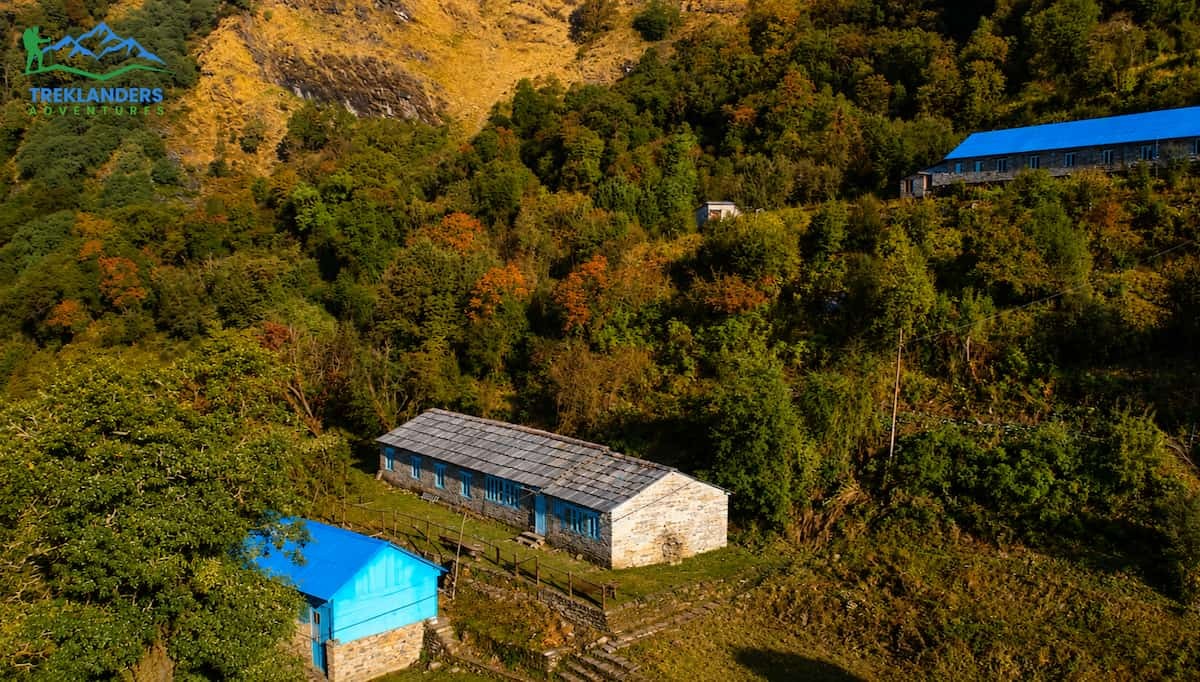
Khopra Ridge has fewer lodges, and the ones higher up are pretty basic. The community lodge at Khopra Danda is run by the community conservation committee and offers simple, clean accommodation. The focus is more on function than comfort.
Food options are quite limited at the higher camps on Khopra as compared to Mardi Himal. The lower areas via Ghandruk have better choices, including some well-established lodges with a larger menu and better facilities.
That is a major factor. If comfort and food variety are your foremost concerns, Mardi Himal Trek is a better choice. If you can live with basic mountain accommodation and, at the same time, really enjoy the peacefulness and remoteness of Khopra Ridge, the simpler setting of Khopra Ridge is a fair exchange.
Nepal's trekking trails pass through communities with distinct identities. The cultural exposure on each route differs in character.
The Mardi Himal trail is accompanied by Gurung and Magar villages at its lower parts. Dhampus, one of the initial places to stop, offers a combination of tourism facilities and an authentic hill lifestyle. The village at Siding, which one can reach by the descent route at the end of the trek, is not a common place for visitors and therefore shows a more peaceful side of traditional agriculture.
Mostly, the middle and upper parts of the trail consist of guest houses managed by local family members. It is in such a setting that sharing experiences through meals and even chatting by the fire in the evenings become heartfelt gestures. Not to mention, since the trail is not a popular one, you hardly ever find yourself engaging in a battle of potential visitors or tables for the attention of hosts or waiters.
Khopra Ridge Trek provides a deeper cultural immersion in farming because the hiking trail cuts through larger and more traditional villages. Ghandruk is one of the largest and most visited Nepali Gurung villages, with stone-roofed houses, narrow stone footpaths, a Gurung museum, and a strong community spirit. The beautifully patterned terraces and the rhythms of everyday life in the village are there for you to experience during your stay.
Swanta village is a Magar settlement, and the descent to the village reveals a Magar settlement of a more serene character. The Magar communities in this area have a cultural identity very different from the Gurung villages in the earlier sections, and time spent in both greatly enriches the experience of the journey.
The Khopra route also passes through Ghorepani, one of the most established teahouse villages in the Annapurna region, where the interaction between trekking culture and local life is on full display. The option to hike up to Poon Hill at sunrise while staying in Ghorepani adds a classic Annapurna experience without extending the trip.
The Gurung communities along both routes are known for their open and hospitable character. Gurung people have a long history connected to the Gurkha military tradition, and many teahouse owners on these trails come from families with that background. Conversations in the evenings over tea often reveal personal histories that give the trekking experience a dimension that photographs cannot capture.
On both routes, simple gestures that convey respect really matter while you move around the villages: these include taking off your shoes when entering the houses, not pointing your feet at religious icons, and asking the people if you can take their photographs.
Nepal's mountain communities are well accustomed to visitors; however, it is the sincere interest in their lifestyle that turns the interaction into a more positive and dialectic one rather than just perceiving the villages as mere backdrops.
The trekking paths in this area are not as busy as the Annapurna Base Camp route, so the bonds you make with your guide, porters, and lodge owners are very important in determining your overall feeling of the experience.
For first timers booking independently rather than through a guided package, this infrastructure difference has a practical implication. On Mardi Himal, you can generally arrive at a camp in the late afternoon and find accommodation without a confirmed reservation during shoulder season. On Khopra Ridge, particularly at the community lodge, availability is more limited, and booking ahead matters more.
Treklanders handles accommodation arrangements on both routes as part of guided packages, which removes the uncertainty. But if you are traveling independently, factor in that Khopra requires more advance coordination for the upper camps.
Season selection matters more in Nepal than most trekkers realize. The difference between an trekking in October and January on the same trail can be enormous in terms of views, temperature, trail conditions, and the quality of your overall experience. Get this right and everything else follows.
September to November is the prime and most dependable time for fall, also. It is the easiest period for natives when the sky is clear, temperatures are stable, and trails are dry. The temperature at mid-elevation during the day varies from 50 to 68 Fahrenheit. At High Camp, nights are dropping to freezing levels. The views are always clear, and although the rhododendrons are no longer flowering, the landscape is green and rich in different textures.
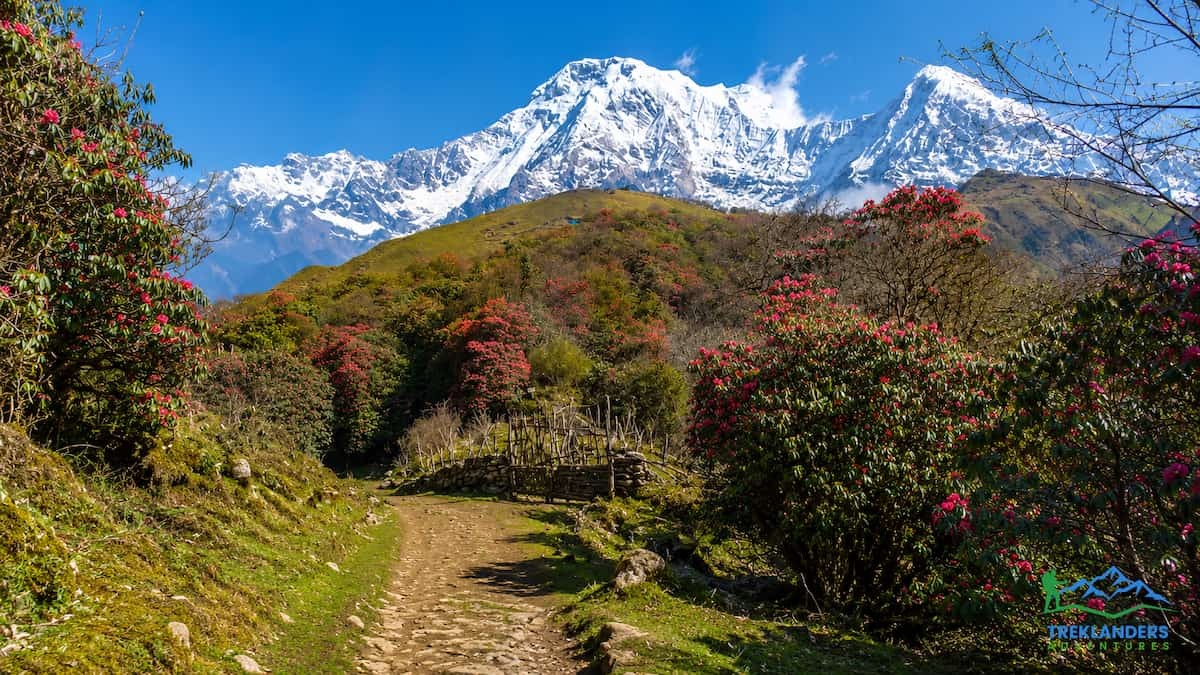
Spring from March to May is the second-best season and arguably more beautiful for photography. Rhododendrons bloom from Forest Camp upward through April, creating a vivid color on the trail. Temperatures are slightly warmer at lower elevations, and the overall atmosphere is softer and more colorful. The trade-off is a higher chance of afternoon cloud buildup, which can obscure peaks by midday.
Winter, from December to February, brings snow to the upper sections and significantly colder temperatures at High Camp and the viewpoint. The trail is passable but demanding, and the number of available lodges drops. For trekkers comfortable in cold and snow, the winter landscape is genuinely beautiful, and the trails are very quiet.
The monsoon from June to August is not recommended. Cloud cover obscures views for most of the day; trails become slippery, and leeches are active in the forest sections.
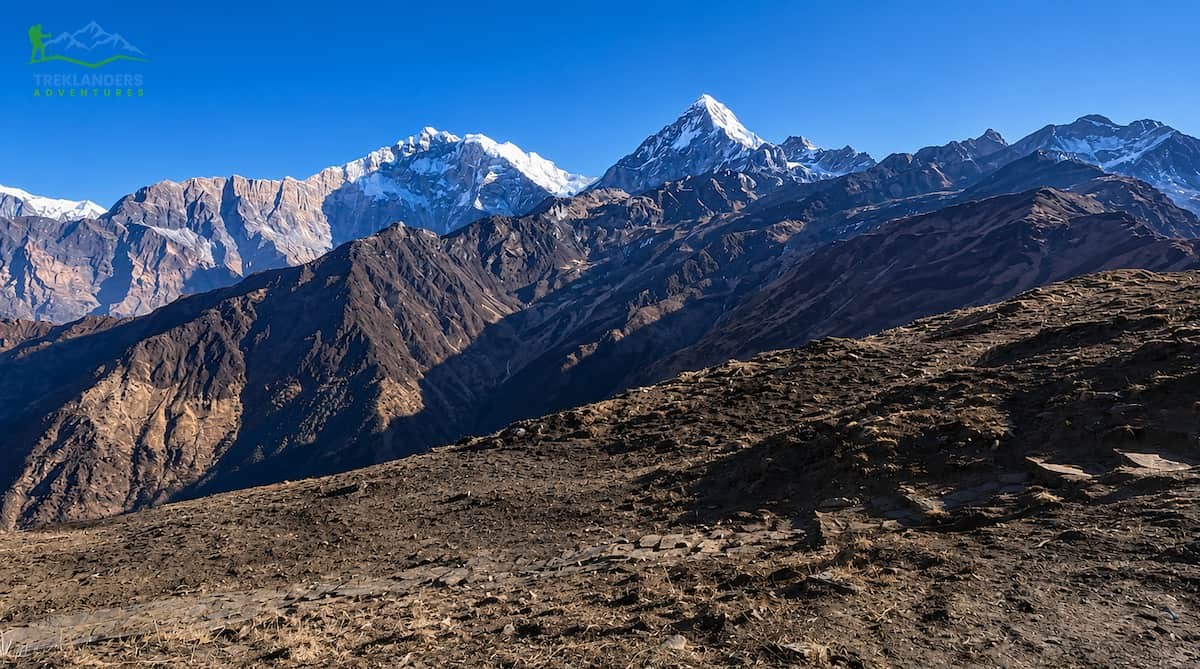
The same seasonal pattern applies to Khopra Ridge, with a few nuances.
Autumn is the perfect season. The post-monsoon atmosphere brings some of the clearest skies of the year, and the visibility from the ridge to the Dhaulagiri and Annapurna ranges is at its best. The trail quickly dries after the monsoon and becomes very firm underfoot.
Springtime is great on the Khopra Ridge for the very same reasons as Mardi Himal, besides the amazing sight of dense rhododendron forests in bloom below the tree line. The ridge itself is above the main rhododendron zone, but the areas around Ghorepani and the woods between the lower villages and Dobato are covered in flowers in April.
Another thing to bear in mind: the Khopra ridge is vulnerable to winds in a way that the forested Mardi Himal trail isn't. Winter on the Khopra Ridge is cold and windy, much more so than Mardi Himal at the same altitudes, which means it is hardly recommended even for first timers if they are visiting outside the main seasons.
Both treks require the same two permits to enter the Annapurna Conservation Area.
Anyone trekking in the Annapurna area must have a permit from the Annapurna Conservation Area Project (ACAP). In addition, the TIMS card (Trekkers' Information Management System) is necessary. These documents are standard, and any registered trekking company should provide them at no extra charge.
In the Mardi Himal and Khopra Ridge delectation packages, Treklanders include permit processing. If you want to book your trip individually and not through a package, you may get these documents from the Nepal Tourism Board office in Kathmandu or the tourist information center in Pokhara.
You do not need restricted area permits for either route. This is different from treks such as Upper Mustang or Nar Phu Valley, where additional special permits are required and are considerably expensive. Both Mardi Himal and Khopra Ridge are free to enter as per the standard conservation area framework.
It is highly advisable to have a guide for both journeys, especially if you are a beginner. The walking routes are, in general, quite easy to follow, but their condition may vary with the weather, and some intersections on the Khopra trail are not so clear. A licensed guide will not only enhance your security but will also give you information on the local conditions and acclimatization, as well as provide you with a way to give back to the local community through employment.
Both treks fall within the Annapurna Conservation Area Project (ACAP), one of the most successful conservation areas in Asia by area. The conservation framework means that both trails pass through relatively intact ecosystems compared to more heavily trafficked routes, where lodges and waste have degraded the natural environment.
The forested lower sections of Mardi Himal support a range of wildlife that you can encounter on a lucky day. Langur monkeys are occasionally spotted moving through the canopy near Forest Camp. The rhododendron and oak forests are good habitat for Himalayan pheasants, including the Danphe (Himalayan Monal), Nepal's national bird. Red pandas have been recorded in the higher forest sections, though sightings are rare.
Bird watching on Mardi Himal is a genuine draw for nature-interested trekkers. The forest between Australian Camp and High Camp supports a variety of species, from small sunbirds and laughing thrushes in the lower forest to alpine choughs and lammergeiers at higher elevations. Birding is best in the early morning, before the trail gets busy and wildlife retreats.
Khopra Ridge offers similar biodiversity in its forested sections. The Himalayan Tahr, a large ungulate related to wild goats, is more commonly spotted along the Khopra route's open ridgeline sections, where it grazes on the rocky slopes. Musk deer have also been recorded in the quieter forested areas.
The Khayer Lake area above the ridge supports the most remote and least disturbed habitat on the route. Early morning visits to the lake, before other trekkers arrive, occasionally reward patient observers with wildlife encounters. The lake's religious significance also means it has historically been protected from hunting by local communities, which has contributed to the surrounding habitat remaining intact.
For trekkers interested in birdlife and natural environments beyond the mountain scenery, both routes deliver. Mardi Himal's denser forests give it the edge for forest birds. Khopra Ridge's more open terrain suits large mammals watching better.
Knowing what fitness level each trek demands helps you prepare accurately rather than arriving underprepared.
The Mardi Himal Trek offers amazing views for those trekkers who can manage 4-6 hours of continuous uphill walking carrying a day pack. You don't have to be a runner or a gym enthusiast, but you should be able to keep going on a steep hill without having to stop too frequently.
If you have 6 to 8 weeks before the trek, a reasonable training plan would be to walk for around 45 minutes to an hour on back-to-back days, including at least two times a week walking on stairs or hill areas. Also, if you can, try to do one or two longer hikes for 3 to 5 hours in the weeks leading up to your travel. This will help you build muscle endurance for downhill walking, which, by the way, is even more stressful for the knees than uphill walking.
Altitude is an entirely different factor compared to fitness. Even those who are very fit can suffer from altitude sickness above 3,000 meters. The best ways to reduce the chances are the right pace, drinking enough water, and the concept of "climb high, sleep low, " which is part of the Mardi Himal trekking plan with two nights at High Camp.
Khopra Ridge Trek requires a bit higher baseline level. The very steep parts of ascent, especially when going to Chistibung and then reaching the ridge, call for a continuous effort which walking at a flat or slightly inclined pace wouldn't have trained you for.
Include stair climbing or weighted uphill training in your training. Use them if you have access to trails with changes in elevation. The way down from the ridge to Swanta is quite steep and sometimes even rocky, so here you will need some knee strengthening and balancing exercises.
If you have never been a hiker and are not physically active generally, Mardi Himal would be the right choice. Those who are infrequent hikers and have some experience in rough terrain might consider Khopra with proper training.
Packing for either trek follows similar principles. Layered clothing is essential because temperatures vary by 15 to 20 degrees Celsius between daytime low-altitude walking and evenings at high camp. A good waterproof shell, warm mid-layer, moisture-wicking base layers, and a hat and gloves for the upper sections cover most scenarios in the main trekking seasons.
Trekking boots with ankle support are necessary. Sandals or light shoes for the teahouse evenings add comfort. A sleeping bag liner improves warmth at higher camps, and a headlamp with spare batteries is essential for the pre-dawn summit push on Mardi Himal.
Both treks require trekking poles on the descent sections. Knee strain on the way down is the most common physical complaint from first timers on the Annapurna trails. Poles distribute the load significantly and protect joints over the course of several days of descent.
In reality, the response hinges on two very tangible elements: your background and the scenic experience you are after.
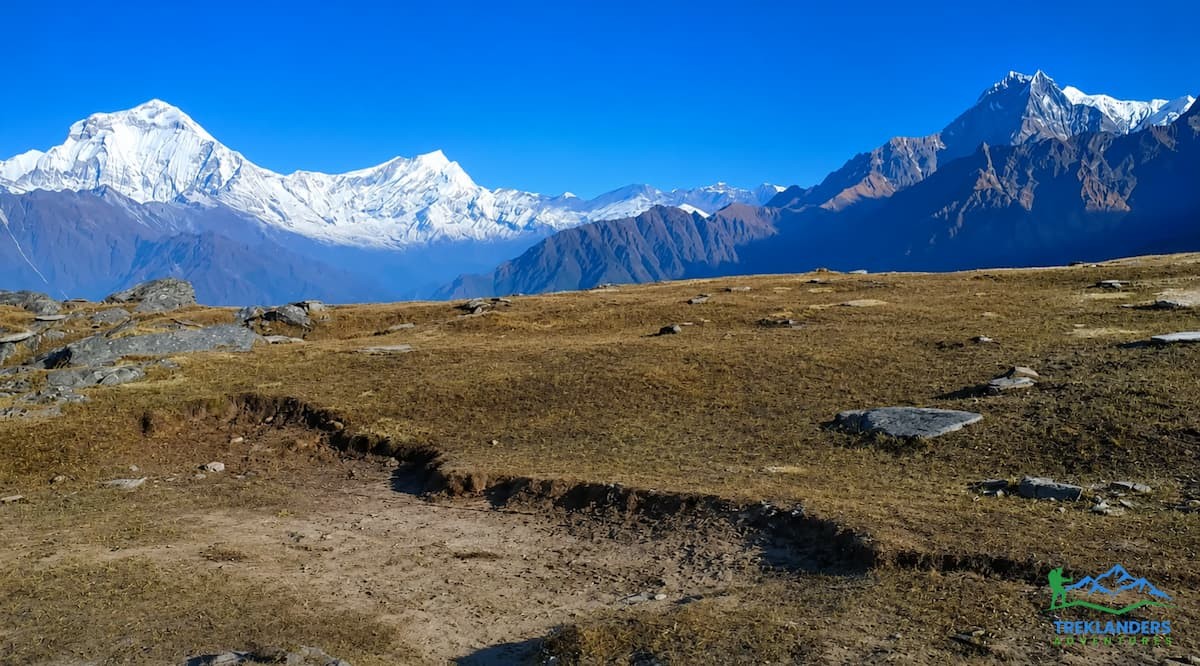
For a newbie trekker who happens to be a first timer in Nepal, the sensible option is Mardi Himal Trek. Physically, the path will not be too harsh on your body, the surroundings are more up to the condition of beginners, and the spectacular Machhapuchhre close views offer an excellent reward for simply walking there without requiring any mountaineering skills. The Treklanders 5-day package is an attainable goal for most people with normal fitness levels. If you want to cover more time for acclimatization and going to the upper ridge, the 8-day version is the choice.
If you are not a beginner and have done some hikes, relish getting exposed to greater slopes, and want to have the most extensive mountain panorama in the Annapurna zone while keeping the trip period within 10 days or less, go for Khopra Ridge. This is very different, in terms of mountain scenery, thanks to the breathtaking views of the ridge and the addition of the Khayer Lake trip. The cultural route via Ghandruk and Swanta is like a bonus that you would not get with Mardi Himal's isolated forest trail.
Neither trek would be a wrong option for someone who is a first timer but has a realistic mindset. A mistake can be made only if one picks one trek on the basis of wrong criteria, for example, selecting Khopra Ridge just because it sounds more adventurous, without realizing that it has a steeper terrain and less developed infrastructure. Or selecting Mardi Himal because it sounds easier, without realizing that it is also at an altitude of 4,200 meters, and one needs to be adequately prepared for high altitude.
Here is one more thought for first-time trekkers. The trekking guide that you choose to travel with will affect your trekking experience as much as the trail itself. A knowledgeable and attentive guide not only sets the right pace but also watches your reaction to altitude, decides smartly about the weather windows, and tells you about the things you see in ways that visually enrich the experience. On both Mardi Himal and Khopra Ridge, it is this human factor that is one of the reasons a Nepal trek is short, memorable, rather than just physically demanding.
Both Mardi Himal and Khopra Ridge are available through Treklanders as fully guided packages from Pokhara, including all permits, accommodation, meals, and support staff. The best way to decide is to contact the team directly with your fitness level, available days, and what you most want to see. They can match you to the right itinerary and adjust the pace to fit your needs.
Either way, you will return from the Annapurna region with a different sense of what the Himalayas actually look and feel like from inside them, not from a postcard.
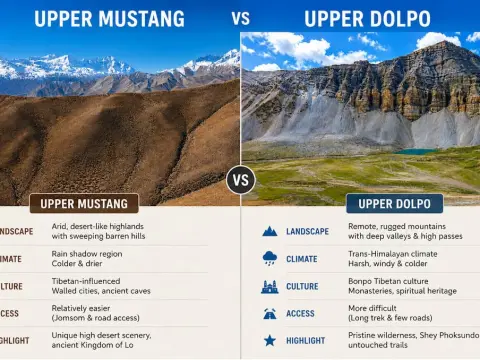
Compare Upper Mustang and Upper Dolpo to discover which of Nepal's most remote treks is right for you.
Completed Everest Base Camp? Cross Kongma La, Cho La, Renjo La, and explore the stunning Gokyo Lakes on Nepal's ultimate trekking circuit.
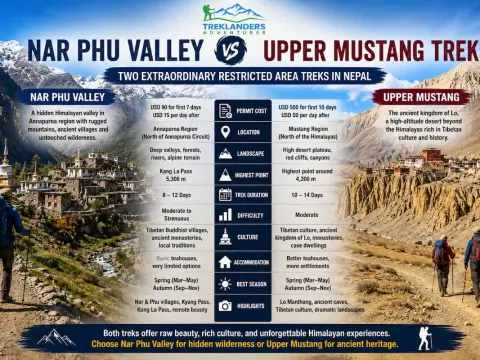
Compare the Nar Phu Valley Trek and Upper Mustang Trek to find the best restricted-area trek in Nepal for your adventure.



