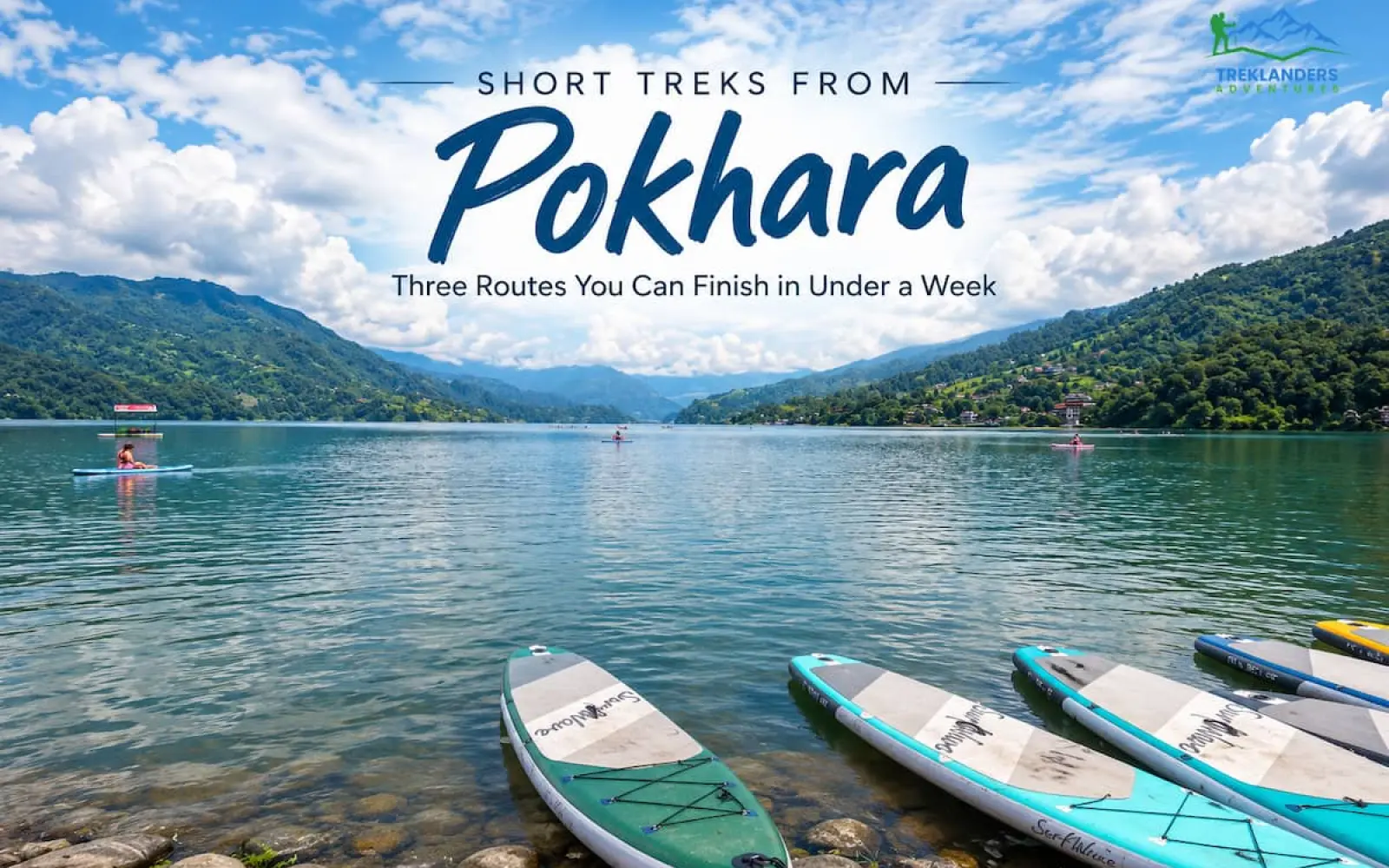
Pokhara is the rare mountain town where you can eat breakfast by a lake at 860 meters and be walking under 7,000-metre peaks by lunchtime the next day. That fact explains why people with only a week in Nepal end up here rather than in the Everest region. No domestic flight to gamble on, no two-day approach walk before the scenery starts. You get in a jeep, drive for two or three hours, and start walking.
This guide covers the three short treks Treklanders runs out of Pokhara: the four-day Ghorepani Poon Hill trek, the five-day Mardi Himal trek, and the seven-day Annapurna Base Camp trek. All three start and end in Pokhara, use teahouse lodges, and sit inside the Annapurna Conservation Area, the largest protected area in Nepal and home to thousands of farmers and lodge owners who still work the land.
Each route is laid out day by day, with the altitudes and walking hours from the actual itineraries, followed by the things that decide whether a short trek goes well: season, fitness, permits, lodges, and how to pick between routes that look similar on a map but feel nothing alike underfoot.
Kathmandu is where most Nepal trips begin, but it is not where the short trekking is. From there you are looking at a flight to Lukla or a long drive to Syabrubesi first. From Pokhara the trailheads are an ordinary morning drive.
The road to Nayapul, which serves the Poon Hill and Annapurna Base Camp routes, takes an hour and a half to two hours on the Pokhara-Baglung highway. Mardi Himal starts even closer, with a drive to Dhampus, Potana and Deurali that puts you on the ridge the same morning. On the Annapurna Base Camp itinerary the drive continues past Nayapul on a rough road to Jhinu, which saves a full day of walking.
The second advantage is altitude. Pokhara sits at 860 meters, low enough that you arrive rested rather than already short of breath, and the routes above it climb steadily instead of dropping you at altitude on day one.
The third is flexibility. Phewa Lake, the caves and the paragliding are all sitting there if a day of rain moves your start. On a fixed twelve-day itinerary in the Khumbu, a lost day hurts. Here it does not.
This is the short trek most people have heard of, and it has earned its reputation. The route is a mini circuit through the southern hills of the Annapurna range: Pokhara to Tikhedhunga, up to Ulleri, on to Ghorepani, up Poon Hill at dawn, across to Tadapani, then down to Ghandruk and back to Pokhara. Roughly 40 kilometers of walking, not counting the drives, with a high point of 3,210 meters.
Treklanders grades it moderate, with plenty of ups and downs. That grade is honest. It is not hard in the mountaineering sense, but the stone staircases will tell you exactly how much stair climbing you did before you flew in.
Three hours of driving, two of walking. The drive leaves Pokhara on good highway, climbing through Nau Danda and Kande with Annapurna filling the windscreen, then drops to Nayapul. From there the road turns rough and runs to Tikhedhunga, a farm village with waterfalls above it.
The walk begins by crossing a bridge, and then the famous stone steps start. This is the hardest hour of the first half of the trek, a relentless staircase with no way to make it pleasant. The reward is Ulleri, a village spread across the hillside at 2,050 meters, with Annapurna behind the green ridges to the north.
Four hours, ending at 2,874 meters. This is the day people remember. The path starts gradually and moves into cool alpine forest of rhododendron and pine. In spring this stretch is why the area gets called the world's largest natural rhododendron garden, with flowers from white through pink to deep red depending on elevation and species.
A few short steep sections bring you to lower Ghorepani and its welcome gate, then a climb to the ridge at Deurali and upper Ghorepani. Most groups arrive by lunchtime, leaving the afternoon free, with Dhaulagiri and the Annapurna peaks visible from the lodges. Ghorepani gets cold after dark and the dining room fire is where everyone ends up.
Six hours. The alarm goes early, usually around half past four, for the hour-long climb to Poon Hill in the dark with a headtorch. At 3,210 meters you get the view the trek is named for: Dhaulagiri, the Annapurna range, Manaslu on a clear morning, and Machhapuchhre, the fishtail peak, catching the first light.
Back down to Ghorepani for breakfast, then the real walking day begins. The trail climbs steeply through rhododendron and pine to Deurali, a ridge at almost the same height as Poon Hill, with Dhaulagiri, Tukuche, the Nilgiris and Annapurna across the skyline. From there it drops to Banthanti, a cluster of lodges in a gorge beside a stream, which is the usual lunch stop. The afternoon is a descent to a bridge and then an hour of steep climbing to Tadapani at 2,640 meters, where the lodges look straight at Annapurna South, Hiunchuli and Machhapuchhre.
Six hours. Depending on the season you may get a sunrise from Tadapani before breakfast. The trail then runs through forest to Bhaise Kharka, down to a stream, and along a winding path to Ghandruk at about 1,950 meters.
Ghandruk is a destination in its own right, a large Gurung village of slate roofs and stone paths that acts as a gateway to half the treks in the region. Lunch on a lodge terrace with Annapurna above you is a decent way to end a walk. Afterwards it is a short stroll to the road head, a jeep to Birethanti and Nayapul, and the highway back to Pokhara.
Families with children, people in their sixties and seventies, and anyone whose fitness is honest but untested. Altitude is not really a factor at 3,210 meters, and there is a teahouse at every reasonable stopping point, so the plan can flex if someone is slow.
It is also the right choice if you want culture as much as scenery. The route passes Magar and Poon villages around Ghorepani and Gurung villages lower down, and the days are short enough that you spend time in them rather than passing through at speed.
Mardi Himal was barely walked fifteen years ago. Early explorers called the area the Other Sanctuary, because it sits a few miles east of the Annapurna Sanctuary, separated from it by the Modi River gorge and a wall of rock. The trail runs up a forested ridge and comes out above the tree line beneath Machhapuchhre.
The route goes Pokhara to Forest Camp, Low Camp, High Camp, Mardi View Point, Badal Danda, and out through Siding. About 35 kilometers of walking, with a high point of 4,200 meters. Treklanders grades it moderate to adventurous, a step up from Poon Hill because of the altitude and the length of the first and fourth days.
Seven hours in total, most of it driving. You leave the Pokhara-Baglung highway for a rough dirt road that climbs to Dhampus, a Gurung village on a green hill with the Annapurna and Manaslu ranges laid out in front of it. The drive carries on through forest to Potana and then up to Pritam Deurali at 2,040 meters, which sits on the old trail linking Dhampus, Landruk and the Annapurna Base Camp route.
From Deurali you leave the main trail and walk into oak, pine, fir and rhododendron. The forest is dense and the light goes green. Forest Camp at 2,520 meters is exactly what the name suggests: a handful of lodges in the trees, with no view at all. After a long day in a vehicle, that is fine.
Four hours, ending at 2,970 meters. A short day, and a welcome one. It starts with a steep climb out of Forest Camp and then follows the high trail through woods, with gaps opening onto the Annapurna range. Low Camp is a small settlement on the ridge, and the afternoon is free.
If you have spare energy, walk ten minutes above the lodges in the late afternoon. The cloud often lifts around four o'clock and Machhapuchhre appears much closer than you expected.
Six hours to 3,700 meters. The distance is moderate but the altitude gain makes it feel long, which is normal. The trail leaves the forest and climbs a high ridge, the vegetation dropping away to dwarf rhododendron and scrub.
High Camp is the highest overnight stop, and the afternoon is deliberately free. Rest, drink water, eat properly even if your appetite has gone quiet. This is the night that decides how the next morning feels.
Seven hours, with the high point of the trek at 4,200 meters. You start early on a narrow ridge climbing steadily towards the viewpoint. It can be strenuous, and the answer is to go slowly enough to hold a conversation. After a few hours you are standing in front of Machhapuchhre with the dark rock of Mardi Himal on its southern flank and the Annapurna range to the west.
Machhapuchhre is 6,993 meters and unclimbed. Nobody has stood on the summit, and by agreement nobody will. Standing directly beneath it is a strange feeling that photographs do not carry.
The return drops back to High Camp for a rest and continues down to Badal Danda at 3,210 meters. Badal means cloud, and the place is named for the mist that sits on it most afternoons. The lodges are simple and the dining room is warm, which after seven hours is enough.
Six hours of walking and two of driving. The morning descends to Low Camp, then takes an alternative route off the ridge and drops a long way to Siding, a farm village at 1,750 meters. Your knees will know it by the bottom, so trekking poles earn their weight here. From Siding a vehicle takes you back to Pokhara and a hotel by Phewa Lake.
Who this route suits
People who want a high viewpoint and a quieter trail, and who are comfortable with a couple of long days. Mardi Himal has become popular over the last decade, so the lodges above Low Camp fill quickly in October and April and beds are limited at High Camp. A pre-booked room matters more here than on any other short route out of Pokhara.
It is also the best of the three for photographers: open foregrounds, cloud below the trail most afternoons, and Machhapuchhre in almost every frame.
This is the full Sanctuary experience compressed into a week. The route runs Pokhara to Jhinu, Chhomrong, Dovan, Machhapuchhre Base Camp and Annapurna Base Camp, then back out through Bamboo and Jhinu, with a high point of 4,130 meters.
It is a shortened version of the standard ten to twelve day route, and the compression is worth understanding before you book: you climb from 1,700 meters at Jhinu to 4,130 meters in four days, with two consecutive nights above 3,500 meters and no rest day built in.
Three hours of driving and three of walking. The drive follows the highway to Nayapul, then turns along the Modi River past Birethanti to Jhinu. The walk starts across a long suspension bridge, climbs to a ridge, and drops into Chhomrong at 2,170 meters.
Chhomrong is the last permanent village before the Sanctuary and the best-equipped stop on the route. Some lodges have attached bathrooms, there are bakeries, and the menus are broader than anything higher up. It is a working Gurung village with terraced fields below it, not a purpose-built trekking stop.
Six hours, ending at 2,505 meters. The day opens with a long descent to the Chhomrong River, then an hour of stone steps up to the ridge at Sinuwa. From there you enter dense rhododendron and pine forest and drop to Bamboo, a settlement in the Modi gorge among bamboo groves, which is the usual lunch stop. The afternoon is a slow climb through shaded forest to Dovan, a few lodges above the river. You sleep with the sound of water.
Six hours to 3,700 meters, and the day the trek changes character. The trail climbs through forest to Hinko Cave, a huge overhang used as shelter for generations, then passes the Himalaya Hotel settlement below Annapurna South and Hiunchuli. A short descent to the river, then a climb to the flat ground at Deurali for lunch.
After Deurali the vegetation gives up. The bamboo shrinks, the trees vanish, and the last hour steepens to Machhapuchhre Base Camp, a ridge of lodges under the fishtail peak. It gets cold as soon as the sun leaves the valley, which happens earlier than you expect.
Three hours, the shortest day of the trek. You climb onto the plateau of the Sanctuary and walk northwest into the bowl, reaching Annapurna Base Camp at 4,130 meters in time for lunch.
The Sanctuary is an amphitheatre. Annapurna I stands to the north, Annapurna South and Hiunchuli to the southwest, Machhapuchhre directly behind you. Annapurna I is 8,091 meters and was the first eight-thousander ever climbed, by a French expedition in 1950, three years before Everest. The wall above the lodges rises more than 4,000 vertical meters.
The afternoon is free to walk out onto the moraine, and you will hear avalanches somewhere on the ridges. The sunrise next morning, when Annapurna I turns gold from the summit down, is why people come.
Six hours of descending, back through Machhapuchhre Base Camp, Deurali and Dovan to Bamboo at 2,310 meters. Descending is easier on the lungs and harder on the knees, and the distance is greater than on any climbing day. The forest closing back in after two days above the tree line is one of the underrated pleasures of this route.
Six hours. A short steep climb out of Bamboo, a winding path to Sinuwa, down the steps to the river, and a steep climb back into Chhomrong for lunch. The afternoon is a couple of hours down to Jhinu at about 1,780 meters, where a natural hot spring sits on the bank of the Modi River, forty minutes below the lodges. After six days of walking, it is worth the detour.
Three hours. A short walk across the suspension bridge to the road head, then a rough drive to Birethanti and Nayapul and the highway back to Pokhara at 860 meters.
People who are fit, who have four to six weeks to prepare, and who want to stand inside the mountains rather than look at them from a distance. No technical skill or prior trekking experience is needed, but daily endurance matters: six to seven hours of walking, four days running, with one long climbing stretch.
If you want a slower pace or a rest day, the longer Annapurna Base Camp itineraries exist for that reason. The seven-day version is a good plan for the right person and a poor one for anybody who wants slack.
Comparing them on altitude alone is misleading. What separates them is the shape of the days.
Poon Hill is the easiest, the most cultural and the best introduction to Himalayan trekking. Its high point is a viewpoint, so you look at the range from outside it. Four days, none longer than six hours, with stone steps as the main challenge.
Mardi Himal is the quietest and the most scenic per hour of walking. You get high, you get close to Machhapuchhre, and you spend two days above the tree line. The first day is long because of the drive, the fourth because of the climb, and the fifth is a knee-testing drop of nearly 1,500 meters.
Annapurna Base Camp is the biggest experience and the most demanding schedule. You are inside the mountains, at the foot of an eight-thousander, and it asks the most of your acclimatisation and your legs.
First trek and four days, take Poon Hill. Five days and you want altitude, take Mardi Himal. Seven days and you train first, take Annapurna Base Camp. Ten or more, the combined Poon Hill and Annapurna Base Camp route gives you both.
Spring and autumn are the two reliable windows, and this is true for all three routes.
Spring runs from early March to May. Days are usually bright from around half past six in the morning until five in the afternoon, with cloud building after lunch and occasional light snow higher up. Mornings and nights are cold, and above 3,000 meters there is a wind chill on top of the air temperature. The afternoon sun is strong, so sunblock, sunglasses, a hat and long sleeves are not optional. Spring is also when the rhododendrons bloom, which matters most on the Ghorepani route and in the forests below Chhomrong.
Autumn runs from September to November and brings the most stable weather of the year. Skies are clear, visibility is long, and the trails are busy for those reasons. Mornings and nights are colder than in spring, and the chance of snow at altitude rises through November. For sunrise photography, autumn edges it.
Winter, December to February, is possible on all three. Skies are crisp and trails are empty, but Ghorepani and anywhere above 3,500 meters gets seriously cold at night, and snow can close the final approach to the Sanctuary. It suits experienced trekkers with proper gear.
The monsoon, June to August, is the season to avoid. Daily rain, cloud that hides the mountains, slippery stone steps and leeches in the forest sections.
On the Annapurna Base Camp route, daytime temperatures in spring and autumn run around 15 to 20 degrees at Jhinu and Chhomrong, dropping to between 5 and minus 5 at night at the two base camps.
If your dates are flexible, late September to mid-November and March to early May are the sweet spots.
Every one of these routes sits inside the Annapurna Conservation Area, so an Annapurna Conservation Area Project permit is required. It is checked near Birethanti and again further along the trail, so keep it somewhere you can reach without unpacking your duffel.
The money from the permit goes to forest conservation, trail maintenance and community projects, including drinking water and school support in villages along the route.
The Trekkers' Information Management System card used to be compulsory on almost every route in Nepal, including these. That requirement has been changing, so check the current position when you book rather than trusting an older guidebook. Trekking with an agency, the permits are arranged for you.
Beyond permits you need a passport with enough validity for your trip and a Nepal visa, usually issued on arrival at Tribhuvan International Airport. Processing takes twenty to thirty minutes depending on how many flights landed at once, so build in a buffer if you are catching a same-day bus to Pokhara.
Travel insurance is the document that matters most and the one people skimp on. Check that your policy covers trekking to at least 4,500 meters and includes emergency helicopter evacuation, not just standard medical cover. Above 3,500 meters a rescue flight is a normal response to a serious altitude problem.
All three routes are teahouse treks, which means simple family-run lodges rather than camping.
Standards vary by location. Ghorepani and Ghandruk have the widest range on the Poon Hill route, from basic rooms with shared bathrooms to lodges with attached baths. Chhomrong is the best-equipped stop on the Annapurna Base Camp route. Above those villages, and on the Mardi ridge above Low Camp, rooms are basic: two single beds, a thin mattress, a blanket, shared toilets, thin walls. The warm clothes you packed for the trail are also your evening clothes indoors.
Hot showers are usually available lower down for a small charge. Higher up they are unreliable, because pipes freeze overnight and the water has to be heated separately.
Dining rooms are the social center of every lodge, built around a stove. This is where you eat, dry out, and pick up trail conditions from people coming the other way.
The food is more varied than you would expect. Breakfast covers porridge, oats, eggs in every form, pancakes, Tibetan bread and chapati, with tea, coffee and hot chocolate. Lunch and dinner menus run through Nepali, Indian, Chinese and Tibetan dishes plus simple continental options like pasta and fried rice. Some lodges in Ghorepani and Ghandruk go further with bakeries.
Dal bhat is the one to order on a long walking day: rice, lentils and vegetable curry, usually with a free second helping. There is a reason the guides and porters eat it twice a day.
If you are a group of four or more, order the same dish. It speeds up a small kitchen and cuts the fuel burned, which matters where firewood arrives on someone's back.
Electricity in the dining rooms comes from micro-hydro or solar, and charging usually costs a small fee higher up. Wi-Fi exists in most lodges but is slow and drops out with weather and user numbers. Download your maps before you leave Pokhara and treat connectivity as a bonus.
Poon Hill asks for ordinary fitness. If you can climb stairs for two to three hours with breaks, you will enjoy it. Three or four weeks of walking, stair climbing and light cardio before you fly makes the Ulleri steps a story rather than a struggle.
Mardi Himal asks for more, mainly because of the altitude and the length of days four and five. Daily walks of thirty to forty-five minutes for two to three weeks, plus uphill practice, cover it.
Annapurna Base Camp in seven days asks the most. Start training at least a month out, longer from a low base. A workable week is two cardio sessions of thirty to forty-five minutes, one strength session for legs and core, one weekend hike of two to three hours with a loaded daypack, and a rest day. Repeat for four to six weeks.
Practice descending, not just climbing. Six hours of going down stone steps loads your knees and ankles far more than the climb did, and if you have knee trouble this is when it shows up.
On altitude: Poon Hill at 3,210 meters rarely causes problems, and Mardi Himal reaches 4,200 meters but you sleep lower, at 3,700 and then 3,210. Annapurna Base Camp is the one to respect. The itinerary steps you up through Chhomrong, Dovan and Machhapuchhre Base Camp, which is sound, but the last morning gains over 400 meters to a sleeping altitude of 4,130 meters with no buffer day.
Above 3,000 meters, aim for 300 to 500 meters of net sleeping-altitude gain a day where the route allows it. Drink three to four liters of water daily and keep eating even when your appetite fades. Skip alcohol and sleeping pills, which interfere with breathing overnight.
Watch for headaches, nausea, loss of appetite and unusual tiredness past Dovan. Mild symptoms are common and usually settle. They become a problem if they worsen, or if confusion, breathlessness at rest or loss of coordination appear. Tell your guide straight away. The response is to stop climbing, rest, hydrate, and descend if nothing improves within a day.
Pace matters more than fitness up high. Guides slow the group deliberately on the climbs above Dovan and above Low Camp, and fighting that pace is the most common mistake fit trekkers make.
Layering is the whole strategy, because you start these routes in subtropical farmland and finish above the tree line.
Bring two or three moisture-wicking base layers, a fleece or light insulated mid-layer, and a waterproof shell for top and bottom. For Annapurna Base Camp and Mardi Himal, add a proper down jacket; you are sleeping above 3,500 meters and the lodges are not heated. Trekking trousers, gloves, a warm hat, a buff and sunglasses with high UV protection finish the clothing. At 4,000 meters, sun reflecting off snow can cause snow blindness in a few hours.
Footwear is what people get wrong. Waterproof boots with ankle support, broken in well before you travel. Two or three pairs of trekking socks, one thicker pair for cold nights, and light camp shoes for the lodge.
Accessories: trekking poles, a 30 to 35 liter daypack, a headtorch with spare batteries, a refillable bottle, and a rain cover. A sleeping bag rated to around minus five is worth carrying for warmth and hygiene even though blankets are provided. Add a power bank and cables, and keep your phone in an inner jacket pocket overnight, since cold drains batteries fast.
Toiletries stay minimal: biodegradable soap, a quick-dry towel, hand sanitizer, sunscreen of SPF 50 or higher, lip balm, and your own toilet paper. A small health kit should cover blister treatment, painkillers, water purification tablets, and prescription medication in its original packaging. Carry Diamox only if a doctor has approved it, and never as a substitute for acclimatisation.
The southern Annapurna hills are Gurung and Magar country. Ghorepani and the ridges around it are Poon Magar villages, one of the largest hill communities in Nepal, and the Poon follow both Hindu and Buddhist practice. Ghandruk, Chhomrong, Dhampus and Siding are Gurung.
The Gurung follow Tibetan Buddhism mixed with the older Bon tradition that predates it, along with elements of shamanism that still run through village life. You see it in prayer flags strung across almost every house and lodge, in lines of blue, white, red, green and yellow standing for sky, air, fire, water and earth.
Many Gurung families here have relatives who served in Gurkha regiments, and that history shows up in the villages. Pensions from military service helped build some of the better guesthouses you walk past, alongside money earned more recently from trekking.
Courtesy costs nothing. Take your shoes off before entering a prayer room, ask before photographing people, and pass mani walls and chortens on your left. Many guides and lodge staff here are Gurung themselves, so ask them rather than trusting a guidebook.
A day either side of the trek gives you Phewa Lake, the World Peace Pagoda, Sarangkot for sunrise, and the caves and gorge north of town. Pokhara is also the paragliding capital of Nepal, and a tandem flight off Sarangkot with the Annapurna's on the horizon is a fair use of a spare afternoon.
If you want more walking, the combinations are straightforward. Poon Hill links to the Annapurna Base Camp route through Tadapani and Chhomrong, which is how the ten-day combined itinerary works. Mardi Himal can be added to an Annapurna Base Camp trip for anyone with two spare weeks, since both start from the same side of the valley.
None of these routes are technically difficult and the main trails are signed, so plenty of people walk them independently. A licensed guide still changes the experience more than you would expect.
A guide handles permits, books rooms ahead in the seasons when High Camp and Ghorepani fill by mid-afternoon, sets a pace that suits the slowest person in the group, and watches for altitude symptoms before you notice them yourself. On the Mardi ridge, where fog can make the sections around Forest Camp and High Camp confusing, that navigation matters.
Treklanders runs all three routes with government-licensed English-speaking guides and porter support, usually one porter for every two trekkers, with meals, teahouse accommodation, ground transport and permits included. Porter support is the biggest quality-of-life upgrade on a short trek: carrying eight kilos instead of eighteen changes how day four feels.
If you are choosing an operator yourself, look for registration with the Nepal Tourism Board, membership of the Trekking Agencies' Association of Nepal, clear information about what is included, and evidence that porters are insured and fairly paid.
The treks out of Pokhara give you more scenery per day of holiday than anything else in Nepal. Four days gets you a sunrise over Dhaulagiri and Annapurna from Poon Hill. Five gets you onto an open ridge under an unclimbed peak. Seven puts you inside the Annapurna Sanctuary at the foot of the tenth-highest mountain on earth.
What they share is that the walking is the point. You climb through farmland, then forest, then out above the trees, and the landscape changes under your feet rather than through a window.
Pick the route that matches the days you actually have and the training you will actually do, book rooms early if you travel in October or April, and let the guide set the pace.