Safe Treks in Nepal Right Now: Routes Untouched by the Recent Floods
30 Aug 2026
Discover which trekking routes in Nepal remain safe and open after the recent floods, and which affected areas travelers should avoid for now.

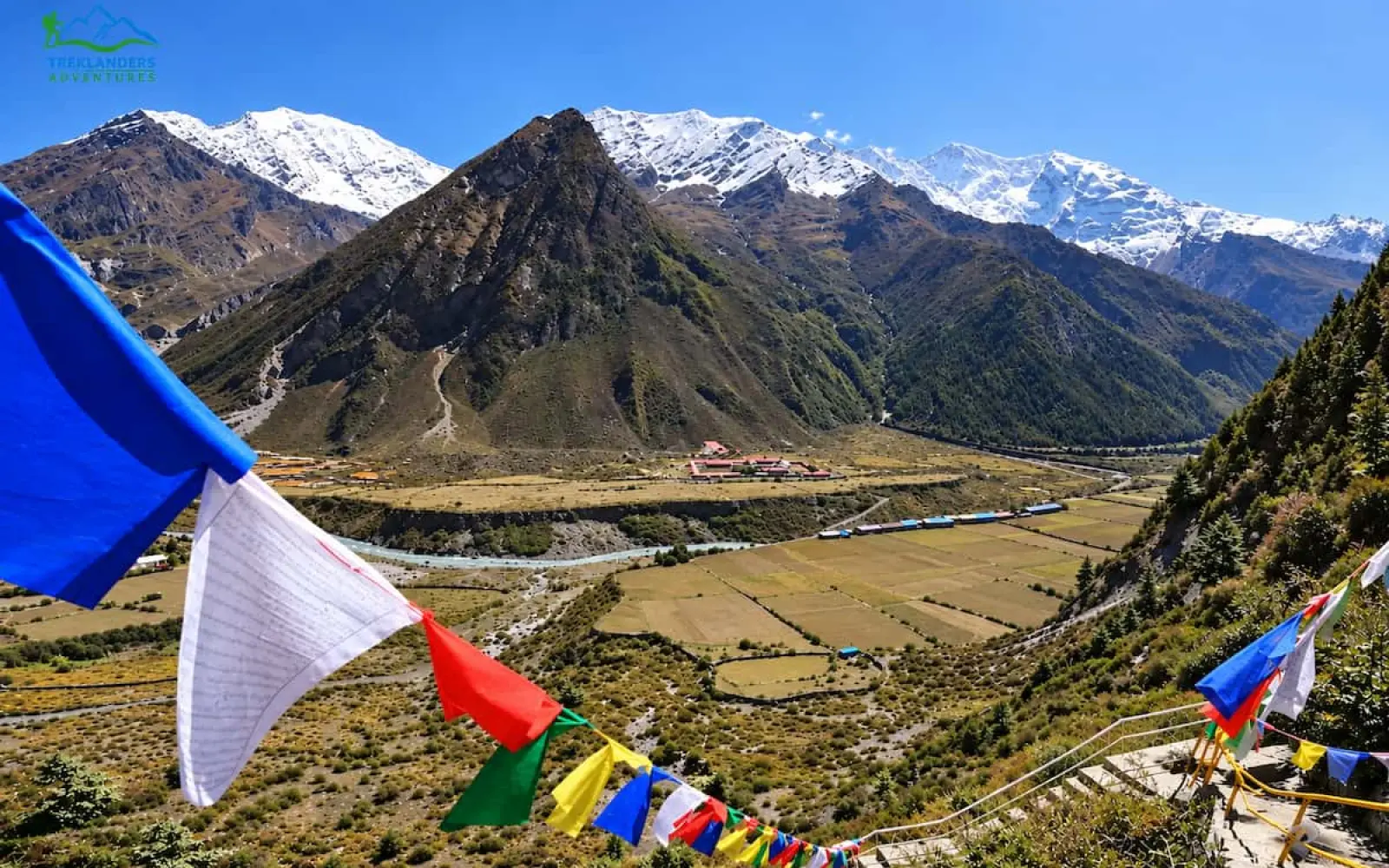
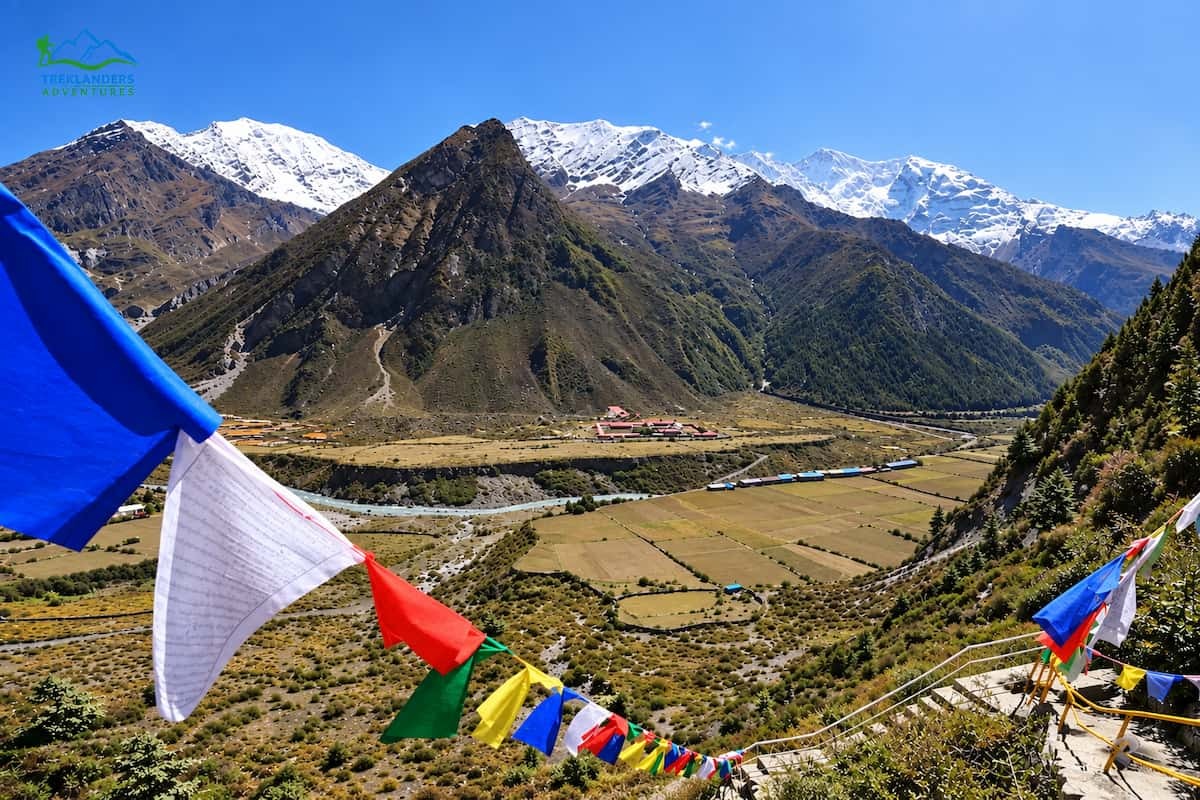
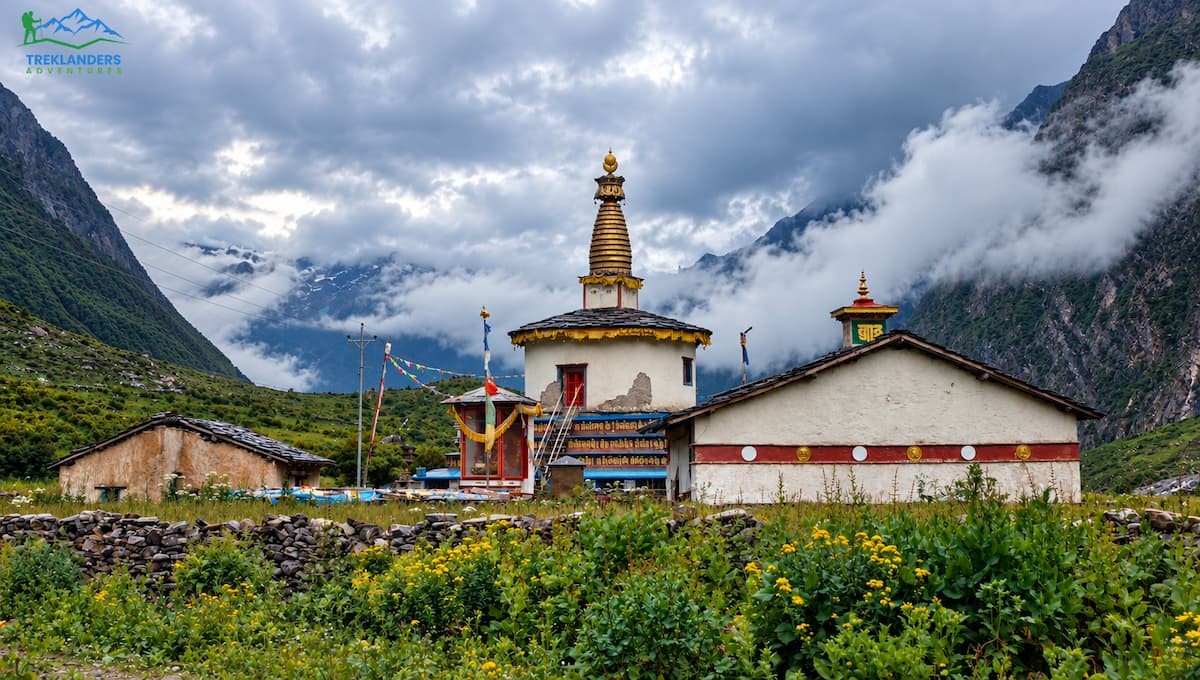
Tsum Valley sits tucked behind the Manaslu range, a few days' walk from the nearest road, and it still feels like a place time forgot. Locals call it Tsum, the "Valley of Happiness," and the name isn't a marketing line invented for trekking brochures. It comes from the Tibetan word for vivid, and once you're standing in front of Mu Gompa with prayer flags snapping in the wind and Ganesh Himal rising behind you, you understand why.
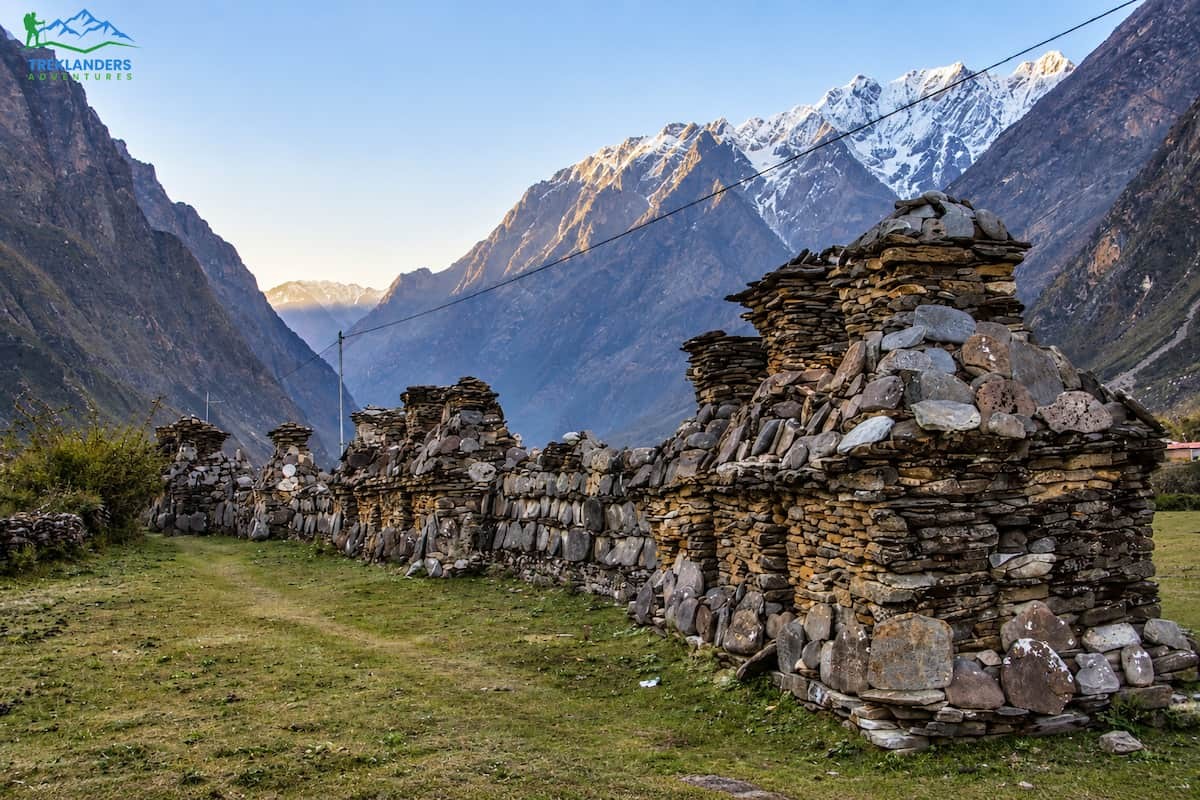
This trek only opened to foreign visitors in 2008. Before that, Tsum stayed closed off from outside trekkers for decades, protected by its remoteness and by government restrictions that treated the whole valley as off-limits. That history matters, because it explains why Tsum still looks and feels the way it does. You won't find the crowded lodges of Everest Base Camp or the souvenir shops that line parts of the Annapurna Circuit. You'll find stone farmhouses, mani walls stretching for hundreds of meters, and villages where Tibetan Buddhism still shapes daily life the way it has for centuries.
If you trek with Treklanders Adventures, you'll walk this route as part of the wider Manaslu Circuit journey, since Tsum Valley branches off the main Manaslu trail at Lokpa before you rejoin it on your way toward Larke Pass. This guide walks you through everything you need to know about the Tsum Valley section: where it is, when to go, what the trail actually feels like day by day, what permits you'll need, and how to prepare your body and your pack for one of the most culturally rich walks in Nepal.
Tsum Valley lies in the Gorkha district of Gandaki Province, in a horseshoe-shaped valley wedged between the Ganesh Himal and Sringi Himal ranges. The valley sits so close to the Tibetan border that the culture, language, and religious practices you'll encounter feel more Tibetan than Nepali. Locals here speak a Tsum dialect related to Tibetan, follow the Nyingma school of Tibetan Buddhism, and maintain traditions that predate the modern Nepali state.
Geography kept Tsum isolated for longer than almost any other trekking region in Nepal. The valley has no roads. Every building material, every sack of rice, and every roof of corrugated tin has to be carried in on someone's back or a mule's, which means development happens slowly and carefully here. That isolation is exactly what draws trekkers now. You're not walking through a museum recreation of old Himalayan life. You're walking through the real thing, still functioning, still lived in.
The valley diverges from the Manaslu Circuit at a village called Lokpa. From there, the trail runs north into Tsum itself, passing through Chumling, Chhokangparo, and eventually reaching Mu Gompa near the Tibetan border, before doubling back to rejoin the main Manaslu route. This structure means most Tsum Valley itineraries, including the one Treklanders runs, combine Tsum with the Manaslu Circuit rather than treating it as a fully separate trek. Doing so gives you the cultural depth of Tsum and the high mountain drama of Larke Pass in a single journey.
Ask five people why they picked this trek over Everest or Annapurna and you'll get five different answers, but they tend to circle the same handful of reasons.
The monasteries are the obvious draw. Mu Gompa, the largest monastery in the valley, sits at roughly 3,700 meters and functions as a living religious center rather than a tourist stop. Monks still live and study there. Rachen Gompa, a nunnery lower in the valley, offers a quieter, equally moving stop. Between the two, and scattered through villages like Chhekampar and Lama Gaun, you'll pass chortens, mani walls, and prayer wheels that have stood for generations.
Then there's the emptiness of the trail itself. Tsum Valley receives a fraction of the foot traffic that Everest Base Camp or even the Annapurna Circuit sees each season. You'll share teahouses with a handful of other trekkers rather than dozens, and you'll get long stretches of trail where the only sounds are your own footsteps and the wind moving through prayer flags.
The scenery holds its own too. Ganesh Himal dominates the skyline through much of the lower valley, and as you climb higher, Himalchuli and other Manaslu-area peaks come into view. The trail moves through pine and rhododendron forest lower down, then opens into stark alpine terrain as you approach Mu Gompa, so the landscape keeps shifting in ways that hold your attention over multiple days.
And because Treklanders' itinerary links Tsum with the full Manaslu Circuit, you also get Larke La Pass at 5,106 meters, one of the more demanding and rewarding high passes in Nepal. Few other treks let you combine remote valley culture with a genuine high-altitude crossing in one trip.
Timing this trek right matters more than people expect, mostly because you're dealing with high altitude, a remote setting, and (if you continue on to Larke La) one of the trickier passes in the country.
Spring, March through May, gives you the most comfortable overall conditions. Rhododendron forests bloom lower in the valley, days warm up enough for pleasant walking, and visibility tends to be strong once the morning haze burns off. Nights above 3,000 meters still get cold, so don't let the mild days fool you into skimping on warm layers. By late March, snow on Larke Pass has usually settled enough to cross safely, which matters if your itinerary continues past Tsum into the wider Manaslu Circuit.
Autumn, September through November, is peak season for good reason. The monsoon has just cleared out, so the air is washed clean and mountain views sharpen up considerably. Trails are dry, teahouses are fully open, and the weather tends to hold steady for longer stretches than in spring. October gets busy by regional standards, though "busy" in Tsum Valley still means a fraction of what you'd see in Everest region trails during the same month. If you want the clearest skies and the most reliable weather window, autumn is your safest bet.
Winter, December through February, turns this into an expedition for experienced, well-equipped trekkers only. Temperatures at higher elevations drop hard, some teahouses close or run with limited services, and heavy snowfall can make Larke Pass genuinely dangerous or impassable. The upside is real: empty trails, dramatic snow-covered scenery, and villages at their quietest. Just go in knowing the margin for error shrinks considerably.
Monsoon, June through August, is the season to skip. Heavy rain triggers landslides along the lower Budhi Gandaki gorge, leeches show up in the forested sections, and visibility drops to the point where the mountain views that make this trek worthwhile mostly disappear behind cloud. River crossings become riskier, and road access to the trailhead can get cut off by washouts. Save your leave days for a different season.
Rather than a bare list of distances and elevations, it helps to understand what this trail actually feels like as you move through it, because the character of the walk changes almost every day.
Your journey starts with a long drive, not a flight. From Kathmandu, the road follows the Trishuli River before turning onto rougher terrain that traces the Budhi Gandaki toward Machha Khola. The drive runs 8 to 9 hours and takes you past terraced hillsides, small roadside villages, and increasingly dramatic river gorges as you gain distance from the city. It's a long day in a vehicle, but it does the job of easing you into rural Nepal before your boots hit the trail.
Into the Budhi Gandaki Gorge
The actual walking begins along the Budhi Gandaki River, and this stretch tests your legs before it tests your lungs. The trail from Machha Khola to Jagat crosses several suspension bridges strung high over the river, threads through narrow gorges, and passes waterfalls that crash down from the cliffs above. Jagat itself is a traditional stone-paved village and the entry checkpoint into the Manaslu Conservation Area, so expect a permit check here.
From Jagat, the trail continues to Lokpa, and this is where your route splits from the main Manaslu Circuit. The path climbs through forest and past scattered settlements as you leave the more heavily used trail behind. Lokpa marks the gateway into Tsum Valley proper, and the shift in atmosphere is immediate. Fewer trekkers, quieter villages, and your first real sense that you're heading somewhere genuinely off the beaten path.
Past Lokpa, the trail drops into pine and rhododendron forest as it follows the river deeper into the valley toward Chumling. This village, sometimes called Lower Tsum, holds several notable monasteries, including Pango Gumba and Gurwa Gumba, and offers your first proper look at traditional Tsum architecture: thick stone walls, timber balconies, and prayer flags strung between rooftops. Manaslu and Himal Chuli both come into view from certain points around the village on clear days.
From Chumling, the trail climbs gradually along the river valley and through terraced fields toward Lama Gaun, one of the main villages of Upper Tsum. The Tibetan Buddhist character of the valley deepens here. You'll notice more mani walls, more prayer wheels built into streamside structures, and a slower, more deliberate pace of life in the villages you pass through. High Himalayan peaks frame the valley on both sides as you gain elevation.
The walk from Lama Gaun to Mu Gompa takes you through increasingly alpine terrain as trees thin out and the landscape opens up. Mu Gompa itself sits near 3,700 meters and is the largest monastery in the entire valley, as well as its spiritual anchor. Reaching it feels less like arriving at a tourist site and more like arriving at the end of a pilgrimage route that locals have walked for generations. Depending on your itinerary and energy levels, some trekkers push further to Milarepa's Cave, associated with the wandering Buddhist yogi who is said to have meditated in the caves scattered around this part of the valley.
Staying overnight near Mu Gompa puts you about as far into Tsum as most itineraries go. The isolation here is complete. No roads, minimal electricity beyond solar panels, and a silence broken mostly by wind and the occasional chant drifting from the monastery.
After Mu Gompa, the trail heads back down through the valley to Chhekampar, giving you a second look at the terrain from a different angle and time of day, which often reveals details you missed on the way up. Chhekampar offers a chance to slow down and take in daily village life, from farming routines to the rhythms of monastery life, before the trail continues its descent back toward Lokpa.
At Lokpa, you rejoin the main Manaslu Circuit route. If your itinerary continues on toward Larke Pass, as Treklanders' 20-day itinerary does, the trail from here pushes on through Ghap, Lho Gaun, and Samagaun, gaining serious altitude as Manaslu itself comes into full view. An acclimatization day in Samagaun gives your body time to adjust before the push toward Samdo, Dharmasala, and the crossing of Larke La at 5,106 meters, followed by the descent to Bhimtang and the drive out through Tilje and Besisahar.
Whether you treat Tsum Valley as a standalone cultural trek or as the opening chapters of a longer Manaslu journey, the character of these first days sets the tone for everything that follows: gradual immersion into a landscape and a culture that very few outside travelers ever see up close.
What strikes most trekkers, looking back on the walk, is how gradually the shift happens. Nothing about entering Tsum Valley feels dramatic in the moment. There's no gate, no sign marking a transition. You simply notice, somewhere between Lokpa and Chumling, that the villages have grown quieter, the mani walls longer, and the pace of life around you slower. By the time you reach Mu Gompa, you've traveled further culturally than the distance on the map would suggest.
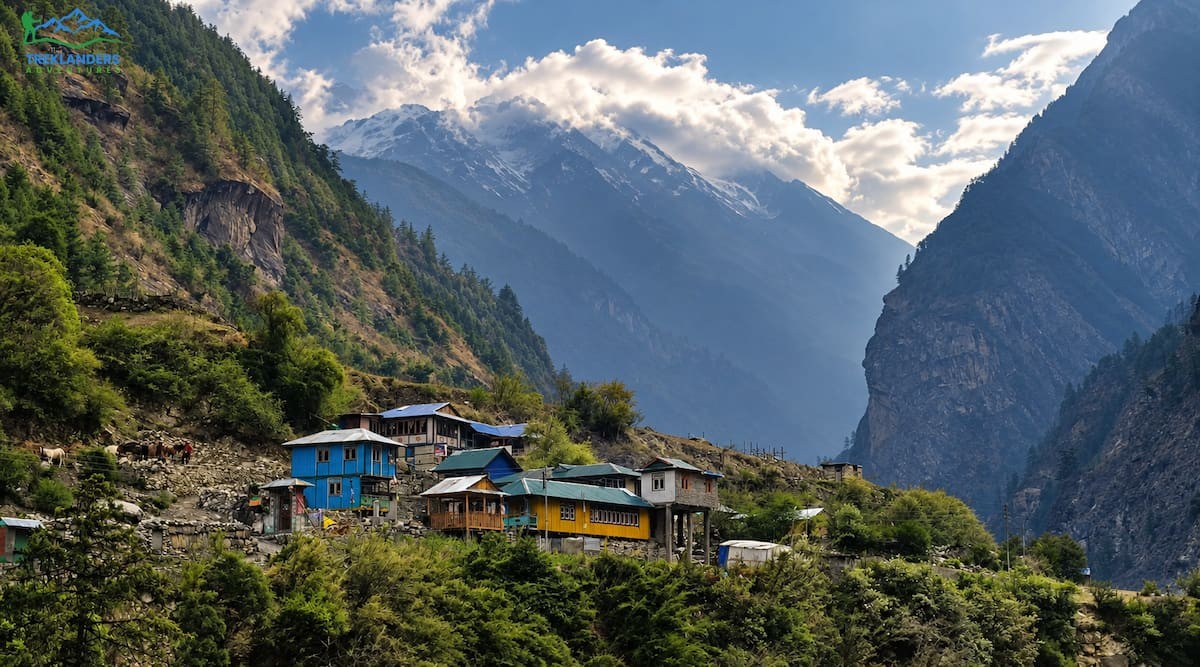
Part of what makes this trail memorable has less to do with the trail itself and more to do with the small moments you catch on either side of it. Farmers threshing barley by hand outside Chumling. Children walking barefoot between houses despite the cold. An elderly woman spinning a prayer wheel on her porch as you pass, not performing for anyone, simply continuing a routine she's kept for decades.
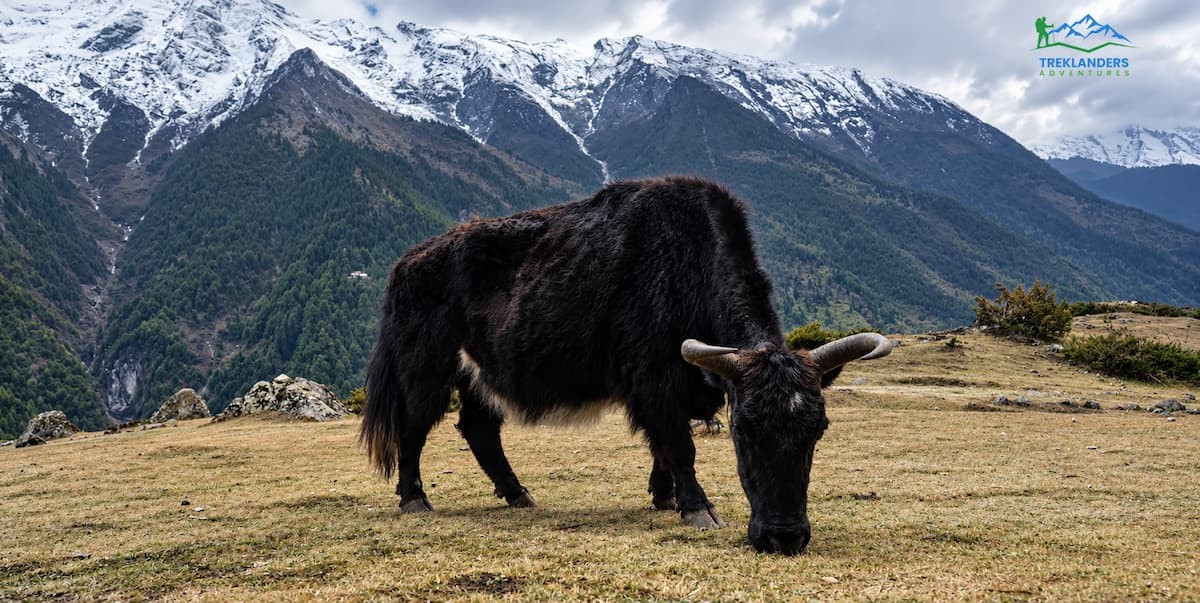
These villages run on subsistence farming, animal husbandry, and increasingly, the modest income that guided trekking groups bring in. Barley, potatoes, and buckwheat grow on terraced fields wherever the terrain allows, and yaks and dzopkyo, a yak-cattle hybrid better suited to lower elevations, do much of the heavy carrying work that porters can't manage alone. None of this is staged for visitors. You're walking through a working agricultural valley that happens to also be one of the most spiritually significant corners of the Himalayas, and the two identities coexist without much friction.
One thing that surprises first-time trekkers on this route is how much the scenery changes over a relatively short distance. You start in warm, subtropical river valley terrain around Machha Khola, where banana trees and terraced rice paddies still grow, and within a few days you're walking through pine and rhododendron forest, then alpine scrub, then bare rock and scree near Mu Gompa. Few treks in Nepal compress that much ecological variety into a single route.
Rhododendron forests put on their best show in spring, when the lower and middle sections of the trail turn red and pink with blooms. Higher up, you'll pass through birch and juniper before the tree line gives out entirely. Keep an eye out along quieter stretches of trail for Himalayan tahr, and if you're trekking in the colder months, there's a real if slim chance of spotting blue sheep on the higher slopes near Mu Gompa. Snow leopards live in this region too, though sightings are exceptionally rare and mostly reported by locals rather than passing trekkers.
Birdlife is more reliably visible. Danphe, Nepal's national bird with its striking multicolored plumage, sometimes appears along the forested middle sections, and various species of eagles and vultures circle the higher ridgelines where thermals rise off the valley walls. None of this is the primary reason to trek Tsum Valley, but it adds texture to the walk, especially on the longer days where the trail itself doesn't offer much conversation.
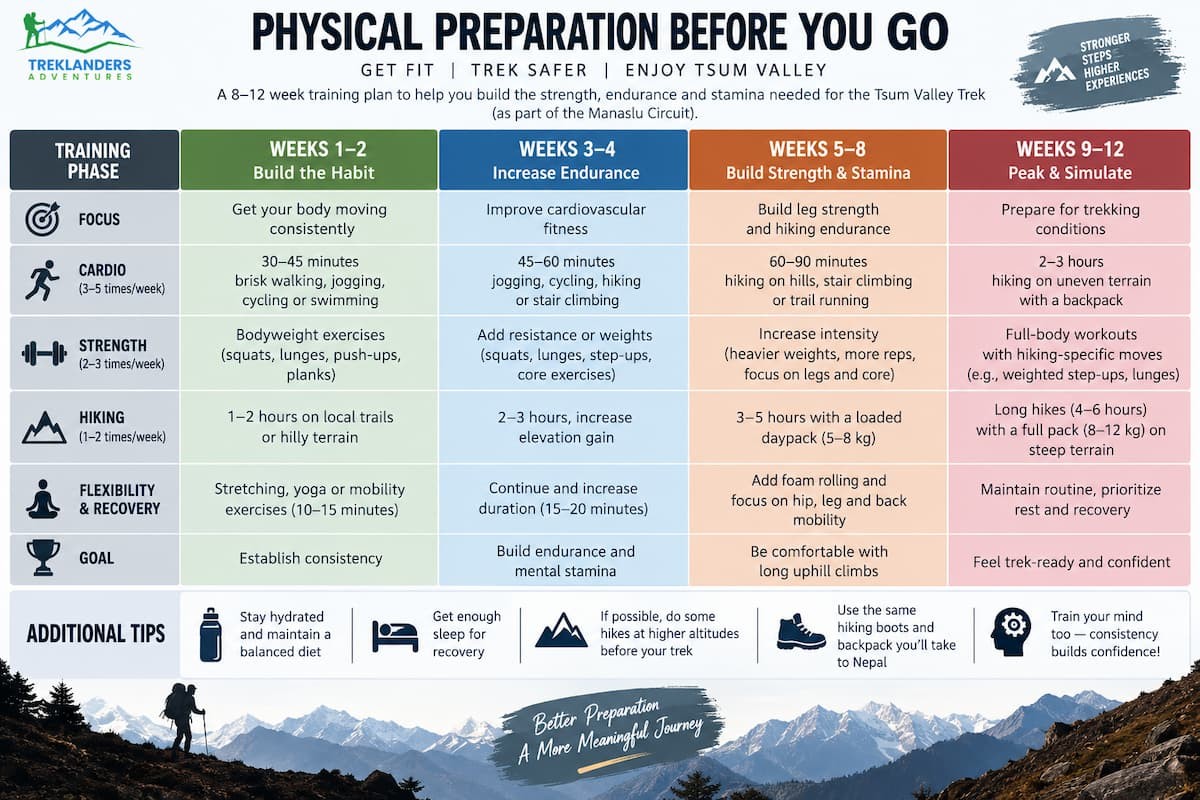
You don't need to be an elite athlete to complete this trek, but you do need a real base of cardiovascular fitness and some experience carrying a loaded pack over multiple consecutive days. Most of the difficulty here comes from sustained effort day after day rather than any single brutal climb, so training your endurance matters more than training your maximum strength.
Start building fitness at least six to eight weeks before you fly to Kathmandu. Regular hiking, especially on hilly terrain with a weighted daypack, does the best job of preparing your body for what's ahead, since it trains the exact muscles and joints you'll rely on for hours of daily walking. Stair climbing, cycling, and running all help build the cardiovascular base you'll need, particularly once you're walking at altitude where every exertion feels harder than it would at sea level.
If you have access to a StairMaster or a local hill with real elevation gain, use it. Simulating the up-and-down rhythm of Himalayan trails does more for your preparation than flat treadmill miles. And if your itinerary continues past Tsum Valley toward Larke Pass, take your training seriously enough to include at least a few long days, six or more hours of continuous walking, so your body has some idea what a demanding trekking day actually feels like before you're doing it at 4,000 meters with less oxygen to work with.
Mental preparation matters just as much. Tsum Valley asks you to accept slow Wi-Fi, basic facilities, and long stretches without contact with home. Trekkers who arrive expecting an adventure rather than a resort tend to enjoy the experience far more than those who spend the trek frustrated by what the valley doesn't offer.
Tsum Valley sits inside a restricted area, which means you can't simply show up with a Nepal visa and start walking. The permit system here exists to protect a culturally sensitive, ecologically fragile region, and it's enforced at checkpoints along the route.
The core document is the Tsum Valley Restricted Area Permit, issued specifically because the valley's proximity to the Tibetan border and its preserved culture warrant special protection. You can only obtain this permit through a registered trekking agency in Nepal, and solo trekking without a licensed guide isn't allowed here. You'll also need at least one other trekker in your group, since independent solo permits aren't issued for restricted areas like this one.
Because the trail also passes through the broader Manaslu region, you'll need the Manaslu Restricted Area Permit as well, which covers the section of trail from Jagat onward. Layered on top of these restricted-area permits is the Manaslu Conservation Area Permit (MCAP), which funds conservation and community development work in the region and applies for the full duration of your trek.
If your itinerary continues past Tsum and Manaslu toward Besisahar, as most combined trips do, you'll also need the Annapurna Conservation Area Permit (ACAP), since the final stretch of trail technically falls within that conservation zone.
All of these permits need to be arranged in Kathmandu before you set out. Trekking agencies handle the applications and fees, but you'll want to have your passport and passport photos ready in advance, since the paperwork gets processed as a batch before departure. Checkpoints at Jagat, Lokpa, Samagaun, and Besisahar verify these permits along the way, so keep the originals on you throughout the trek rather than leaving them packed away in your main bag.
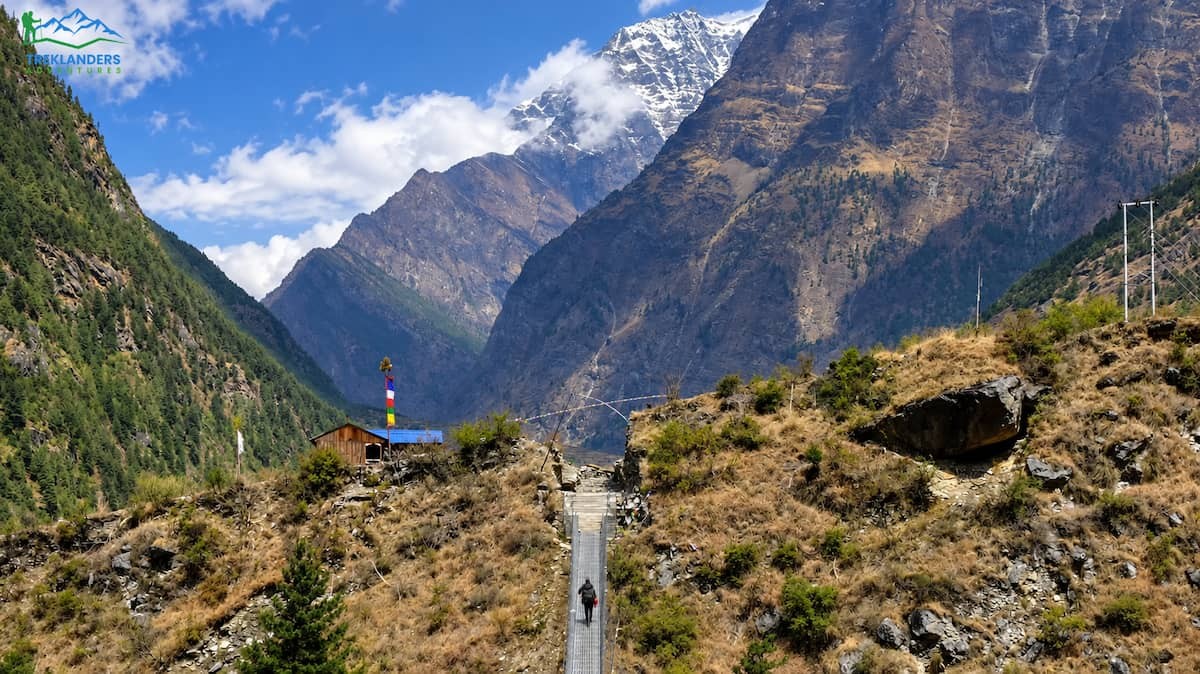
Tsum Valley Trek falls into the moderate to challenging category, and the difficulty comes less from technical climbing and more from sustained days of walking, remote terrain, and altitude exposure. If your itinerary continues to Larke Pass, that difficulty rating climbs further, since you're crossing a 5,106-meter pass with no possibility of quick evacuation if something goes wrong.
Altitude sickness is the health issue you need to take seriously here. Once you cross above 3,000 meters, which happens fairly early in the Tsum Valley section, your body has less oxygen to work with, and pushing too hard too fast increases your risk of Acute Mountain Sickness. Symptoms include headache, dizziness, nausea, and loss of appetite, and ignoring early signs can turn a manageable situation into a dangerous one. The standard advice holds here as much as anywhere: walk at a steady pace, drink enough water, and tell your guide immediately if you start feeling off, rather than pushing through and hoping it passes.
If your route includes the full Manaslu Circuit, the built-in acclimatization day in Samagaun exists precisely to give your body extra time to adjust before the final push toward Larke Pass. Skipping or rushing that day is a common mistake among trekkers eager to keep moving, and it's rarely worth the risk.
Beyond altitude, the terrain itself demands respect. The lower Budhi Gandaki section runs through landslide-prone gorge terrain, especially right after monsoon season, and river crossings on narrow suspension bridges require careful footing. Good, broken-in hiking boots with ankle support matter more here than on flatter, more established trekking routes. Weather near Dharmasala and around any high-pass crossing can shift quickly, bringing sudden wind, cold, or snow even during the more stable trekking seasons.
Medical facilities along the trail are minimal to nonexistent once you're past the lower villages. If something serious happens at altitude, evacuation likely means a helicopter, weather permitting. That reality makes comprehensive travel insurance, one that specifically covers high-altitude trekking and emergency evacuation, a non-negotiable part of your preparation rather than an optional add-on. Check the altitude ceiling on your policy carefully, since many standard travel insurance plans stop covering you above 4,000 meters, which won't help you if Larke Pass is part of your route.
Trekking with a licensed guide, which the restricted area permits require anyway, adds a real layer of safety. Guides working this region are trained to recognize early signs of altitude sickness, manage checkpoint logistics, and adjust the day's plan if weather or health concerns demand it.
What sets Tsum Valley apart from most other trekking regions in Nepal isn't just its remoteness. It's the fact that the culture you encounter here hasn't been shaped around tourism the way parts of the Everest and Annapurna regions have.
Tibetan Buddhism runs through daily life in Tsum in a way that's hard to fully appreciate until you're walking past your third mani wall of the morning or hearing monastery bells carry across a valley at dawn. Villages like Chumling, Lama Gaun, and Chhekampar have preserved architecture, farming practices, and religious customs that trace back centuries, largely because outside influence simply couldn't reach this valley until relatively recently.
Mu Gompa functions as the spiritual heart of the region, but it's far from the only religious site worth your attention. Rachen Gompa, a working nunnery lower in the valley, offers a different window into local religious life, and the caves associated with Milarepa, the wandering yogi whose meditation retreats are woven into local legend, add a layer of pilgrimage history to the physical landscape you're walking through.
Locals here descend largely from Tibetan lineage and speak a dialect closely related to Tibetan rather than Nepali. You'll notice this in the prayer flags, the specific style of chortens along the trail, and in small daily rituals, like the way villagers spin prayer wheels as they pass, that reflect a lived faith rather than a performance staged for visitors.
None of this means Tsum Valley exists as some kind of frozen relic. Life here changes too, slowly, and the earthquakes of 2015 caused real damage to villages and monasteries throughout the region. What you'll see now reflects both the resilience of these communities and the ongoing work of rebuilding, which makes walking through Tsum feel less like visiting a museum and more like witnessing a place that's still very much alive and adapting.
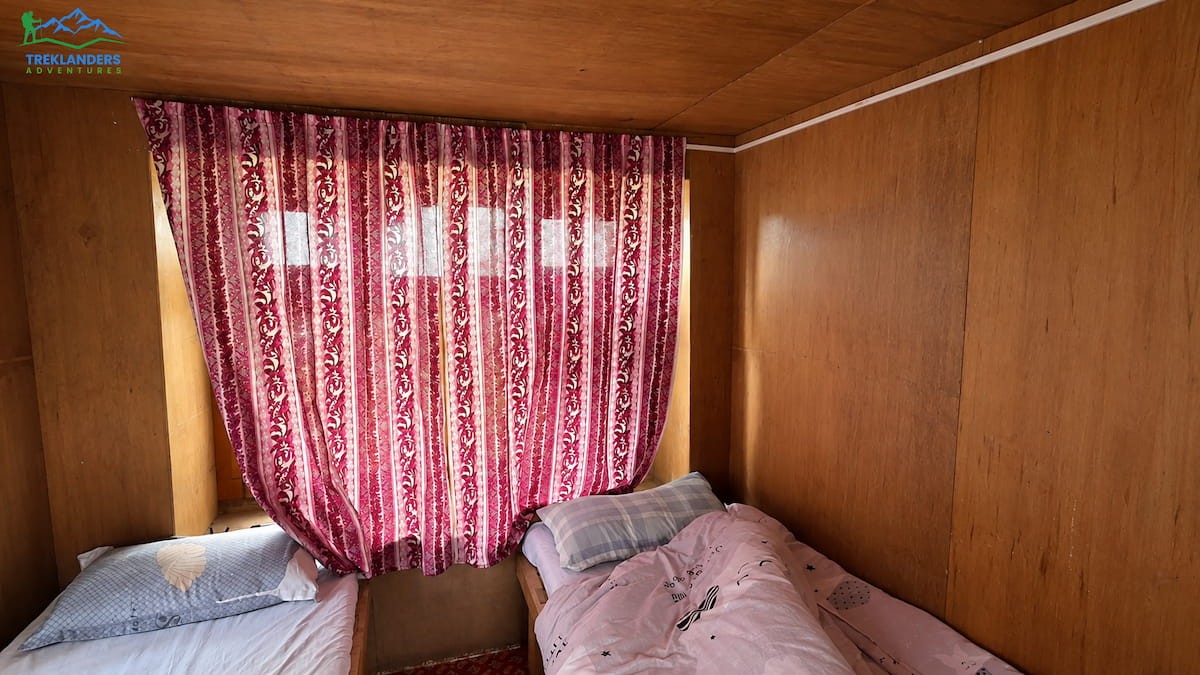
Don't expect luxury here, and that's largely the point. Accommodation on the Tsum Valley Trek runs through family-operated teahouses and lodges, mostly built from stone or timber, offering simple twin-sharing rooms with a mattress, pillow, and blanket. Comfort levels shift as you gain elevation. Lower villages like Jagat and Chumling offer relatively comfortable stone or wood lodges with warm communal dining rooms, while accommodation gets more basic the closer you get to Mu Gompa, where resources are harder to bring in and the climate turns harsher.
Shared bathrooms are standard almost everywhere, and hot showers, where available, usually cost extra. Electricity typically comes from solar panels, so charging your phone or camera might mean paying a small fee or simply waiting your turn. Wi-Fi is patchy at best and often absent entirely in the more remote villages, which for many trekkers turns into an unexpected highlight rather than an inconvenience.
Meals follow a familiar teahouse pattern across the trail: dal bhat, noodles, fried rice, soups, momos, Tibetan bread, eggs, and porridge, prepared fresh from locally available ingredients. Dal bhat remains the trekker favorite for good reason. It's filling, it's usually available for a second helping at no extra cost, and it delivers the carbohydrates and protein your body needs after a long day of walking at altitude. As you move deeper into Tsum and closer to Mu Gompa, menu variety narrows since supplies have to be carried in over greater distances, but you'll still find warm, adequate meals throughout.
Drinking water comes from natural sources, village taps, and teahouses, and it should always be treated before you drink it. Purification tablets, drops, or a portable filter work well, and most teahouses will also sell you boiled water for a small fee, which counts as one of the safer options in colder areas. Aim for 3 to 4 liters a day, since proper hydration plays a real role in how well your body handles the altitude.
If you follow a vegetarian diet, you're in good company here. Vegetarian meals are widely available and often recommended at higher elevations anyway, since the lack of reliable refrigeration makes meat quality harder to guarantee the further you get from the nearest road.
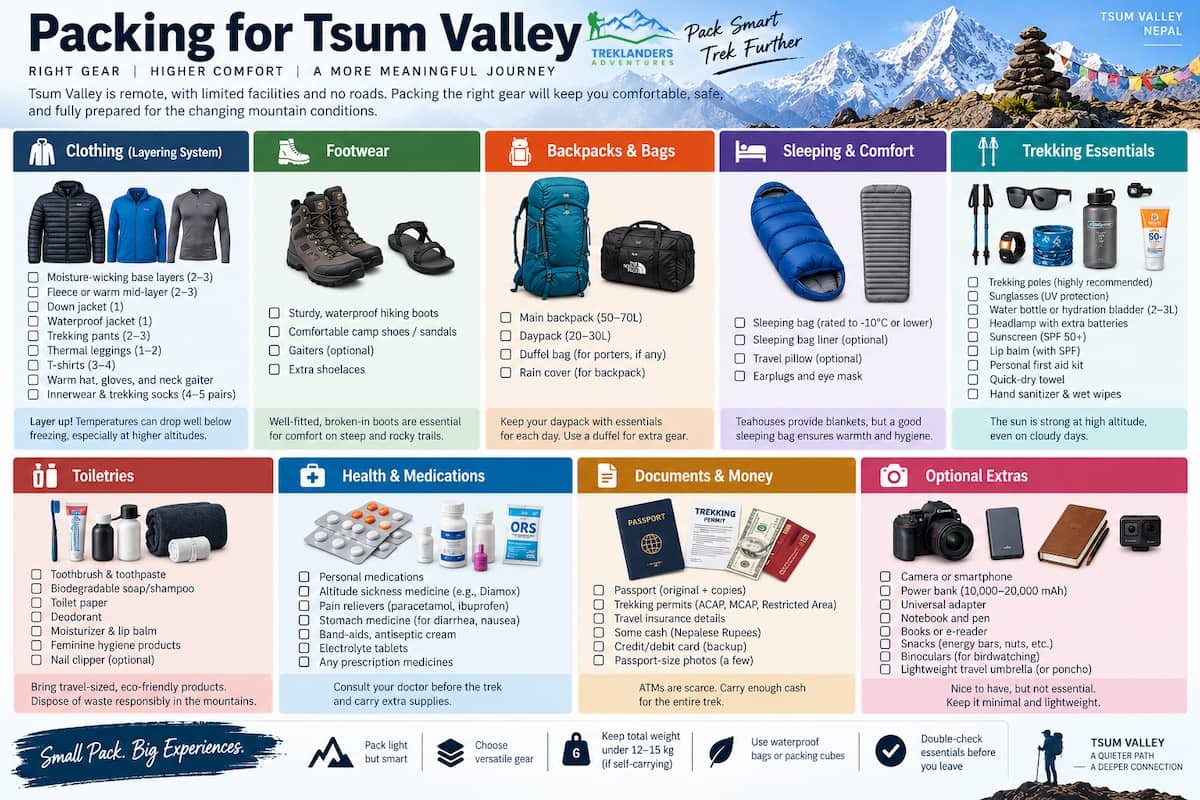
Layering is the single most important packing principle for this trek, since you'll move through everything from subtropical river valleys to alpine terrain approaching 4,000 meters, sometimes within the same day.
Start with moisture-wicking base layers, both tops and bottoms, made from synthetic fabric or merino wool. Add a mid layer for insulation, typically a fleece jacket, along with a lightweight down or synthetic insulated jacket for colder mornings and evenings. Over that, you'll want a proper waterproof, windproof outer shell, both jacket and pants, along with a heavier down jacket for the coldest stretches if your route pushes toward higher elevations.
For your feet, invest in sturdy, waterproof trekking boots with ankle support, and make sure they're broken in well before you arrive in Nepal. Blisters on day three of a multi-week trek can genuinely derail your trip. Pack two or three pairs of good trekking socks along with a thicker pair for colder nights, and bring lightweight camp shoes for evenings at the teahouse.
Trekking poles make a real difference on the steep, sometimes uneven terrain along the Budhi Gandaki gorge and through the higher sections of the trail, easing pressure on your knees especially on descents. A daypack in the 30 to 35 liter range works well for carrying what you need during the day, while a larger duffel bag handles the rest if you're using porter support.
Don't skip the accessories that seem minor until you need them: a headlamp with spare batteries, a reusable water bottle or hydration bladder, water purification tablets, a warm hat, gloves, and UV-blocking sunglasses rated for high altitude sun exposure. A sleeping bag rated to at least -10°C is worth bringing even though teahouses provide blankets, since nights at elevation get genuinely cold.
For health and hygiene, pack a personal first aid kit with blister treatment, basic pain relievers, and any prescription medications you need, along with sunscreen rated SPF 50 or higher and a good lip balm, since sun exposure at altitude is more intense than it feels. Keep your travel insurance documents, permits, and passport copies somewhere accessible, since you'll need to produce them at checkpoints along the way.
Tsum Valley rewards trekkers who want something beyond scenery, though the scenery alone would justify the trip. What stays with most people afterward isn't just the view from Mu Gompa or the crossing of Larke Pass if their itinerary includes it. It's the sense of having walked through a place that has largely resisted the pull of mass tourism, where daily life still runs on rhythms shaped by geography and faith rather than trekking season schedules.
This isn't a trek to take lightly. The remoteness that makes Tsum Valley special also means limited medical access, real altitude risk, and days of walking with no easy way out if you change your mind halfway through. Preparation matters here more than on some of Nepal's more established routes, from physical training in the weeks before you arrive to making sure your insurance actually covers the altitudes and evacuation scenarios you might face.
For trekkers willing to put in that preparation, Tsum Valley offers something increasingly rare in Nepal: a multi-week journey through genuinely remote terrain and living Tibetan Buddhist culture, without the crowds that now define some of the country's more famous trails. Combined with the Manaslu Circuit and the crossing of Larke La, it becomes one of the most complete Himalayan journeys available, blending cultural depth with high-altitude adventure in a way few other routes manage.
If you're drawn to quiet trails, ancient monasteries, and villages that feel genuinely lived in rather than shaped for visitors, Tsum Valley deserves a serious look. Treklanders Adventures runs this route as part of a guided Manaslu Circuit itinerary, with the permits, logistics, and local guiding handled for you, so your energy goes toward the walk itself rather than the paperwork behind it.
Most trekkers who complete this route describe it less as a checklist destination and more as a shift in how they think about travel in the Himalayas. You come away with fewer photos of famous landmarks and more memories of small, specific moments: a monk's chant carrying across a courtyard at dusk, a shared pot of dal bhat in a stone kitchen warmed by a yak-dung stove, the particular quiet of a valley that most of the trekking world has yet to discover. That's the real case for choosing Tsum Valley over a more famous route. It isn't about avoiding crowds for its own sake. It's about giving yourself the space to actually notice where you are, walk at a human pace, and let a genuinely remote corner of the Himalayas leave its mark on you the way it has on everyone who has walked it before.
Discover which trekking routes in Nepal remain safe and open after the recent floods, and which affected areas travelers should avoid for now.
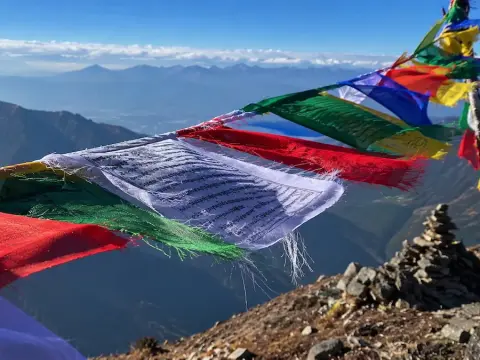
Discover the meaning behind Nepal’s prayer flags and mani walls, and learn the traditions, mantras, and trail etiquette every trekker should know.
Discover the top 5 treks in the Annapurna region and find the perfect route for your Himalayan adventure.



