Everest Three Passes Trek Guide: The Ultimate Next Adventure After Everest Base Camp
23 Jun 2026
Completed Everest Base Camp? Cross Kongma La, Cho La, Renjo La, and explore the stunning Gokyo Lakes on Nepal's ultimate trekking circuit.

Most trekkers who look at Upper Mustang immediately reach for spring or autumn dates. The reasoning is obvious: stable weather, open lodges, and temperatures that make long walking days manageable. Spring brings April and May sunshine over the canyon formations. Autumn delivers October clarity with sharp views of the surrounding Himalayan peaks. Both seasons work well, and logistics are predictable.
But a growing number of experienced trekkers are asking a different question. They want to know what December, January, and February actually look like on the ground in this high-altitude desert. They want to know what remains standing when the crowds disappear, and the villages go quiet. They are specifically looking for an Upper Mustang experience without other trekking groups on the trail, without the seasonal pressure on lodge beds, and without the noise that comes with any destination in its busiest months.
This blog gives an in-depth report of winter trekking in Upper Mustang. The risks are not a myth, and this is one side of the story. The blog tells us about the scenery, the arrangements, the historical places, and the sort of experience you cannot find elsewhere, since only a couple of people come to the area. Treklanders Adventures organizes the Upper Mustang Trek as a 17-day itinerary from Kathmandu, which is the route to Kagbeni, Chusang, Samar, Ghiling, Tsarang, and Lo Manthang. All the information in this guide is based on what that route really looks like during the off-season months.
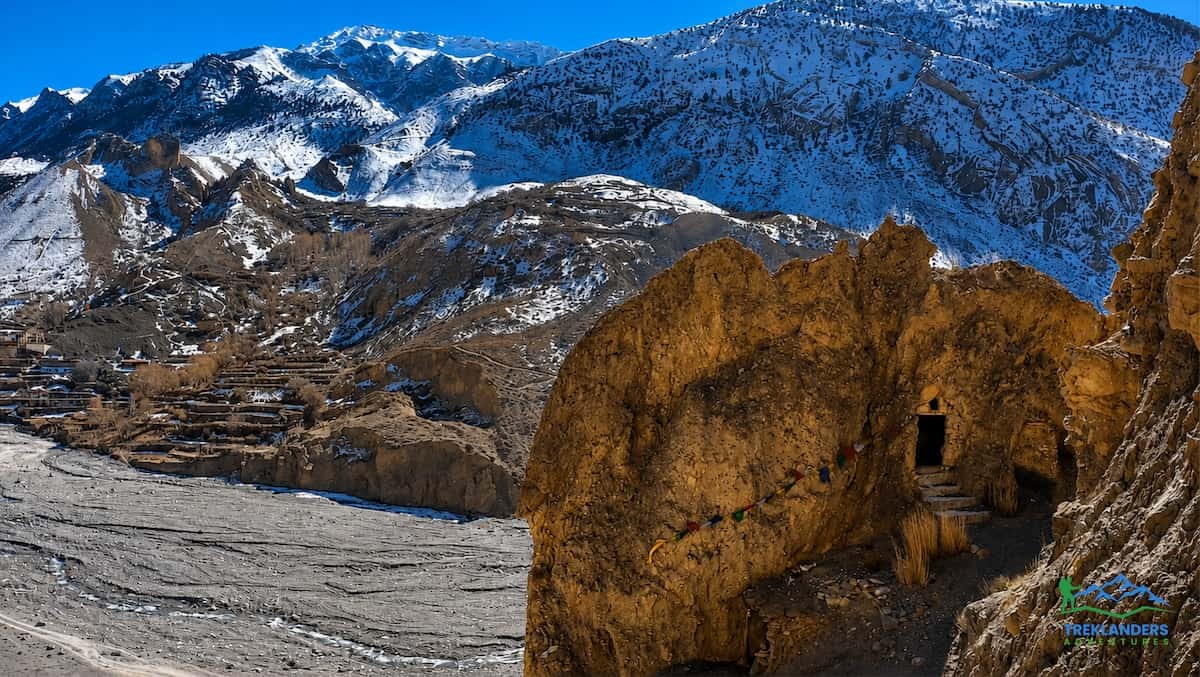
Upper Mustang lies in a trans-Himalayan rain shadow. The Himalayas act as a barrier to the monsoon clouds that bring heavy rainfall to the rest of Nepal from June to August, and it is these mountain features that also produce a different winter climate. The area is dry throughout the year, with almost desert-like scenes that look nothing like the forested mountain ridges or snow-bound passes that cover most of the Himalayan region.
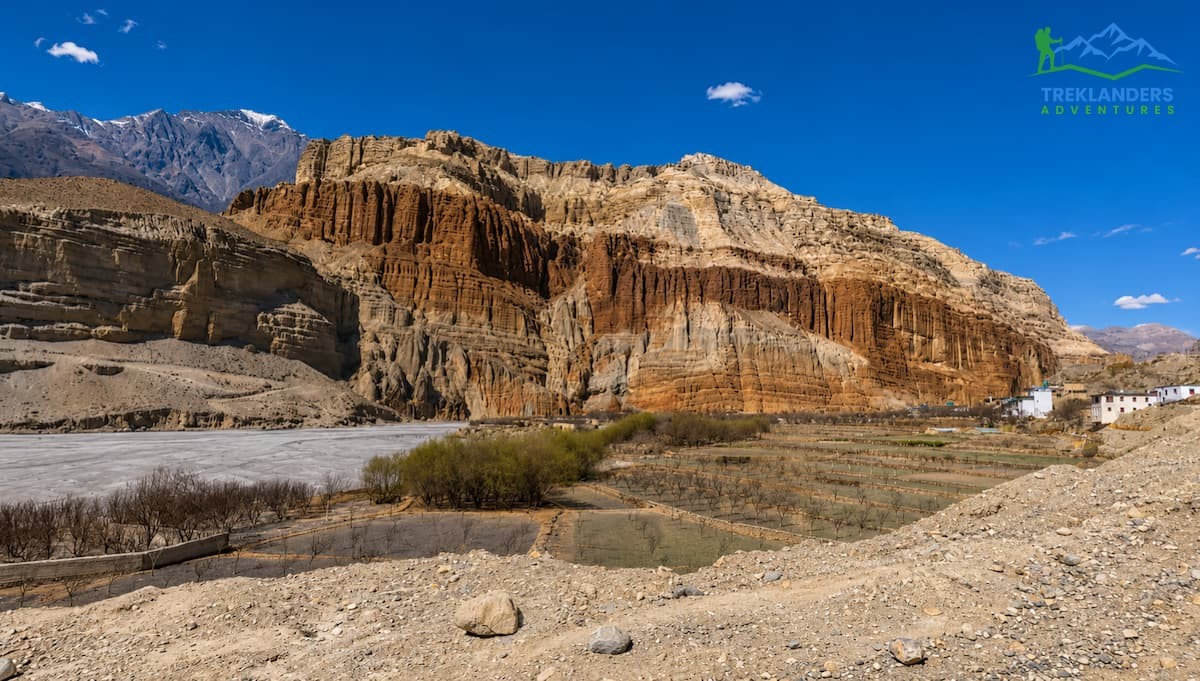
This is what makes winter so critical when the main danger on most Himalayan treks becomes heavy snowfall closing mountain passes, making trails wet, and creating conditions that range from difficult to very dangerous. Mustang Upper won't be affected that way. Rain is hardly ever produced during the whole year. What winter brings is cold and dry air and strong winds during the day that rise, especially in the afternoon; at night, the temperatures drop dramatically. The land itself remains open. Paths continue to be there. The well-known red and brown canyon features near Chusang and the huge, windswept plateau leading to Lo Manthang are certainly not covered by several meters of snow, just like the trails in the Everest or Annapurna high routes.
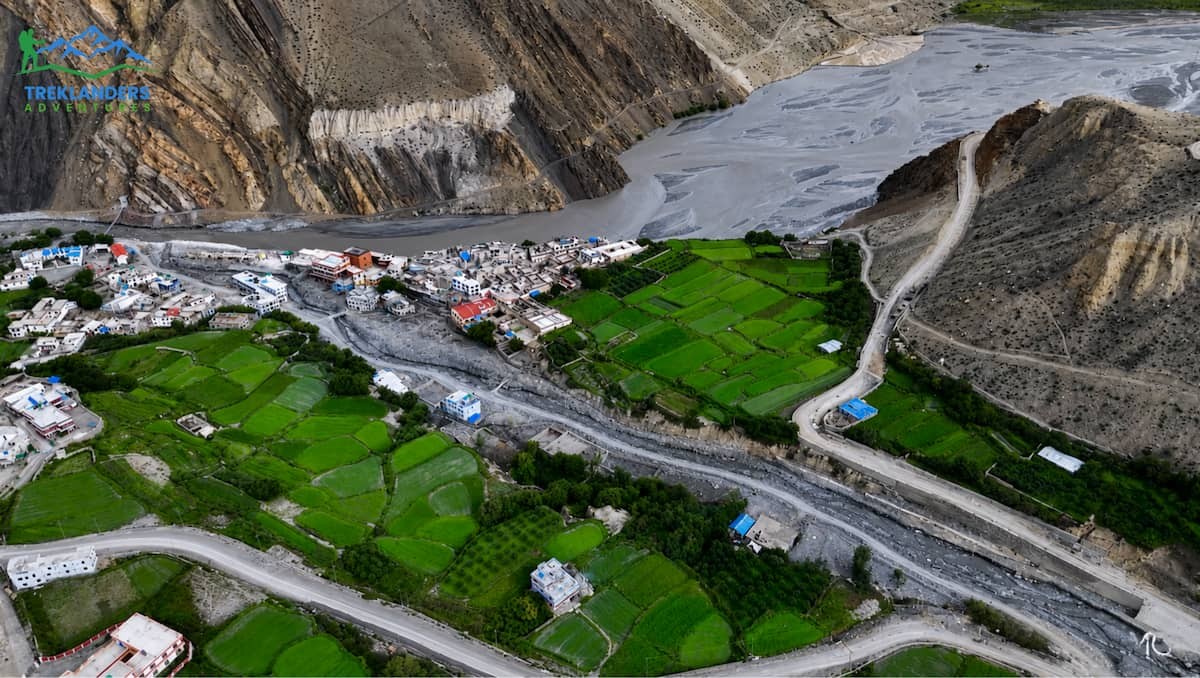
The maximum elevation on the Treklanders Upper Mustang itinerary is 3,950 meters at Nyi La pass, the highest point of the route and the spot that delivers the most expansive panoramic views of Mustang's plateaus and peaks. For comparison, Thorong La on the Annapurna Circuit reaches 5,416 meters and is closed for much of winter. The Renjo La and Cho La passes in the Everest Three Passes circuit go to over 5,300 meters and becomes dangerous or impassable. Upper Mustang stays below 4,000 meters for the entire route. That elevated ceiling changes the winter calculus significantly. Altitude sickness risk stays lower, and the physiological stress of sustained cold at extreme altitude is absent.
The region is a restricted area, and that status applies regardless of season. All trekkers need a Special Restricted Area Permit and must travel with a licensed trekking company and a government-registered guide. Treklanders handle the full permit arrangement as part of the trip package. The restrictions that preserve this region so carefully are in effect twelve months a year, which is part of why the environment remains as intact as it does.
Upper Mustang, set in the lap of the quaint mountain ranges of Nepal, is one of the ancient trans-Himalayan salt trade routes between Nepal, India, and Tibet. The Lobas, the aboriginal inhabitants of the region, and the Thakali people from the lower Kali Gandaki valley have been trading goods across the Tibetan border for centuries. Their long-established trade has contributed to the development of the monasteries, the fortified villages, and the cultural structures which characterize this region as unique among the regions of Nepal. The historical built environment is so ancient and durable that it remains unaffected no matter which month you choose to visit.
The severe winter cold of Upper Mustang should be the first thing you understand before anything else. You can expect temperatures of 0 to 8 degrees Celsius during the day in areas above 3, 000 meters in elevation. Nighttime temperatures usually fall within the range of -15 to -20 degrees Celsius. These figures do not allow a lot of margins for light packing, casual preparation, or the idea that you can make it with the same gear that worked during the warm season.
Besides the cold, the daytime wind is another difficulty, and in some ways, it is the one that is more unrelenting. Even in spring and autumn, Mustang is strongly, constantly, and powerfully windy. Kali Gandaki Valley is not only a beautiful place to visit, but also one of the windiest corridors in the world. It is well known that strong gusts regularly appear in the afternoon and force cold air into any holes in your clothing system. On top of that, in winter, those winds are even stronger. Going against that headwind on a January afternoon at an altitude of 3 500 meters on an exposed ridge can be a real physical challenge that requires careful preparation to prevent one from getting cold too fast.
It is common to start your walking day early on this route, no matter what season you are travelling in, but in winter it becomes mandatory. Leaving before 8 am ensures you finish the more open parts of the route while the air is still calm. Usually, the wind gets stronger from midday to late afternoon. Arriving at your overnight stop before the gusts of wind become strong in the afternoon is simple winter route management, and any good guide will plan the day accordingly.
Snowfall does happen in winter in Upper Mustang. Treklanders' report on the area indicates that snow can fall at any time of the year, but winter is the season when it occurs most often. Snowfall in the vicinity of Lo Manthang can cause road sections and high passes to be closed. A 4WD vehicle is able to deal with most road conditions, but sometimes experienced drivers will even decide to wait for better conditions before continuing. It is quite normal to build one or two days of flexibility into the schedule when doing winter trips. Trekkers who have fixed departure dates and are not able to extend their trip in any direction are advised to take this into consideration in their expectations.
One genuine and significant advantage winter delivers is sky clarity. The air is dry and free of the dust and haze that accumulate in summer heat and can soften views even in the popular October season. In winter, the views of Dhaulagiri, Nilgiri, Tukuche Peak, and the mountain ranges visible from the higher sections of the route are extraordinarily sharp. On a clear January morning before the wind builds, the visibility from Nyi La or from the high ridges above Ghiling extends to peaks that feel impossibly close and detailed.
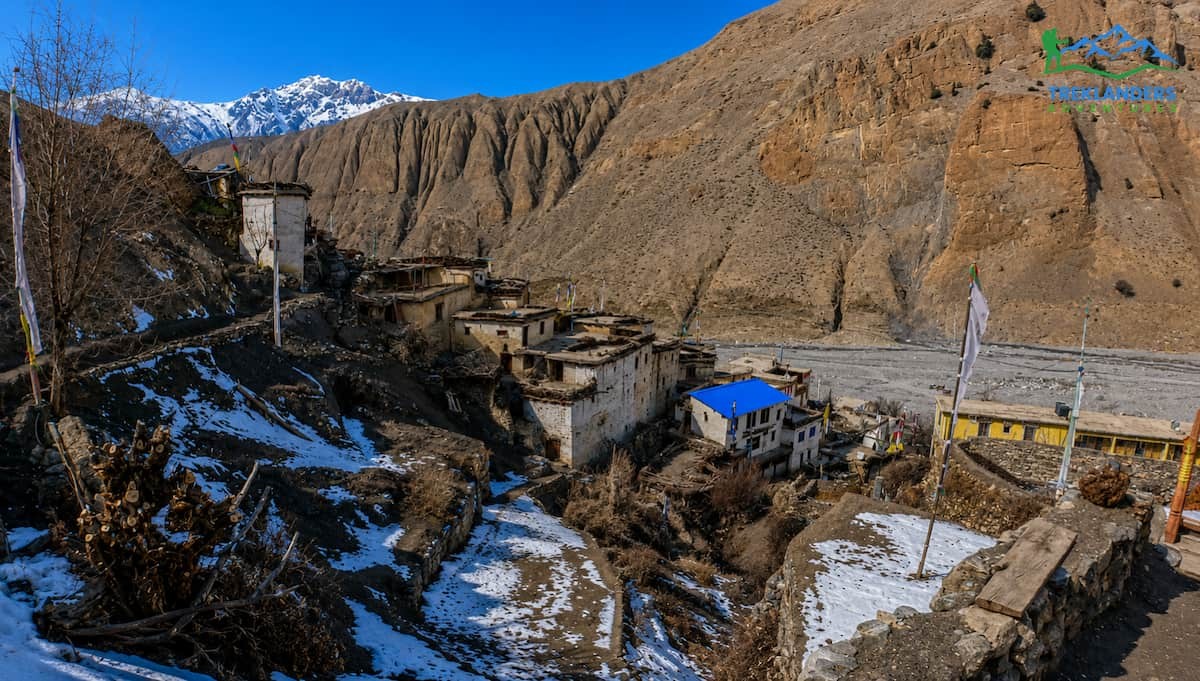
It's important to talk frankly about this point because it really is the main logistical fact about doing a winter Upper Mustang trek. About the Lobas -- the native people of Upper Mustang -- it's well-known that they have been following a migratory pattern for the changing seasons for hundreds of years. At the beginning of winter, most of the population moves to the lower, warmer regions. By November, the majority of villages and lodges along the trekking route are starting to close. This is not a little inconvenience that one can plan around with some time and effort. It implies that the whole teahouse and lodge network, which is able to support the trekkers so effortlessly in spring and autumn, practically disappears.
While on the lower part of the trek route, Jomsom and Kagbeni are the places that will most likely always offer some facilities even during the off-season. Actually, Jomsom is the chief town of the Mustang district, and Kagbeni is the village which opens the gate and serves as a transit point for the restricted zone. Both places have lodges that remain open outside the main trekking season to different extents. However, by the time you get further into the restricted area, i.e., Chusang, Samar, Ghiling, Tsarang, and Lo Manthang, it becomes increasingly difficult to find lodges available to you.
A winter trip needs your trekking company to make arrangements far ahead and to have dependable local contacts who can verify what is open. Treklanders manages this via the planning and booking method, but travelers ought to realize that the logistical framework changes in winter. You may be accommodated in the few lodges that keep bare-minimum operations running for the few winter visitors, or you might need camping gear as a fallback for stretches where there is no opening at all. This is a substantially different setting than when trekking in October, as then you can expect a warm dining room and a menu at every overnight stop.
Lo Manthang, the walled capital and the main attraction of the whole route, has the most developed accommodation options inside the restricted zone. The town serves as the administrative and cultural center of Upper Mustang, and a few lodges there are open during winter for the few visitors who make it. However, do not count on this. Checking with your trekking company for a go-ahead is compulsory, not optional.
A sleeping bag rated to -10 or -20 degrees Celsius is not a luxury addition to your pack. It is a core piece of safety equipment. Lodges provide blankets, and in some lodges, there are wood stoves that heat the dining room in the evenings. But the bedrooms in stone teahouse structures at high altitude in January drop to ambient outside temperatures by early morning. A sleeping bag that matches the conditions keeps you warm and allows you to recover properly for the next day's walking.
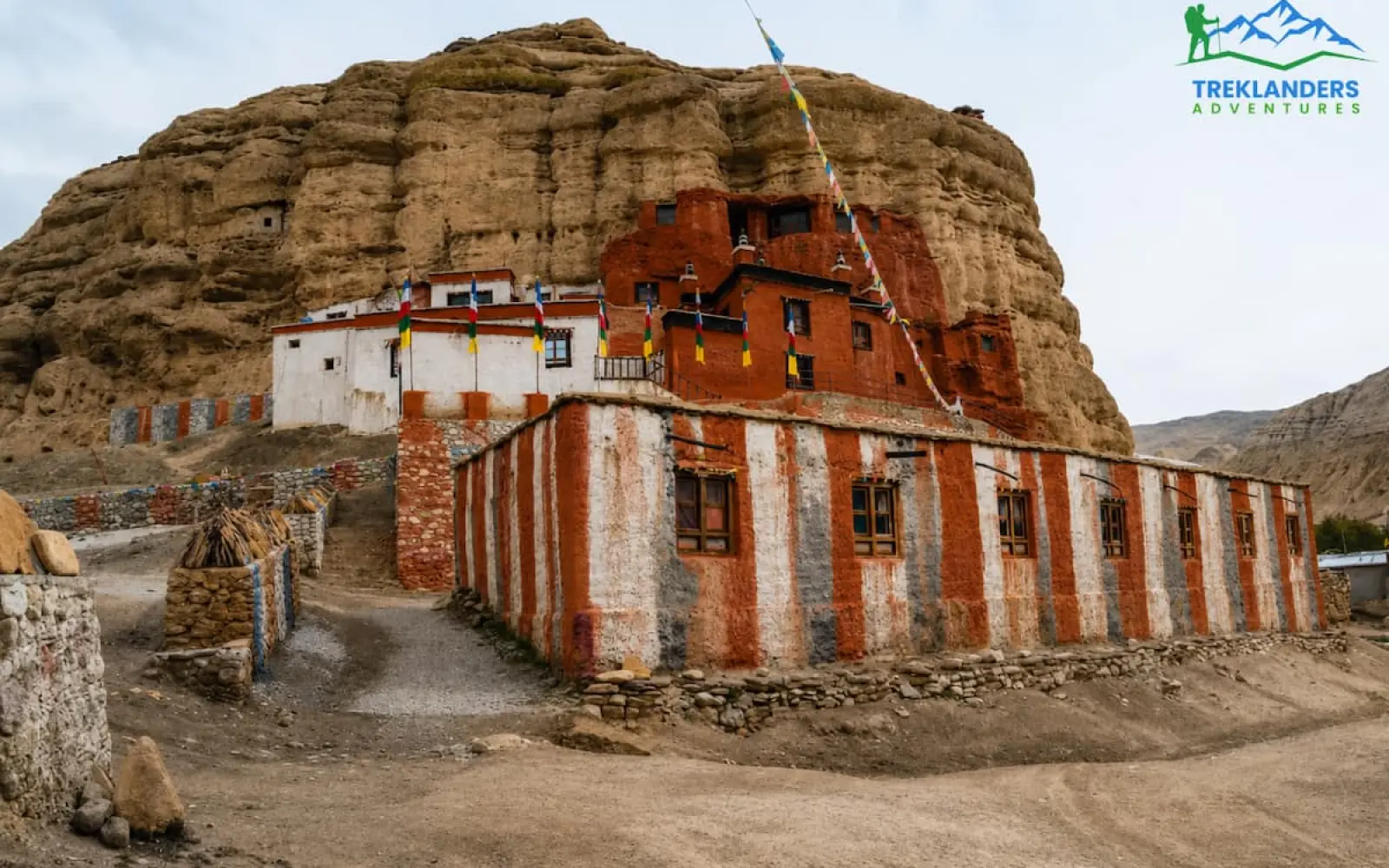
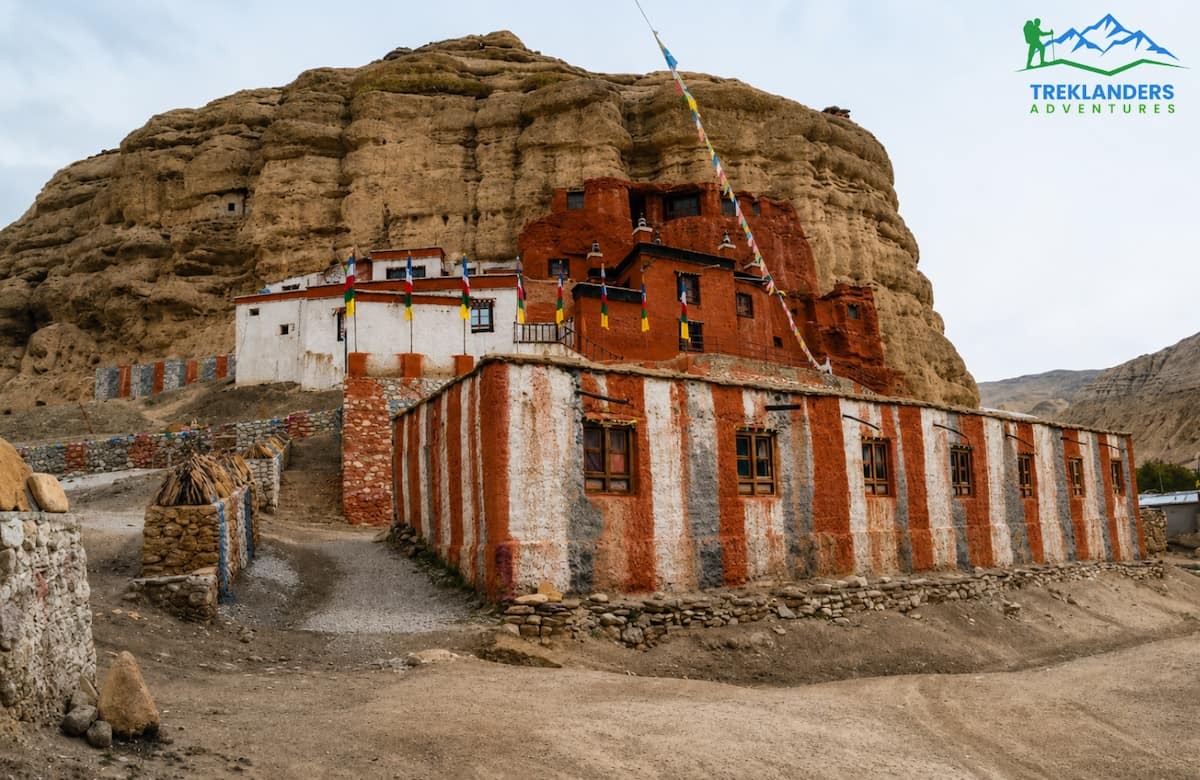
The core visual identity of Upper Mustang is among the most distinctive of any trekking region in Nepal. The eroded red and brown cliffs rising above the Kali Gandaki River between Kagbeni and Chusang, the enormous canyon formations that dwarf the walking trail and stretch for kilometers in every direction, the ancient cave complexes carved into cliff faces above the trail, the Mani walls and Chortens painted in the official colors of the Sakya sect of Tibetan Buddhism, and the medieval walled town of Lo Manthang sitting in a wide plateau basin.
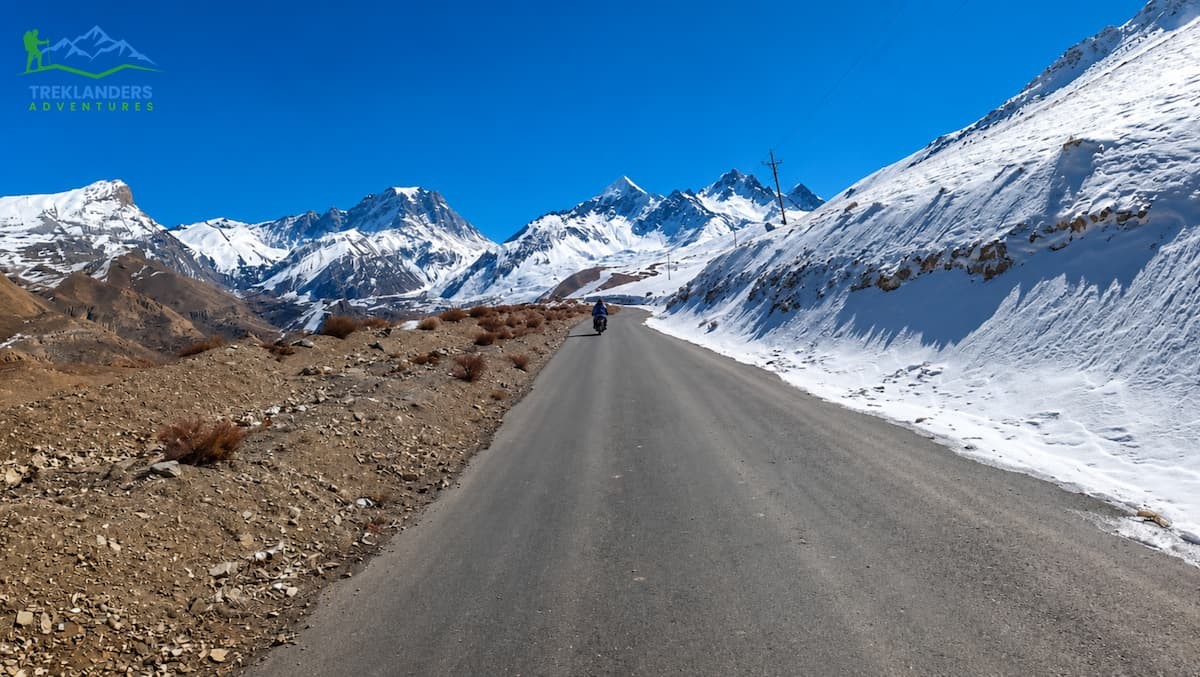
None of that changes with the season. The geology and the built environment are permanent. What winter adds is snow on certain higher sections. Nyi La at 3,950 meters can carry snow in January. The ridges above Chele that climb past 3,500 meters may have icy patches. The high point above Tsarang that leads to the approach of Lo Manthang can be covered. This does not make the route impassable, but it adds technical difficulty that is absent in the other seasons. Microspikes, trekking poles, and the awareness to test footing before trusting it fully are practical requirements on certain sections.
The village scenes greatly change when they are deserted. Ghiling is an especially charming village surrounded by barley fields and buckwheat at the time of the year, which turns into a set of stone houses with only flags for prayers moving in the wind and almost nothing else. The white five-storied Dzong and monastery of Tsarang are located at the edge of the Kali Gandaki gorge, which is extremely quiet. Samar, which is generally a small, hospitable place for an overnight stop, is basically the building only. I guess some people find the absence to be spooky. Some even thought that was exactly why they had come. The buildings and nature have their own significance even without the human activity that usually fills them.
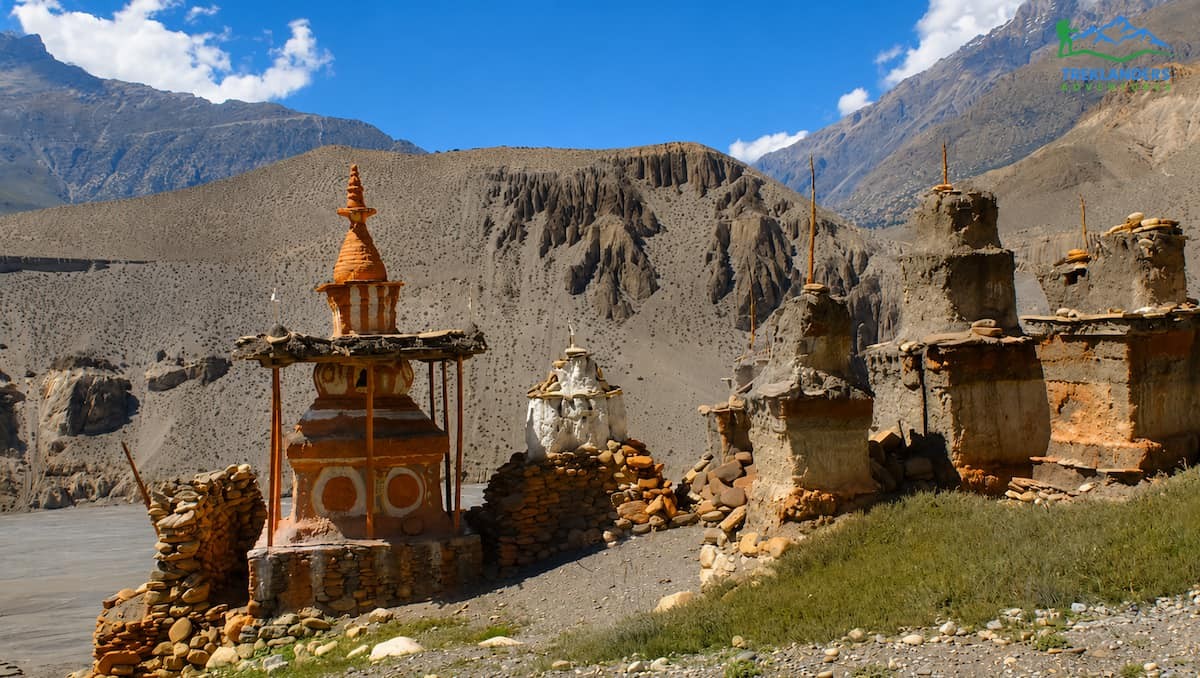
Buddhist religious buildings are not locked. Namgyal Gompa, Champa Lakhang, Thubchen Gompa, and Chyodi Gompa in Lo Manthang are existing and can be used as structures independent of the season. Thubchen is home to some of the most highly regarded Tibetan Buddhist murals and sculptures in the whole region. Whether there will be monks present to open the interior spaces in winter depends on the number of people left. However, the very existence of these monasteries, their walls, their painted exteriors, their location within the walled town, and the plateau landscape they sit within have not been changed.
The sky caves of Upper Mustang, the ancient cave systems carved into cliff faces at height and visible from the trail in the canyon sections between Kagbeni and Samar, are accessible in winter in the same way they are any other time. Reaching the accessible caves requires scrambling and careful movement. In winter, a thin layer of ice on rock faces where meltwater has refrozen demands additional caution, but the caves themselves and the extraordinary cliff formations surrounding them are as visible and dramatic in January as in any other month.
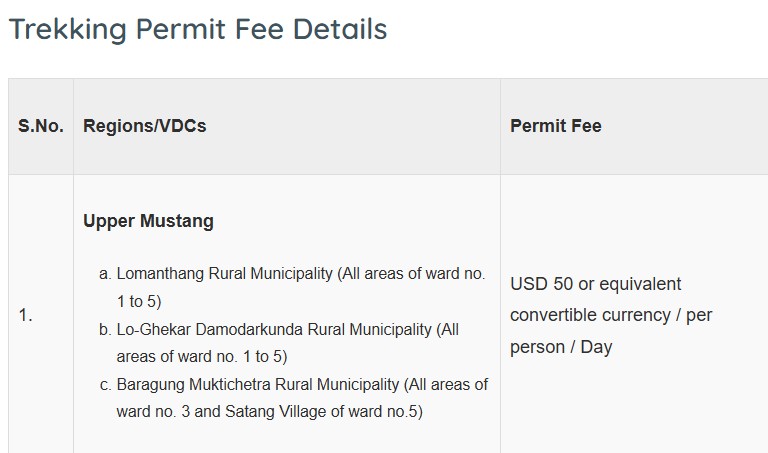
There is no change in the permit system for Upper Mustang with regard to different seasons. Foreign hikers need two types of permits: the Special Restricted Area Permit, which can be obtained through Nepal Immigration, and the ACAP (Annapurna Conservation Area Permit). Both these permits are available only through a government-authorized trekking agency like Treklanders Adventures. To get the restricted area permit, one must have at least one other person (a minimum group size of two), and without a licensed guide, independent trekking in the zone is forbidden.
Packing the permits with the Upper Mustang Trek package by Treklanders means you get the full permit handling done. ACAP permit and Restricted Area Permit paperwork, along with their charges, are taken care of by the company and are part of the package. Trekkers are not involved in managing this process themselves. Before entering the restricted zone, the permits are verified at the Kagbeni checkpoint. This checkpoint is open all year, and anyone without the required documents will be sent back, even if they have travelled a long distance to reach it.
The permit requirement is a measure to protect the region, which is an outcome of a planned policy. To specifically save the cultural heritage and the delicate environment of the former Kingdom of Lo, the Nepalese government controls the number of visitors through the permit system. The monasteries, the painted interiors, the ancient fort structures, and the daily life patterns of the Lobas who remain are all safeguarded to a great extent through the permitting process. Being accompanied by a licensed company and guide is not simply a bureaucratic formality. On the contrary, it is the method through which the area remains safe and unspoiled.
Travel insurance that specifically covers high-altitude trekking is a must for being in Upper Mustang at any time of the year.
Winter emergencies are infrequent, but it is important to be prepared. Getting rescued from inside the restricted area will be a hard task in winter. Flights from Jomsom, the closest airport, are dependent on the weather and can be stopped for several consecutive days due to winter conditions. Travelling by road back to Pokhara will take about eight to ten hours on a good day. Getting an insurance policy that covers helicopter evacuation is a sensible thing to have on this trip; it is not a precaution for extremely unlikely events.
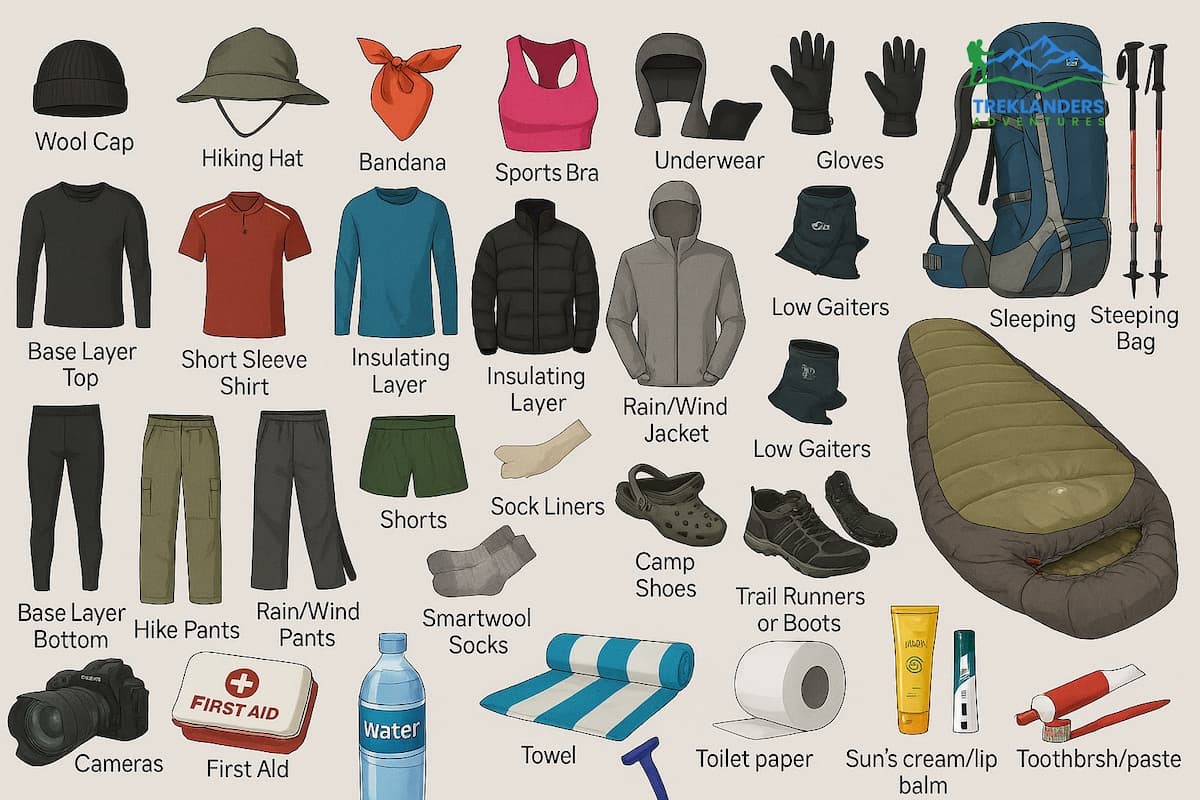
The gear list for Upper Mustang in any season significantly features wind protection and efficient layering due to the Kali Gandaki valley's persistent afternoon gales. During winter, the list gets quite extensive. Wearing the right winter gear versus three-season gear is like the difference between a good day and a bad day, or even a dangerous one, at such low temperatures.
For base layers, merino wool or high-performance synthetic fabric will do. Cotton is not only unsuitable for this trip in any month, but it will be very risky in winter. A mid-weight fleece can be your main insulating layer over the base layer in milder conditions. A lightweight down jacket serves as a second insulation layer for rest breaks and high-altitude sections. The heavy down jacket is a separate item and not a replacement for the light jacket. At minus 15 degrees Celsius at night or on a cold, windy ridge, it is the heavy down jacket layer that will keep you going. All three of these are different articles that correspond to different times of day and different temperature ranges.
Your outer shell needs to be fully windproof and waterproof to a Gore-Tex standard or equivalent. On the exposed ridges above 3,500 meters in January wind, a fleece without a windproof shell allows heat loss fast enough to create a cold injury risk within minutes. Hard-shell waterproof pants serve the same function for your legs. Thermal bottoms under trekking pants provide the base insulation layer.
Gloves require specific planning. Lightweight trekking gloves handle the warmer hours of a three-season trek. Winter in Upper Mustang requires a heavier insulated glove or mitten for exposed sections and ridge crossings. The wind chill at altitude turns temperatures that look manageable on paper into genuine cold injury risk for exposed hands. A neck gaiter or buff, a warm beanie that covers the ears, and UV-blocking sunglasses rated for high altitude complete the face and head protection. High-altitude UV is strong even in winter because of the angle of the sun and the absence of atmospheric moisture to filter it. Sunscreen at SPF 50 or higher is not optional.
Footwear should be able to cope with the frozen ground and the possibility of icy patches. At the very least, you should have waterproof hiking boots with ankle support and good tread on the soles. If you reach areas of ice, microspikes are a great way to ensure safety. Trekking poles give you extra balance on the uneven frozen ground and can also help to relieve joints when walking for a long time. Wool or synthetic trekking socks in 2/3 pairs with at least one pair of heavier mountaineering socks for cold nights and summit sections will round off the footwear system.
Your sleeping bag should be able to handle temperatures of at least -10 degrees Celsius. In fact, spending a night at -15 to -20 degrees in high altitude lodges with no central heating means that a bag with a -20 rating will give you the extra comfort of a nice sleep versus a difficult one. During the day, keep your electronics in inside pockets and at night, keep them in your sleeping bag. Lithium batteries lose their charge very fast when the temperature drops, and in winter in Upper Mustang, a phone or camera that runs out of battery means a lost communication and documentation tool.
The Treklanders itinerary classifies the Upper Mustang Trek difficulty level as moderate to adventurous. Generally, a day consists of five to seven hours of walking on dry, uneven, and always windy terrain. The tallest summit is 3, 950 meters at Nyi La, and mostly, the trek is at an altitude of 2,800 meters in Kagbeni and 3, 780 meters in Lo Manthang. The altitude changes profile means that the risk of severe altitude sickness is much lower compared to treks with high passes, but the physical exertion each day for 12 days of trekking is a fact.
That being said, the physical demand goes up significantly if you go trekking in winter. To keep warm, the body must use more metabolic energy. Each exposed section's wind resistance adds up to the final effort. Frozen ground alters walking mechanics and thus requires more deliberate foot placement. Muscles might react differently to cold, and mornings can be the time when muscles stiffen first until the circulation normalizes. An October five-hour walking day can very well feel like a seven-hour day in January, with the same distance covered but much more energy used.
Two to three weeks of pre-trek training makes a material difference in how your body handles consecutive long days. Regular hill walking, stair climbing, light jogging, and leg-strengthening exercises build the cardiovascular and muscular baseline needed. The goal is not peak athletic conditioning. The goal is that your body is already adapted to sustained low-intensity aerobic effort before the trek begins. Maintaining a steady pace rather than pushing hard and recovering throughout each trekking day is the practical principle that determines how you feel at the end of each section.
Altitude sickness remains a consideration even at the elevations Upper Mustang reaches. Headache, nausea, fatigue, and poor sleep are possible symptoms at Lo Manthang at 3,780 meters and on the approach to Nyi La. The standard protocol applies ascend gradually, do not push through symptoms, drink water consistently throughout the day, and communicate any symptoms to your guide immediately. Treklanders guides are trained in altitude protocol and carry first aid equipment. The route structure through Kagbeni and the gradual daily elevation gain provide reasonable acclimatization before reaching the highest points.
Seasoned trekkers who have previously experienced high altitudes will be at an advantage when it comes to winter Upper Mustang as compared to complete novices. This is not due to the fact that the route is extremely technical, but the winter conditions throw in some factors that call for strong decision-making.
Without any previous high-altitude trekking experience, the usual advice is to do Upper Mustang during the summer or autumn.
Get accustomed to the altitude of 3,500 or 4,000 meters and see how your body reacts. Find out the right layering through the actual field conditions. Then, you may come back in the winter when you are familiar with your own responses.
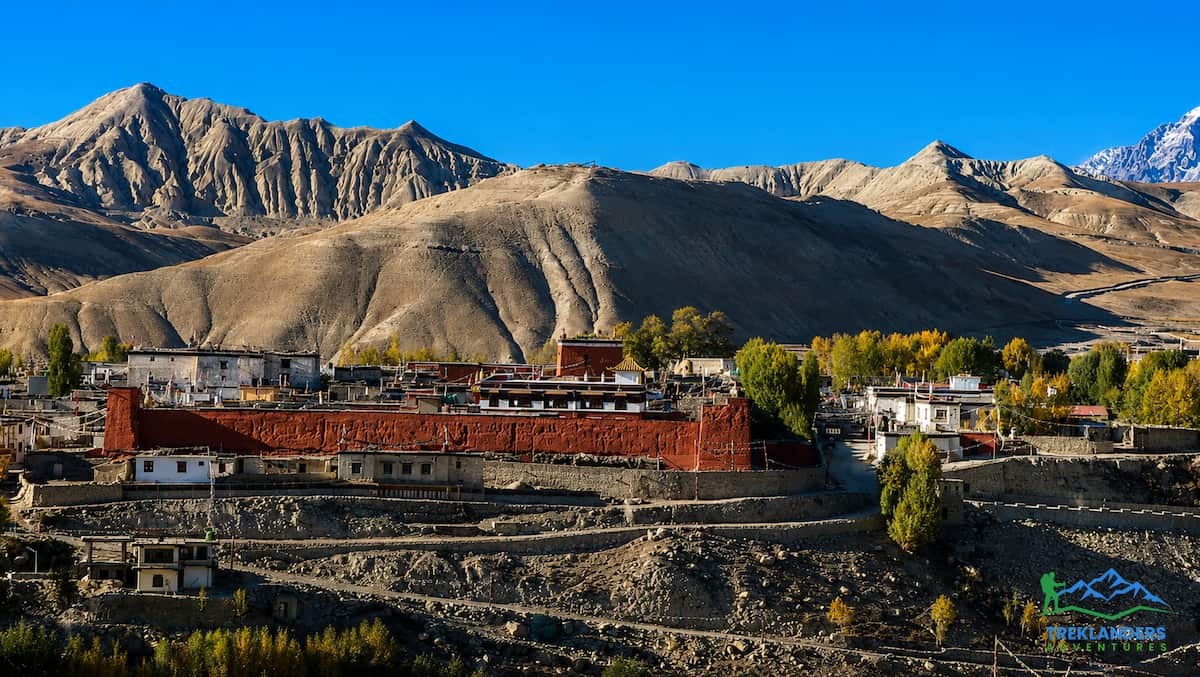
Most trekkers are drawn here for a single reason, namely, Lo Manthang. The ancient walled city that served as the capital of the former Kingdom of Lo is located at an altitude of 3,780 meters on a huge plateau valley close to the Tibetan border. Over 150 houses are grouped inside the walls. The royal family's fort palace, constructed during the medieval period, is located right in the center of the town. The four major monasteries, Namgyal Gompa, Champa Lakhang, Thubchen Gompa, and Chyodi Gompa, have Tibetan Buddhist art and iconography that are several centuries old. Ame Pal, the first king, founded the Kingdom of Lo circa 1380 AD. The last king, Jigme Parbal Bista, reigned up to 2016.
The indigenous people of Upper Mustang, the Lobas, speak a Tibetan language called Loke and closely practice Buddhism that is very much in line with the traditions of their Tibetan ancestors across the border. Lo Manthang's culture is, to some extent, frozen in time, like almost nowhere else in the Himalayan region. The Long Area Permit System is a few restricted, but also the town's geographical isolation has been a limiting factor in the pace of change.
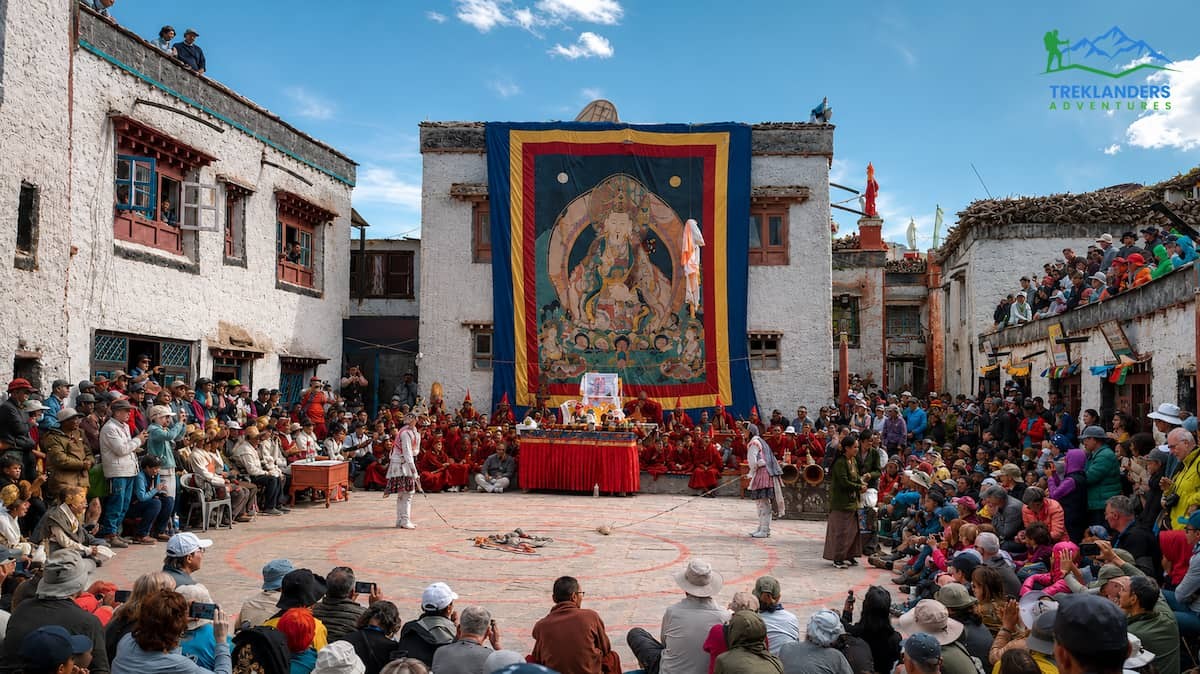
During spring, especially at the time of the Tiji Festival in May, Lo Manthang is buzzing with activity, by Mustang standards that is. Trekking teams, photographers, scholars, and Buddhist devotees gather in the town during the three-day festival. The narrow streets get packed with folks. Monasteries happen to be full of monks, mask dance performances, and rituals. Lodging gets fully booked. Attending the festival is one of the main reasons to visit the Kingdom of Lo, and choosing spring to attend the festival further spices up the decision.
In winter, this scenario completely flips. The streets get deserted. Most of the people who live there have moved to areas at a lower altitude. What is left behind are the buildings, the stone walls standing just like they did centuries ago, the Chortens with their colored patterns, the monastery doorways with their carved frames, and the huge, empty plateau around the town. The Thubchen Gompa, with its murals of Tibetan Buddhism, is physically there. Whether you can get inside is determined by whether monks or caretakers remain at that particular winter. Some years, they do, and the interior is accessible. Other years, it is through local knowledge and the relationships your guide has built over years of operating in this region that you can get the entry.
Trekkers narrate their experience of wintertime arrival at Lo Manthang as if they have reached a medieval town frozen in time. Besides themselves, there are no other tourists. The only sounds are the wind stirring the prayer flags and birds at intervals. For trekkers who have come with the sole purpose of cultural and historical immersion and not for the festival atmosphere, this is not a diminished version of the experience. It is a totally different one, and the majority of those who have been there during multiple seasons actually prefer this one. The architecture displays a different character when unoccupied. You can wander in it without the noise of other groups, without lining up for lodge space, and without the 'performance' that any site gets when a large number of visitors arrive.
Using a winter Upper Mustang trip as a selling point definitely is a journey-type specific one. Only hard-core trekkers with both high skill level and extreme cold gear can do winter travel in the region with little trouble, says Treklanders about winter travel. That is exactly how one may get their bearings and understand the situation. This is not a Himalayan adventure for the first timer, and the reason isn't the technicality of the path, but the fact that cold winter conditions require not only knowledge of gear selection but also good physical fitness, mental calmness to handle uncomfortable days without panic, and good judgement to know when it is time to wait rather than push through.
If you have done other high-altitude treks and know from personal experience how your body reacts to elevation and cold, if you have wintered in other places and have a personal gear system that is working for you, not just a list of items that you are aware of but haven't tested yet, if you are after solitude and raw nature rather than village and teahouse networks that one could get in peak-season, and if you can allow one to three days of weather-related delays at Jomsom or the higher sections of the trek, then you would be a good candidate for a winter trek to Upper Mustang.
Think about switching to spring or autumn if staying at lodge and teahouse is a major part of your physical and mental comfort after days of long walking, if you'd like to see the Tiji Festival at Lo Manthang in May and experience the monastery ceremonies which turn Lo Manthang into a living cultural hub, if this is your first high altitude trek above 3,000 meters and you have not yet figured out how your body reacts, or if your travel schedule is fixed and cannot accommodate changes due to weather.
The months of September and October are considered by many to be the perfect time for the overall Upper Mustang experience. The weather is fairly nice, the temperature is cool but quite comfortable, the lodges are open and have staff, visibility for the mountain views is top-notch, and the villages have a well-functioning cultural life. If it is your first time, autumn is a great choice.
The argument is strong for experienced trekkers who fit the winter profile and can handle the harsh conditions. You will see the whole Upper Mustang landscape, including the canyon formations, the medieval monasteries, the ancient cave complexes, the walled architecture of Lo Manthang, and the Himalayan peaks surrounding the region, which the crisp, clear winter air will reveal to you at its best. Moreover, you will have all these experiences without seeing a single other trekking group on the trail. The restricted area permit system controls the number of visitors even during the peak season, but the winter scenario takes this to a whole new level. You may even be one of those very few foreign trekkers in the entire restricted zone during your whole trek.
Upper Mustang in winter is not like spring in terms of offering warmth and easy logistics. What it does, however, is offer something that the popular months can only dream of. It is a very secluded, ancient, desert landscape which is so deserted, that the Kingdom of Lo, the built history which is standing there exactly as it has for centuries, and the only change is the weather moving in the valley. It is entirely up to you whether trekking off-season is worth it. If what you wanted was to see the landscape and history in their pure, elemental forms and if you have the right skills and equipment to brave the winter conditions, then the answer is yes, it is worth it.
Treklanders Adventures operates the Upper Mustang Trek year-round as a 17-day itinerary. The team handles all permit logistics, guide and porter arrangements, accommodation booking, and ground transportation. For winter departures, advance planning and direct confirmation of accommodation availability are built into the booking process. Contact Treklanders to discuss winter-specific logistics and to plan a departure date that aligns with the best available window within the December to February period.
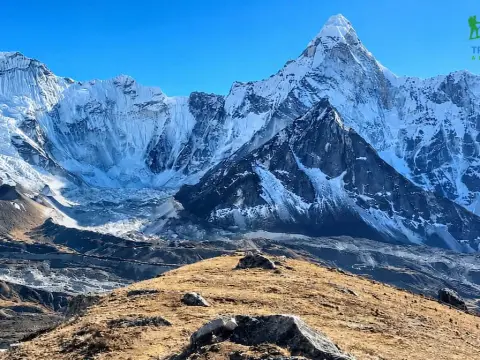
Completed Everest Base Camp? Cross Kongma La, Cho La, Renjo La, and explore the stunning Gokyo Lakes on Nepal's ultimate trekking circuit.
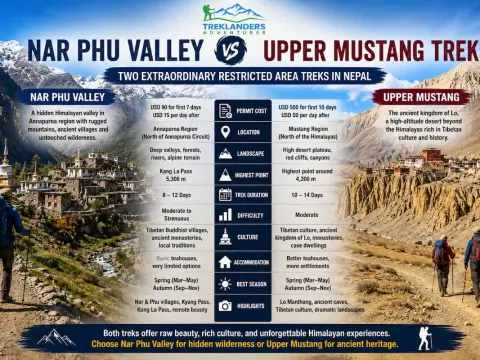
Compare the Nar Phu Valley Trek and Upper Mustang Trek to find the best restricted-area trek in Nepal for your adventure.
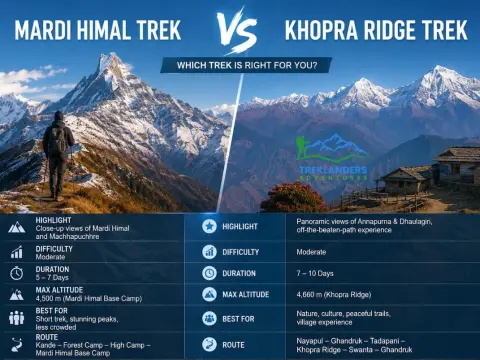
Compare Mardi Himal and Khopra Ridge to choose the best short Annapurna trek for your first Himalayan adventure.



