
Top 7 Less Crowded Treks in Nepal: Best Quiet Trails Away From the Crowds
14 Aug 2026
Discover 7 less crowded treks in Nepal with quiet trails, stunning Himalayan views, remote villages, and authentic experiences away from the crowds.

Yes, Nepal is safe for solo female trekkers. Thousands of women walk the trails to Everest Base Camp, around the Annapurna Circuit, and through the Langtang Valley every year, and the overwhelming majority describe the experience as one of the safest solo trips they have taken anywhere.
That answer needs context, though. Safety in the Himalayas depends on preparation, not luck. The mountains do not care about your gender. They care whether you have the right permits, a licensed guide, proper insurance, and the judgment to turn back when the weather or your body tells you to. Human safety and mountain safety are two different questions, and this guide covers both.
You will read a lot of reassurance online. Some of it is genuine. Some of it comes from trekking companies trying to sell you a package without addressing your real concerns. This guide takes a different approach. It tells you what actually keeps solo female trekkers safe in Nepal, what has changed in the rules since 2023, which regions suit a first solo trek, and what to do before you land in Kathmandu.
Family and friends will ask the same question before you leave, usually with more worry in their voice than the situation warrants. You do not need to argue with them about statistics. You need a clear plan you can point to: a licensed guide, real insurance, a shared itinerary, and a route that matches your experience level. That plan is what this guide gives you.
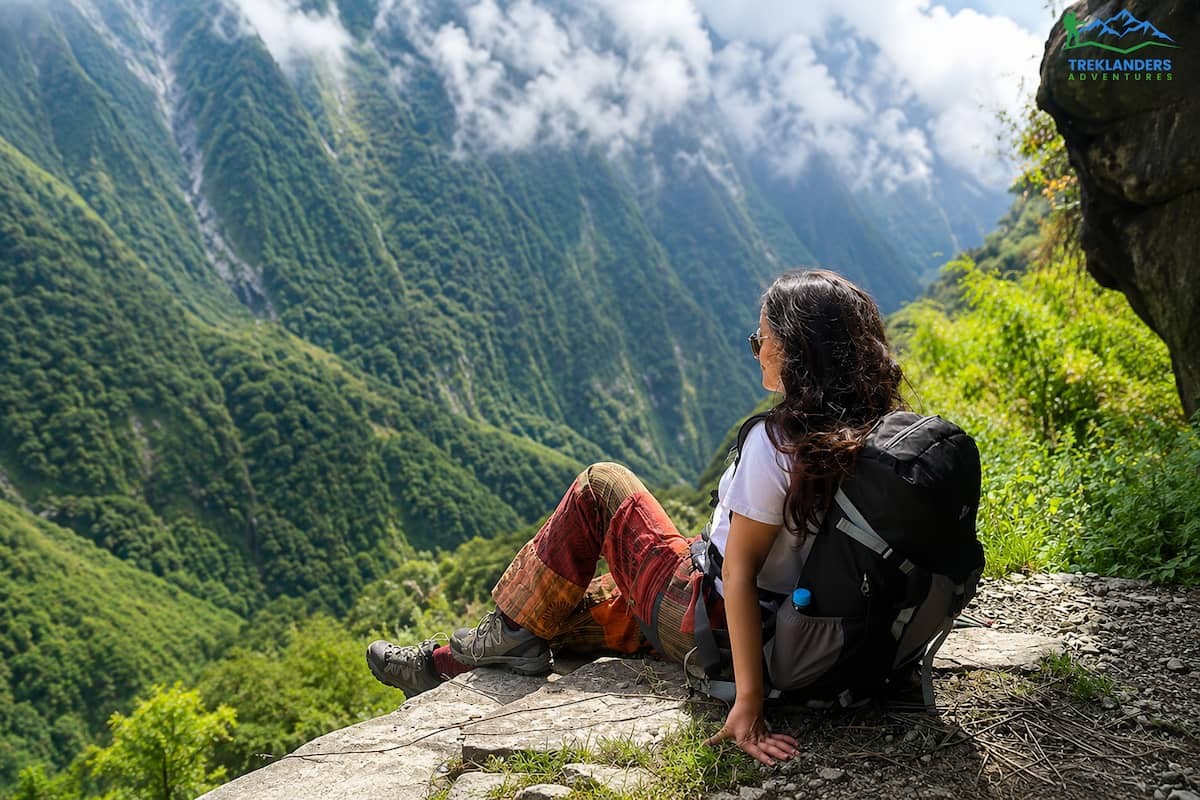
Nepal ranks consistently as one of the safer countries in Asia for women traveling alone. Violent crime against tourists is rare. The culture runs on a concept called Atithi Devo Bhava, which treats the guest as sacred. In practical terms, that means teahouse owners, guides, and porters tend to look out for solo women rather than exploit them. Local economies along trekking routes depend on repeat visitors and good reviews, so guesthouse owners in Pokhara, Namche Bazaar, and Kyanjin Gompa have every reason to protect their reputation.
None of this means you should switch off your instincts. It means the baseline risk from other people is lower than what most first-time visitors expect, and lower than what you would face in many major cities back home.
The bigger risks on a Himalayan trail are not human. They are altitude sickness, sudden weather changes, river crossings, and getting lost on unmarked sections of trail. Search and rescue data from before 2023 showed hundreds of helicopter evacuations every year, and a large share involved solo trekkers who pushed through symptoms of altitude sickness alone, lost the trail in poor visibility, or continued walking after dark. These are risks that affect men and women equally, and they are exactly the risks a licensed guide is trained to catch before they become emergencies.
Ask any experienced Nepali guide what worries them about solo female clients and most will not mention personal safety from other people. They will mention sun exposure, dehydration, blisters that go untreated, and trekkers who skip acclimatization days to keep pace with a schedule. Handle those basics well and you remove most of what could go wrong.
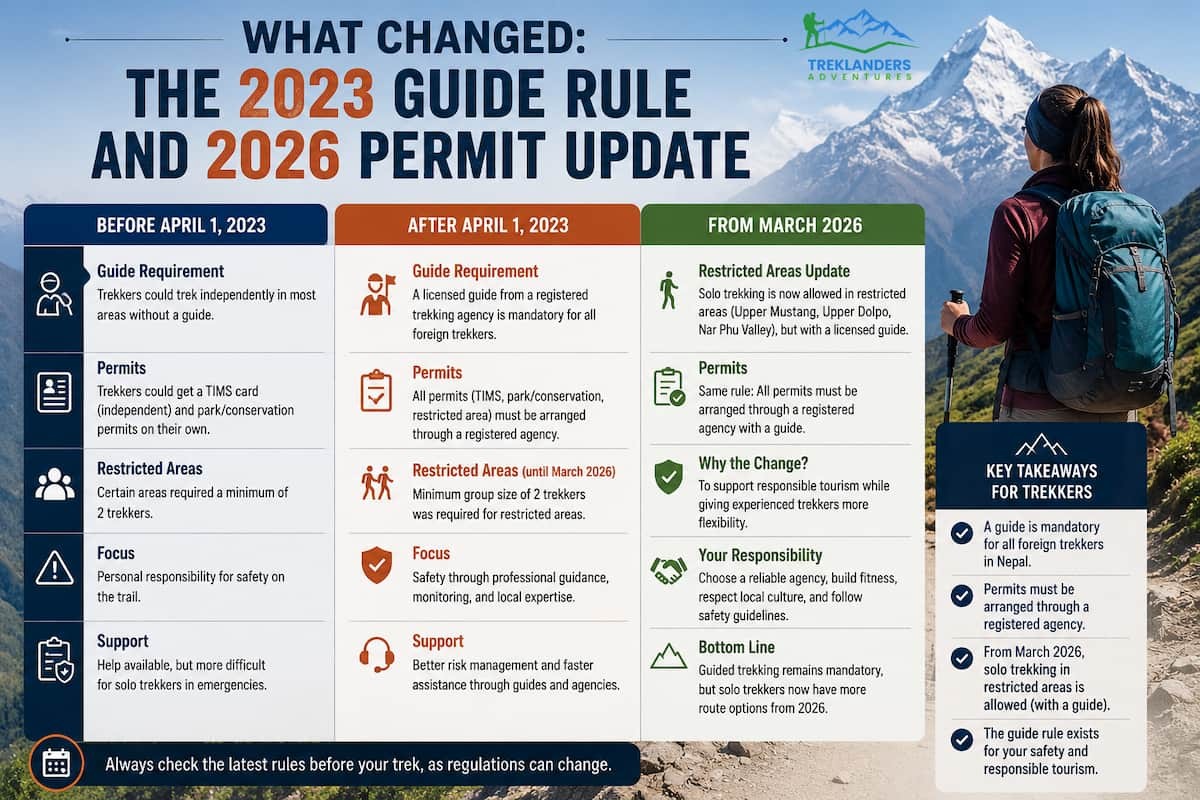
If you read older blog posts about solo trekking in Nepal, some of the information is now out of date. The rules changed in 2023 and changed again in 2026, and the gap between what old articles say and what checkpoints actually enforce can catch travelers off guard.
Since April 1, 2023, every foreign trekker entering a national park, conservation area, or restricted area in Nepal must be accompanied by a licensed guide from a government-registered trekking agency. This applies to men and women, solo travelers and groups. The old system, where you could walk into the tourism office, fill out a form, and buy an independent Green TIMS card, no longer exists for these regions. You now arrange your guide and your permits through a registered agency, and the two are linked.
This was not designed as a restriction on women specifically. It followed years of search and rescue callouts involving unguided trekkers who got into trouble that a local guide would have prevented. A guide reads weather patterns, recognizes early signs of altitude sickness before you do, knows which teahouses are open in the off season, and can make the call to turn back when a client cannot.
For solo female trekkers, this rule works in your favor. You get a trained companion for the trail without losing the independence of a solo trip. You still make your own decisions about pace, rest days, and how much you want to talk to the people around you. You simply do it with a professional who monitors your health and knows the terrain.
The rules shifted again in March 2026. Previously, restricted areas such as Upper Mustang, Upper Dolpo, and Nar Phu Valley required a minimum group size of two trekkers. As of this year, Nepal's Department of Immigration allows solo travelers to apply individually for permits to these restricted regions, provided they still travel with a licensed guide. This opened up some of the country's most remote trekking routes to women traveling without a companion, which was not possible before.
The permit landscape also varies by region. TIMS cards are no longer required in the Everest and Annapurna regions, where a Local Entry Permit and the Annapurna Conservation Area Permit now cover the same function. TIMS remains required in Langtang, the Manaslu region, and parts of far-western Nepal including Rara Lake. A registered trekking agency will handle this paperwork correctly, which is one more reason to book through one rather than trying to piece permits together yourself.
Not every trail suits a first solo trip the same way. Some routes have dense teahouse networks and heavy trekker traffic, which means help is never far away. Others are remote enough that you should have a season or two of Himalayan trekking behind you first.
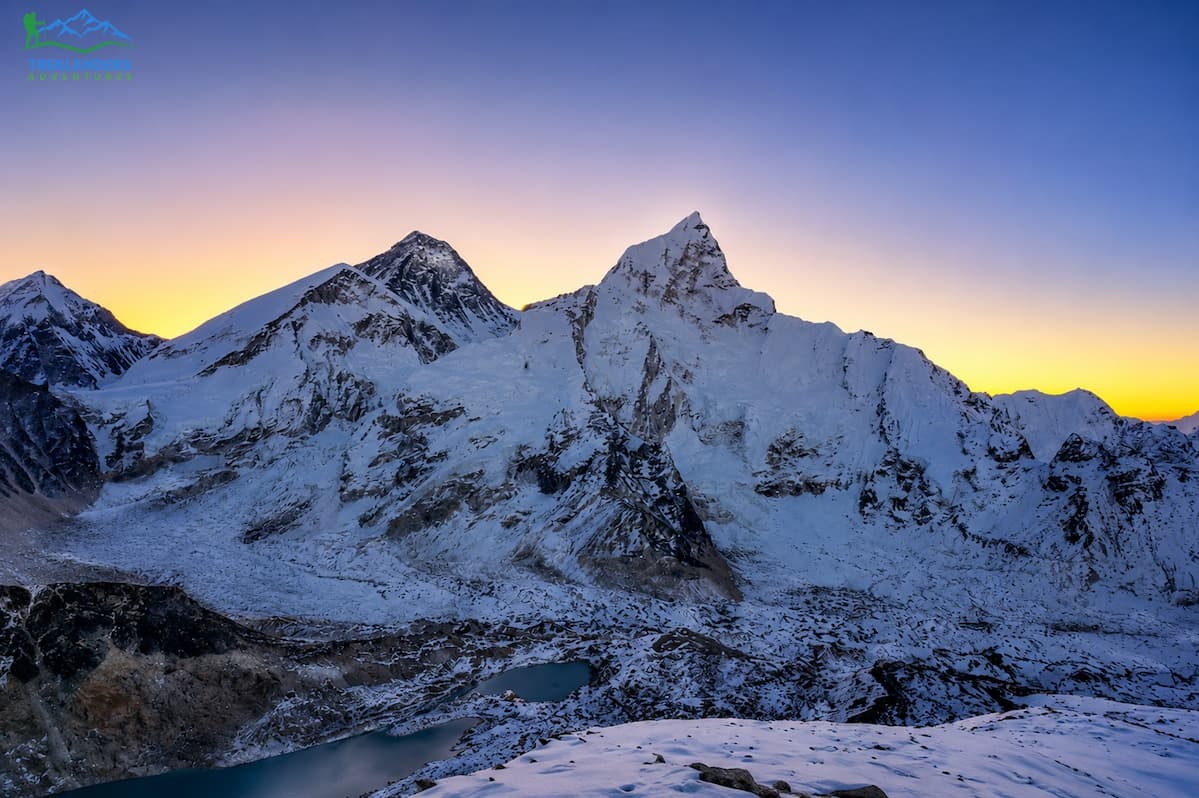
The Everest region sees more solo female trekkers than any other part of Nepal. Namche Bazaar functions as a small town with bakeries, pharmacies, internet cafes, and a weekly market. Teahouses appear every hour or two along the main trail, and during peak season in spring and autumn you will rarely walk more than twenty minutes without passing another trekking group. Mobile signal now reaches most of the route, including 4G in many villages within sight of Everest itself.
The trade-off is altitude. Base Camp sits above 5,300 meters, and the trek requires careful acclimatization over twelve to fourteen days. A guide who takes altitude seriously matters more here than almost anywhere else in Nepal.
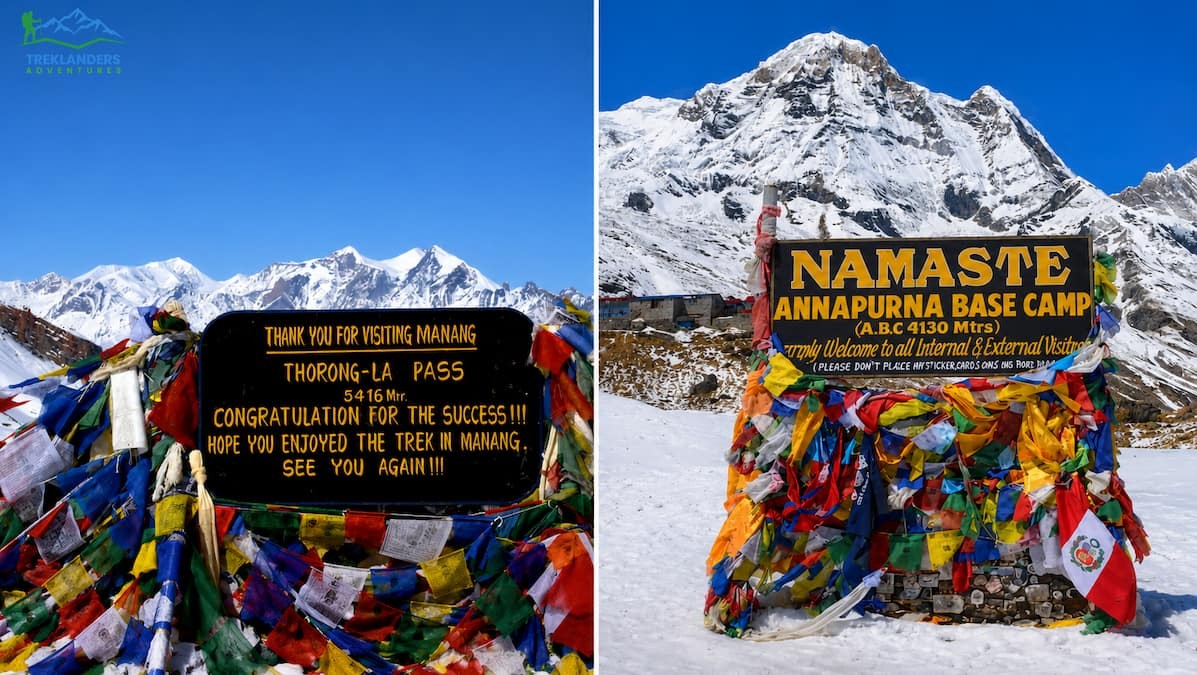
The Annapurna region offers the country's most developed teahouse infrastructure. Villages like Manang, Chame, and Jomsom have guesthouses, shops, and enough foot traffic that solo women rarely feel isolated. The Annapurna Circuit crosses Thorong La Pass at 5,416 meters, which demands the same acclimatization discipline as Everest Base Camp, while the shorter Annapurna Base Camp trek stays lower and suits trekkers with less time or altitude experience.
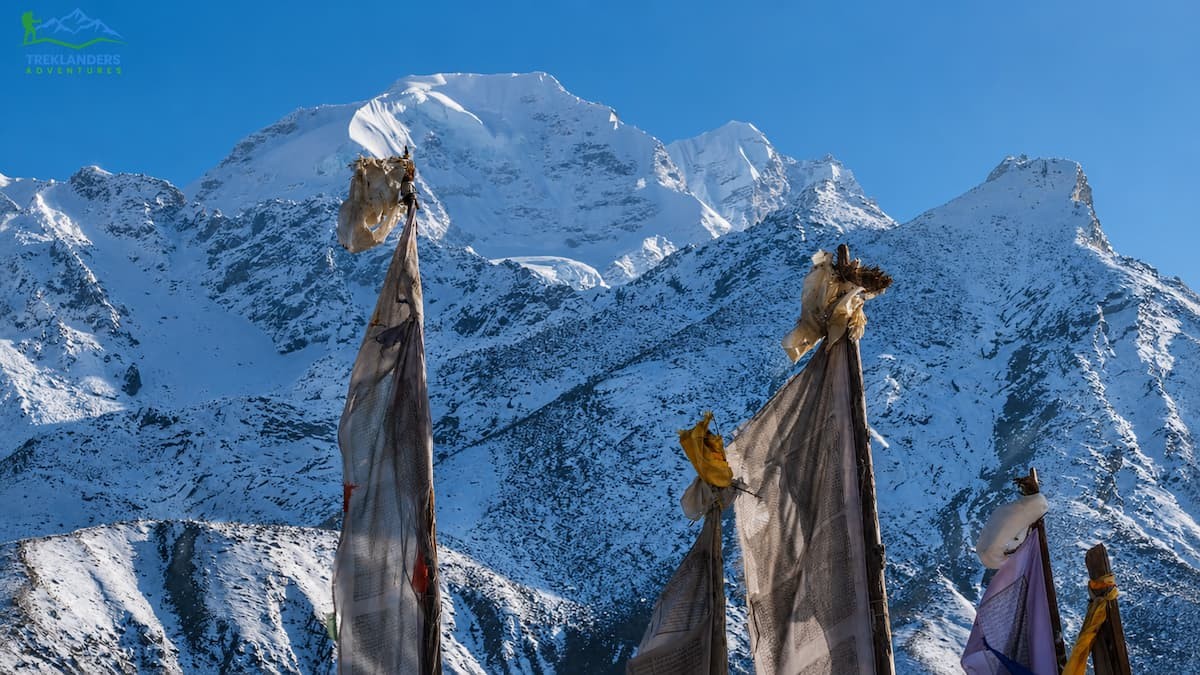
Langtang sits closer to Kathmandu than Everest or Annapurna, which makes it a strong choice if your trip is shorter. The valley rebuilt steadily after the 2015 earthquake, and the trail now runs through a mix of rebuilt villages and forest that feels quieter than the bigger circuits. TIMS remains required here, so your agency will need to arrange it in advance.
If this is your first trek anywhere, not just your first solo trek, these two routes give you a genuine Himalayan experience without the altitude or duration commitment of the bigger circuits. Both stay under 4,000 meters, both can be completed in under a week, and both pass through Gurung villages with steady teahouse traffic. They work well as a confidence-building trip before you commit to something longer, and they let you test how your body handles multi-day walking and moderate altitude before you plan a trek that carries you above 5,000 meters.
Manaslu and Upper Mustang used to sit off limits to solo travelers because restricted areas required a minimum group of two. The March 2026 permit change removed that barrier, and both routes now welcome individual trekkers as long as they travel with a licensed guide. Manaslu circles one of the world's eighth highest peaks through forest, farmland, and high desert, crossing the Larkya La pass above 5,100 meters. Upper Mustang feels different again, a dry, wind-carved landscape bordering Tibet with a culture that has stayed largely intact for centuries. Both regions see far fewer trekkers than Everest or Annapurna, which means longer stretches without other travelers and a genuine sense of remoteness. Save these for your second or third Himalayan trek rather than your first, once you know how your body handles altitude and how you feel walking longer days with less foot traffic around you.
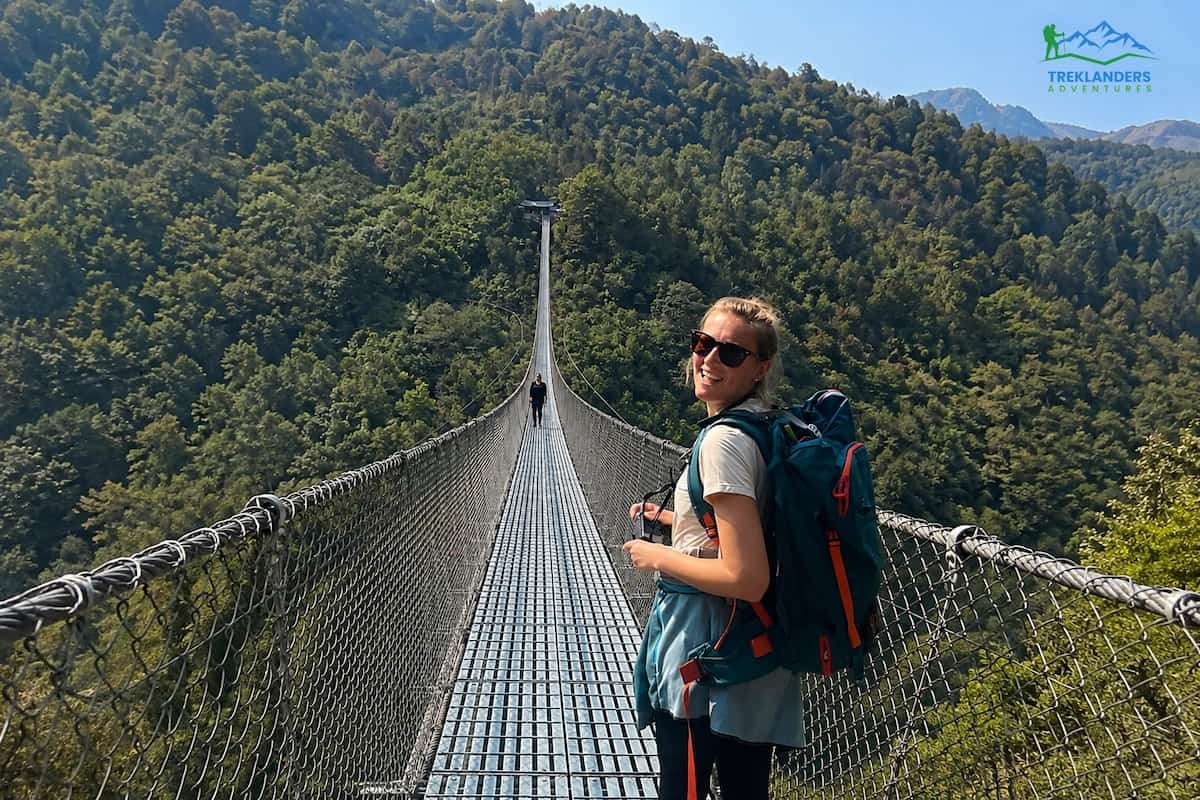
One advantage solo women have in Nepal that did not exist a decade ago is a large, active network of other women who have already done the trek you are planning. Facebook groups built specifically around solo female trekking in Nepal share route conditions, teahouse reviews, and honest accounts of what a given trail actually felt like for a woman walking it. Reddit communities such as r/solotravel carry similar threads, often with specific advice about which agencies treated women well and which did not.
This live knowledge network closes a gap that makes solo travel risky in places with less documentation. You are not guessing what a trail will be like. You can read a trip report from someone who walked it three weeks ago, ask a direct question, and get an answer from someone with recent, specific experience rather than a generic travel forum reply.
Nepal's tourism workforce also skews toward daily contact with foreign women. Guesthouse owners in Pokhara, teahouse managers along the Annapurna Circuit, and shop owners in Thamel interact with international travelers, many of them women, on a near-daily basis. This ongoing exposure builds a kind of practical fluency in how to make a solo woman feel comfortable and safe, which is different from a destination where foreign women arrive only occasionally.
Use this community before you leave home. Ask about recent conditions on your specific route, not just general reassurance. Ask what the other trekkers wished they had packed differently, and ask directly about their experience with the guide or agency they used. Specific, recent answers from other women who did your exact trek carry more weight than any generic safety article, including this one.
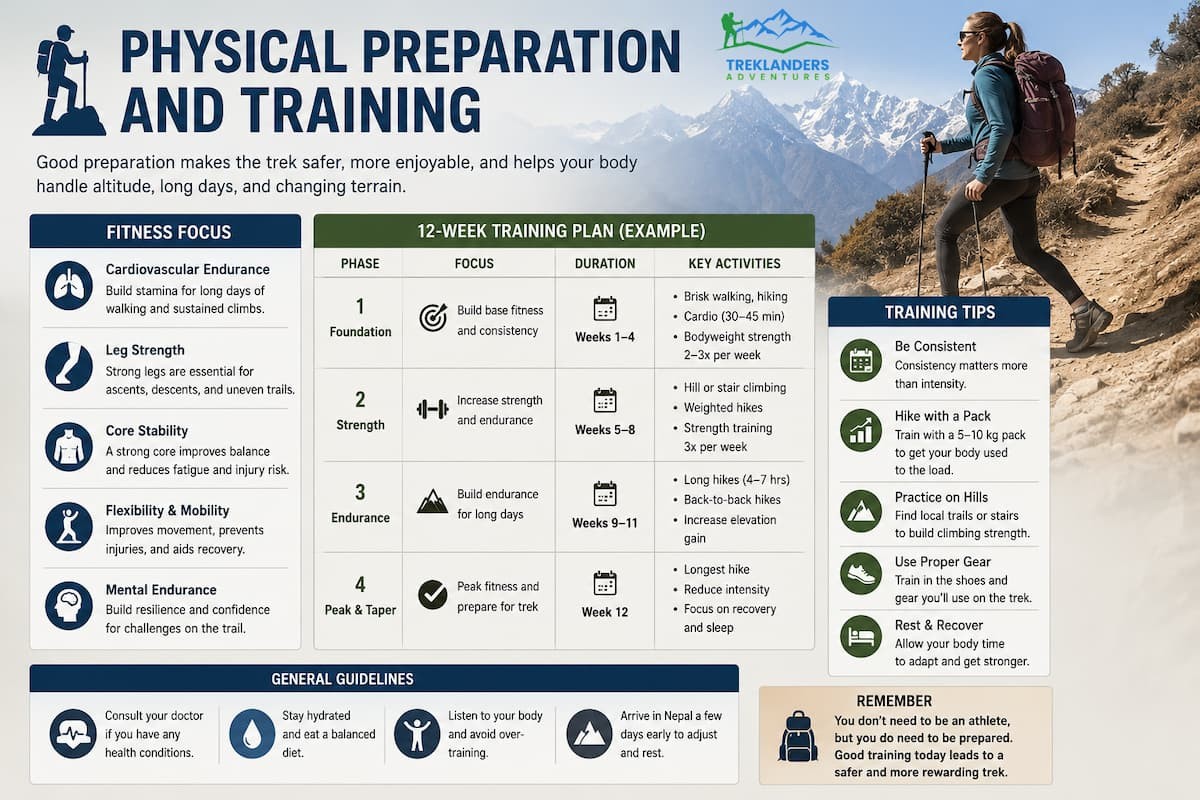
Nepal's trails do not require elite fitness, but showing up unprepared makes every other safety consideration harder to manage. Fatigue clouds judgment, slows your pace late in the day, and makes you more likely to push through symptoms you should be reporting to your guide instead.
Start training at least six to eight weeks before you fly out if you can. Focus on cardiovascular endurance and leg strength rather than speed. Long walks on hilly terrain, stair climbing with a loaded daypack, and steady hiking sessions of two to four hours build the specific stamina these trails demand better than gym cardio machines alone. If you have access to any elevation near home, even modest hills, use them.
Break in your boots well before you land in Kathmandu. New boots on day one of a multi-day trek is one of the most common, and most avoidable, ways trekkers end up with blisters severe enough to slow or end their trip. Wear them on every training walk until they feel like an extension of your feet rather than new gear.
Practice walking with a loaded daypack similar in weight to what you will carry on the trail. Most solo trekkers carry a daypack with water, layers, and daily essentials while a porter carries the main bag, but you should still train with realistic weight so the first day on the trail is not the first time your shoulders and hips feel that load.
If you have any underlying health conditions, particularly heart or lung conditions, talk to a doctor familiar with high-altitude travel before you book anything. Altitude puts strain on the body that a doctor can help you plan around, and getting this conversation done early gives you time to adjust your itinerary if needed.
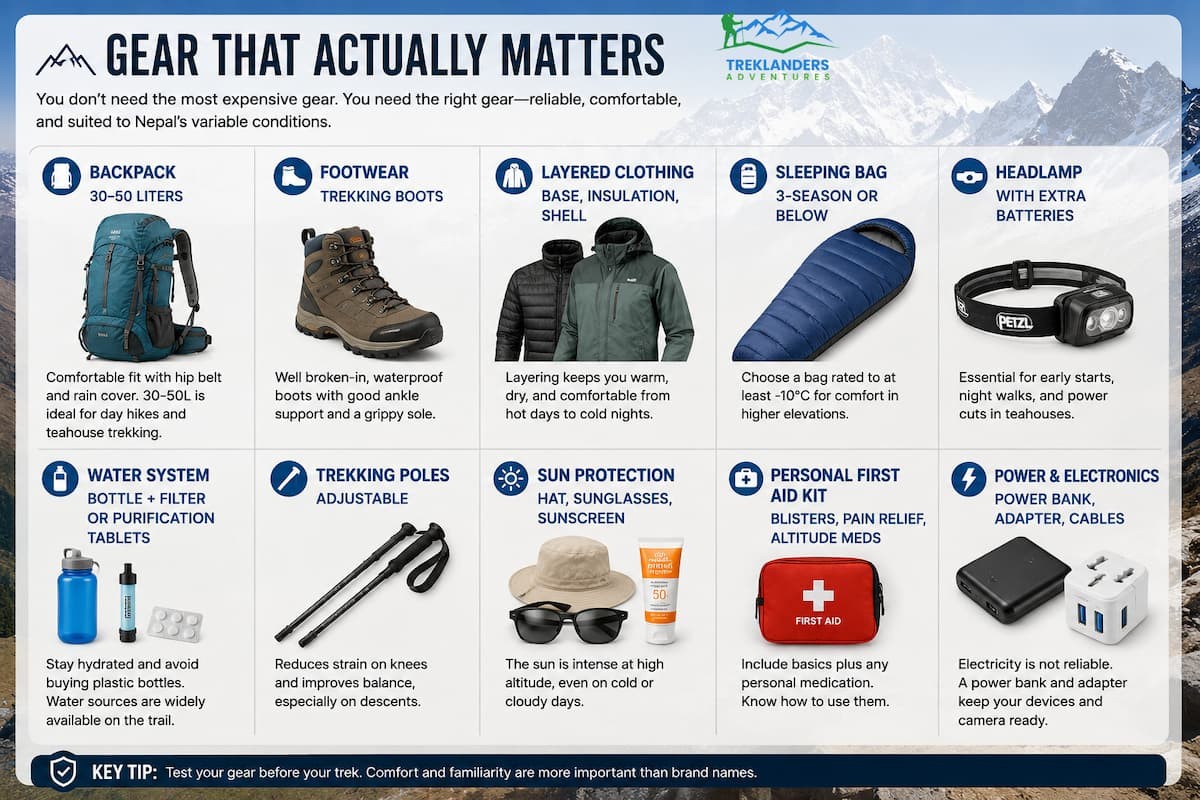
Trekking gear lists online tend to repeat the same generic content regardless of season or route. A few items matter more than the rest for solo female trekkers specifically.
Layering beats a single heavy jacket. Himalayan weather shifts fast, and mornings that start below freezing can reach comfortable, even warm, temperatures by early afternoon before dropping again after sunset. A base layer, an insulating mid layer, and a windproof or waterproof outer shell give you more control than one bulky coat.
A quality sleeping bag rated well below the temperatures you expect matters more than most first-time trekkers realize. Teahouse rooms are not insulated or heated above the dining area, and a bag rated for conditions ten degrees colder than forecast gives you a genuine margin instead of a cold, sleepless night that leaves you exhausted for the next day's climb.
A headlamp with spare batteries covers you for early starts on summit or pass-crossing days, and for the walk to a shared bathroom in a dark guesthouse at 2 a.m. A basic water purification method, either a filter or tablets, removes your dependence on buying bottled water at every stop, which also reduces the plastic waste piling up along popular routes.
Bring a lightweight lock for your duffel bag, not because theft is common, but because a locked bag gives you one less thing to think about when you leave your room to eat or wash. A portable power bank keeps your phone charged for photos, GPS, and check-in messages on days when charging at a teahouse costs extra or is not available at all.
The trek itself is often the safest part of the trip. The transitions before and after it, moving through Kathmandu or Pokhara and getting to your trailhead, deserve just as much attention.
Arrange an airport pickup through your trekking agency for your arrival in Kathmandu rather than negotiating with drivers outside the terminal at night. Most reputable agencies include this as a standard part of their service, and it removes one of the more chaotic moments of the trip, arriving jet-lagged in an unfamiliar city, from your list of things to manage alone.
In Kathmandu and Pokhara, use registered taxis or ride apps rather than flagging down unmarked vehicles, particularly after dark. Thamel and Lakeside stay well lit and busy into the evening, but side streets away from the main tourist areas can be quiet enough that walking alone late at night is not worth the risk it carries anywhere in the world.
Domestic flights to trailheads such as Lukla for Everest region treks or Jomsom for parts of the Annapurna region are weather-dependent and sometimes delayed by a day or more. Build slack into your schedule around these flights rather than booking an international departure that leaves no room for a weather delay. Trekkers who cut this margin too close create their own pressure to rush the trek itself to make a flight home.
The work that keeps you safe starts well before you reach the trailhead. Most serious problems on Himalayan treks trace back to a preparation gap, not bad luck on the trail.
Book through a registered agency. Verify that any company you consider is registered with the Nepal Tourism Board and, where relevant, the Trekking Agencies Association of Nepal. A legitimate agency will assign you a licensed guide, handle your permits correctly, and give you a direct contact who can respond if something goes wrong.
Buy insurance that actually covers your trek. A standard travel insurance policy will not cover high-altitude search and rescue. Your policy needs to explicitly cover emergency helicopter evacuation up to the highest point on your route. If you are crossing Thorong La at 5,416 meters, your coverage needs to extend to at least that altitude, ideally higher. Print a copy of your policy and keep it in your daypack, not buried in your main bag.
Share your itinerary with someone at home. Give a trusted contact your day-by-day route, your guide's name and phone number, and your trekking agency's emergency contact. Update them when you get signal, even with a short message.
Get a local SIM card. Ncell and Nepal Telecom both sell tourist SIM cards at Tribhuvan International Airport or in Thamel. Mobile data now reaches most major trekking routes, including many villages in the Everest and Annapurna regions, which gives you a way to check in and use GPS even when you are walking without your guide for short stretches.
Download offline maps before you leave Kathmandu. Maps.me and the offline function in Google Maps both work well for Nepal's trekking routes. Your guide will know the way, but having your own reference adds a layer of confidence and matters if you ever get briefly separated.
Pack for your body, not a generic list. Bring enough menstrual products for your entire trip. They are difficult to find once you leave Kathmandu or Pokhara, and teahouses will not stock them. The same goes for any prescription medication. Bring more than you think you need, in original packaging, with a copy of the prescription.
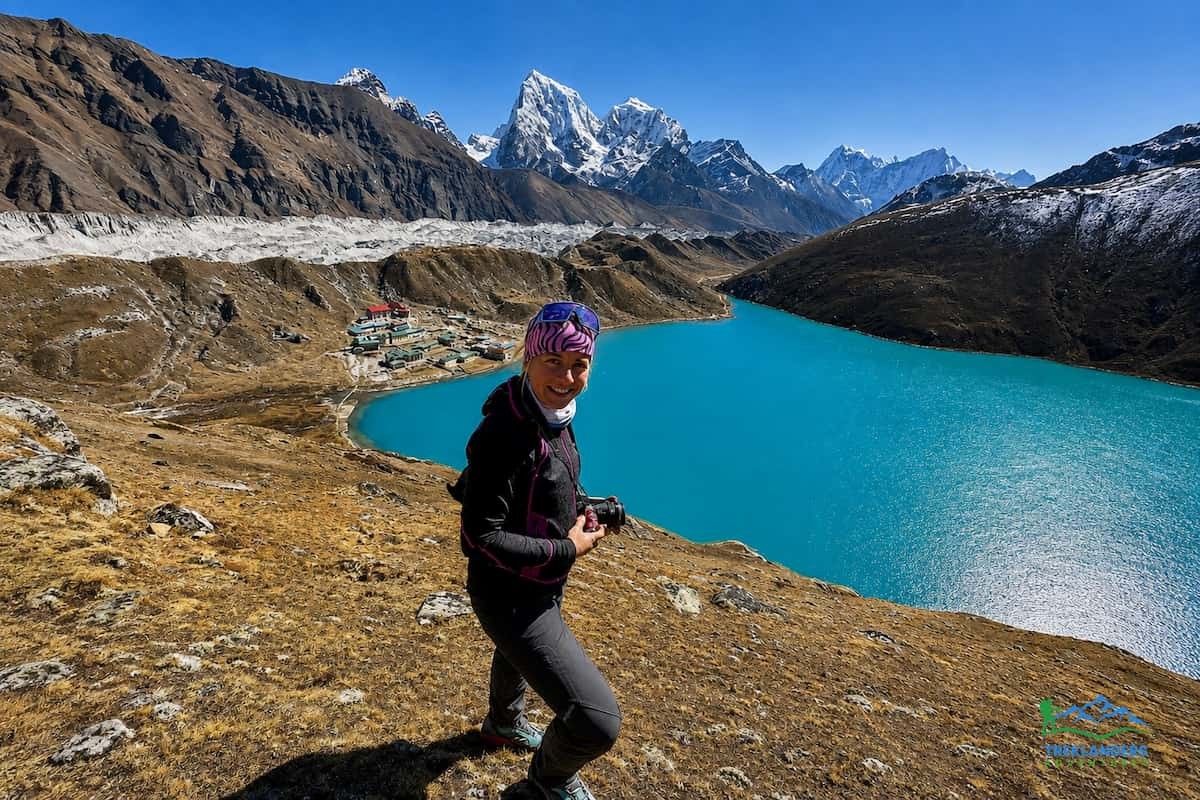
Once you start walking, safety becomes a daily practice rather than a single decision.
Stick close to your guide, especially in the first few days while you learn how they communicate and how they read the trail. A good guide will check in on your pace, your hydration, and your mood without hovering. If yours feels careless about any of these, say something directly and early. Trekking agencies want this feedback, and a professional guide will adjust.
Aim to reach your destination for the day before sunset. Trails that look obvious in daylight become confusing fast once the light drops, and teahouses fill their best rooms early during peak season. Building in a buffer also gives you room to rest if the altitude is hitting you harder than expected.
Drink more water than feels necessary. Altitude dehydrates you faster than you notice, and dehydration mimics or worsens the early symptoms of altitude sickness, including headaches and fatigue. Carry a filter or purification tablets rather than relying on bottled water, which creates plastic waste that has become a real problem on popular routes.
Trust your instincts about people and situations the same way you would at home. If a teahouse feels wrong, ask your guide to help you find another one. If someone on the trail makes you uncomfortable, walk with other trekkers or your guide until the discomfort passes. These moments are uncommon, but they do happen, and there is no reason to talk yourself out of a reasonable reaction.
Learn a handful of Nepali phrases before you go. A simple greeting, a thank you, and a few basic words go further than most travelers expect. It signals respect, and it tends to warm up interactions with teahouse owners and porters immediately.
Teahouses along Nepal's major routes are family-run guesthouses, and the person managing the front desk is often a local woman running the business while her husband farms, porters, or guides on the same route. This matters for solo female trekkers because it means you are usually dealing directly with another woman when you check in, ask questions, or need something during the night.
Most teahouse rooms are built for two people, with twin beds. As a solo trekker, you typically get the room to yourself, though this can change during the busiest weeks of spring and autumn when teahouses fill up and may ask you to share. A reputable trekking agency will prioritize single rooms in its bookings where the teahouse allows it.
Rooms are basic. Expect a bed, a thin mattress, a pillow, and sometimes a small table. Walls between rooms are often just plywood, which means sound travels. Bring earplugs if you are a light sleeper, and do not expect a lock that would satisfy a Western hotel. Most trekkers store valuables in their sleeping bag or daypack overnight rather than relying on the door.
If a teahouse ever feels unsafe or the owner behaves inappropriately, your guide should move you to another location without argument. This is rare, but it is exactly the kind of situation where traveling with a licensed guide, rather than completely alone, makes the difference between an isolated bad moment and a genuine problem.
Nepal operates within a conservative Hindu and Buddhist cultural framework, and gender norms differ from what many Western travelers are used to. Understanding these norms is not about restricting yourself. It reduces unwanted attention and builds better relationships with the people you meet along the way.
Cover your shoulders and knees in villages, teahouses, and any religious site. Loose, breathable trousers and long-sleeve layers work well for both modesty and sun protection at altitude, so this is not really a sacrifice against comfort. Save shorts and tank tops for genuinely remote stretches of trail where no villages are nearby, if you wear them at all.
Public displays of affection are uncommon in rural Nepal, even between married couples, so keep this in mind if you are trekking with a partner you met along the way. Physical contact between unrelated men and women, including handshakes, is sometimes avoided in traditional communities, particularly outside Kathmandu and Pokhara. Let local people set the tone rather than initiating contact yourself.
When photographing people, especially in villages and at religious sites, ask first. Most people say yes, and asking builds a small moment of genuine connection instead of a transaction. At monasteries and stupas, walk clockwise around the structure, following the direction locals use, and remove your shoes before entering temple interiors.
None of this requires you to change who you are for six weeks. It asks for the same basic respect you would show as a guest in anyone's home, applied consistently across a country where you are, in fact, a guest.
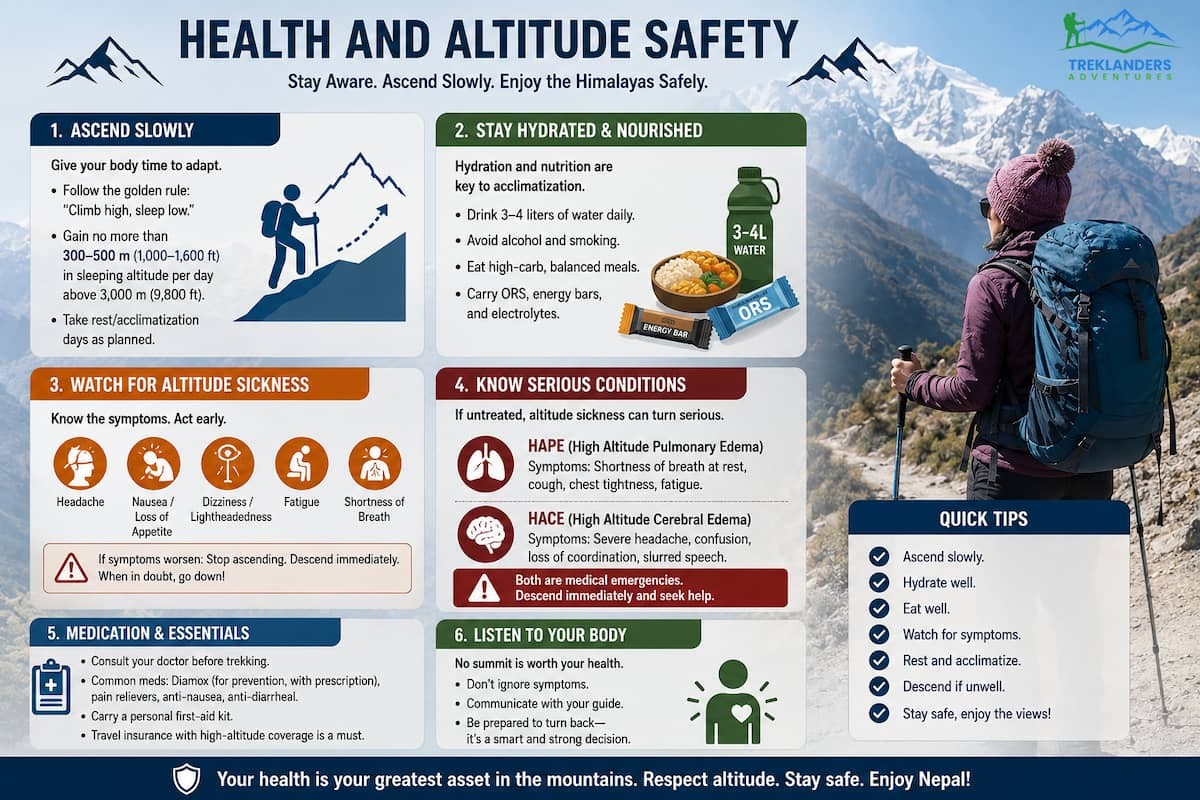
The single biggest physical risk on any Nepal trek is altitude sickness, and it affects strong, experienced hikers just as often as first-timers. Fitness does not protect you from it. Genetics and pacing do.
Acute Mountain Sickness typically starts with a headache, nausea, and unusual fatigue above 2,500 meters. Mild symptoms are common and usually resolve with rest, hydration, and a slower pace. The warning signs that require immediate descent are confusion, loss of coordination, a persistent cough, or breathlessness at rest. A good guide watches for these signs constantly and will not hesitate to turn a client around, even when the client wants to push forward.
Build acclimatization days into any itinerary above 3,000 meters. The standard guidance is to avoid increasing your sleeping altitude by more than 300 to 500 meters per day once you pass that threshold, with a rest day roughly every three to four days of climbing. Reputable itineraries for Everest Base Camp and the Annapurna Circuit already build these days in. Do not let anyone talk you into compressing the schedule to save time.
Carry a basic personal medical kit even though your guide will have one too. Include blister treatment, any personal prescriptions, oral rehydration salts, and a basic pain reliever. Discuss altitude medication such as Diamox with a doctor before you leave home, not on the trail.
Sun exposure at altitude is stronger than most people expect, even on overcast days, because you are closer to the sun and surrounded by reflective snow and rock. Use a high-SPF sunscreen, lip balm with sun protection, and sunglasses rated for glacier conditions on any route that crosses snow or a high pass.
Sleep quality drops at altitude for almost everyone, and interrupted sleep compounds fatigue faster than trekkers expect. Periodic breathing, where your breathing pattern feels irregular overnight, is common above 3,000 meters and usually not dangerous on its own. Mention it to your guide anyway, so they can track whether it lines up with other symptoms rather than treating it as an isolated concern.
Stomach issues send more trekkers home early than altitude sickness does. Stick to hot, freshly cooked food at teahouses, avoid raw vegetables and untreated water, and wash your hands before every meal, even when it feels excessive. Carry oral rehydration salts and a basic anti-diarrheal in your kit, and tell your guide immediately if symptoms last more than a day, since dehydration from stomach illness raises your risk of altitude sickness at the same time.
Before you start walking, confirm exactly how your trekking agency handles emergencies. Ask what happens if you need a helicopter evacuation, who authorizes it, and how the cost is handled with your insurance provider. A serious agency will have a clear answer to this question without hesitation.
Save the direct phone number of your trekking agency's Kathmandu office, not just your guide's personal number. If your guide's phone loses signal or battery, you still have a backup contact who can coordinate on your behalf.
Keep a physical, printed copy of your emergency contacts, insurance policy number, and passport photo page in a waterproof bag inside your daypack. Phones die, get wet, or get lost, and paper backups have saved trekkers real time during actual emergencies.
Check in with your contact at home whenever you reach a village with signal. This does not need to be detailed. A short message confirming you are safe and roughly where you are gives peace of mind on both ends and creates a record of your last known location if anything does go wrong later in the trip.
Ask your agency in advance whether your guide carries a satellite communication device for stretches of trail without mobile signal. Reliable agencies increasingly equip guides with satellite messengers on remote or restricted-area routes, which closes the gap on days when regular signal simply is not available. Knowing this detail before you start walking removes one more unknown from the trip.
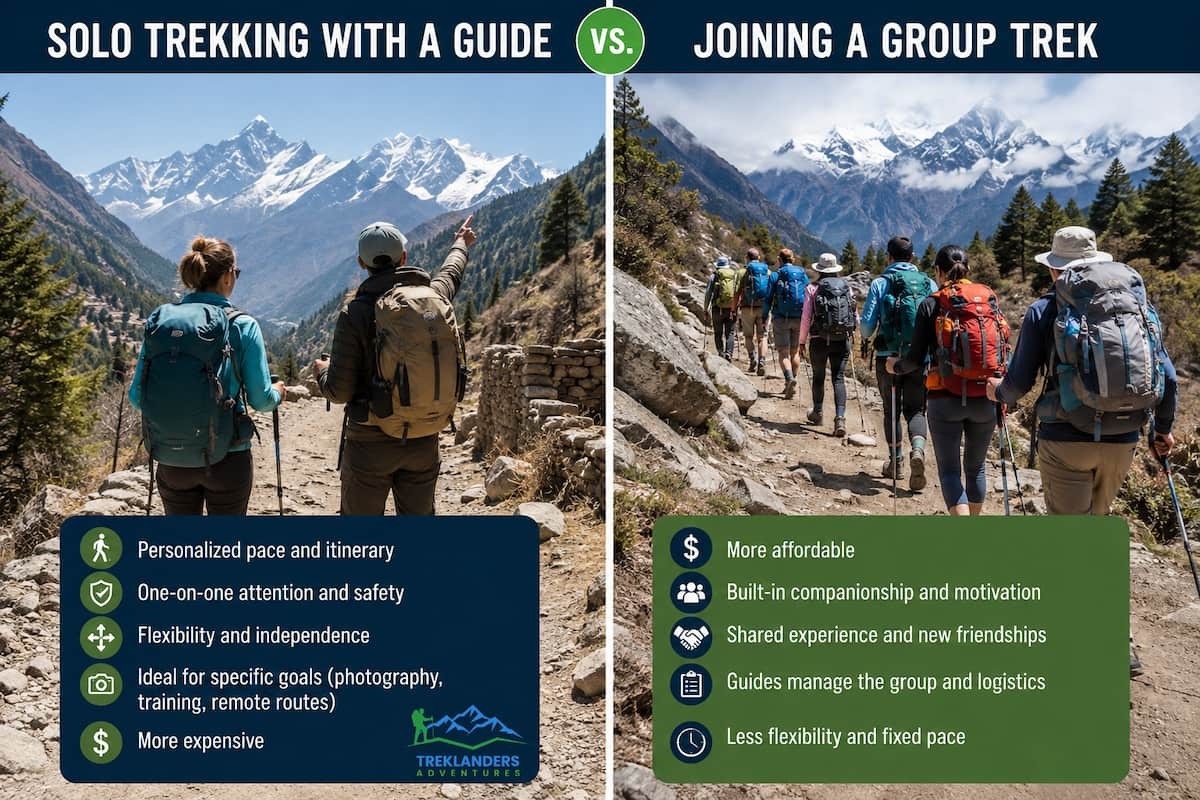
Since 2023, every foreign trekker in Nepal's regulated regions needs a licensed guide, so the real choice is not between solo and guided. It is between trekking with a private guide as an individual client or joining a small group departure with other trekkers.
A private guide gives you full control over your pace, your rest days, and your daily schedule. You are not waiting for slower group members or rushing to keep up with faster ones. This suits trekkers who want to move at their own rhythm or who prefer quieter interactions with the people they meet along the way.
A small group departure puts you alongside other trekkers, often other solo travelers who booked the same dates. This adds built-in social contact each evening, which some solo women prefer over eating dinner alone in a teahouse every night. It can also work out more efficiently if you want a private guide's flexibility split across the group's shared costs.
Neither option is inherently safer than the other, since both come with a licensed guide as standard. The choice comes down to what kind of trip you want, not what kind of risk you are willing to accept. If you are unsure, ask your agency what a typical day looks like under each option, including meal arrangements and how much flexibility you have to adjust the pace once the trek is underway.
Book through a Nepal Tourism Board registered agency with a licensed guide assigned to your trek
Confirm your insurance covers high-altitude evacuation up to the highest point on your route
Print your insurance policy, emergency contacts, and passport page and store them in your daypack
Share your full itinerary and guide's contact details with someone at home
Buy a local SIM card and download offline maps before you leave Kathmandu
Pack menstrual products and any prescription medication for your entire trip, plus extra
Build in acclimatization days for any route above 3,000 meters
Pack clothing that covers shoulders and knees for villages and religious sites
Learn a few basic Nepali phrases before you arrive
Confirm your agency's emergency evacuation process before you start walking
Solo female trekking in Nepal works because the country's culture, its trekking infrastructure, and its current guide requirements all point in the same direction. The mountains ask for respect and preparation. The people you meet along the way, almost without exception, will offer you welcome instead of trouble. Walk in with a licensed guide, the right permits, real insurance, and a healthy respect for altitude, and Nepal will give you one of the safest solo adventures available anywhere in the world.
Discover 7 less crowded treks in Nepal with quiet trails, stunning Himalayan views, remote villages, and authentic experiences away from the crowds.
Compare the Everest Heli Tour vs Base Camp Trek and choose the best Everest experience for your time, fitness, and travel style.

Explore Nepal’s UNESCO World Heritage Sites, from ancient temples and sacred Lumbini to Chitwan’s wildlife and the spectacular Everest region.



