
Chasing Everest: The Ultimate 12-Day Base Camp Trek
15 Nov 2026
Explore the 12-day Everest Base Camp Trek itinerary, stunning Himalayan views, difficulty, acclimatization, best seasons, and essential trekking tips.

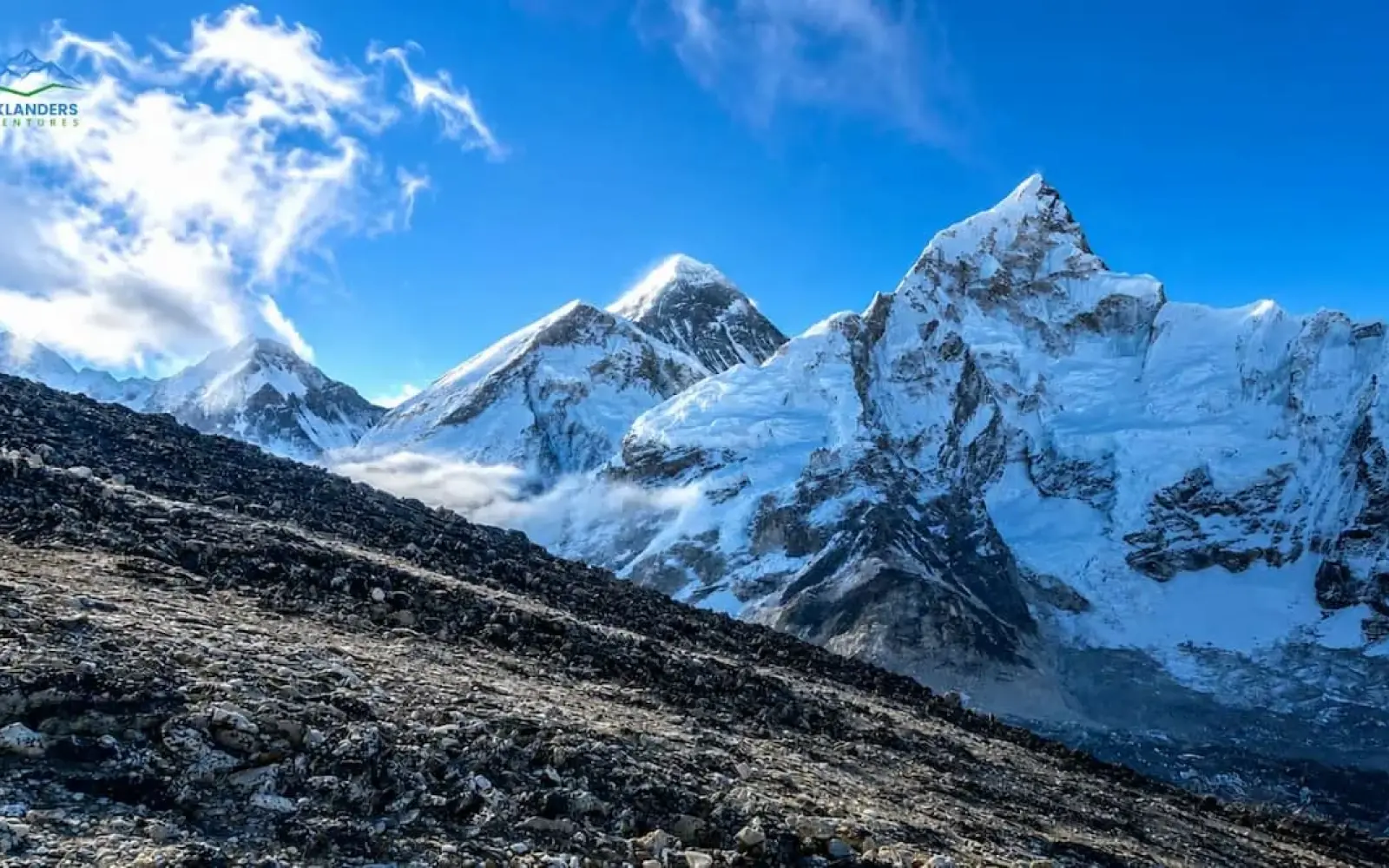
Day 9 of the 12-day Everest Base Camp trek starts in the dark. You wake at Gorakshep, 5,180 m, put on every layer you packed, and climb 463 m to the top of Kala Patthar before the sun reaches the valley. The day before, you stood at Everest Base Camp. You have already reached the goal of the trek, so the extra climb deserves a fair look.
The short answer is yes, for most trekkers who feel well that morning. Kala Patthar is the only place on the standard route where you see Everest's summit clearly. Base camp gives you the glacier and the icefall. Kala Patthar gives you the mountain.
This guide covers what the climb involves, how 5,643 m feels, what you see, what can go wrong, and who should stay at the lodge. It follows Day 9 of the Treklanders 12-Day Everest Base Camp Trek, so the altitudes and timings match what your guide will tell you. If you are still choosing a route, read our complete guide to the 12-day itinerary and our first-timer's guide to Everest Base Camp beside this one.
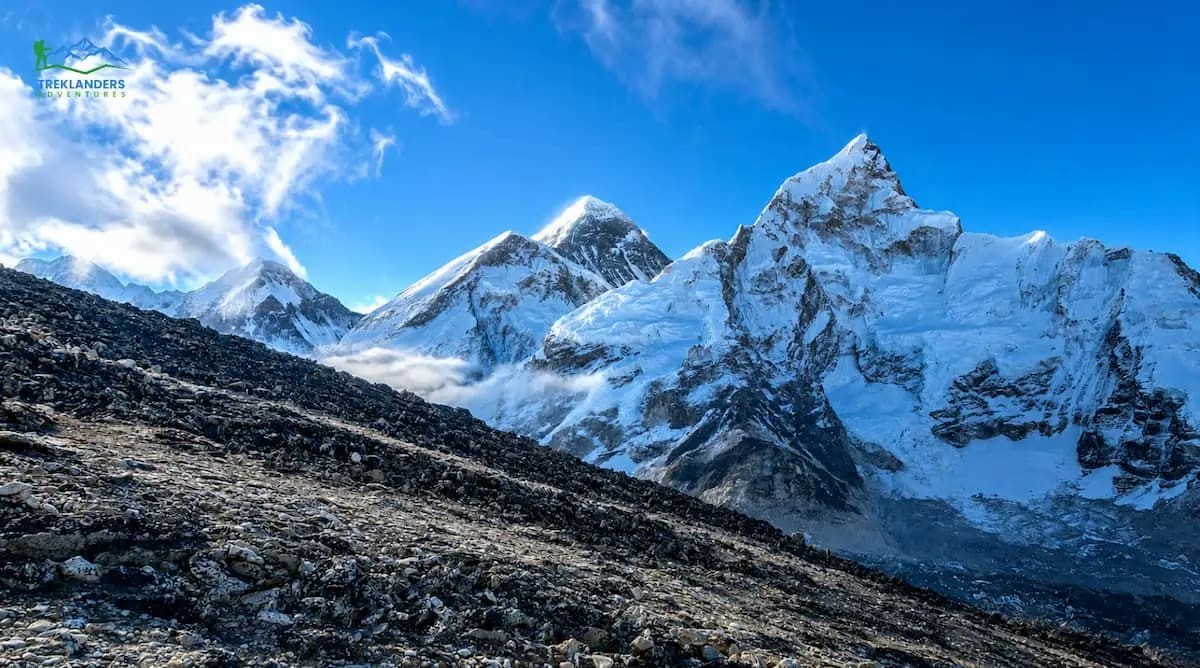
Kala Patthar means "black rock" in Nepali. The name is accurate. The top is a ridge of dark, loose rock on the shoulder of Pumori, directly above Gorakshep. Treklanders lists the high point at 5,643 m (18,514 ft), which makes it the highest point of the whole trek. Other sources print figures between 5,545 m and 5,644 m depending on the survey, so a watch that disagrees with this number is not broken.
The climb is a walk. You use no ropes, no crampons and no climbing skills. The trail zigzags up a steep slope of rock and gravel, with a few short sections where you use your hands for balance. Plan on two to three hours up from Gorakshep and about an hour down. The terrain is easy. The altitude is the difficulty.
Everest Base Camp sits at 5,364 m on the Khumbu Glacier, and from there the long wall of Nuptse hides the summit of Everest. You see the Khumbu Icefall, the tents of the climbing season and the ice around you. You do not see the top of the highest mountain on Earth. Kala Patthar fixes that. From the ridge you look over the Nuptse wall to the dark pyramid of Everest at 8,848 m, with Lhotse to its right and Pumori beside you, close enough that it fills the sky on one side.
That difference explains why guides push the climb. Base camp is a place you arrive at. Kala Patthar is a place you look from. Trekkers who skip it can reach base camp and still leave without a clear view of the summit.
The 12-day plan is compressed, so every day has a job. Day 1 is a 35-minute flight from Kathmandu to Lukla at 2,860 m, followed by about four hours of walking to Phakding at 2,610 m. Day 2 is the long walk to Namche Bazaar at 3,440 m, about six hours, with a stop at Monjo where you enter Sagarmatha National Park. Namche gets two nights. On Day 3 you rest, then walk up toward the Everest View Hotel for a first look at Everest, Lhotse and Ama Dablam.
Day 4 takes you to Tengboche at 3,867 m in about five hours, through rhododendron and pine forest to the largest monastery in the Khumbu. Day 5 climbs to Dingboche at 4,410 m, passing Pangboche and Somare below the north face of Ama Dablam. Dingboche also gets two nights. Day 6 is the second acclimatization day, with a short hike toward the Nakarjung ridge.
Day 7 moves you to Lobuche at 4,928 m in about five hours, by way of Thugla. Day 8 is the longest push. You walk up to Gorakshep at 5,180 m, continue to Everest Base Camp at 5,364 m, and return to Gorakshep to sleep. That is six hours at altitudes above 5,000 m. Day 9 is Kala Patthar.
The two rest days matter more than they look. Namche and Dingboche are the reason the plan works, because they give your body time to adapt before the climb. Trekkers who want more margin can choose the 14 Day Everest Base Camp Trek or the 16-day standard itinerary. Trekkers with fewer days can look at the Everest Panorama Trek, which stays lower, or the 9-Day Everest Base Camp Trekking with Helicopter Return.
The 12-day plan puts Kala Patthar on the same morning as the start of the descent. You climb to 5,643 m at dawn, drop to Gorakshep for breakfast, and keep going down to Pangboche at 3,900 m by evening. That structure has a benefit and a cost.
The benefit is a fast loss of altitude after your highest point. The cost is that you get one attempt. A cloudy morning, a bad night or an upset stomach leaves no spare day at Gorakshep. Longer itineraries add days to the schedule, which gives more room for weather and acclimatization. The article Chasing Everest explains how the 12-day pacing compares with longer plans, and this complete guide walks through each stage in detail.
For many trekkers that trade is fair. You save four days compared with the standard 16-day trek, you still reach 5,643 m, and you still stand in front of Everest at sunrise. The question is whether you are prepared to climb on a fixed morning, and the next sections help you answer it.
Your guide sets the wake-up time from the season's sunrise and the group's pace. Plan to leave the lodge at least two hours before first light. At that hour Gorakshep sits well below freezing, and the dining room stove is cold. Drink tea, eat what you can, and fill an insulated flask with hot water before you go. Water in a plain bottle can freeze solid on the way up.
Appetite drops at 5,000 m, so carry something you will actually eat, such as biscuits, chocolate or dried fruit. A small bite every half hour keeps the climb from feeling worse than it is. Take only your daypack. Your porter stays at the lodge with the rest of your bags, one porter for every two trekkers, as the 12-day package arranges.
Headlamps matter. Put fresh batteries in before you sleep and keep a spare set in an inner pocket, because cold drains batteries fast. Wear your heaviest down jacket, insulated gloves or mittens, a warm hat and a buff over your face. Temperatures on the ridge commonly sit between minus 10 and minus 20 degrees Celsius before sunrise, and wind makes it feel colder. Our guide to trekking in Nepal in December explains how winter cold changes the plan.
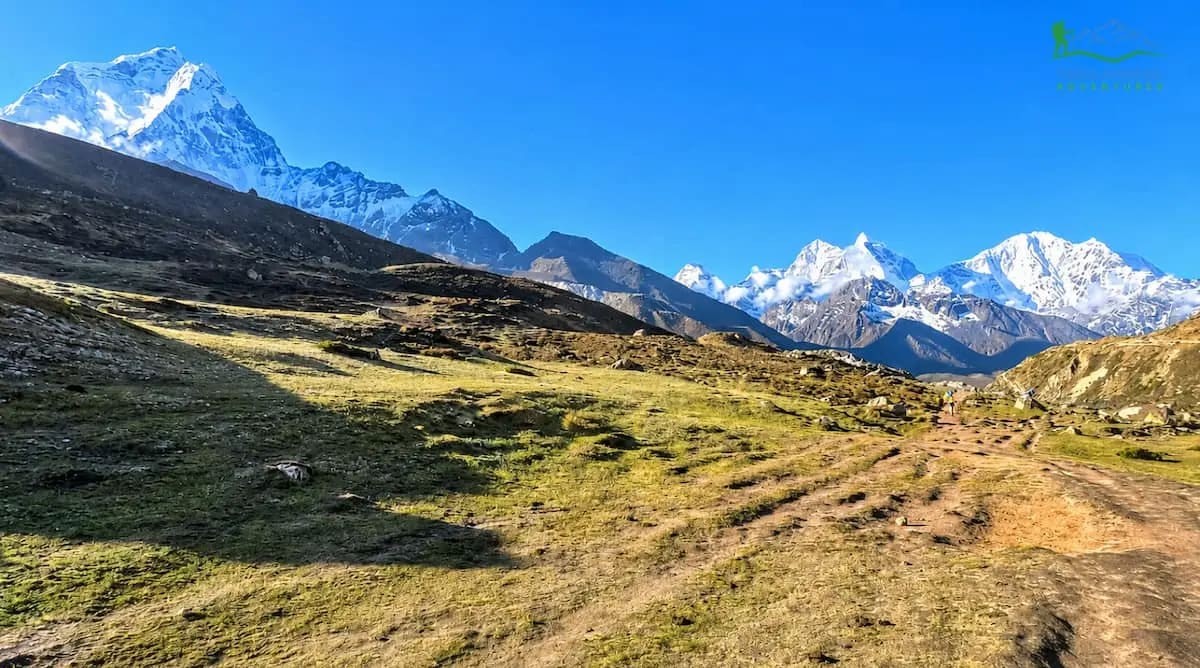
The trail begins on the flat sandy plain behind the lodges, then turns uphill at the base of the ridge. The first section is gentle, and the temptation is to walk at your normal pace. Resist it. Take short steps and breathe through each one. If you can still speak in full sentences, your pace is right. If you cannot, slow down. Your guide walks beside or behind you and checks your breathing, color and balance at each rest stop. Give honest answers.
Climbing 463 m in this air takes longer than the number suggests. At 5,600 m each breath brings in roughly half the oxygen it would at sea level. Expect to stop every 50 to 100 steps. That is normal, and nobody on the trail counts it against you. Headlamps from other groups appear above and below you in a line. As the sky lightens to deep blue, the black shapes around you become ridges and faces.
The last stretch is a scramble over larger rocks to a cluster of prayer flags on the top. Leave on time. A late start means you reach the summit after first light has already passed.
A steady pace beats a fast start. Use three rules. First, match your steps to your breath. Aim for one or two steps per breath, a rhythm that holds for hours at this altitude. Second, rest on your feet. Sitting lets your legs stiffen and makes the restart harder. Lean on your poles, take ten slow breaths and move again. Third, keep drinking. Sip from your flask at every rest stop, even without thirst, because thin dry air pulls water out of you with every breath.
Walk behind your guide. The guide's pace looks slow, and it is slow on purpose. Passing the group in the first thirty minutes usually means stopping an hour later with a pounding headache.
Agree on a turnaround time with your guide the night before. If the group has not reached the top by that time, you descend. The sun rises on the summit whether or not you stand on it, and the walk down takes about an hour. A fixed rule removes the argument on the mountain, where tired people make poor decisions.
Gorakshep is a small settlement of a few lodges on a wide, flat plain of glacial sand beneath Pumori and Kala Patthar. At 5,180 m it is the highest overnight stop on the trek. The lodges serve trekkers and climbers, and the dining rooms fill with people eating dal bhat and noodle soup in their jackets.
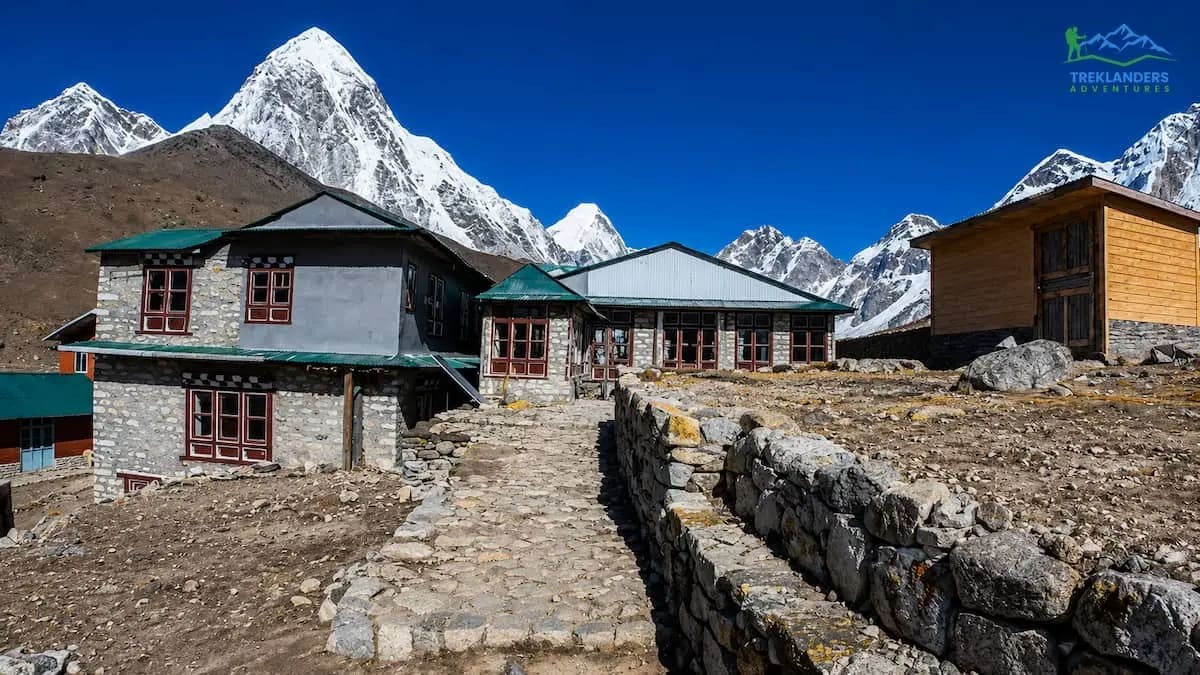
The name is usually translated as "dead ravens". The plain was once a lake bed, and the sand underfoot still looks like one. Rooms are basic, with thin walls, twin beds and shared toilets. Solar panels supply the electricity, charging costs extra, and Wi-Fi works slowly when it works. You may have no mobile signal at all above Lobuche, so tell your family the plan before you leave Namche. Bring a sleeping bag rated for minus 10 to minus 20 degrees Celsius. Blankets alone will not be enough.
Sleep at this altitude is thin. Expect to wake several times, feel a pounding heart or breathe in short bursts at night. These are common effects of altitude and do not mean you are ill. A headache that grows, nausea or vomiting does mean something. Tell your guide at once. If you want a warmer room and better food at this elevation, the Everest Base Camp Luxury Trek uses higher-grade lodges on the same route.
Day 8 already took you to base camp and back, so you arrive at the lodge tired. Eat a full dinner, drink water and go to bed early. Gorakshep is also where your guide decides about Day 9. They check your pulse oxygen, your symptoms and your appetite. A reading in the low 80s is common at this height. A reading far below that, or a low reading alongside symptoms, changes the plan. The decision belongs to the guide, and a good guide does not bend it to please a group.
Everest comes first. You see it as a dark pyramid above the Nuptse wall, and in strong wind a plume of snow can stream off the summit. Lhotse sits to the right, and its face drops toward the Western Cwm. Pumori stands beside you, so close that on a clear morning its upper slopes look within reach. Changtse rises north of base camp, and the Tibetan peaks lie beyond the border.
Below you, the Khumbu Glacier runs south along the trail you walked on Day 8. During the spring climbing season you can pick out Everest Base Camp as a patch of colored tents on the ice. Treklanders describes the moment trekkers come for: Everest, Nuptse and Pumori catch the first rays while the valley stays in shadow.
The light arrives in stages. First the sky behind Everest turns from black to deep blue. Then a thin orange line appears along the ridge of Everest and Nuptse. Pumori follows. The sun reaches your own ridge last, and you feel it on your face before you feel it in your hands. The whole sequence takes roughly half an hour.
Stay at the top for ten to twenty minutes. The cold makes longer stays unpleasant, and fingers go numb quickly when you take off gloves to use a phone. Wear thin liner gloves under your mittens for photos, shoot in short bursts and keep your spare battery warm. Then put the phone away for a minute. You will remember the view better.
Photographers get the best light by facing the summit with Pumori in the frame during the first ten minutes of alpenglow. A short zoom lens works better than a wide one, because Everest looks smaller from Kala Patthar than most people expect. It sits behind the Nuptse wall, and only its upper pyramid shows.
Base camp wins on meaning. Kala Patthar wins on view. On Day 8 you stand on the Khumbu Glacier at 5,364 m with the Khumbu Icefall above you. The icefall is one of the riskiest sections of the main climbing route, and from base camp you watch it from a safe, flat distance. In spring you also see expedition tents as teams prepare for their summit attempts.
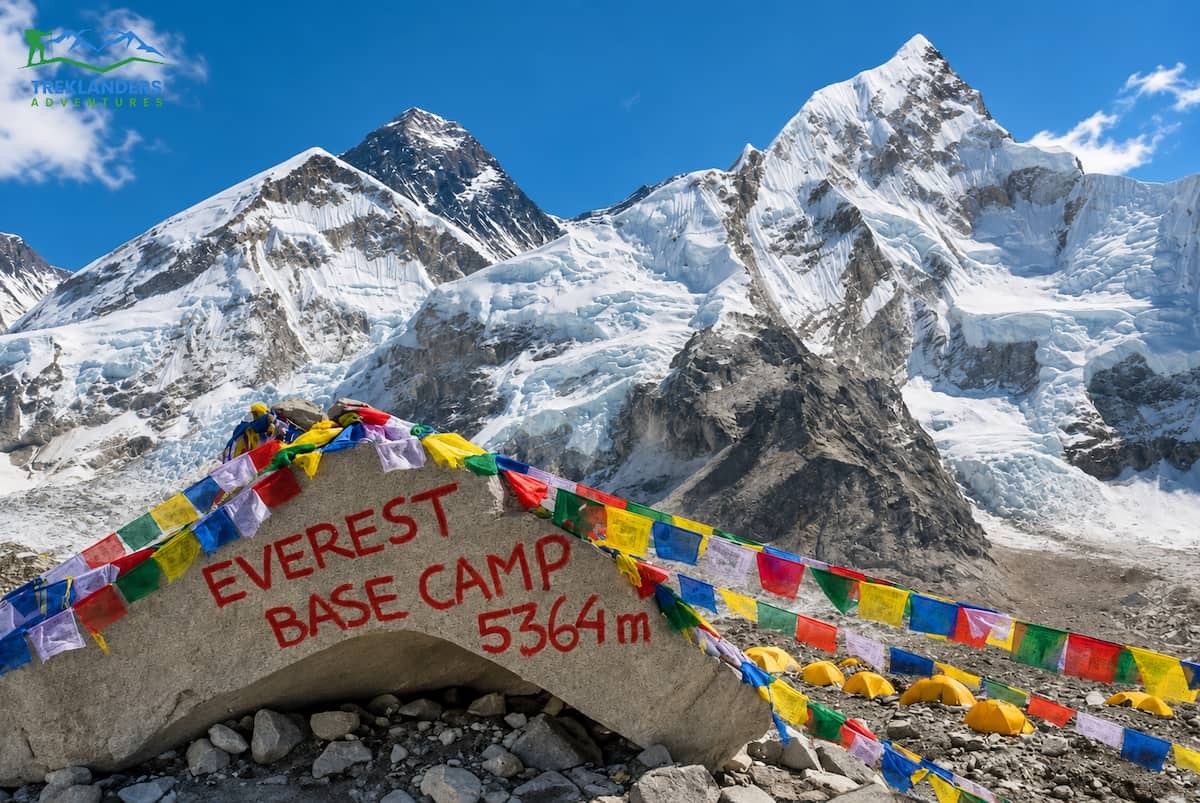
Base camp, though, sits at the bottom of a valley. The walls around you block the mountain. You feel the scale of the place, but you do not see the summit. Kala Patthar stands 279 m higher than base camp, and that height is enough to look over Nuptse.
If you can choose only one, choose Kala Patthar for the view and base camp for the arrival. The 12-day plan removes the choice, because it includes both. Trekkers on the Everest Base Camp Trek and Returning via Heli fly out from Gorakshep after the walk up, so ask your guide how a Kala Patthar morning fits that schedule. The 9-day helicopter return option works the same way for trekkers with less time.
The highest point you reach is 5,643 m. Altitude sickness is unpredictable and affects fit people as well as unfit ones. The rest days at Namche Bazaar and Dingboche lower the risk, but they do not remove it.
Learn the early signs: headache, nausea, dizziness, unusual fatigue, loss of appetite and poor sleep. One reviewer on our site reported dizziness between Lobuche and base camp, and said the guide monitored the condition, slowed the pace and kept supporting the group. That is how it should work. The symptom gets reported early, the pace changes and the trekker still finishes.
Severe signs are different. Confusion, loss of balance, breathlessness at rest, a wet cough, or a headache that does not respond to rest and painkillers can point to cerebral or pulmonary edema. Both are life-threatening. The treatment is immediate descent. Your guide starts it, and an emergency helicopter evacuation follows if needed. Your travel insurance must cover trekking to at least 6,000 m and include helicopter evacuation, so read the policy wording before you buy.
Medication such as acetazolamide is a decision for you and your doctor before the trip. Do not start it on the mountain because someone at the next table recommended it. Drink water through the day and walk slowly. Report symptoms early, because a guide cannot treat a symptom that nobody mentions.
Training also lowers the effort of the final 463 m. The 12-week plan in our EBC trek training guide builds the leg strength and cardio that make the climb feel less severe. Trekkers with heart, lung or severe joint conditions should see a doctor before booking.
Spring, from March to May, brings clear mornings, blooming rhododendron on the lower trail and the climbing season at base camp. Nights above 4,000 m still fall below freezing. Autumn, from September to November, offers the clearest air after the monsoon, the busiest trails and the festivals of Dashain and Tihar. Mornings at Gorakshep are very cold in both seasons.
Winter, from December to February, is quiet and often clear, but nights drop far below freezing at Lobuche and Gorakshep. Some lodges above Dingboche reduce services or close in the coldest weeks, so confirm availability with your guide. The December guide covers the winter plan in more detail. Monsoon, from June to August, hides the peaks behind cloud and is a poor choice for a sunrise climb.
Cloud affects every season. Mornings are usually the clearest part of the day, and cloud tends to climb the valley by late morning. That is the main reason trekkers climb at dawn rather than in the afternoon. Even in the best weeks, no season guarantees a clear sky. If the morning is cloudy, your guide may delay the start, and the 12-day plan leaves you no spare day to try again.
Some trekkers climb Kala Patthar on the late afternoon of Day 8 instead, after base camp, to see sunset light on Everest. The 12-day plan uses sunrise for good reasons. Mornings are the clearest part of the day, cloud tends to build in the valley after midday, and a dawn climb leaves you with a full day of descent ahead. An afternoon climb after a six-hour walk to base camp asks a tired body for more at the highest point of the trip, and the descent happens in fading light and deepening cold.
Sunrise has its own cost. You climb in the dark during the coldest hour of the day. Sunset costs you fatigue instead. Sunrise wins for most groups because cold is a problem you can manage with gear, and fatigue at 5,600 m is not. Longer plans such as the Everest Base Camp Trekking from Jiri add walking days through the lower Solu villages, and your guide can tell you whether a longer schedule leaves room for a second attempt.
Layers beat bulk. Wear a moisture-wicking base layer, a fleece, your heavy down jacket and a hard shell on top. Add insulated pants over thermal bottoms. Your hands need liner gloves under insulated mittens. Your head needs a warm hat and a buff. Your eyes need Category 3 or 4 sunglasses once the sun clears the ridge, because snow glare at 5,600 m burns quickly. Wear broken-in boots with ankle support. Trekking poles help on the loose gravel of the descent more than on the way up.
Pack a headlamp with spare batteries, an insulated flask, a power bank kept inside your jacket and lip balm with SPF. The full list sits on the 12-Day Everest Base Camp Trek page, sorted into clothing, footwear, accessories and health items. Our first-timer's guide adds notes on what to leave at home.
Skip Kala Patthar, or stop partway, in these cases. You have a growing headache, nausea or vomiting at Gorakshep. Your oxygen reading is low and your guide is not comfortable with it. The wind is strong enough to make the ridge unsafe. Ice covers the upper trail. You slept badly and feel weak at breakfast. In every one of these cases the decision belongs to your guide, and turning back is not a failure. It is the reason you hired a guide. Tell your guide about symptoms the evening before. Early reports leave more options than late ones.
Our trekkers typically range from 12 to 65 years old with reasonable fitness. If you want a Himalayan view without the altitude, other options exist, and the next section lists them.
Kala Patthar is one of several dawn climbs in Nepal. Comparing them shows what you gain for the effort. Gokyo Ri sits at about 5,357 m above the Gokyo lakes and looks across to Everest, Lhotse, Makalu and Cho Oyu. You reach it on the Gokyo Valley Trekking route or the 11 Days Gokyo Valley Trekking itinerary. The Everest Base Camp via Cho La Pass trek combines Gokyo with base camp and Kala Patthar, and the Everest Three Passes Trekking route crosses Kongma La, Cho La and Renjo La. Both Gokyo Ri and Kala Patthar are steep climbs above 5,300 m.
If you want a lower dawn view in the same region, the 6 Day Pikey Peak Trek climbs a hill with a sunrise view of Everest, Kanchenjunga and Makalu, according to one of our reviewers. The 8-Day Everest Panorama Trek and the Everest Panorama Trek keep you below the altitudes of Gorakshep. Trekkers who want the highest Everest-region experience can look at the Everest Base Camp Trek with Lobuche East Peak Climbing Expedition, the Island Peak Trek and Climb or the Mera Peak Trek and Climb. Our peak climbing page compares them.
In the Annapurna region, Poon Hill at about 3,200 m is the famous sunrise viewpoint. You reach it on the Ghorepani Poonhill Trek, the 4-Day Ghorepani Poonhill Trek from Pokhara or the 10-Day Ghorepani Poonhill with Annapurna Base Camp Trek. Annapurna Base Camp has three versions: Annapurna Base Camp Trekking, the 7-Day Annapurna Base Camp Trek from Pokhara and the 11 Day Annapurna Base Camp Trek. The Mardi Himal route offers a high ridge sunrise at lower altitude through the 9 Day Mardi Himal Trek, the 5-Day Mardi Himal Trek from Pokhara and Mardi Base Camp Trekking. For winter conditions, read whether the Mardi Himal Trek is possible in winter. You can see the whole range of options on our Annapurna region page.
For a short morning near the capital, the Nagarkot Sunrise Tour and the Nagarkot Sunrise Tour with Day Hike show the Himalayan skyline from about 2,100 m. If you only want a view of Everest and have no interest in altitude, the Everest Mountain Flight from Kathmandu and the Everest Heli Tour get you close in a single morning. A flight shows you the mountain. It does not give you the walk, the villages or the arrival, and that difference is why most trekkers still choose Kala Patthar.
Trekkers worried about crowds on the Everest trail often ask about other routes. The Manaslu Circuit is quieter than Everest Base Camp, and the Manaslu Circuit Trek, the 13-Day Manaslu Circuit Trekking and the 14 Day Manaslu Circuit Trek cover it at different paces. The 20 Day Manaslu Circuit with Tsum Valley Trek adds a side valley. Compare itineraries in the Manaslu itinerary guide, check difficulty in this comparison with the Annapurna Circuit, and read the 12-day safety article and the winter Larkya La guide before you choose dates.
Langtang is closer to Kathmandu. The Langtang Valley Trek, the 9 -Day Langtang Valley Trek and the 7-Day Langtang Valley Trek reach Kyanjin Gompa and the viewpoints above it. Read the Langtang route update for 2026 before you book. Related routes include the Gosainkunda Lake Trek, the 15 Day Langtang Gosaikunda Lake Helambu Trek, the 14 Day Tamang Heritage with Langtang Valley Trek and the Helambu Trek.
Longer circuits suit trekkers with more time. The Annapurna Circuit Trek and the 13-Day Annapurna Circuit Trek cross Thorong La, and the Annapurna Semi Circuit Trek covers a shorter loop. The Tilicho Lake Base Camp Trek, the 15-Day Tilicho Base Camp with Thorong-La Pass Trekking and the Nar-Phu Valley with Thorang-La Pass Trek add remote side trails. Restricted and remote routes include the Upper Mustang Trekking route, the Upper Dolpo Trek and the Kanchenjunga Trek. Shorter and quieter trails include Mohare Danda Trekking and Khopra Ridge and Khair Lake Trekking. Our trekking in Nepal page lists everything in one place.
Flights to and from Lukla depend on weather and air traffic. In the busiest months, flights can be rerouted through Manthali Airport in Ramechhap, about three to four hours from Kathmandu by road. Build at least one spare day before your international flight home. If bad weather stops the flights, a helicopter transfer between Lukla and Kathmandu is an option, and your guide can arrange it.
Spare days in Kathmandu are easy to fill. The Kathmandu Full Day Sightseeing Tour covers the main sites, the Seven UNESCO Heritage Sites Day Tour in Kathmandu goes deeper, and the Patan and Bhaktapur Sightseeing Tour covers the two old royal cities. The Chandragiri Cable Car Tour gives you a view of the Himalayan range from the hills west of the city. Food lovers can book the Cooking Class in Thamel with a Full Course Meal or the Momo Making Class in Thamel. For a longer break, consider the 3-Day Chitwan Wildlife Tour, the 3-Day Pokhara Sightseeing Tour or the 7-Day Kathmandu, Pokhara and Chitwan Wildlife Tour.
Pre-trek training hikes near the capital help too. The 4-Day Trekking Adventure near Kathmandu, the Chisapani-Nagarkot to Dhulikhel Hiking route, the Nagarkot Day Hike, the Namobuddha Day Tour with Shiva Statue and the Nagarjun Jamacho Day Hiking trail let you test boots, packs and pace. Our 12-week training plan schedules them into your preparation.
After the summit you descend to Gorakshep for breakfast. The rest of Day 9 is a long walk down. You pass Lobuche and Thugla, take an alternate route into the Pheriche valley for lunch, and finish in Pangboche at 3,900 m, with Ama Dablam in view from the lodge. You end the day roughly 1,700 m below the summit you stood on at sunrise. Appetite and sleep usually return quickly once you drop.
Day 10 takes you from Pangboche to Namche Bazaar by way of Tengboche, about six hours. Day 11 follows the Dudh Koshi valley down through Monjo and Phakding to Lukla, another long day of about six hours. Day 12 is the flight to Kathmandu and a transfer to your hotel. The itinerary runs 11 nights from Kathmandu to Kathmandu, and the days after Kala Patthar are as much about recovery as about distance.
For most trekkers on the 12-day plan, yes. The climb adds about 463 m of ascent and two to three hours in the dark. In return you get the clearest view of Everest on the standard route, the first light on Nuptse and Pumori, and a descent that starts when your body most needs it. Base camp gives you the arrival. Kala Patthar gives you the view you will describe afterward.
The climb is not worth forcing. If your guide advises against it, if symptoms appear or if the weather turns, stay at the lodge and walk down with the group. The trek is still a success. Reaching base camp on Day 8 already completes the main objective of the 12-day Everest Base Camp trek.
Make the decision at Gorakshep, and make it early. Check how you feel after dinner and again at wake-up. Compare your oxygen reading and your appetite with the previous evening at Lobuche. Then ask your guide for a direct recommendation. If all three point the same way, go. If one of them looks wrong, discuss it before you leave the lodge, not halfway up the slope. Decisions made on a dark ridge, with cold hands and little oxygen, tend to be worse than decisions made at the dining table.
Prepare in the weeks before you fly. Train for twelve weeks, break in your boots, check your insurance and pack a headlamp with spare batteries. Choose spring or autumn if you want the best odds of a clear morning. Pick the longer 14-day trek if you want extra margin, or the helicopter return if you have fewer days.
Questions about the route, dates or fitness need a direct answer from a person who has walked it. Our team in Thamel answers them through the contact page, and the About Us page explains who guides your group. You can also explore the Everest region treks, compare heli tours, or browse the Nepal destinations page. When you are ready, start with the 12-Day Everest Base Camp Trek and plan your own dawn on Kala Patthar.
Explore the 12-day Everest Base Camp Trek itinerary, stunning Himalayan views, difficulty, acclimatization, best seasons, and essential trekking tips.
Prepare for the 12-Day Everest Base Camp Trek with a 12-week training plan, fitness tips, altitude preparation, and essential trekking advice.
Discover the best treks in Nepal in December, including Everest Base Camp, winter weather, itineraries, and essential trekking tips.



